Claim scoring is the practice of giving each insurance claim a number, from rules or a model, that decides how it is handled: which desk, how much review, and whether the special investigations unit (SIU) should see it. In fraud detection, insurers use scores mostly to refer claims for investigation, 83 companies in the NAIC's auto survey, and rarely for the opposite: only 10 reported using fraud models for "fast-tracking of likely non-fraudulent claims." That leaves half the value unused, because most claims are honest. A score that only flags is half a tool; the other half is giving the clean majority a reason to move. Botminds' Claims Fraud Detection scores every new claim out of 1,000 as a sum of plain-word reasons and innocent explanations; claims above the referral line wait for the SIU, claims below pay normally, and the reasons travel with both.
Most of the claim stream belongs in the normal or fast lane
California workers' compensation claims, 2016
- Not referred to an SIU · 95.44%
- Referred to an SIU only · 3.83%
- Also reported to the state · 0.73%
One European insurer, cost-minimising audit strategy
- Settled routinely · 90.77%
- Audited by the SIU · 9.23%
Bodily injury claims closed with payment, 2012 (file review)
- No appearance of fraud or buildup · 79%
- Appearance of fraud and/or buildup · 21%
What is claim scoring?
Claim scoring is any rule or model that puts a number on a claim to decide its route. Carriers score for severity, for litigation risk, for subrogation potential, for complexity and for fraud, and some combine several into one triage score. The NAIC's surveys show how widely: auto insurers reported AI claims models used "to make claim assignment decisions (58)" and "to determine claim settlement amounts (50)," and homeowners insurers reported them "mostly for subrogation and claims triage (44 companies each)" (NAIC auto survey; NAIC homeowners memo).
A fraud score is one input to that routing, with a narrower question: should an investigator see this claim? The triage side, routing by severity and complexity, is covered in the Property and Auto Claims guide on claims triage solutions, and for injury files in the casualty guide to a claims triage model for injury. This guide stays with the fraud score and the two directions it can send a claim.
How do insurers score claims? A baseline, reasons, and what explains them
Most fraud scores are either a statistical model's probability or a sum of points from red flags, and the second is easier to explain. Research on audit strategy treats both the same way: Dionne, Giuliano and Picard rank fraud signals into a suspicion index and refer a claim to the SIU "when the suspicion index i exceeds" a threshold (Dionne, Giuliano and Picard). Claims Fraud Detection uses points, so the number is only the sum of what a person can read.
How a claim score is calculated in Claims Fraud Detection
Baseline for the loss type
set per loss type
In the sample settings: homeowners theft 120, homeowners fire 150, auto theft 140, auto injury with three or more people 150, glass 40.
Set by the SIU, versioned
Indicators the file supports
+ points per approved indicator
Only indicators on the carrier's approved list, each tied to its source line. Never a protected trait, territory on its own or a credit-based score.
Indicator list, owned by the fraud manager
Innocent explanations found
− points per explanation
A prior insurer, a lapse letter, a police report, travel proof, a witness. Every check is shown, found or not.
Checked on every claim
The baseline matters more than it looks. A glass claim starts at 40 and needs a great deal of evidence to reach a line of 600; a homeowners fire starts at 150. Setting baselines per loss type is how a carrier says, in numbers, that the same flag means more on some claims than on others, without inventing a new flag for each.
The NAIC's surveys: 83 companies refer, 10 fast-track
When insurers use fraud models, they use them overwhelmingly to send claims for investigation. In the auto survey, 83 companies used fraud models chiefly to refer claims for investigation and only 10 to fast-track claims that looked clean (NAIC auto survey; the survey's own words are in the guide to AI in insurance fraud detection). The survey also asked how far each model drives the decision. For referral, it found "an even split between augmentation and support," that is, between models that suggest an answer to a person and models that only inform one.
The imbalance is understandable: a wrong referral costs an investigator's time, while a wrong fast-track pays a fraudulent claim. But it means most of the scoring effort is spent on the few percent of claims above the line, and almost none on the many below it. The cost of each kind of wrong referral shows why both sides belong in the same calculation.
What is fast tracking in claims?
Fast tracking is paying low-risk claims through a quicker process with less review. The NAIC's survey defines it precisely: "For claims that are identified to be at a low risk of fraud, establishing a rapid process for approving and paying those claims without further scrutiny or follow-up with the claimant." Its opposite in the same survey, referral, means "determining that those claims should be assigned to investigators for a more intensive and human-driven review process."
Two words in the definition do the work: "low risk." A fast lane built on the absence of red flags treats a claim nobody read the same as a claim whose file was read and found clean. The second is the only kind that deserves to skip review, and the difference is whether the score carries reasons on the low side too.
Can a fraud score speed up a claim? Only if a low score carries reasons too
Yes, when the low score is evidence rather than silence. A claim that scores low because its file was read in full, its flags checked and its innocent explanations found is a claim an adjuster can move with confidence. A claim that scores low because the model saw only a few structured fields is a claim nobody has looked at.
A score that only flags, and a score that explains both ways
A flag-only score: A number and a referral.
A score with reasons on both sides: Each reason with its source line, and what was checked that might explain it.
A flag-only score: Silence: no flags fired.
A score with reasons on both sides: The file was read; the flags it checked; the explanations it found, such as a police report or a prior insurer's letter.
A flag-only score: Nothing new; handle as usual.
A score with reasons on both sides: Pay with the evidence in hand, unless a coverage question remains.
A flag-only score: How many claims it flagged.
A score with reasons on both sides: Both rates: confirmed fraud above the line, and fraud found in a random sample below it.
Claims Fraud Detection is honest about which half it does. It does not pay claims or put them on a fast track; no agent "denies, delays, pays or contacts the insured," and claims below the line pay normally under the adjuster. What it adds below the line is the reading: the facts with their sources and the explanations found, which a carrier can use in its own fast-track rules. A coverage question, such as the $1,500 special limit for jewelry theft on the sample claim, stays with the adjuster whatever the score.
Do low risk claims get paid faster? The law sets the ceiling, not the speed
No law requires low-risk claims to be paid faster, but every state's claims rules set a maximum, and the standard is speed. California requires an insurer to accept or deny a claim at once on receiving proof of claim, and within 40 calendar days at the latest (10 CCR § 2695.7(b)). Forty days is the outer limit, not the target; immediacy is the rule. How other states set their clocks is compared in the Property and Auto Claims guide on prompt payment laws by state.
California's decision clock from proof of claim: the clean claim and the suspected one
- Accept or deny: immediately, and within 40 daysday 0–40
- The same 40 daysday 0–40
- Extended periodday 41–80
The extension is narrow on purpose. The decision period becomes 80 days only "where there is a reasonable basis, supported by specific information available for review by the California Department of Insurance," for believing the claim is fraudulent. A score is not specific information; the reasons behind it, with their sources, might be. That is one more reason the reasons matter on both sides of the line.
What happens to claims with a high fraud score?
They wait for a person, and the claim keeps moving. In the sample, a claim above the line goes to the SIU intake analyst, who accepts it, returns it to the adjuster with a question or closes it with no referral; the adjuster is told and keeps handling the claim on its deadlines. Nothing in the referral packet recommends a denial, and the claimant is not told the claim is being looked at, which California's rules allow: its notice rules do not make an insurer say anything that would tip a claimant off to a fraud investigation (the guide to an insurance claim under review quotes the rule).
Three routes from one score in Claims Fraud Detection, and who decides each
Agent
Score with reasonsEvery new claim read at first notice and again when a document arrives; the score can rise or fall.
A person decides
Below the line: the adjusterHandles the claim normally, with the facts and explanations the reading found.
Agent
Below the line: audit sample1% of claims below the line go to the SIU at random, so the line can be tested.
Never: Chosen by anything but chance.
A person decides
Above the line: SIU intakeAccepts, returns with a question, or closes with a written reason.
A person decides
Above the line: the adjusterIs told the claim crossed the line and keeps it moving on its clocks.
Never: Stops the claim because of the score.
Claims above the dashed line wait for the SIU; claims below it pay normally
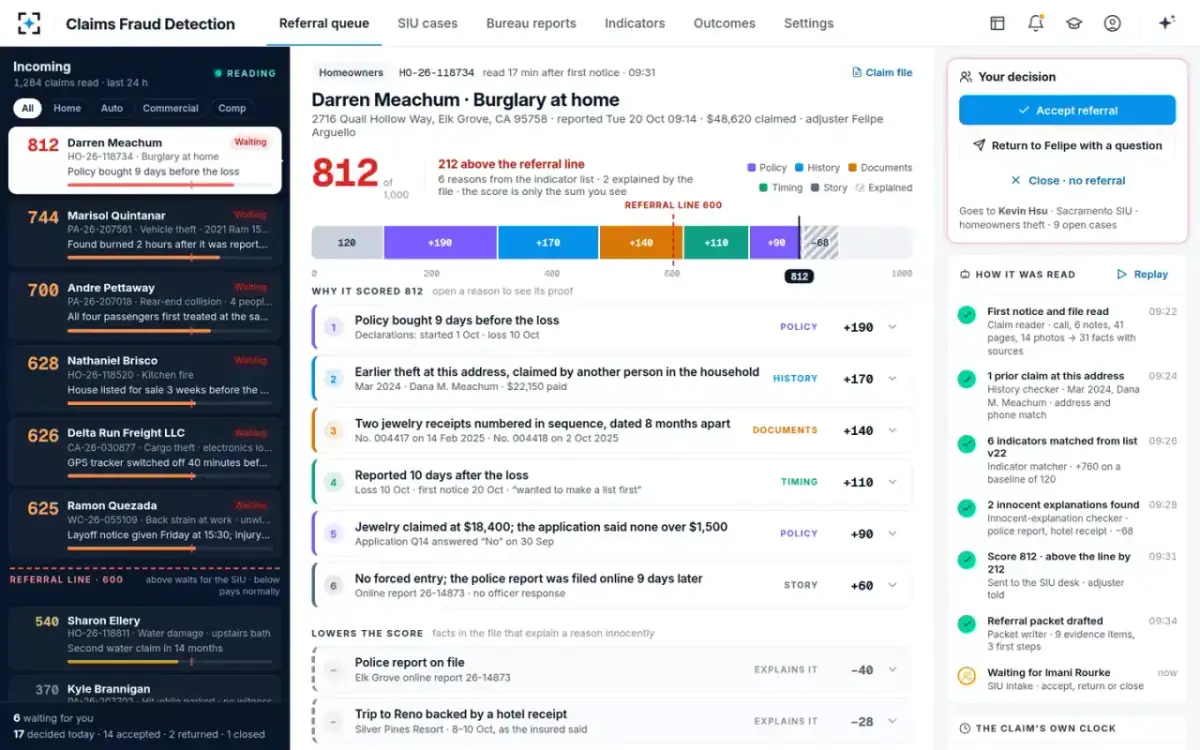
Keep an audit sample below the line, or the fast lane cannot be trusted
A random sample of claims below the line is what tells a carrier whether its fast lane is leaking. Without it, nobody investigates the claims the score let through, so nobody finds the fraud among them. The sample carrier sends 1% of claims below its line to the SIU at random; from 1 July to 20 October, 14 of the 702 sampled claims were confirmed, 2%, against 18% in the lowest band above the line. Those are fictional sample figures, but the arithmetic is the same on real ones.
The research argues for randomness, not just sampling. The Dionne paper notes in its review of the literature that "Mookherjee and Png (1989) have shown that random auditing dominates deterministic models," and its own control group, about 1,000 claims the insurer had not suspected, turned up 55 with some indication of fraud. A fraudster who knows exactly where the line sits can stay under it; one who knows that any claim may be sampled cannot.
The settings behind the routes: lines, baselines and the audit sample
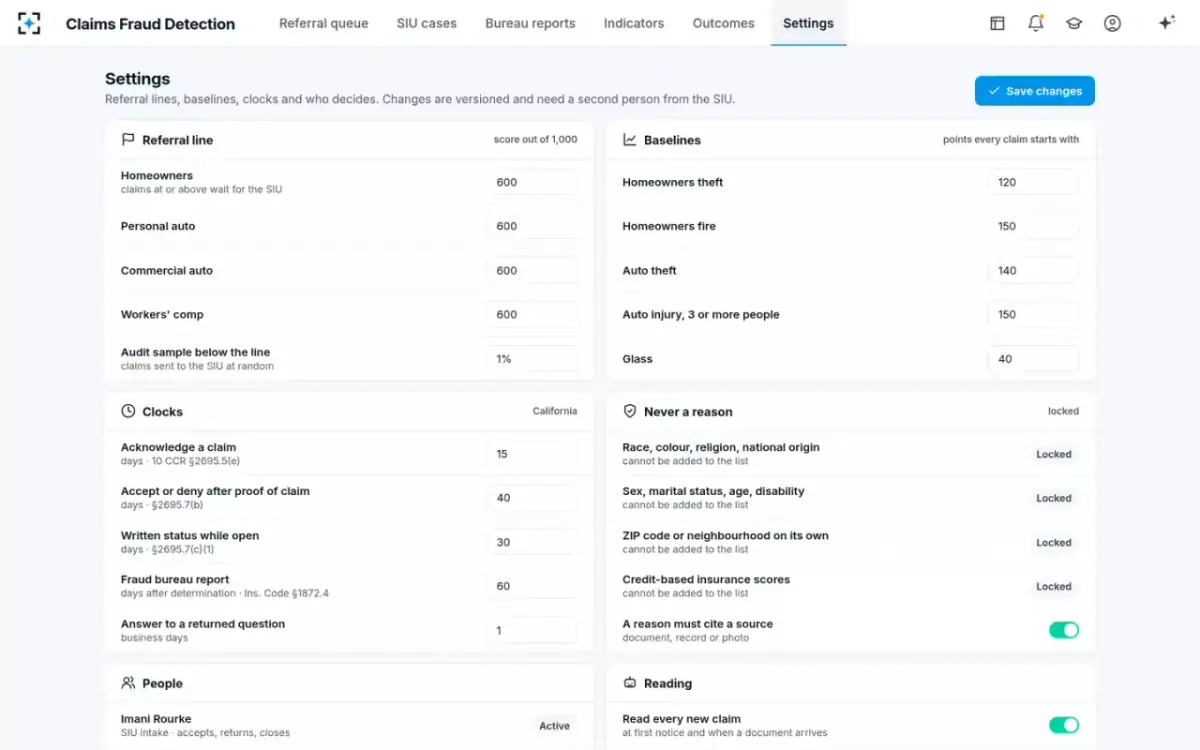
Whether the line itself is well placed is a validation question: the confirmed rate should rise band by band above it and stay low in the sample below it. The checks are set out in what to validate in a fraud scoring model, and the minute-by-minute trace of one claim shows how a score with reasons is built in the first place.
Questions people ask
What is a claims triage score?
A number that routes a claim to a handling track, such as fast-track, desk review, field adjuster, complex or specialist, by expected severity and complexity. A fraud score is narrower: it decides whether the SIU should see the claim. Carriers often run both, and some combine them.
Does a low fraud score mean a claim is honest?
No. It means the score found little, which depends on what it read. In the sample carrier's random audit of claims below its line, 2% were confirmed as fraud. A low score backed by a full reading and innocent explanations is good evidence; a low score from a few fields is just an absence of flags.
Can a fast-tracked claim still be reported as fraud later?
Yes. California's Department of Insurance has told its Fraud Assessment Commission that the reporting duty applies "regardless of payment status," so a claim settled before an investigation finished should still be reported if there is a reasonable belief of fraud. Paying fast does not close the door on a later finding.
Who sets the referral line?
The SIU, with the fraud manager owning the decision. In Claims Fraud Detection the line is set per line of business, 600 out of 1,000 in the sample for homeowners, personal auto, commercial auto and workers' compensation, and changing it needs a second person from the SIU. The line should move only on evidence from outcomes.
Does claim scoring use credit scores or ZIP codes?
It should not use them as fraud reasons. California bars discrimination in claims settlement based on listed personal characteristics or on where the insured property or person is (10 CCR § 2695.7(a); the full list is in the guide to red flags in insurance claims). The sample carrier locks credit-based insurance scores and ZIP code or neighbourhood on its own off its indicator list.
How often should claims be re-scored?
Whenever something new arrives. In the sample settings every claim is read at first notice and again when a document arrives, and the score can rise or fall; the adjuster is told when a claim crosses the line. A score frozen at first notice misses the proof of loss, the estimate and the receipts.