Insurance fraud detection software reads claims for signs of fraud and sends the suspect ones to the special investigations unit (SIU), usually as a score with reasons. The products differ less in their models than in what they can prove afterwards: whether each reason opens to the evidence in your own file, whether the software looks for the innocent explanation, whether it can hold, deny or pay a claim (it should not), and whether it leaves the trail a state examiner will ask for. Those are the questions below, fifteen of them in five groups. Botminds' Claims Fraud Detection is one answer: six agents read every new claim at first notice, score it out of 1,000 with plain-word reasons and their proof, check each reason for an innocent explanation and draft the SIU referral, and the SIU intake analyst decides. It is not the answer to every fraud problem, and the last section says where it does not fit. Once a tool is chosen, rolling it out so adjusters trust it is covered in claims fraud detection tools.
Fifteen questions to ask any insurance fraud detection software vendor
- Does every reason open to the line in our file that supports it?
A page, a note, a photo or a prior claim: not a feature name or a weight.
- Is the score only the sum of the reasons we can see?
If anything else moves the number, ask what, and how an examiner would check it.
- What does it read: structured fields only, or notes, documents, photos and prior claims?
Most fraud signals sit in text and images.
- Does it look for the innocent explanation, and show the checks that found nothing?
The SIU must write down why it closes a referral; give it the checks.
- What does it do for honest claims?
A score that only flags is half a tool; ask whether low scores carry reasons too.
- What can never be a reason, and is that locked?
Protected traits, territory on its own, credit-based scores.
- Can it deny, delay, pay or contact the insured?
The right answer is no, written into the configuration, not promised in a meeting.
- Who decides each referral, and what happens if nobody does?
A named person; and the system waits rather than acts.
- Who can change the indicator list, the points and the referral line?
Versioned changes with a second approver, and a history an auditor can read.
- How does it help the SIU document a closed referral?
California requires the reasons in the file when the SIU declines to investigate.
- Can it draft the state fraud report from the case file?
The FD-1 in California asks for amounts, parties and a five-part summary.
- What will you give us for the NAIC AI bulletin?
Model inventory, validation, data lineage, audit rights and cooperation with regulators.
- How does it learn from what the SIU finds, and who approves a change?
Proposals tested on last quarter, including what each change would miss.
- Will you run it on our own closed referrals before we buy?
Confirmed rate by score band, and the frauds it would have missed.
- What does it cost per claim read, and what does it cost us to run?
Licence, data feeds, integration and the hours of the people who decide.
What is insurance fraud detection software?
It is any system that selects claims for fraud investigation, from a rules engine that fires on red flags to a model that ranks claims, a graph that links them, or agents that read each file. Regulators expect insurers to have something. The NAIC's antifraud plan guideline asks every plan for "A description of the technology and/or detection procedures the insurer has put in place to identify suspected fraud," and for the criteria that send a suspicious claim to the SIU (NAIC GL-1690). Whatever a carrier buys becomes part of that description.
Most carriers buy rather than build. The NAIC's homeowners survey found that most fraud models come from outside vendors, and its auto survey that 83 companies used AI in fraud detection chiefly to refer claims for investigation (NAIC homeowners memo; NAIC auto survey; both read closely in AI in insurance fraud detection). A purchased referral engine is an outside model making a regulated recommendation inside the claim process, which is why the questions are mostly about evidence and authority, not accuracy alone.
What features should insurance fraud detection software have? Start with the evidence (questions 1–3)
The first feature to demand is that every reason cites its source in your file. An intake analyst who cannot open a reason to its evidence rebuilds the file by hand, and an examiner who samples a referral will ask the same question. The second is that the score is nothing but the sum of the reasons shown, so the number can be challenged a line at a time. The third is breadth of reading: on the sample claim in Claims Fraud Detection, the reasons came from the declarations page, the online application, two receipts, the photos' timestamps and a prior claim at another carrier, none of them a structured field.
A score from fields, and a score that reads and cites: the same claim, two answers
A score from structured fields: Loss type, amount, policy age, prior claim count.
A score that reads the file and cites it: Ten sources on the sample claim: call, notes, declarations, application, police report, receipts, contents list, photos, a hotel receipt and the prior claim.
A score from structured fields: "High risk, 0.87."
A score that reads the file and cites it: 812 = baseline 120 + six reasons (760) − two innocent explanations (68), each reason in plain words.
A score from structured fields: Pulls the declarations, application and history to see why.
A score that reads the file and cites it: Opens each reason to the highlighted line that supports it, and decides.
A score from structured fields: Invisible to the score.
A score that reads the file and cites it: Found and subtracted: police report on file −40, hotel receipt for the trip −28.
A score from structured fields: That the model was validated, somewhere.
A score that reads the file and cites it: The list version in force, the arithmetic, the evidence, and who decided.
Questions about honest claims (4–6)
Most claims are honest, and fraud software is judged by how it treats them as much as by what it catches. Question four asks whether the software looks for the innocent explanation of each reason and shows the checks that came up empty. In California, where the SIU closes a referral at preliminary review because its red flags are reasonably clearly not fraud, it must write its reasons into the claim or SIU file (10 CCR § 2698.36(c)). Software that has already looked for those reasons saves the SIU the work and gives it the words.
Question five asks what the software does for the claims it does not flag. The NAIC's auto survey counts fast-tracking claims that look clean as a separate use of fraud models, reported by 10 companies against 83 using them for referral. A low score with reasons is evidence an adjuster can use to pay faster; the other job of a claim score is worked through separately. Question six asks what is locked off the list. California bars discrimination in claims settlement on age, race, gender, income, religion, language, sexual orientation, ancestry, national origin, physical disability or where the insured property or person is (10 CCR § 2695.7(a)); a vendor should show those inputs locked out, not merely unused.
Can fraud detection software deny claims? Questions about authority (7–9)
It can if it is built to, and it should not be. The NAIC's auto survey found AI claims models used for claim approval by a handful of companies and for claim denial by none. Denial is a coverage decision with its own legal duties; the NAIC's model act on unfair claims practices makes refusing to pay without a reasonable investigation one of them (NAIC Model 900). Fraud software that can deny a claim on a score has taken a decision the investigation is supposed to make.
Ask to see the limit in the configuration. In Claims Fraud Detection it is written into each agent's role: the claim reader "Never decides coverage" and "Never contacts the insured"; the packet writer makes "No recommendation on coverage or denial" and "Never stops the claim's clock." The packet the SIU receives ends with the same rule in plain words: whether to examine the insured under oath is left to the investigator, and nothing in the packet recommends a denial (the SIU referral form guide shows the packet whole).
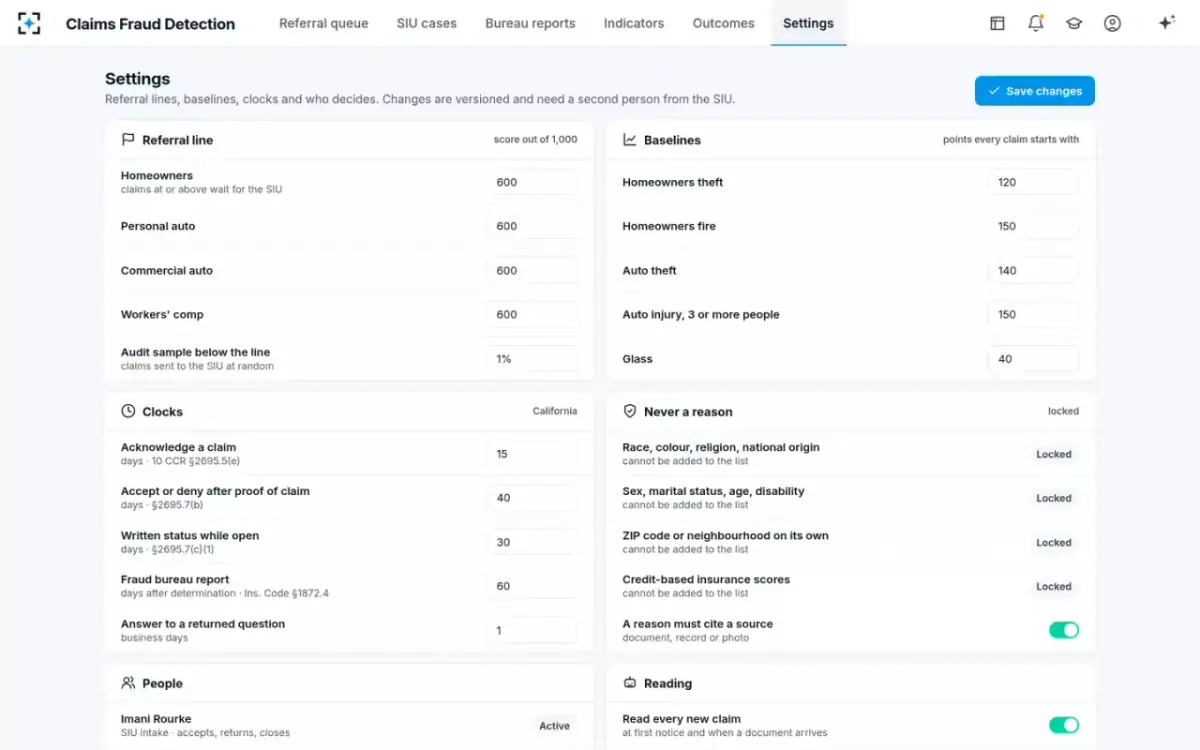
Questions eight and nine are about who holds the pen. Each referral needs a named decision-maker, the SIU intake analyst in the sample, and a defined outcome when nobody acts: the claim waits for the SIU and keeps its own clock, nothing happens to the insured. Changes to the indicator list, its points and the referral line should be versioned and need two people. In the sample, list changes need the fraud manager and a second approver, and settings changes a second person from the SIU.
The settings an SIU should own: lines, baselines, clocks, and what is never a reason
Questions the regulator will ask (10–12)
Question ten is about closures, covered above: the reasons must be written, and examiners check them. Question eleven is about the state report. California's FD-1 asks, among much else, for the potential loss before fraud was identified, the amount paid, the suspected fraudulent amount paid, the parties with their identifiers, and a summary that answers what facts caused the belief, what was misrepresented and by whom, why it matters, who the witnesses are and what documents exist (10 CCR § 2698.38). It must be filed within 60 days after the insurer determines a claim appears to be fraudulent, according to the form (FD-1). Software that drafts it from the case file is saving the fraud manager real hours; software that cannot is leaving them.
State fraud reports, drafted from the case file and counted down to the deadline
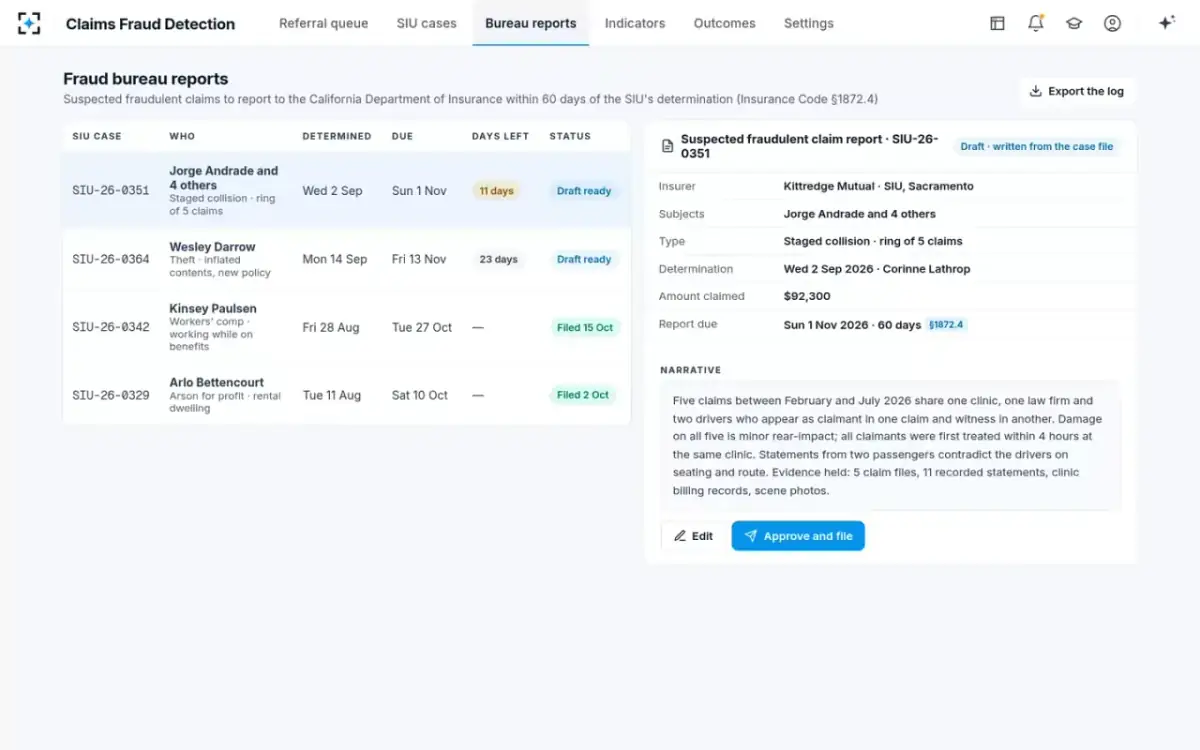
Question twelve is about the NAIC's model bulletin, adopted by 29 jurisdictions as of 8 October 2026. It expects an insurer's AI program to cover third-party systems, with due diligence on each vendor and, where available, contract terms that give the insurer audit rights and oblige the vendor to cooperate with regulators' inquiries (NAIC model bulletin). A vendor that will not agree to those terms is asking the carrier to answer for a model it cannot inspect.
California adds a contract point that is easy to miss. Its SIU rules exclude pure database vendors from the definition of a contracted entity, but include any entity that makes "decisions on behalf of the insurer with respect to the insurer's SIU or integral anti-fraud functions" (§ 2698.30(f)). Such contracts must "Not include provisions that could provide disincentives to the referral and/or investigation of suspected insurance fraud" (§ 2698.33(c)(2)). Pricing that rewards fewer referrals deserves a second look from counsel.
Questions about learning and cost (13–15)
Question thirteen asks how the software learns. A good answer reads what the SIU found on every closed referral, proposes changes, tests them on past referrals, shows what each change would miss and waits for people to approve. In the sample, three proposals tested on last quarter's 1,412 closed referrals meant 67 fewer weak referrals and four more confirmed frauds above the line, at the cost of two confirmed frauds dropping below it; the fraud manager and a second approver decide. The validation file for a fraud score sets out what to ask for in detail.
Question fourteen is the cheapest test in the list: ask the vendor to run on a sample of your own closed referrals before you sign, and to report confirmed rate by score band, the referrals it would not have made, and the frauds it would have missed. Question fifteen is the price.
How much does insurance fraud detection software cost?
Vendors rarely publish prices, and a list price would tell you little, because the cost that matters is per claim read and per referral decided. Ask for the licence on a per-claim or per-policy basis, then add what the carrier pays to run it: data feeds such as industry claims history, integration with the claim system, and the hours of the intake analysts and fraud manager who decide. Set that against the two numbers the tool should move: fraud not paid, and investigator hours spent on honest claims. The cost of each kind of wrong referral shows how to price both on your own book.
Implementation time is mostly the carrier's. Reading claim documents needs no training data from the carrier; an indicator list written per line of business, with points and last quarter's outcomes, takes as long as it takes the SIU to agree it. A sensible plan shadows on closed claims first and climbs to live referrals only when the SIU's outcomes say so.
Where Claims Fraud Detection fits, and where it does not
Claims Fraud Detection is built for one job: reading every new property and casualty claim at first notice, scoring it with reasons and proof, and getting the suspect ones to SIU intake with a referral it can decide on. Several neighbouring problems need different tools, and a buyer should know which is which.
The fraud problem, and whether Claims Fraud Detection is the right tool for it
| The problem | Claims Fraud Detection? | Where to look instead |
|---|---|---|
| Spotting suspect claims at first notice, with reasons and proof, in homeowners, auto and workers' compensation | Yes: its core job | — |
| Rings across many claims: shared clinics, shops, drivers and witnesses | Sees prior claims for one claim's parties; does not map networks | Fraud Network Analysis |
| Altered invoices, receipts and estimates: is this document genuine? | Compares documents in the file, such as receipt numbers and dates; does not examine the file itself | Document Fraud Detection |
| Running the investigation: case board, interviews, examinations under oath | Hands off the case with its packet | SIU Case Management |
| Storm-chasing contractors and inflated roofing estimates | Reads each claim; not built around contractors across a storm | Contractor Fraud Detection |
| Health-care provider billing fraud | No | Health plan fraud tools |
| Application fraud at the point of quote | Reads the application on a claim; does not score new business | Underwriting controls |
The neighbours are Fraud Network Analysis for rings, Document Fraud Detection for altered documents, SIU Case Management for the investigation and Contractor Fraud Detection for storm work. A carrier choosing one tool should start where its referrals are weakest: if the SIU complains about thin referrals and late ones, start at first notice.
Does fraud detection software work for small insurers?
It can, but small books make two things harder: validation, because a few hundred referrals a year give wide margins on a confirmed rate, and staffing, because the person who decides may also be the person who investigates. The obligations do not shrink with the carrier. California's SIU rules apply to most licensed insurers, and the Department's review program analyses annual SIU reports "filed by over 1,100 insurance companies each year" (CDI). New York's plan requirements, including a full-time SIU "separate from the underwriting or claims functions," apply to insurers above a policy-count threshold (11 NYCRR 86.6).
For a small carrier the best fit is software that does the reading and drafting, so the scarce person spends time deciding, and that keeps the trail an examiner will sample, because there is no separate model risk team to rebuild it. Pooling outcomes over several quarters, and keeping the random audit sample below the line, makes the validation numbers usable sooner.
Questions people ask
How do you compare fraud detection software?
Run each candidate on the same sample of your own closed referrals, some confirmed and some cleared, and compare the traces: the reasons, their sources, the innocent explanations found, the confirmed rate by score band and the frauds each would have missed. A demonstration on the vendor's data shows the interface, not the fit.
What should you ask fraud detection software vendors?
Start with the fifteen questions above, and insist on seeing answers in the configuration and in a trace on your own claim. The three that separate products fastest: does every reason open to its evidence, can the software deny or hold a claim, and will the contract give you audit rights and cooperation with regulators.
What data does fraud detection software need to start?
The claim file as your claim system holds it, first notice, notes, documents and photos, plus prior-claim history and your red-flag list with points. Historical SIU outcomes are needed to validate and tune, not to start: a points list can run from day one and be tested against outcomes as they arrive.
Does it replace our SIU's red-flag list?
It should run on it. California requires the SIU to keep a written red-flag list for each line of insurance or product (10 CCR § 2698.35(b)); software that substitutes its own hidden list leaves the SIU unable to explain its referrals. Claims Fraud Detection uses only indicators on the carrier's approved list.
Can it run alongside our existing claim system?
It should read from the claim system rather than replace it: first notice, notes and documents in; scores, reasons and referrals out to the people who decide. Claims Fraud Detection reads from the claim system and from industry claims history, and the adjuster keeps working the claim where it lives.
What belongs in the contract?
Audit rights, cooperation with regulatory inquiries, data ownership and security, and in California no terms that discourage referrals or investigation (10 CCR § 2698.33(c)(2)). Add the right to export every reason, score and decision, so the trail stays yours if the software leaves.