The FD-1 form is California's Suspected Fraudulent Claim (SFC) Referral Form, the document a licensed insurer sends the Department of Insurance's Fraud Division when it believes a claim may be fraudulent. The form itself states the deadline: insurers must "submit this form WITHIN 60 DAYS after determining that a claim appears to be fraudulent", under California Insurance Code § 1872.4, and workers' compensation cases go to both the Fraud Division and the local District Attorney within the same 60 days. What the referral must contain is set by regulation, 10 CCR § 2698.38, and its heart is a synopsis of the facts behind the belief.
That synopsis is where accuracy is won or lost, because every fact in it has already travelled through an SIU file: from a transcript, an invoice or a records check, into notes, a timeline and a summary. Botminds' SIU Case Management is software built for that journey. Its agents keep each case board and chronology with every item sourced, and draft the FD-1 from the board with a numbered citation on each fact, for the investigator to check and sign. Below, one fact from a sample case is followed hop by hop. The carrier, Halden Mutual, and everyone in the case are fictional.
The FD-1 by its own numbers
60days
from the determination that a claim appears fraudulent to the referral
5
questions the summary must answer, plus a statement of whether the investigation is complete
$5,000
maximum penalty per act of non-compliance with the SIU rules; $10,000 if wilful
1,100+
insurers file California SIU annual reports each year
What is an FD-1 form?
The FD-1 is a seven-section referral, revision 6/2015, that California insurers send the Fraud Division for each suspected fraudulent claim. Section I identifies the reporting insurer; II the loss, the claim and the money; III the suspected fraudulent claim activity, with the synopsis and a disaster box; IV other agencies told; V contacts; and VI and VII each party to the loss, down to driver's licence, plate and VIN. A check box marks it as a new or an amended referral. The regulation behind it lists what a referral contains "to the extent applicable", and that list applies whether the referral goes on paper or through the electronic eFD-1.
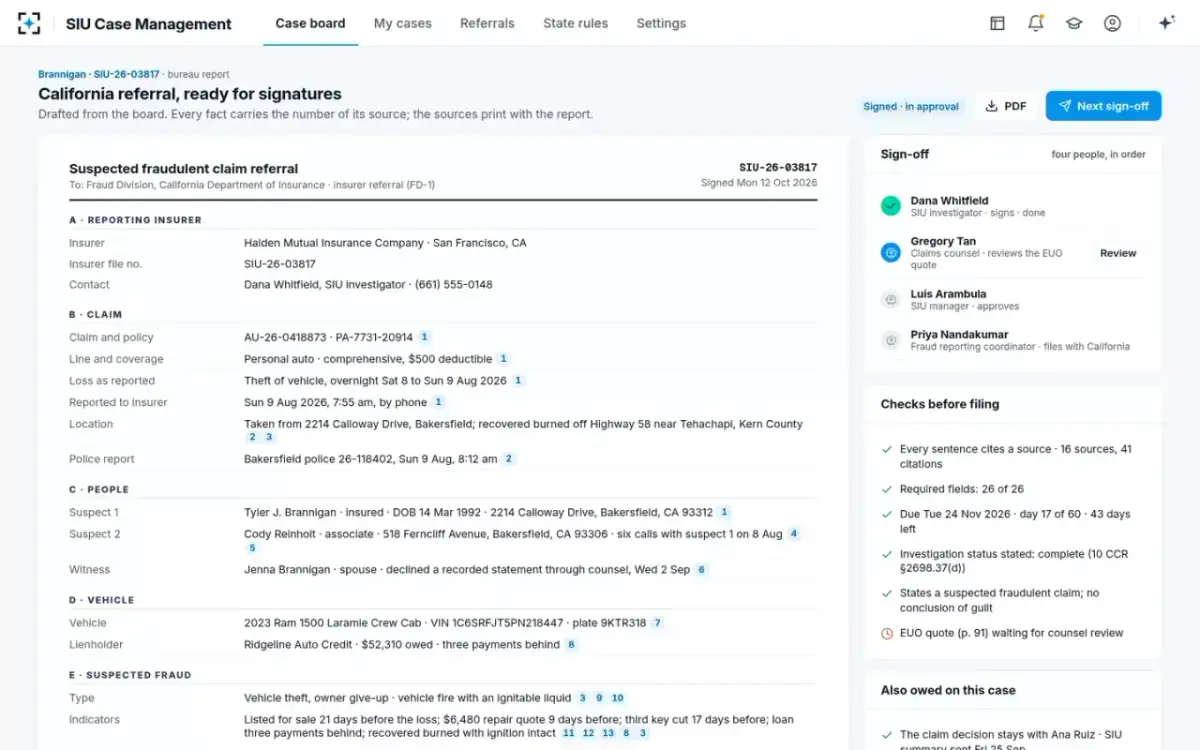
The money fields deserve care, because the regulation asks for a three-way split: "(6) Total potential loss on claim prior to the identification of fraud (7) Total claim loss paid to date (8) Actual suspected fraudulent loss amount paid to date". On the sample case the claim was for $51,310 and $630 had been paid as a rental advance; the third figure is the part of any payment the investigator believes fraud obtained.
Who has to file an FD-1, and when is it due?
Every insurer licensed to write insurance in California must file one within 60 days of determining that a claim appears fraudulent. The regulation sets the trigger lower than proof: a referral is due in any transaction where the facts and circumstances give a reasonable belief that fraud may have been, or is being, committed (§ 2698.37(b)). Self-insured employers are in a different position; at the Department's Fraud Assessment Commission in November 2024 its SIU audit manager explained that they are only required to submit the FD-1 and respond to demand letters (minutes).
Payment does not end the duty. At the same meeting the Department confirmed that a claim settled before the investigation finished should still be referred: "if the case was settled before the investigation was finalized, should the insurer send the FD-1, yes the insurer should send the referral." A case board that closes with the claim payment would lose that file from view. In the sample, the clock started on Friday 25 September, when the SIU manager confirmed the determination, so the referral is due on Tuesday 24 November.
What goes in the FD-1 synopsis?
The synopsis has to carry the whole investigation summary. The form asks for "the facts (who, what, when, where, how, why) that support your suspicion of fraudulent claim activity including any material misrepresentation(s)", and the regulation requires the summary prepared under § 2698.36 to be part of the referral. That summary has to answer five questions, if the answers are known, and say whether the investigation is complete.
What the summary in a California referral must answer
- What facts caused the belief that fraud occurred or may have occurred?
The trigger, stated as facts, not as a conclusion.
- What are the suspected misrepresentations, and who made them?
Each one attributed to a named person.
- How are they material, and how do they affect the claim?
Why the statement matters to payment.
- Who are the pertinent witnesses?
If there are any.
- What documentation shows each misrepresentation?
The evidence items, identified.
- Is the investigation complete, or is more needed?
A statement either way, required on every referral.
A strong synopsis answers every question with an attributed fact and the document that shows it. A weak one states a conclusion. The Department notices the difference: at the November 2024 meeting it said it had added a check box to flag an FD-1 that lacks information, and that its intake procedure flags poor-quality FD-1s for its SIU compliance team to review (minutes). Its review program also uses the quantity and quality of an insurer's referrals when choosing which insurers to examine (CDI).
One fact's journey: a third key, from the transcript to the referral
The sample case is a 2023 Ram 1500 reported stolen from a driveway in Bakersfield on the night of 8 August and found burned near Tehachapi, 47 miles away. Among five contradictions, one is simple to state and easy to get wrong: how many keys existed. In his recorded statement the insured said he had two. A locksmith invoice showed a third was cut 17 days before the loss. Here is how that fact moves from the record to the referral, and who touches it at each step.
The third key, hop by hop
Agent
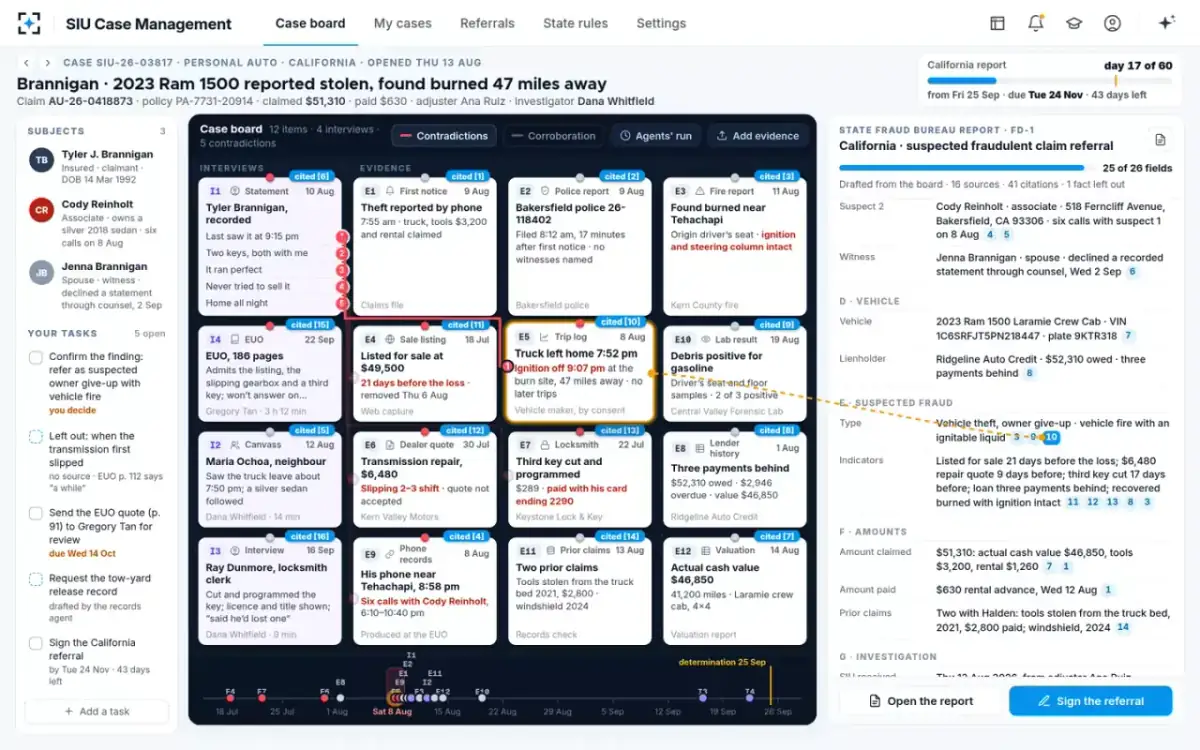
Evidence keeper · 16 SepKeystone Lock & Key’s invoice 4471 arrives. It is fingerprinted, indexed as E7 and pinned to the board: a third smart key cut and programmed for this VIN on 22 Jul, $289, paid with the insured’s card ending 2290.
Never: edits the invoice
Agent
Statement analystFinds the matching assertion in the recorded statement of 10 Aug, page 3:03: “Two. Both of them are with me.” Marks it contradicted by E7 and by the locksmith interview, I3. In the EUO of 22 Sep, page 63:22, the answer has become three keys.
Never: calls the answer a lie
Agent
Chronology builderWrites the entry for Wed 22 Jul, 2:14 pm: third key cut and programmed; he said two, the record shows a third. Sources E7 and I3.
Never: adds an entry without a source
Agent
Bureau report drafterPuts “third key cut 17 days before” into the indicators of the referral, with citation 13 pointing to E7.
Never: writes a fact with no item behind it
A person decides
Investigator, then counselDana Whitfield reads each cited source and signs. Claims counsel reviews the EUO quotations before anything goes to the state.
A person decides
Manager, then coordinatorThe SIU manager approves; the fraud reporting coordinator files with the Fraud Division, inside the 60 days.
Each hop is a place where a fact can be bent without anyone meaning to. Transcription can drop a qualifier, so that an answer such as "two that I know of" becomes "two". Attribution can move a statement from the insured to his spouse. Date arithmetic can turn 17 days into three weeks. A citation can point at the wrong item after documents are renumbered. And a quotation lifted out of an EUO can lose the question that produced it, which is why the solution sends any referral quoting an EUO to claims counsel before it is filed. The test of accuracy is simple: can a reviewer open the source behind every sentence and find the same words?
Twenty-five fields drafted, 41 citations, one fact left out
Which FD-1 fields come from where in the SIU file
Most of the FD-1 is already in the file before the investigator starts writing; the work is getting it out without re-typing. The map below follows the regulation's order and shows where each block of data normally lives.
FD-1 content, the rule that asks for it, and where it comes from
| Block | What § 2698.38 asks for | Where it lives in the case file |
|---|---|---|
| Fraud and referral type | Fraud type; new or amended referral | The case’s line of business and its filing history |
| Reporting party | Two-digit party code, name, Certificate of Authority, address, email, FEIN | Fixed per insurer; never typed per case |
| Policy and claim | Claim and policy numbers, date and place of loss, premium loss, potential loss, paid to date, suspected fraudulent amount paid | Claim file and payment history |
| Summary | The complete § 2698.36 summary, with the five answers and the completeness statement | Chronology, statements and evidence index |
| Disaster indicator | Whether the claim relates to a disaster, and which kind | Catastrophe code on the claim |
| Other agencies | District attorney, NICB and other agencies receiving the referral | The case’s referral log |
| Contacts | Referral contact, file handler, the person completing it, date completed | The case team |
| Each party | Name and role, phone, address, date of birth or age, SSN, tax ID, licence and state, plate, VIN, other names, injury claimed | Subjects on the board, with the records check behind each |
Can you amend an FD-1?
Yes. The form has a check box for an amended referral, and the regulation lists a "new referral/amended referral indicator" among the required data. The more important point is timing: the SIU is expected to finish as much of the investigation as is reasonable before it refers (§ 2698.37(d)), and every referral must say whether the investigation is complete or further investigation is needed. A referral filed on day 58 that says more work is needed is on time and says what it must; one that waits until day 75 to be complete is late.
At the 2024 Commission meeting a commissioner said they send a supplemental narrative after their FD-1. The Department replied that a rejected case can be discussed and reopened if it merits it, and that a case closed for lack of resources can be reopened when staffing allows (minutes). An amended referral is the formal route for new evidence that arrives after filing.
The referral as a document, with the checks before filing
How do you file an FD-1 electronically?
Insurers can file through the Department's electronic FD-1 system, the eFD-1; the paper form gives a mailing address for the Fraud Division Intake Unit in Sacramento. The Department's review program counts referrals made on "eFD-1, FD-1, or SFC forms". The portal is not always available: the Department's 2025 notices to SIUs include several eFD-1 outages and maintenance windows (2025 e-blasts). A referral left to its last day is exposed to an outage on that day.
Two habits reduce that risk. File early in the 60 days, as soon as the investigation is reasonably complete or clearly needs more time; and keep proof of when the referral was submitted with the case. In the solution, each case shows its California clock from the determination, warns the investigator and coordinator 14 days before the limit and the manager seven days before, and the coordinator files, never an agent.
Is the FD-1 confidential, and is the claimant told?
Information given to the Fraud Division is protected, and in California the claimant need not be told. California's SIU regulations say the referral rules do not diminish the confidentiality the Insurance Frauds Prevention Act gives to information provided in an investigation, or the immunity it gives reporters (§ 2698.37(e)–(f)). The claims regulations, separately, do not require an insurer to disclose anything likely to tip a claimant off that the claim is being investigated as suspected fraud (§ 2695.7(b)(2)).
That cuts both ways for the file. Because the claimant cannot see the referral, its accuracy rests entirely on the SIU's own discipline: attributed facts, quoted words with their page, and documents a reviewer can open. The claimant's view of an SIU investigation covers what the person on the other side can expect.
What happens after an FD-1 is submitted?
The Fraud Division reviews it and decides whether to open a case, and it communicates with the party that filed it. At the 2024 meeting the Department said it communicates with whoever submitted the FD-1, which for a self-insured employer is its third-party administrator. Many referrals never become criminal cases; the Department reported closing 875 cases for lack of resources in fiscal 2022-23 and 1,102 the year before (minutes). For the insurer, the claim still has to be decided on its own merits. California lets the time to decide run to 80 days on a documented belief of fraud, and be suspended beyond that until the Commissioner orders otherwise, where the insurer has complied with § 1872.4 and tried diligently within the 80 days (§ 2695.7(k)). What happens after an SIU investigation sets out every ending.
Questions people ask
What is the difference between the FD-1 and the eFD-1?
They are the same referral in two channels. The FD-1 is the paper Suspected Fraudulent Claim Referral Form (Rev. 6/2015); the eFD-1 is the Department's electronic system for submitting it. The regulation's content list applies to both, and the date-completed field is not required when the referral is filed electronically.
Does a workers' compensation FD-1 also go to the district attorney?
Yes. The form cites Insurance Code § 1877.3, which requires suspected fraudulent workers' compensation claims to be reported to both the CDI Fraud Division and the local District Attorney's office within 60 days. If a complete copy of the claim file goes to the District Attorney, the form asks for a copy to be attached to the FD-1 as well.
Do you have to attach the claim file to an FD-1?
Usually not. The form says insurers may attach documents showing the suspected activity, and that a complete copy of the claim file is not required unless one was sent to the District Attorney. The Fraud Division can request the full file later, and the insurer must release it within 30 days, or 60 for workers' compensation.
What is the disaster claim indicator on the FD-1?
A box for referrals connected to a major disaster. The form offers earthquake, flood, firestorm, wind, other natural and non-natural (man-made) events, and the regulation lists a "disaster claim indicator" among the required data, so catastrophe-related fraud can be grouped by event.
What happens if an insurer files an FD-1 late?
Late or missing referrals are compliance failures under the SIU regulations. The Commissioner may impose up to $5,000 for each act of non-compliance and up to $10,000 for each wilful act, and the Department weighs the quantity and quality of referrals when it selects insurers for SIU compliance examinations.
Is an FD-1 required if the claim has already been paid?
Yes. The trigger is a reasonable belief that fraud may have occurred, whatever the payment status, and the Department confirmed in November 2024 that a claim settled before the investigation finished should still be referred.