An examination under oath (EUO) is a sworn interview an insurer conducts under a condition in its own insurance policy, usually while a claim is being investigated and before anyone has sued. A deposition is sworn testimony taken under court rules after a lawsuit has been filed, as part of discovery between the parties. Both produce a transcript of questions and answers under oath. They differ in where the power to ask comes from, in who controls the questions, in how long they can run and in how the transcript may be used later. Those differences are written into statute and court rules, and they matter to the person answering, to claims counsel asking, and to the special investigations unit that may rely on the transcript in a report to the state.
SIU investigators read EUO transcripts for a living. Botminds' SIU Case Management is case management software for those units: its agents read recorded statements and EUOs, list each assertion with page and line, flag answers that changed or that the records contradict, and draft the state referral with every quotation cited, for people to review, sign and file. The examples below come from its sample case at a fictional carrier, Halden Mutual; the people and claim are invented.
Which one applies? A short decision path
The insurer’s right under the contract. State rules may limit scope, notice, place and length, and may give the insured rights to counsel, a recording and the transcript.
An interview without an oath, such as a recorded statement the adjuster takes with consent. The policy’s other conditions still apply.
Discovery under the court’s rules. Every party gets notice, the opposing lawyer may cross-examine, objections are noted on the record, and the court can limit or extend it.
What is an examination under oath?
It is a right the insurer writes into its policy, not a power a court gives it. The standard fire policy, which New York sets out in full in its insurance law, requires the insured, as often as may be reasonably required, to be examined under oath by anyone the insurer names and to sign the examination, and to produce books of account, bills and invoices (§ 3404). The same policy says no suit on it is sustainable unless all its requirements have been complied with, which is why an EUO usually comes before litigation, not during it.
Statutes then shape the condition. Florida's no-fault law makes submitting to an EUO part of complying with the policy and "a condition precedent to receiving benefits". Florida also lets an insurer require EUOs of a contractor holding an assignment of benefits, but only on matters related to the services, their cost and the assignment (§ 627.7152(4)). California's Insurance Code § 2071.1 lists the rights of every insured asked to submit to an EUO under a property policy. The sworn statement in proof of loss is a different document again, though it comes from the same clause of the policy; the sworn statement in proof of loss guide covers it.
What is the difference between an examination under oath and a deposition?
Authority, timing and control. The EUO comes from the contract and is controlled by the insurer, within limits set by state insurance law. The deposition comes from the court's rules and is controlled by those rules, with every party entitled to notice and to take part. The table sets them side by side.
Examination under oath against deposition, row by row
| Examination under oath | Deposition | |
|---|---|---|
| Source of the power | A condition in the insurance policy, shaped by state insurance law | Court rules of civil procedure (in federal court, Rule 30) |
| When | While the claim is investigated, usually before any lawsuit | After a lawsuit is filed, during discovery |
| Who asks | Any person the insurer names (in the sample, its claims counsel) | Lawyers for any party; the other side may cross-examine |
| Scope | California: relevant and reasonably necessary to process or investigate the claim. Florida no-fault: relevant information or what could reasonably lead to it | Any non-privileged matter relevant to a claim or defence and proportional to the needs of the case |
| Length | California: a reasonable length of time | 1 day of 7 hours in federal court, unless agreed or ordered |
| Objections | California: any objection that could be made in a deposition | Noted on the record; the testimony proceeds subject to them |
| Transcript | California: free copy on request, within 10 business days; sworn corrections allowed | Recorded by the officer; review and changes under the court’s rules |
| Refusing | Can affect the insured’s rights under the policy | Can bring court sanctions for impeding the examination |
The scope line matters most in practice. A deposition's scope is wide: parties may obtain discovery regarding "any nonprivileged matter that is relevant to any party's claim or defense and proportional to the needs of the case". An EUO's scope is tied to the claim. California allows an EUO "only to obtain information that is relevant and reasonably necessary to process or investigate the claim". In California, an investigator who treats an EUO as a deposition and wanders into everything will draw objections the statute expressly allows.
What questions are asked in an examination under oath?
Questions that test the claim against the records, one subject at a time. In the sample case, the insured reported his 2023 pickup stolen from his driveway and it was found burned 47 miles away. Before his EUO, the file already held a vehicle trip log, phone records produced in the claim, a locksmith invoice, a dealer's repair quote, an online sale listing and a lender's payment history. Each EUO subject below follows one of those records; this is an illustration of how questions are built, not a script.
EUO subjects in the sample case, and the record behind each
| Subject | What the questions establish | Record the answer is tested against |
|---|---|---|
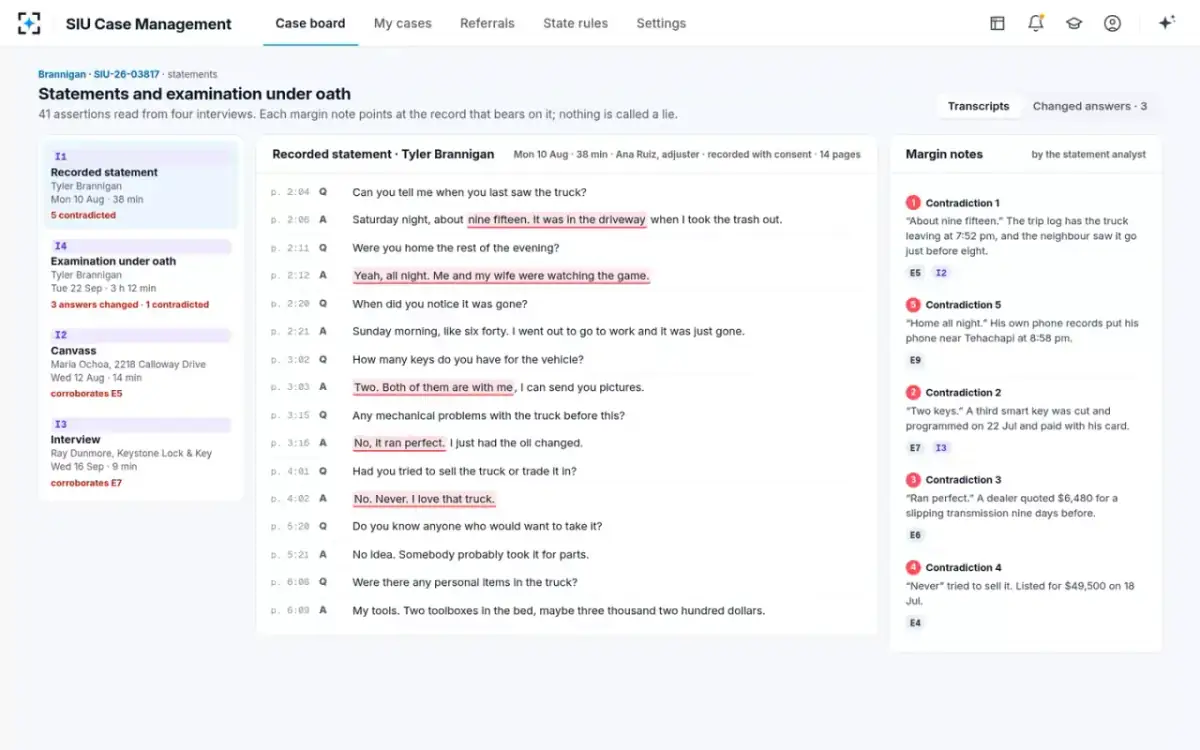
| Keys | How many keys existed, where each was on the night | Locksmith invoice: a third key cut and programmed on 22 July |
| The night of the loss | Where the insured was, hour by hour, and when he last saw the truck | Trip log: ignition on at 7:52 pm; phone records near Tehachapi at 8:58 pm |
| Condition of the vehicle | Mechanical problems before the loss | Dealer quote of 30 July for a slipping transmission, $6,480 |
| Attempts to sell | Whether the truck was offered for sale or trade | Online listing at $49,500 on 18 July, removed 6 August |
| Finances | Payments on the loan and its balance | Lender history: three payments behind, $52,310 owed |
| Prior claims | Earlier losses and what was paid | Prior claims check: two earlier claims with the same insurer |
Three answers in the sample EUO differed from the insured's recorded statement in August: on keys, on the truck's condition and on whether he had tried to sell it. A changed answer is not a lie; it may be a correction, a misunderstanding or a memory that improved once the record was put to him. That judgement belongs to the investigator and counsel, which is why the software's statement analyst reports only "contradicted by" with the source.
Recorded statement and EUO, read side by side against the record
Can an EUO transcript be used in court?
Often, yes, against the person who gave it. In federal court, a statement offered against an opposing party that "was made by the party in an individual or representative capacity" is not hearsay under Rule 801(d)(2), and state rules of evidence have similar provisions. A deposition has its own route: at a hearing or trial it may be used against a party who was present, represented or given reasonable notice, and any party may use it to contradict or impeach the witness (Rule 32). Whether a given transcript comes in is for the court.
For an SIU, the more immediate use is the referral. Fraud reporting forms expect it: Kentucky's uniform form, for example, has an evidence box for "EUO / Deposition" beside sworn and recorded statements. A quotation that goes to a state bureau should carry its page and line and the question that produced it. In the solution, any report that quotes an EUO goes to claims counsel before it is filed; in the sample, counsel's review of the quotation on page 91 is the last check before the manager approves.
In an examination under oath, an insured may assert any objection that can be made in a deposition under state or federal law.
Cal. Ins. Code § 2071.1(a)(6), as quoted by the Court of Appeal
How long does an examination under oath take?
As long as is reasonable, in California's words; a deposition in federal court has a default ceiling. California says an EUO "may only be conducted upon reasonable notice, at a reasonably convenient place and for a reasonable length of time". The federal rule for depositions is that, "Unless otherwise stipulated or ordered by the court, a deposition is limited to 1 day of 7 hours", and the court must allow more if needed for a fair examination. The sample EUO ran 3 hours 12 minutes and produced 186 pages.
Two sworn interviews in the sample case, and the federal default
38min
recorded statement taken by the adjuster with consent, 14 pages
3 h 12
examination under oath conducted by claims counsel, 186 pages
3
answers that changed between the two
7hours
federal default for one deposition, on one day
Examination under oath vs recorded statement
A recorded statement is an interview without an oath, typically taken by the adjuster with the person's consent; an EUO is sworn and formal. In the sample case the adjuster took a 38-minute recorded statement the day after the loss was reported, and counsel examined the insured under oath six weeks later. In the sample, the recorded statement is where the story was first told, and the EUO is where it was tested against the records gathered since.
The two documents are most useful together. Answers that changed between them are the ones an investigator has to explain in the case summary, either as corrected memory or as misrepresentation, and the explanation is the investigator's, not the software's. The FD-1 form in California follows one such change from the transcripts into the state referral.
Do you get paid for an examination under oath?
In some states, yes. New York's no-fault regulation requires the insurer to tell the applicant, when the EUO is scheduled, "that the applicant will be reimbursed for any loss of earnings and reasonable transportation expenses incurred in complying with the request", and to base EUO requests on objective standards available for review by the Department's examiners. California's statute does not address costs in the part quoted here, though it requires a free copy of the transcript on request. Witness fees in a deposition follow the court's own rules.
What happens if you refuse an examination under oath?
The claim can fail, because the EUO is a condition of the policy. Under Florida's no-fault law, compliance is a condition precedent to receiving benefits. Under the standard fire policy, no suit is sustainable unless all the policy's requirements have been met, and the same policy is void for "any fraud or false swearing by the insured relating thereto". California's statute puts the line at material questions: an objection that leaves one unanswered, and so prevents the insurer from determining the extent of loss and validity of the claim, may affect the insured's rights under the contract.
A deposition is one stage of a lawsuit's discovery, and how long a personal injury lawsuit takes shows where it falls. Refusing a deposition is a court matter: the court can impose sanctions, including costs and attorney's fees, on a person who impedes, delays or frustrates a fair examination (Rule 30(d)(2)). A claimant facing either should take advice from a lawyer licensed in the state; what to do if there is an insurance SIU investigation covers the claimant's side in general terms.
How an SIU should handle an EUO transcript
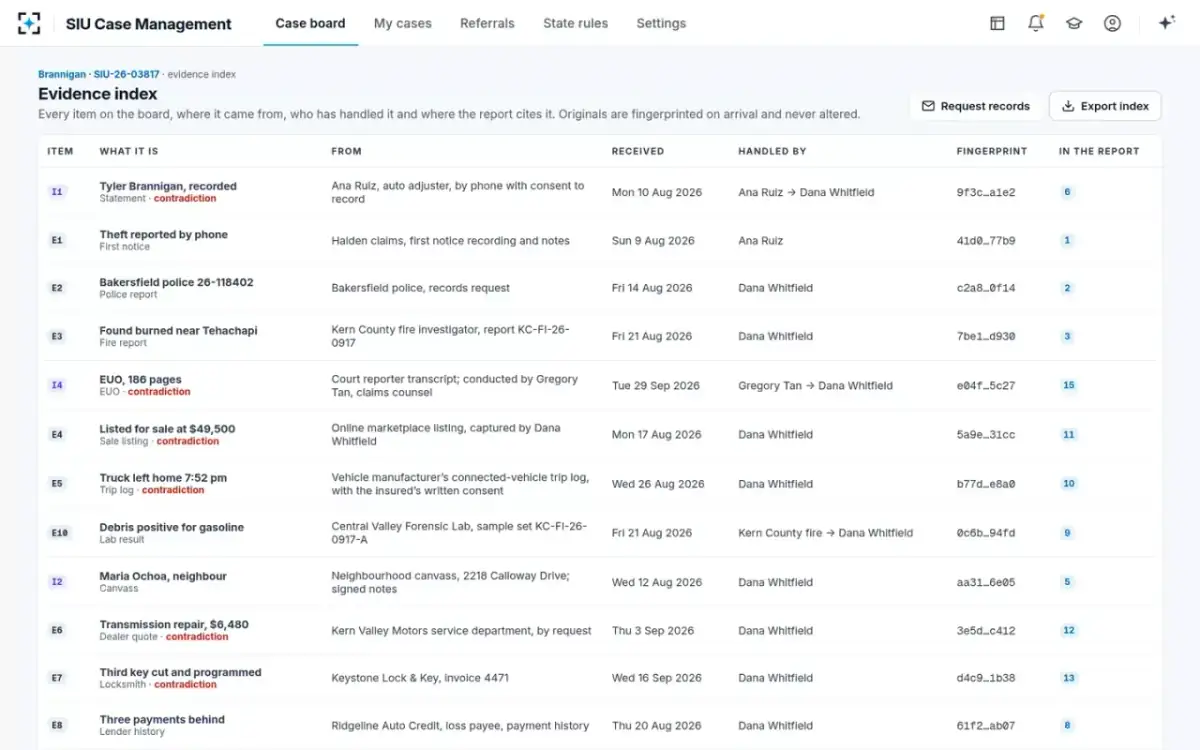
As evidence, from the moment the court reporter delivers it. In the sample, the transcript arrived on 29 September, was fingerprinted on arrival and logged with both its sender and its handler, and was read the same day. The checklist below is what a defensible EUO file holds.
A defensible EUO file
- The written request and notice
In California, with a copy of § 2071.1; in New York no-fault, the objective standard behind the request.
- The scope, written down
The subjects and the record behind each, so every question is relevant to the claim.
- The transcript as received
Fingerprinted, with the reporter and date; any recording kept with it.
- The insured’s corrections
Sworn corrections filed with, not over, the original.
- Assertions with page and line
Each one set against the records, and changed answers listed with both references.
- Counsel’s review of every quotation
Before any report that quotes the EUO is filed.
The EUO in the evidence index, with its handlers
Questions people ask
Is an examination under oath required?
When the policy makes it a condition and the request is reasonable, generally yes. Florida's no-fault statute makes it a condition precedent to benefits, and the standard fire policy requires the insured to submit to examinations under oath as often as may be reasonably required.
Can I have a lawyer at an examination under oath?
In California, yes: § 2071.1 lets the insured bring a lawyer and record the whole examination, and a 2024 Court of Appeal decision held that this includes video of the insurer's participants. Other states' rules differ.
Is an EUO the same as a deposition?
No. An EUO is the insurer's contractual right, used while it investigates a claim; a deposition is discovery under court rules after a lawsuit is filed, with notice to every party and cross-examination. Both are under oath and both produce a transcript.
Who conducts an examination under oath?
Any person the insurer names, under the standard fire policy's wording, which may be the insurer's lawyer. In the sample case, claims counsel examined the insured while the SIU investigator worked from the transcript afterwards.
Can I get a copy of my EUO transcript?
In California, yes, free of charge on request; the insurer must provide it within 10 business days of receiving it and must tell you of the right. You may also make sworn corrections so the transcript reflects your testimony accurately.