If there is an insurance SIU investigation on your claim, it helps to know that it is a review of the claim, not a decision that you have done anything wrong. The steps that keep a claim moving are practical ones: answering the insurer's reasonable requests, asking for those requests in writing, keeping copies of everything sent and received, and finding out the rules in your own state: how long the insurer may take, whether an examination under oath can be required, and where to complain. In California, for example, an insurer that needs more time must say so in writing and repeat the notice every 30 days, and it may take up to 80 days instead of 40 to decide where it has specific information supporting a suspicion of fraud. This page is general information, not legal advice; a lawyer licensed where you live can advise on your claim.
It comes from Botminds, whose SIU Case Management is software insurers' special investigations units use to run these cases: the file, the timeline and the report a state fraud bureau may require. The aim here is to explain the same process from the other side of the table, plainly and neutrally, using the rules regulators publish. Where the text mentions the software, it is to show how an SIU's own file is meant to work.
What usually happens after a claim goes to the SIU
- A referral to the SIU
An adjuster, or an automated system, flags facts that may point to fraud. In California the SIU must look at every credible referral, including automated ones.
- A first review
The SIU decides whether to open an investigation. If it is reasonably clear the flags are not fraud, it may close the referral, writing down its reasons.
- Questions and documents
You may be asked for a recorded statement, receipts, bank or phone records, repair estimates or medical records. Witnesses and others may be contacted too.
- Possibly an examination under oath
A formal, sworn interview, transcribed, where the policy allows it. State rules limit its scope.
- A decision on the claim
Paid, paid in part, or denied. In California a denial must be in writing, with the bases for it and how to ask the Department of Insurance to review it.
- Possibly a report to the state
Where the insurer forms a reasonable belief of fraud, most states require a report to a fraud bureau. In California the insurer does not have to tell you.
Does an SIU investigation mean I am accused of fraud?
No. A referral means a claim had features that an adjuster or a scoring system thought should be looked at, and in some states the SIU has to look at all of them. California's rule is that the SIU must look into every credible referral it receives from claims staff, and that includes the ones a scoring system generates (10 CCR § 2698.36(c)). A referral is credible if it contains a red flag, which can be as ordinary as a loss soon after a policy began. If the SIU decides at a first review that the flags are reasonably clearly not fraud, it may close the referral without opening an investigation, but it must write down why.
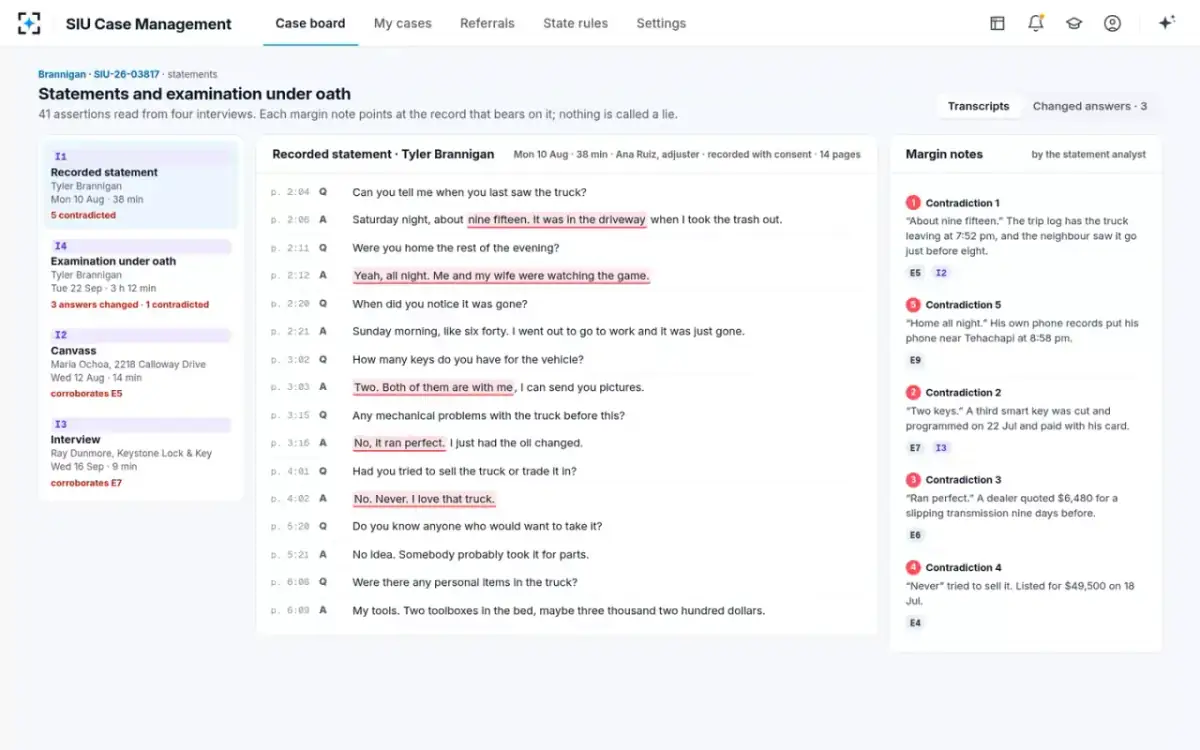
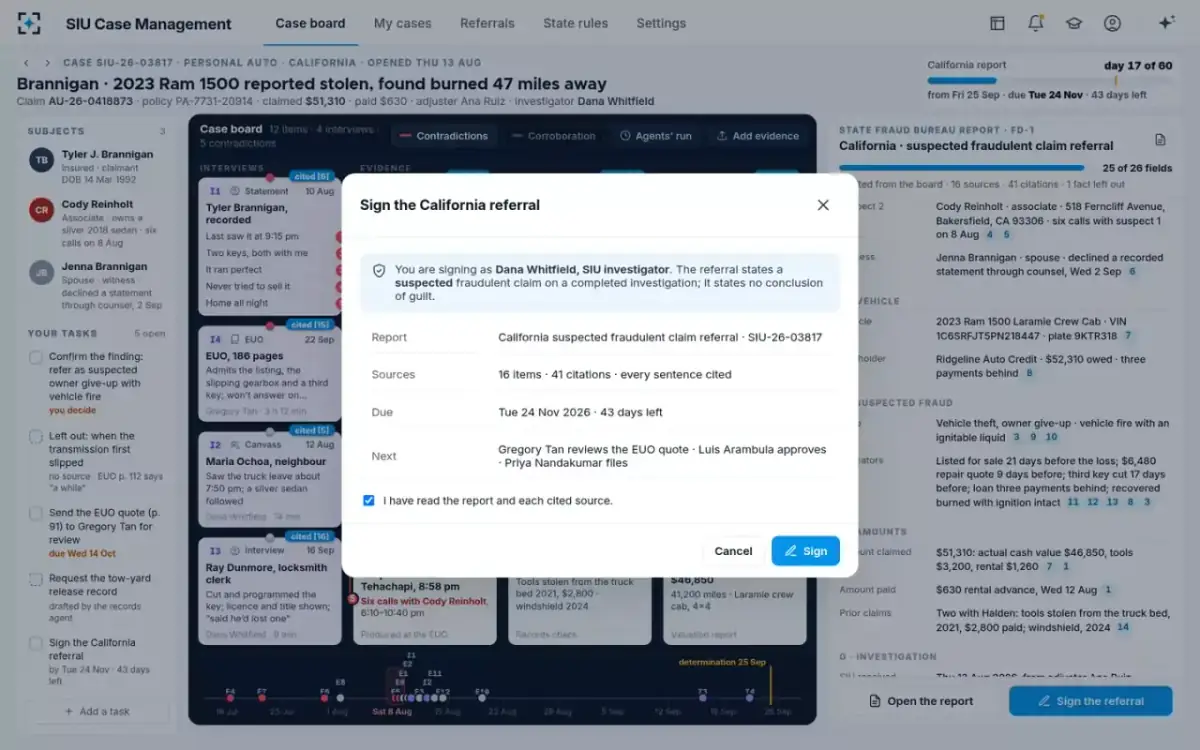
Even when an investigation goes further, the language is careful. A state report describes a suspected fraudulent claim, not a crime, and a good SIU file keeps it that way. In the software this page comes from, the agents that read statements report an answer as contradicted by a named document and never call a person a liar, and a draft referral states no conclusion of guilt. In that software’s sample SIU, the claim decision stays with the adjuster.
How an SIU file is meant to describe a statement
How long does an SIU investigation take?
There is no single limit, but claim rules cap how long the insurer may take to decide. California's rules show how this works. An insurer must accept or deny a claim within 40 calendar days of receiving proof of claim. Where the insurer has a reasonable basis for believing a claim is fraudulent, backed by specific information the Department of Insurance can review, that becomes 80 days (§ 2695.7(k)). Beyond that, the time can be suspended until the Commissioner orders otherwise, but only if the insurer has reported the suspected fraud to the state and can show it tried diligently to resolve the question within the 80 days.
California’s claim clock, with and without a fraud question
- Accept or deny after proof of claim40 d
- Same first 40 days40 d
- Extension+40 d
Other states set different claim clocks, and Minnesota links them to the fraud report directly: an insurer's proper notice of suspected fraud to the state's Bureau of Criminal Apprehension pauses the claim-handling deadlines in its unfair claims practices rules (Minn. Stat. § 60A.952) until 30 days after the Bureau decides not to recommend action. The general rules on how long insurers have to pay or deny are set out in prompt payment laws by state.
Can my insurer delay my claim for an investigation?
Within limits. In California the insurer's investigation has to be thorough, fair and objective and diligently pursued, and it may not keep asking for information that is not reasonably required or material to resolving the claim (§ 2695.7(d)). If it needs more time than the rules allow, its written notice must say what additional information it needs and why it cannot yet decide. The same regulation lets it leave out anything that would reveal a fraud investigation, so a notice that asks for documents without explaining why is not unusual.
The notice is still worth reading closely. It is the insurer's statement of what it needs, and answering it fully and on time, with copies kept, is what moves a claim. Requests that keep growing, or that seem unrelated to the loss, are worth asking about in writing. The insurance claim under review guide covers what a status update should tell you while you wait.
Do I have to give an examination under oath?
Often yes, if your policy requires it, and refusing can affect the claim. The condition appears in the standard fire policy, which New York sets out in its insurance law: the insured must be examined under oath by whoever the insurer names, as often as reasonably required, and sign the result (§ 3404). Florida's no-fault law makes submitting to an examination under oath part of complying with the policy and "a condition precedent to receiving benefits". California's statute warns that if an objection leaves a material question unanswered and the insurer cannot then determine the loss, "the rights of the insured under the contract may be affected".
The same rules protect the person being examined. Florida limits the questions to relevant information or information that could reasonably lead to it, and an insurer that requests EUOs without a reasonable basis as a general business practice is subject to its unfair-practices statute. New York's no-fault rules require objective standards behind an EUO request and reimbursement of lost earnings and reasonable travel costs. How an EUO differs from a deposition, and why that matters, is set out in examination under oath vs deposition.
Can I have a lawyer at an examination under oath?
In California, yes, by statute, for property policies with an EUO provision. Insurance Code § 2071.1 says "The insured may be represented by counsel and may record the examination proceedings in their entirety". A 2024 Court of Appeal decision held that this includes video of the insurer's own participants. Other states' rules differ; a lawyer in your state can say what applies. What changes once a lawyer is involved is covered in letter of representation to an insurance company.
EUO protections written into three states’ rules
| Protection | California (property, § 2071.1) | Florida (no-fault, § 627.736) | New York (no-fault, 11 NYCRR 65-3.5) |
|---|---|---|---|
| Scope of questions | Only information relevant and reasonably necessary to process or investigate the claim | Relevant information, or what could reasonably lead to it | Request must rest on objective standards with specific justification |
| Notice | Notice of the decision to examine, with a copy of the statute | Not stated in this section | Held at a time and place reasonably convenient to the applicant |
| Counsel and recording | May be represented by counsel and record the whole examination | Not stated in this section | Not stated in this section |
| Transcript | Free on request, within 10 business days of the insurer receiving it; sworn corrections allowed | Not stated in this section | Not stated in this section |
| Costs | Not stated | Not stated in this section | Lost earnings and reasonable travel reimbursed |
| Objections | Any objection that could be made in a deposition | Not stated in this section | Not stated in this section |
What to keep, and what to ask for
Most of what protects a claimant during an investigation is ordinary record-keeping. The list below reflects what the rules quoted on this page give claimants a right to, and what an SIU's own file will contain. It is not legal advice.
A claimant’s working file during an SIU review
- Ask for requests in writing
And note which policy provision or rule each one relies on.
- Keep a copy of everything you send
With the date and how it was sent.
- Keep every letter you receive
Including notices that the insurer needs more time; in California they come every 30 days.
- Ask for the transcript
Of any recorded statement or EUO; in California it is free on request after an EUO.
- Correct mistakes in writing
California lets an insured make sworn corrections to an EUO transcript.
- Know the polygraph rule
California bars requiring a polygraph unless the policy and state law authorise it.
- Keep your complaint rights
California bars making withdrawal of a complaint a condition of settling a claim.
- Note the people you speak to
Names, dates and what was asked; in California a denial cannot rest on a conversation that is not documented in the claim file.
An examination under oath can sometimes be requested.
California Department of Insurance, auto accident guide
What happens after an SIU investigation?
The claim is paid, paid in part or denied, and separately the insurer may report the claim to the state. A denial in California must be in writing, list all the bases for it with their factual and legal grounds, and include a statement that if you believe the claim was wrongly denied you may have the matter reviewed by the California Department of Insurance, with the address and telephone number of the unit that reviews claims. In California the insurer does not have to tell you whether it reported the claim, and a report is not a charge; the state decides whether to open its own case.
What an SIU signs when it reports: suspicion, not guilt
What follows a report depends on the state's fraud bureau, and most reports never become criminal cases. What happens after an SIU investigation explains the four ways an investigation ends and what each leaves on file. For claims that end without payment, the claim closed without payment guide explains the usual reasons and how to read the letter.
How do I complain about an insurance investigation?
To your state's department of insurance, which handles complaints about claim handling. In California, the denial letter itself must name the Department's claims-review unit and its contact details. Texas's Department of Insurance takes complaints online and through its help line at 800-252-3439. A complaint asks the regulator to look at how the claim was handled: delays, unexplained requests, a missing written reason. The department of insurance complaint form guide explains what a complaint should contain.
A complaint is not a way to stop an investigation, and the complaint process is not where fraud is decided. It can ask the insurer to explain its timeline and its requests in writing, which can bring a stalled claim back to a decision.
Questions people ask
What should I do if my claim is under SIU investigation?
Answer reasonable requests fully and on time, ask for requests in writing, keep copies of everything, and learn your state's rules on time limits and examinations under oath. In California an insurer that needs more time must tell you in writing every 30 days. For advice on your own claim, speak to a lawyer licensed in your state.
Will the insurer tell me it is a fraud investigation?
Not necessarily. California's claims regulation does not require an insurer, in its notices, to tell a claimant anything likely to reveal that the claim is being investigated as possibly fraudulent.
Do I get paid for attending an examination under oath?
In New York no-fault claims, yes: the insurer must tell the applicant that lost earnings and reasonable travel costs will be reimbursed. Other states and policies differ, so check the rule and the policy that apply to your claim.
Can the insurer make me take a polygraph?
In California, an insurer may not request or require an insured to take a polygraph examination unless the insurance contract and state law authorise it. Other states have their own rules.
Can I see the SIU's report about me?
Usually not while the matter is open. Reports to state fraud bureaus are generally confidential by law, and the NAIC's model act keeps information given to the commissioner in a fraud investigation out of private civil discovery. An EUO transcript is different: in California you can ask for a free copy.