AI case management software is case management software in which AI agents do part of the work on each case: reading documents, pulling out what was said and by whom, building the timeline and drafting the report, inside the same file the people work. For an insurer's special investigations unit the test is narrow. The software has to take the reading and writing off the investigator while leaving every decision the law puts on a person where it is: the belief that fraud occurred, every contact with a witness, and the report to the state. Regulators already expect AI here to be governed. The NAIC's model bulletin on insurers' AI systems names "case management" and fraud detection among the areas an insurer's AI program should address.
Botminds' SIU Case Management is built on that line. Six agents keep each case's board, chronology and evidence index current and draft the state fraud bureau referral from the board, every fact carrying a numbered citation; investigators interview, decide and sign. This guide walks through the six, the three things none of them may do, the rules that put those limits there, and the questions to ask any vendor. The worked example is a sample case at a fictional carrier, Halden Mutual; its people and claims are invented.
Six agents, and the steps the law keeps with people
Agent
Referral intakeReads the adjuster’s referral and the claim file, opens the case, names the subjects and scores the claim’s indicators from 0 to 100.
Never: scores the person, or uses a protected characteristic
Agent
Records agentReads prior claims, lender histories, dealer and locksmith records, trip logs and phone records produced, and drafts requests for what is missing.
Never: sends a request; the investigator sends it, with its lawful basis
Agent
Statement analystReads recorded statements and EUO transcripts, lists each assertion with page and line, and flags answers the records contradict or that changed.
Never: calls a person a liar or infers intent
Agent
Chronology builderLays every item on the board in date order, the claimant’s account beside the record wherever they differ.
Never: writes an entry without a source
Agent
Evidence keeperFingerprints each file on arrival with SHA-256, indexes it, pins it to the board and logs every handler.
Never: alters an original
Agent
Bureau report drafterMaps the board to the state form and writes the narrative, each fact with a numbered citation to its evidence item.
Never: states guilt, or files
A person decides
Investigator, manager, counsel, coordinatorThe investigator decides the finding and signs; the SIU manager confirms the determination and approves; claims counsel reviews any EUO quote; the fraud reporting coordinator files with the state.
What is AI case management software for an SIU?
It is the case file an investigator already keeps, with agents doing the clerical reading and writing inside it. Classic SIU case management software stores the referral, the documents, notes and deadlines, and routes the file between people. AI case management adds work on the content: reading a 186-page transcript for changed answers, placing a trip log beside a recorded statement, or drafting a state referral from the facts on file. The data the regulators ask for stays the same. What changes is how much of it a person types.
Insurers already use AI on fraud, mostly upstream of the SIU. In the NAIC's private passenger auto survey, 95 of 193 reporting companies said they used AI or machine learning for fraud detection, and the most common use, reported by 83 companies, was deciding which claims to refer for further investigation (NAIC). In the homeowners survey, the NAIC working group found that referral models mostly supported a person’s decision rather than taking it (NAIC). Detection decides what reaches the SIU. Case management is what happens after it arrives, and it is the part the surveys barely measure.
Where insurers already use AI on fraud
49%
of private passenger auto insurers in the NAIC survey used AI or machine learning for fraud detection
83
companies used those models mostly to refer claims for investigation
29
jurisdictions had adopted the NAIC AI model bulletin by 8 October 2026
42%
of homeowners insurers in the NAIC survey used AI or machine learning for fraud detection
Can AI decide if a claim is fraud? Why the rules say a person must
No. The reporting statutes quoted here hang the duty on a person's knowledge or belief, so the determination has to be someone's. New York's clock runs from a person's determination that the transaction looks fraudulent (§ 405). Texas counts from the day a person determines or reasonably suspects it (§ 701.051). The NAIC's model act puts the duty on a person in the business of insurance who knows or reasonably believes fraud is afoot (Model #680). Each statute's own words are compared in insurance fraud reporting requirements by state. A model can rank indicators; it cannot hold a belief that a regulator can examine.
What the rules require, and who has to do it
| Rule | What it requires | Who does it in SIU Case Management |
|---|---|---|
| 10 CCR § 2698.36(c) | The SIU investigates each credible referral, including automated or system-generated ones, and writes down why when it declines one | Intake agent scores; the SIU manager decides below the threshold; the investigator investigates |
| 10 CCR § 2698.36(a)(5) | A written summary with the investigators’ findings and the basis for them | Drafted from the board; the finding is the investigator’s |
| 10 CCR § 2698.37(b), (d) | Refer on a reasonable belief; say whether the investigation is complete | SIU manager confirms the determination; investigator states the status |
| Tex. Ins. Code § 701.051 | A written report to the fraud unit within 30 days of the determination or reasonable suspicion | Coordinator files; the clock runs from the date the SIU sets |
| N.Y. Ins. Law § 405 | A report on the superintendent’s form within 30 days of the determination | Coordinator files; manager approves first |
| NAIC model act § 6 | A person with knowledge or reasonable belief provides the information | People only; agents never file |
California's rule on automated referrals matters most for buyers. The SIU must investigate every credible referral from claims staff, the ones a system generates included (§ 2698.36(c)), and may close one at preliminary review only when it is reasonably clear the red flags are not fraud, writing down why. An AI that opens and closes cases on its own would leave the reasons unwritten by any person. In the solution, the intake agent opens a case automatically at a score of 70; below it, the referral waits for the SIU manager.
The three nevers: contact, decide, file
The first never is contact. Investigators speak to insureds, witnesses and providers, and agents do not, because an interview is evidence and the person who took it may have to explain it. The records agent drafts requests for missing records, the investigator sends them, and the lawful basis is written down with each. The second never is deciding. The statement analyst reports an answer as "contradicted by" a named item and never characterises the person; the drafter writes "suspected" and states no conclusion of guilt; the referral score ranks the claim's indicators and never the person.
The third never is filing. Immunity for reporting fraud is tied to the reporter's state of mind: in Texas it is lost by anyone who acts with malice, fraudulent intent or bad faith (§ 701.052). A report has to come from someone who can be asked what they knew and when. In the solution the investigator signs, claims counsel reviews any EUO quote, the SIU manager approves and the fraud reporting coordinator files, in that order.
Every agent step on one case, with the time it took
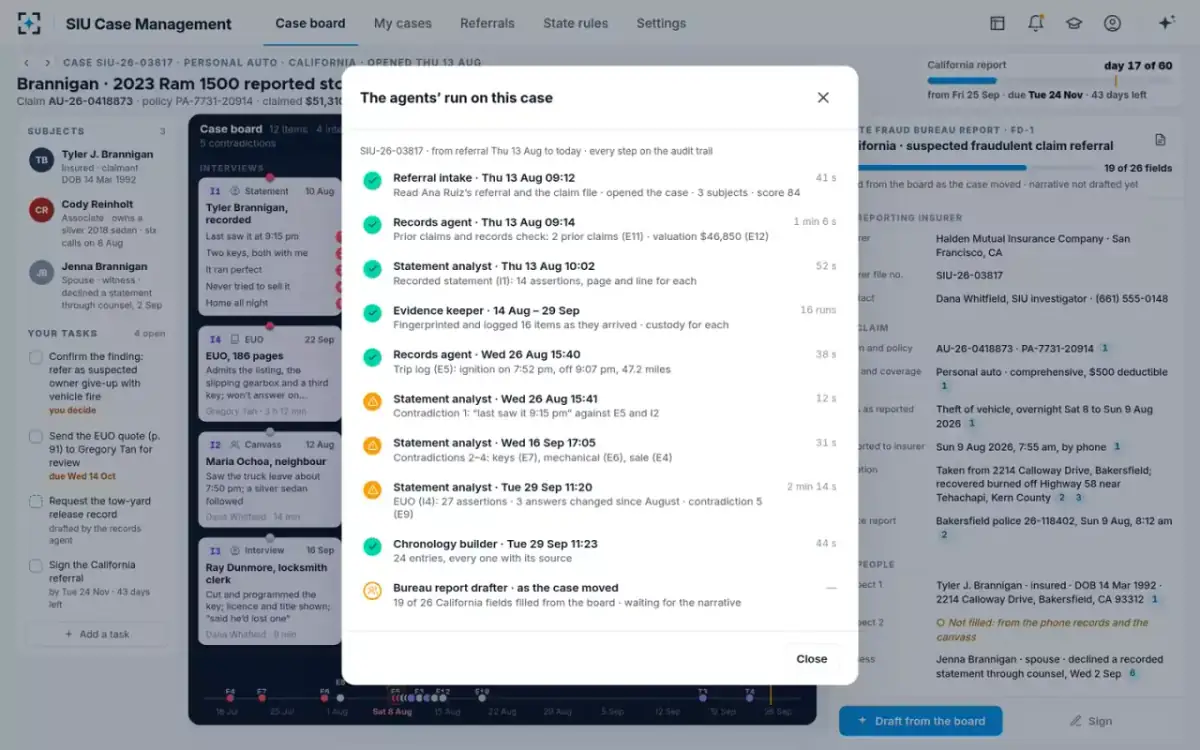
How does AI read an EUO transcript?
It reads the way a careful investigator does, at a different speed: each answer becomes an assertion with its page and line, and each assertion is set against what is already on the board. In the sample case the insured, Tyler Brannigan, reported his pickup stolen from his Bakersfield driveway; it was found burned 47 miles away. His examination under oath ran to 186 pages. The statement analyst listed 27 assertions and three answers that had changed since his recorded statement in August. On keys, he first said "Two. Both of them are with me." at 3:03 of the statement, then described a third key in the EUO. On the truck's condition, "No, it ran perfect." became "slipping a little".
Each flag points at the evidence item behind it, here a locksmith invoice for a key cut 17 days before the loss and a dealer quote for a slipping transmission, and the analyst says no more than that. Whether a changed answer is a lie, a correction or a misunderstanding is for the investigator, counsel and, in time, a prosecutor. The examination under oath vs deposition guide explains why an EUO answer carries the weight it does.
Can AI write an SIU report? Only if every sentence points at evidence
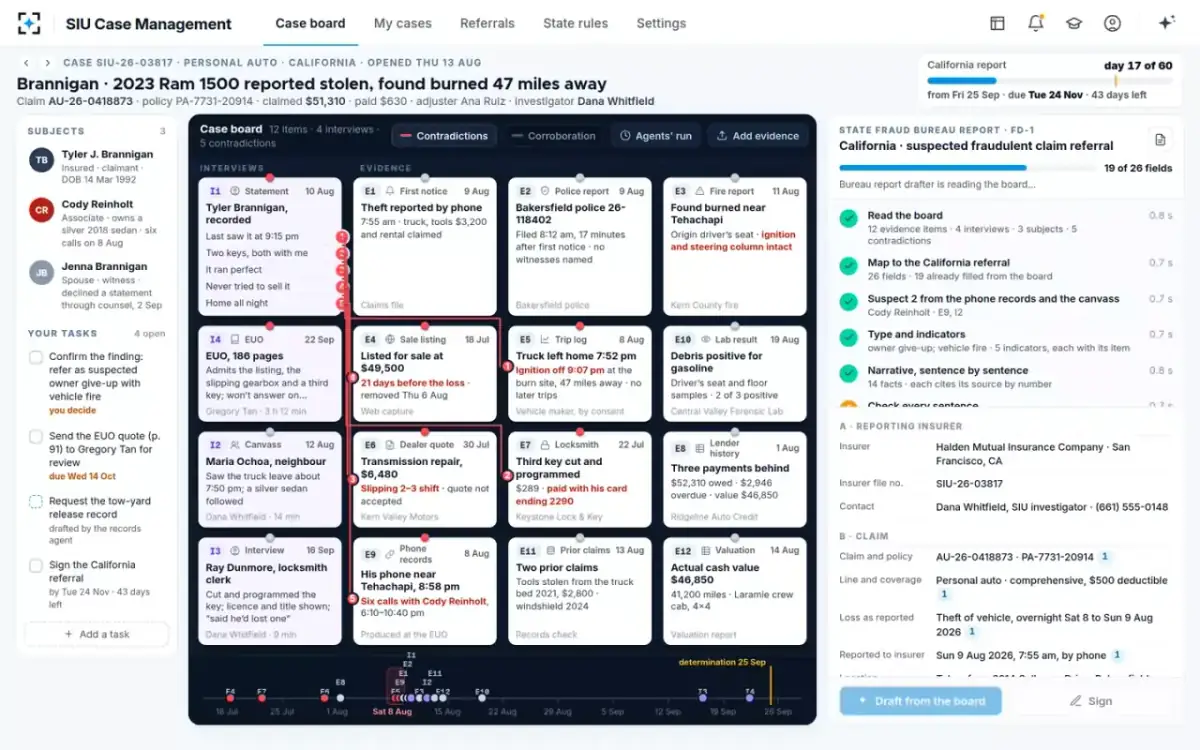
It can draft one, and the draft is only safe if each sentence can be traced to an item in the file. General-purpose language models invent legal facts at high rates. In a study published in the Journal of Legal Analysis, researchers asked general-purpose models verifiable questions about federal court cases and found invented legal content in 58% to 88% of answers, depending on the model (Dahl et al.). A later preregistered evaluation of commercial legal research tools built on retrieval found that they still produced invented content in roughly one answer in six to one in three, by tool (Magesh et al.); the version cited here is an arXiv preprint. An SIU narrative goes to a state bureau and may end up in front of a prosecutor. An invented fact there is worse than a missing one.
A chat assistant against a drafter tied to the case board
General chat assistant: Whatever was pasted in, plus what the model fills in.
Bureau report drafter: Only the board: evidence items, interviews and the chronology.
General chat assistant: Often written anyway, in confident prose.
Bureau report drafter: Left out, and listed as a task for the investigator.
General chat assistant: None, or citations that may not exist.
Bureau report drafter: A numbered citation on every sentence and field; the sources print with the report.
General chat assistant: May describe intent or guilt.
Bureau report drafter: “Suspected”, never a verdict; “contradicted by”, never “lied”.
General chat assistant: Depends on the tool’s terms.
Bureau report drafter: The SIU, claims counsel and the reporting coordinator only.
Draft from the board: every sentence checked for a source
Do regulators allow AI in SIU investigations?
Yes, with governance. By 8 October 2026, 29 jurisdictions had adopted the NAIC's AI model bulletin, and California, Colorado, New York and Texas had issued their own insurance-specific guidance (NAIC adoption map). The bulletin expects an insurer's AI program to cover systems bought from vendors as well as those built in-house, including due diligence on the vendor and, where available, contract terms giving audit rights. The line regulators draw around AI in claim decisions applies here too: the more an output drives a decision about a consumer, the more evidence of oversight an examiner will ask for.
California's SIU regulations are written around a result a person stands behind: an investigation with the five required elements, a summary with the investigators' findings, and a referral that says whether the investigation is complete. Agents that make that file faster to build serve those rules. Agents that made the finding would not.
Is AI case management secure and confidential?
It has to be at least as confidential as the paper file, and everything it produces is part of that file. Under the NAIC model act, information given to the commissioner in a fraud investigation is "confidential by law and privileged" in the commissioner's hands. Inside the insurer, California can demand the investigation files, claim notes and investigator notes on written request, to be released within 30 days, or 60 for workers' compensation (§ 2698.34). An agent's working notes are part of what a regulator may ask for.
In the solution, reports and SIU files are shared only with the SIU, claims counsel and the reporting coordinator. Every original is fingerprinted with SHA-256 on arrival and never altered, custody is logged for every handler, and every agent step and person's action is on the audit trail. A buyer should ask any vendor the same three things: where the files sit, who can read them, and whether the run log can be exported when a regulator asks.
Questions to ask before you buy AI case management software
Judge an AI product by what it refuses to do as much as by what it does. Ask for a demonstration on a closed file of your own, with the transcript and records you used, and ask the vendor to show each of the following.
Ten questions for any AI case management vendor
- Show me the source for this sentence.
Every line of a drafted referral should open the evidence item behind it.
- What happens to a fact with no source?
The right answer is that it is left out and flagged, not written in.
- Can the AI contact anyone?
Insureds, witnesses, providers, records holders: the answer should be no, as a fixed setting.
- Can it file a state report?
Filing should take a named person; ask how the sign-off order is enforced.
- What does the score measure?
Claim indicators only; ask for proof that no protected characteristic is an input.
- Where does each state clock start?
From the determination date your SIU sets, kept on the case, not from the referral date by default.
- Are originals preserved?
A fingerprint on arrival and a custody log for each handler.
- Can I export the run log?
A regulator may ask for investigation files and notes on 30 days’ notice in California.
- How is it tested on my files?
Replay closed cases and compare the drafted summary with what your investigators wrote.
- What do I need to connect?
Claims system, transcripts, records sources; ask which are live and which are a project.
Be equally clear about what this software is not. It does not score claims at first notice of loss; that is claims fraud detection. It does not find rings across many claims; that is network analysis. It does not replace surveillance, interviews or the EUO. And in the current version the connections to a carrier's claims system and to state portals are set up per customer, so wiring them is the first piece of work in a pilot. SIU case management software compared sets the agentic approach beside spreadsheets and classic case systems, and investigation management software pricing puts a cost on each case.
Questions people ask
How can AI help an SIU?
By taking over the reading and re-typing: extracting assertions from transcripts with page and line, building the chronology from every source, indexing evidence and drafting the state referral with citations. Botminds estimates that this cuts the writing on one referable case from about nine hours to about one hour twenty; that is an estimate from a carrier baseline, not a measured result.
Can AI write an SIU report?
It can draft the report, but a person must check it and sign it, and the draft is only safe if each sentence is tied to evidence. Research on legal AI tools has found invented content between 17% and 33% of the time even in retrieval-based tools, so a drafter that leaves unsourced facts out is the safer design.
What should AI never do in a fraud investigation?
Contact the insured or witnesses, decide that fraud occurred, describe a person's intent or guilt, or file the state report. Reporting statutes in New York, Texas and the NAIC model act tie the duty to a person's determination or reasonable belief, and Texas withdraws immunity from a reporter who acts with malice or in bad faith.
Do regulators allow AI in SIU investigations?
Yes. The NAIC AI model bulletin, adopted in 29 jurisdictions by 8 October 2026, expects insurers to govern AI used in case management and fraud detection, including systems bought from vendors. It does not ban AI; it asks insurers to be able to explain and evidence how it is controlled.
Is AI case management different from fraud detection software?
Yes. Fraud detection scores claims and decides what reaches the SIU; the NAIC auto survey found 83 insurers used AI mainly to refer claims for investigation. Case management is what the SIU does with a referral afterwards: the investigation file, the chronology and the report to the state.