Investigation management software pricing comes in three common shapes: a fee per user per month, a fee per case or a volume tier, or a platform licence with an implementation project on top. Where a vendor publishes no price list, and even where it does, a buyer needs a yardstick of their own. For an insurer's special investigations unit, the right yardstick is the cost of one referable case: the investigator hours it takes to turn a file into a chronology, a summary and a state fraud bureau referral, plus the regulatory exposure if that referral is late or incomplete. A product is worth its price if it lowers that cost by more than it charges, without making any referral harder to send.
Botminds' SIU Case Management is case management software for SIUs in which six agents keep the case board, chronology and evidence index current and draft the state referral from the board with every fact cited; investigators interview, decide and sign. Its effect on cost is concentrated in one place, the writing, so this guide prices the writing first. Where it uses the product's sample data, the carrier (Halden Mutual) and every person in it are fictional, and the hour figures are Botminds' own estimate from a carrier baseline, not a measured result.
The writing cost of one referable case, line by line
Chronology from every source
Investigation summary
Re-keying into the state form
Referral narrative
Checking sources and signing
One referable case
How is investigation management software priced?
Three models are common, and each rewards a different behaviour. Per-user pricing ties cost to headcount, which is predictable but says nothing about volume. Per-case pricing ties cost to the work, which looks fairer until it puts a price on every additional referral. Platform pricing buys capacity and moves the risk into the implementation project. None is wrong; each needs a different question before it is signed.
Three pricing models, and what each means for an SIU
| Model | What you pay for | What it rewards | The question to ask |
|---|---|---|---|
| Per user (seat) | Each investigator, manager, counsel and coordinator login | Small teams; heavy use per person | Do counsel and the reporting coordinator need full seats, or review access? |
| Per case or volume tier | Each case opened, or a band of cases a year | Low volumes; seasonal spikes paid as they come | Does the price per case fall as volume rises, and is a referral ever priced separately? |
| Platform licence | The system, often with a fixed implementation project | Large units with stable volumes | What is in the implementation, and what does each new state form or connection cost? |
One California rule should shape any per-case conversation. Contracts for SIU work may not contain terms that could discourage the referral or investigation of suspected fraud (10 CCR § 2698.33(c)(2)). The rule is written for firms that perform SIU duties under contract, but its logic applies to any price that rises with each referral: a unit that pays more per referral has a reason, however small, to send fewer. Ask for pricing that is flat across the referral decision, so the decision is made on the facts.
What does an SIU case cost? Build it from hours
An SIU case costs what its hours cost, and most of the hours that software can remove are writing hours. Bureau of Labor Statistics data put the median annual wage for claims adjusters, examiners and investigators at $78,000 in May 2025 (BLS), about $37.50 an hour. Wages were 70.0 percent of private employers' compensation costs in June 2026, the rest being benefits (BLS), which puts a loaded hour near $53.57. At Botminds' estimate of nine hours of writing per referable case, that is about $482 a case before anyone has typed a word of new evidence.
Hours of writing per referable case, by hand and with agents
The chart shows where the savings are and where they are not. The chronology and the re-keying shrink most, because they are copying work: the facts already exist on the case and only need to be laid out or carried into the form. Checking and signing does not shrink, by design. A product that claims to cut review time is claiming that a person reads less of what goes to the state under their name.
How many hours does an SIU case take?
No regulator publishes a standard, but every SIU can compute its own. California's annual SIU report asks for the total hours SIU staff spent on California fraud investigations, the number of claims referred to the SIU, and the number of those that became investigations (§ 2698.40(b)(7)–(8)). Divide the hours by the investigations and a unit has its average hours per case, from figures it already files under penalty of perjury. New York and Florida ask each insurer's plan to justify staffing with an assessment of the caseload one investigator can handle in a year (11 NYCRR 86.6; § 626.9891).
Split that average into investigation and writing before talking to a vendor. Interviews, surveillance and records requests are fixed by the case. The writing is what changes. If a unit's own split shows less than nine hours of writing per referable case, its saving per case will be smaller than the estimate on this page, and the arithmetic below should use its own figure.
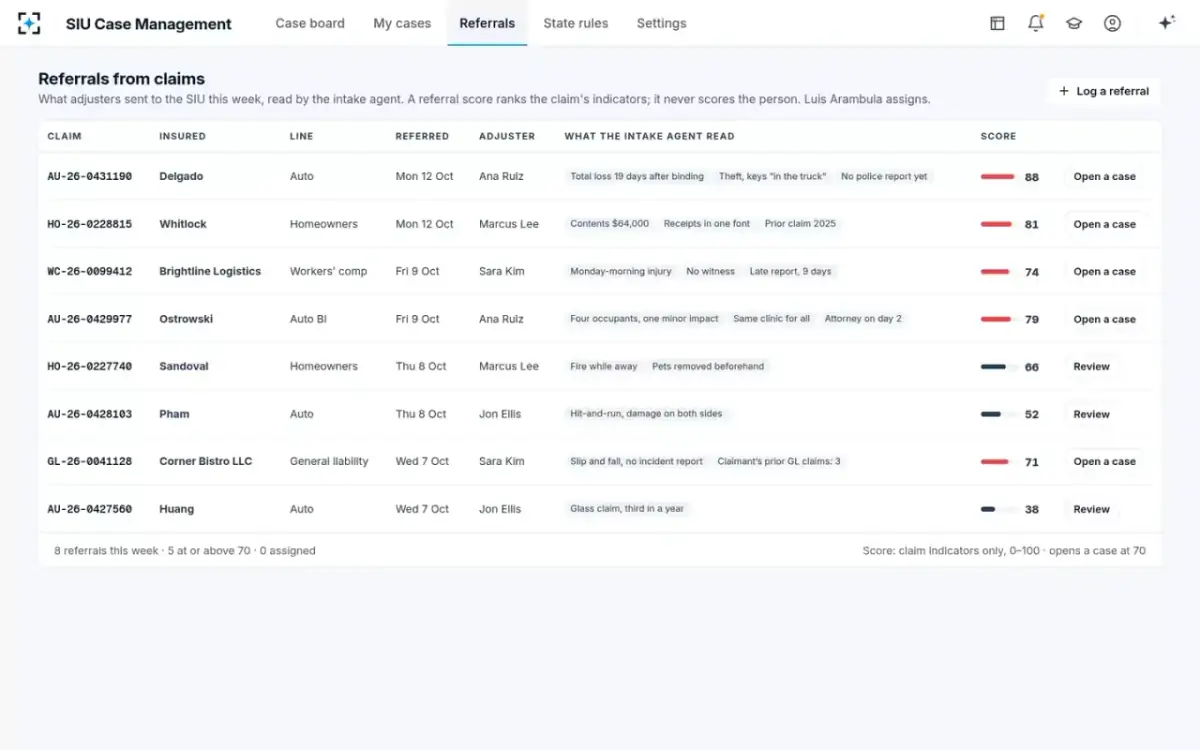
This week’s referrals, scored on the claim’s indicators
What are the penalties for late fraud referrals?
In California, up to $5,000 for each act of non-compliance with the SIU regulations and up to $10,000 for each wilful act (§ 2698.42). Referrals must be made within the period the statute sets, so a late referral is an act of non-compliance. The Department also uses the quantity and quality of an insurer's referrals when it chooses which SIUs to examine (CDI). In Florida, an insurer that fails to keep its anti-fraud unit, plan, training and data reporting in order faces an administrative fine of up to $2,000 a day until it complies (§ 626.9891(8)).
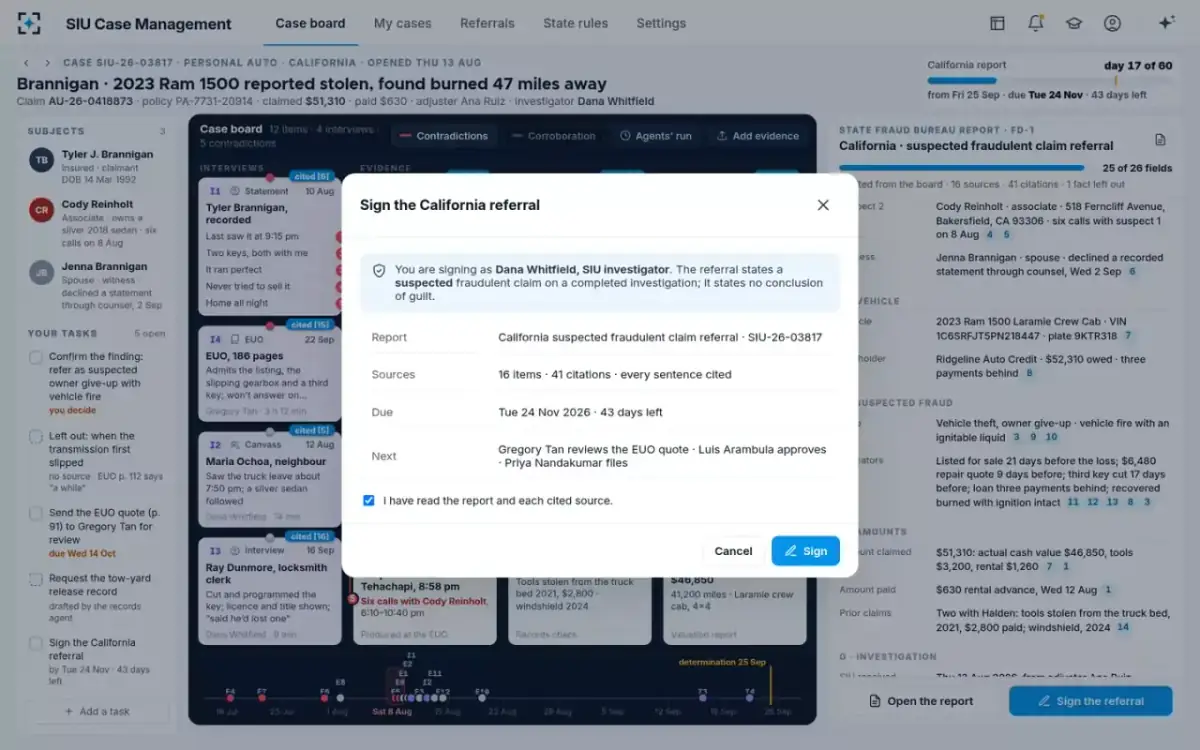
Set beside the writing cost, the arithmetic is lopsided. One wilful act in California can cost twenty times what it costs to write a referable case by hand. That is the second line of a cost per case: not the average penalty, which most units never pay, but the share of cases that run within 14 days of their limit, which is where late referrals come from. In the solution, each case shows how far its state clock has run since the determination, and the investigator and coordinator are warned 14 days before the limit.
Is per-user pricing right for an SIU?
Often, yes, if the seat count is honest. SIU headcount answers to the antifraud plan and to regulators' expectations, not only to volume: New York requires each plan to state staffing levels for a full-time unit, and California judges staffing by the SIU's demonstrated compliance. A stable team suits a seat price. The risk lies at the edges. The people who must touch every referral without working cases (claims counsel reviewing EUO quotes, the reporting coordinator filing, the manager approving) can add a seat for every reviewer if each needs a full licence.
Whatever the model, convert the quote to a price per referable case at your volume, and do it at two volumes: this year's and a bad catastrophe year's. A per-case price that looks cheap at 300 referable cases a year can look different at 600, and a seat price that looks steep for a small team can be the cheapest per case once volume rises.
How do you calculate SIU ROI?
Start from hours, not from fraud savings. Savings from fraud stopped depend on the cases and are hard to attribute to software; hours are not. New York already asks each insurer's SIU for an annual report on its "experience, performance and cost effectiveness", signed by an executive officer, so the inputs below are figures a New York unit has to defend anyway.
Return on case management software, per year
Writing hours returned
referable cases × (writing hours before − after) × loaded rate
At 300 cases and Botminds’ estimate: 300 × 7.7 h × $53.57 ≈ $123,000 of investigator time a year.
Your hours split; your volume
Exposure reduced
cases near the limit × chance of a late or thin referral × penalty
Use your own count of cases filed in the last 14 days of their clock.
Compliance
Subscription
seats, cases or platform fee per year
Converted to a cost per referable case.
Procurement
Implementation and review
connections + migration + training + the 30 minutes of review that stays
One-off in year one, then the review time every year.
IT and the SIU
What hidden costs come with case management software?
The hidden costs are mostly the ones a regulator will eventually see. Connections to the claims system and records sources are the largest: a product that cannot read your referral packet and transcripts will move the typing rather than remove it. State forms change; California's FD-1 is a 2015 revision, and other states revise their forms and bulletins on their own schedules. Open cases have to move without losing their clocks. And whatever the system produces must be producible: California can demand claim notes, investigation files and investigator notes on written request, within 30 days, or 60 for workers' compensation (§ 2698.34).
Costs to put in writing before you sign
- Connections
Claims system, document store, transcripts, records sources: which are included, which are a project.
- State forms
Who updates each state’s form when it changes, and what that costs.
- Migration of open cases
Every open case keeps its determination date and clock; ask how.
- Review seats
Counsel, coordinator and manager access, priced separately or included.
- Regulator requests
Exporting a complete case, with notes and the run log, inside 30 days.
- Retention
Years of storage for closed files; the sample setting keeps seven.
- Training records
California expects records of anti-fraud training; does the system keep them?
- Exit
Getting every case, document and fingerprint out in a format you can read.
Where SIU Case Management changes the cost per case, and where it does not
The solution's value sits in the writing lines above: the chronology, the summary, the state form and the narrative, with every fact cited and nothing re-keyed, which is a design target. It does not shorten interviews, surveillance or the EUO, and it does not detect fraud at first notice of loss or map rings across claims; those are separate tools. In the current version, connections to a carrier's claims system and to state portals are set up for each customer, which is part of the first pilot rather than an afterthought.
The honest test is your own files. Botminds will run SIU Case Management on a sample of your closed SIU cases, so the hours in the formula come from your work rather than from an estimate. SIU case management software compared covers the choice between approaches, and AI case management software for an SIU covers what the agents may and may not do.
The investigator signs; the next sign-offs are already queued
Questions people ask
How much does investigation management software cost?
We know of no published benchmark price for SIU software, from a regulator or a research body. Compare quotes by converting each to a cost per referable case at your volume, alongside the writing cost it removes: about $482 a case by hand at the BLS median wage loaded for benefits and Botminds' estimate of nine hours of writing.
How is case management software priced?
Usually per user, per case or volume band, or as a platform licence with implementation. Per-user pricing suits a stable team; per-case pricing tracks volume but should never make one more referral cost more, given California's rule against contract terms that discourage referrals.
What does an SIU case cost?
Each unit has its own figure, which it can compute from its California annual report: total investigation hours divided by investigations opened, times a loaded hourly rate. The writing part alone is about nine hours by hand on Botminds' estimate, roughly $482 at a loaded median wage.
What hidden costs come with SIU case management software?
Connections to the claims system and records sources, updates when a state changes its form, migration of open cases with their clocks, review access for counsel and coordinators, and exporting complete files when a regulator asks. California requires release of investigation files and notes within 30 days of a written request.
How do you calculate SIU ROI?
Multiply referable cases by writing hours saved and a loaded hourly rate, add the exposure reduced on cases filed near their deadline, and subtract the subscription, implementation and the review time that remains. New York already requires SIUs to report their cost effectiveness each year by 15 January.