SIU case management software is the system an insurer's special investigations unit uses to run each suspected fraud case from the referral to the state report: the case file, the evidence, the interviews, the chronology, the deadlines and the referral itself. Regulators treat it as part of the antifraud program. The NAIC's Antifraud Plan Guideline asks each plan for "An overview of any case management system and/or computer program used to memorialize SIU referrals received and investigations conducted", and for how the insurer tracks the number of referrals received, investigations opened and their outcomes. Three approaches answer that: a spreadsheet with a shared drive, a classic case management system, and a case board on which AI agents do the reading and drafting.
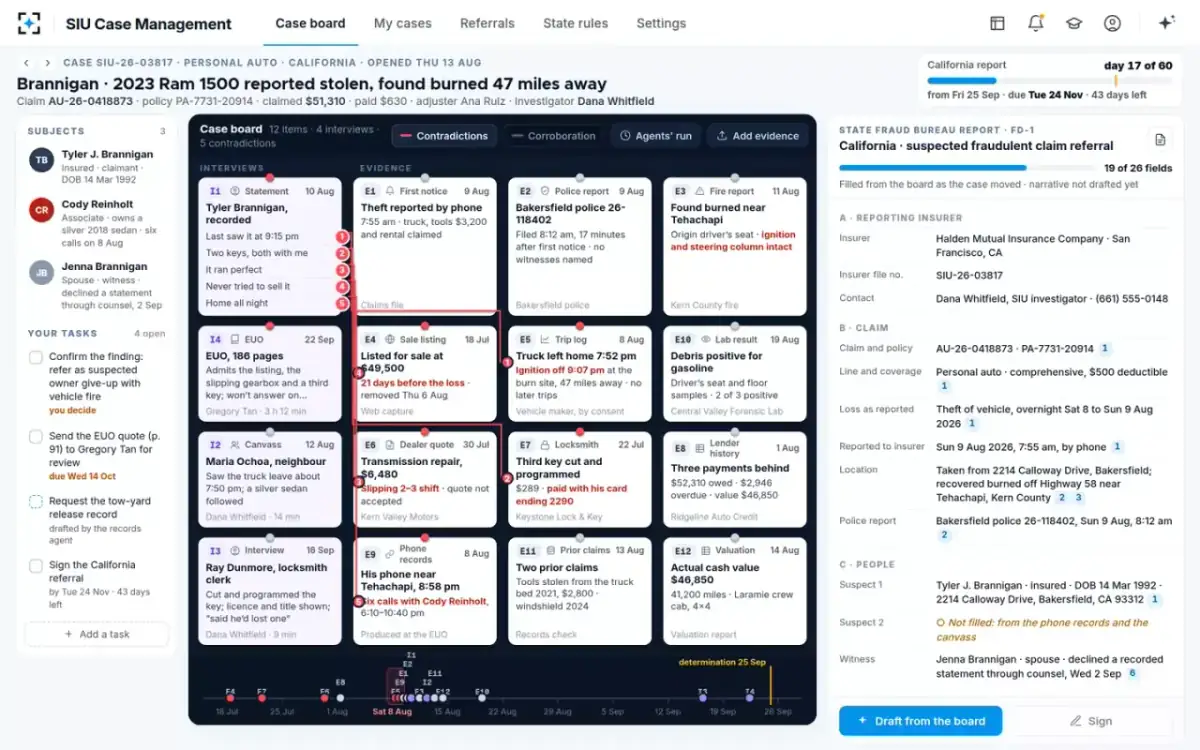
Botminds' SIU Case Management is the third kind. Six agents keep each case's board, sourced chronology and evidence index current and draft the state fraud bureau referral from the board, every fact citing its evidence item; investigators interview, decide and sign. This guide is written to be useful whichever approach you choose. It tests all three on one sample case, a pickup reported stolen and found burned, at a fictional carrier, Halden Mutual, and ends with a plan for switching systems without losing a single deadline.
Three approaches, tested on one case
| Task on the Brannigan case | Spreadsheet and shared drive | Case management system | Agentic case board |
|---|---|---|---|
| Open the case from the referral | Row typed from the adjuster’s email | Referral form creates the case; fields typed or imported | Intake agent reads the referral and claim file, names three subjects, scores the claim’s indicators |
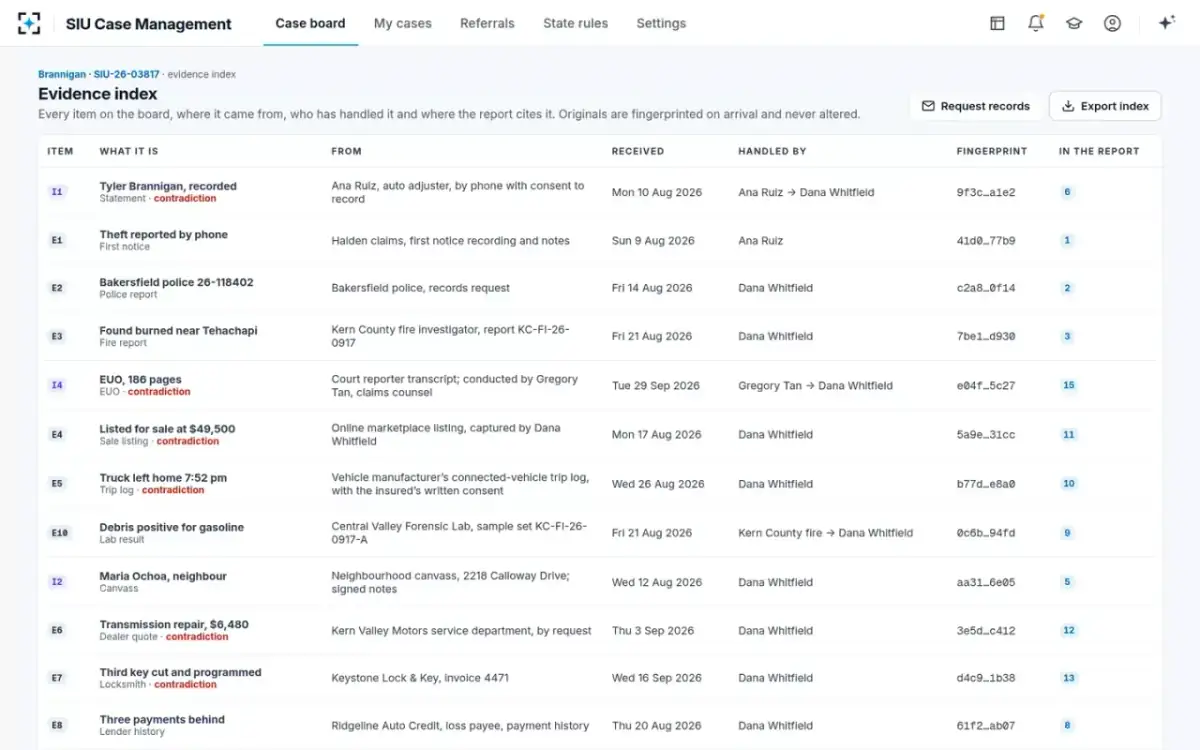
| Keep 16 evidence items | Files in a folder; custody in someone’s notes | Attachments with upload dates | Each file fingerprinted on arrival; sender, date received and every handler logged |
| Read a 186-page EUO for changed answers | Investigator re-reads it | Investigator re-reads it | Statement analyst lists 27 assertions with page and line; 3 changed answers flagged |
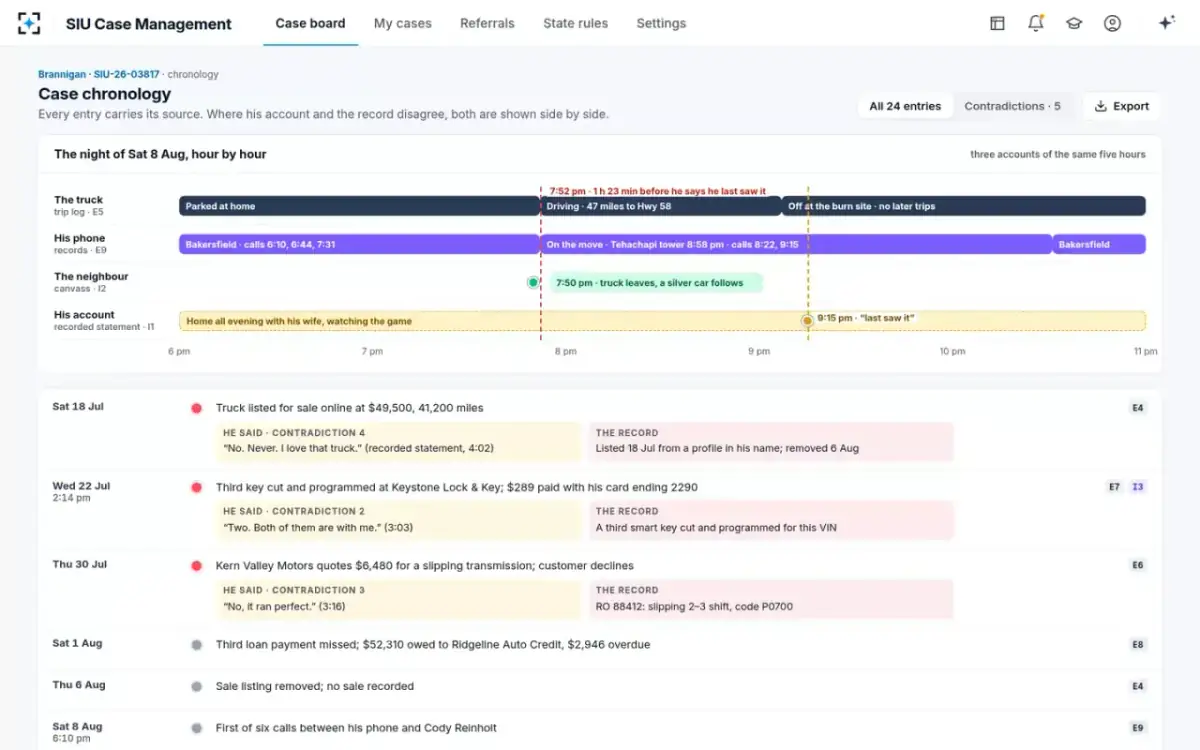
| Build the chronology | Typed by hand in a document | Typed into a timeline view | Built from every item on the board; 24 entries, each with its source |
| Know the state deadline | A date someone remembers to enter | A diary date, if set | Clock from the determination date, by the claim’s state; warnings at 14 and 7 days |
| Draft the state referral | Every fact typed again | Some fields pre-filled; the narrative typed again | Drafted from the board; 41 citations to 16 sources; a fact with no source left out |
| Count for the annual report | Counted by hand at year end | Report from case statuses | Counts by state from each case’s referral and outcome |
What is SIU case management software?
It is the SIU's system of record for investigations: where referrals arrive, cases open, evidence is kept, people are interviewed, deadlines run and reports are written. What separates it from a claims system is purpose. A claims system decides payment; an SIU system has to support a belief about fraud that a regulator, a prosecutor or a court may later test. That puts weight on things a claims system rarely needs, such as custody of every document, the exact words of every statement, and the date the SIU formed its belief.
Regulators examine those things. The NAIC standard that market conduct examiners work from asks whether an insurer's antifraud initiatives are reasonably calculated to detect, prosecute and prevent fraud (NAIC examination standards). The software does not meet any requirement on its own; the insurer does. But a system that cannot produce the evidence quickly makes every examination slower and every answer weaker.
What do regulators expect an SIU's system to produce?
Counts, deadlines and files, on request. Each of the large states asks for a different slice, and a multi-state carrier answers them all from the same cases.
What the rules ask an SIU to be able to show
| Requirement | Rule | What the system has to hold |
|---|---|---|
| Annual SIU report | California, 10 CCR § 2698.40 | Hours on California investigations; claims referred to the SIU; investigations opened; referrals to the Department and district attorneys; civil actions filed |
| Annual report on the plan | New York, 11 NYCRR 86.6(d) | Experience, performance and cost effectiveness, filed by 15 January and signed by an executive officer |
| Annual fraud data | Florida, § 626.9891(5) | By line: claims received, referred to the unit, investigated, referred to the Division and others; estimated damages; due 1 March |
| Reasons for not investigating | California, 10 CCR § 2698.36(c) | Written reasons when a referral is closed at preliminary review |
| Release of files on request | California, 10 CCR § 2698.34 | Claim notes, investigation files and investigator notes within 30 days (60 for workers’ compensation) |
| Timely state reports | Texas § 701.051; California FD-1; N.Y. § 405 | The determination date for each case, and the date each referral was filed |
A spreadsheet can hold all of this if someone keeps it perfectly, which is the problem. Florida's list alone asks for counts that depend on a status being updated at every step, by line of business. Each count the system produces as a by-product of the work is one nobody has to reconstruct in February.
One case on one board: subjects, evidence, contradictions and the form
Spreadsheets, case systems or agents: where each one breaks
A spreadsheet breaks on custody and deadlines. It can list cases, but the evidence lives somewhere else, the history of who handled each file lives in memory, and a deadline exists only if someone typed it. For a unit with a handful of cases a year in one state, that can be enough. For a unit reporting in several states, it fails quietly, usually in the week a referral is due.
A classic case management system fixes storage, routing and diary dates. It breaks on the writing. The investigator still re-reads the transcript, still types the chronology, and still types the same facts into each state's form. Pre-filled fields help with names and claim numbers; they do not help with the synopsis, which is where the hours are. An agentic case board changes the writing, and it introduces a new risk in exchange: text drafted by software. The answer to that risk is the same discipline examiners expect of people, a source for every sentence and a named person who signs.
"Half my week is chasing a missing date of birth on a form that's due Friday."
Priya Nandakumar, the sample fraud reporting coordinator
What features should SIU case management software have?
Start from the rules, not from a feature list. Each feature below exists because a regulator, a prosecutor or a court will ask for what it produces.
Features to require, and the reason for each
- A determination date on every case
Every state clock runs from a trigger; the system must store the trigger, not only the referral date.
- Clocks by state
The claim’s state decides the limit: 60 days in California, 30 in Texas and New York.
- Evidence kept as received
A fingerprint on arrival and a custody log of every handler.
- Statements with page and line
Quotations a reviewer can find in the transcript in seconds.
- A chronology with a source on every entry
The backbone of the summary every state wants.
- Referral drafts in each state’s format
Filled from the case, never re-keyed; a fact with no source left out.
- Sign-off in order
Investigator, counsel where an EUO is quoted, manager, coordinator.
- Counts for annual reports
Referrals received, investigations opened, outcomes, by state and line.
- Export on request
A complete file, with notes and history, inside California’s 30 days.
- Access limited to the SIU
Investigators, claims counsel and the reporting coordinator; every action on the audit trail.
Can SIU software file state fraud reports?
Software can prepare them, and many states take them electronically, through their own portals or the NAIC's system, but a person should file. The NAIC runs an Online Fraud Reporting System that a number of states accept; Delaware's insurance department told insurers in March 2026 that most of them already file through it (Delaware Bulletin No. 15). California takes referrals through its own eFD-1 system. Texas accepts reports in its fraud unit's format or the NAIC's (§ 701.051; the forms are compared in the uniform suspected insurance fraud reporting form guide), and lets a member of an anti-fraud organisation authorise that organisation to report on its behalf, though the insurer keeps the liability if the report is not made properly.
That last clause is the reason filing should stay with a named person. A reporting duty is a legal obligation of the insurer, and immunity for reporting depends on good faith. In the solution, agents never file: the investigator signs, claims counsel reviews any EUO quotation, the SIU manager approves and the fraud reporting coordinator files. How one case maps to several states' forms is covered in the uniform suspected insurance fraud reporting form.
How do you migrate open SIU cases without losing a deadline?
By moving the clocks first and the documents second. An open case's most important data is not its folder of files but its determination date and the state whose clock it runs on. Lose that, and a case that was on day 52 of 60 restarts at day one in the new system, which is how referrals end up late. A safe switch runs in four stages and lets any case near its limit finish where it started.
A switch in four stages, with no clock reset
- Replay closed casesweeks 1–3
- Earlier stages
- Connect; run new referrals in bothweeks 3–6
- Earlier stages
- Move clocks, then evidenceweeks 6–8
- Earlier stages
- Old system read-onlyweeks 8–10
Stage one is the cheapest insurance a buyer can buy. Replaying closed cases, with the transcripts and records your investigators actually used, shows whether the drafted summary says what your investigator said and whether every citation opens the right document. It also produces your own figure for writing hours per case, which matters more than any vendor's estimate.
Every item, where it came from and who has handled it
How long does it take to implement SIU software?
As long as the connections take. A spreadsheet is ready on day one and costs its hours every day after. A classic case system's timeline is mostly configuration and data migration. An agentic system adds a step that should not be skipped: proving the drafts on your own closed files before any of them go to a state. The plan above runs ten weeks as an illustration; a unit with one claims system and a few states may move faster, and a unit with several claims platforms will not.
Two dates constrain the calendar more than any vendor. Annual reports fall due on fixed dates, 15 January in New York and 1 March in Florida, and California's report is due 90 days after the Department's June notice. Avoid cutting over in the weeks before one of them, so the counts come from one system.
Where SIU Case Management fits, and where it does not
The solution fits a unit whose cost is in the writing: many referable cases, several states, long transcripts and records, and a reporting coordinator re-keying forms. It is weaker where the work is mostly field investigation with few referrals, and it is not a detection tool: it starts when a referral arrives. In the current version, connections to a carrier's claims system and to state portals are set up per customer, and the state forms drafted out of the box are California, Texas, New York and Florida.
The way to decide is the replay in stage one. Botminds will run SIU Case Management on a sample of your own closed SIU files, so you can compare its drafts with the referrals your team filed. For the agent design and its limits, see AI case management software for an SIU; for the money, investigation management software pricing.
The night of the loss, hour by hour, from four sources
Questions people ask
What is the best SIU case management system?
The one that produces your regulators' counts and your states' referrals from the work itself, with every document kept as received. Test any candidate on your own closed cases and compare its output with what your team filed; a vendor demonstration on prepared data proves little.
What reports should SIU software produce?
At least the inputs to each state's annual filing: in California, investigation hours, referrals to the SIU, investigations opened and referrals to the Department; in Florida, the same by line of business with estimated damages. It should also show every open case's clock and export a complete case file on request.
Does SIU software meet antifraud plan requirements?
Software cannot meet them on the insurer's behalf, but the plan has to describe it. The NAIC guideline asks each plan for an overview of the case management system and how referrals, investigations and outcomes are tracked for compliance.
Can a spreadsheet work as SIU case management?
For a small unit in one state, it can hold the list. It cannot keep custody of evidence, run state clocks from the determination date, or draft referrals, so the risk grows with every state added and every case near its deadline.
How do you migrate open SIU cases?
Move each case's determination date and state first, so no clock restarts, then import the evidence with a fingerprint and received date. Let any case within 14 days of its limit finish in the old system, and avoid cutting over just before an annual report is due.