What happens after an SIU investigation depends on what it found, and there are four common endings. The referral may be closed at a first review because the red flags are plainly not fraud; the claim may be investigated and paid; it may be investigated and denied; or the insurer may form a reasonable belief of fraud and report the claim to the state's fraud bureau, sometimes saying that more investigation is needed. The claim decision and the report are separate tracks: a claim can be paid and still reported, and a report is not a finding of guilt. Each ending has to leave a file that explains itself to someone who was not there: an examiner, a prosecutor or a court.
Botminds' SIU Case Management is case management software for insurers' special investigations units: six agents keep each case board, chronology and evidence index current and draft the state referral from the board with every fact cited, while investigators decide and sign. This guide follows the four endings from the SIU's side and then from the state's, using the rules regulators publish and a sample case at a fictional carrier, Halden Mutual, whose people and claims are invented.
Four endings from one case board: the claim, the state, the file
Ending 1
Closed at first reviewThe claim
Handled as an ordinary claim by the adjuster.
The state
Nothing, unless a reasonable belief of fraud was formed.
The file must hold
The red flags, and the written reasons they are reasonably clearly not fraud.
Ending 2
Investigated, then paidThe claim
Paid in full or in part by the adjuster.
The state
Nothing, if the investigation dispelled the suspicion.
The file must hold
The investigation, the summary of findings, and why the facts did not support a belief of fraud.
Ending 3
Investigated, then deniedThe claim
Denied in writing with every basis for it; in California, with notice of the right to Department review.
The state
A referral too, if a reasonable belief of fraud was formed.
The file must hold
The policy basis, the facts, and the documents a regulator or court would read.
Ending 4
Referred to the stateThe claim
Decided on its own merits, whatever the report says; it may already have been paid.
The state
A referral inside the state’s deadline, saying whether the investigation is complete.
The file must hold
The summary’s answers, every fact with its source, and proof of filing.
Can an SIU investigation end in payment?
Yes. A referral to the SIU means a claim had features worth checking, not that it is false. California requires the SIU to investigate each credible referral, but lets it decline to open an investigation where a first review shows it is reasonably clear the red flags are not the result of fraud; when it declines, it has to put its reasons in the claim file or the SIU file (§ 2698.36(c)). A fuller investigation that dispels the suspicion ends the same way: the adjuster pays, and the SIU file says why the facts did not support a belief of fraud.
That closing note is not paperwork for its own sake. The NAIC's antifraud plan guideline expects insurers to track the outcome of investigations conducted, not only referrals received (GL-1690), and California's annual SIU report asks how many referred claims became investigations. A unit that closes most referrals without a written reason has no way to show an examiner that its closures were sound.
Does settling a claim end an SIU investigation?
No. Payment status does not decide whether a report is owed; the belief does. The NAIC's guideline says a claim may show evidence of suspected fraud regardless of whether it has been paid, and at the November 2024 meeting of California's Fraud Assessment Commission the Department said that a claim settled before the investigation finished should still be referred (minutes). An SIU whose case list closes when the claim closes will lose exactly those files.
The reverse also holds: a report does not decide the claim. California expects the claim to be accepted or denied within 40 days of proof of claim, or 80 where specific information supports a suspicion of fraud, with written notices if more time is needed, and only allows longer, until the Commissioner orders otherwise, where the insurer has reported to the state and shown diligence (§ 2695.7). In the sample case, the claim decision stays with the adjuster, who received the SIU's summary on the day the determination was made.
Minnesota ties the two tracks together explicitly. An insurer's proper notice to the state's Bureau of Criminal Apprehension pauses the time limits in its unfair claims practices rules, and any bad-faith action on the claim, until 30 days after the Bureau decides not to recommend action and tells the insurer (Minn. Stat. § 60A.952). There, the date of the report protects the claim decision as well as the fraud file, and both files need it.
How is an SIU case closed?
With a written conclusion that matches the ending. California's regulation requires every investigation to end in a summary that is concise, complete, specific to the case, separate from every other document and includes the investigators' findings and the basis for them, with a statement of whether the investigation is complete. A denial adds the policy reasons. A referral adds the state's form. The checklist below is what each closed file should hold before it leaves the investigator's desk.
What a closed SIU file holds, whatever the ending
- The referral and its red flags
What was flagged, by whom or by which system, and when.
- The investigation steps taken
Analysis, interviews, database checks, evidence preserved; or why a step did not apply.
- The summary and its answers
The facts, the suspected misrepresentations and who made them, materiality, witnesses, documents.
- The ending, and who decided it
Closed, paid, denied or referred; the person, the date and the reason.
- The claim decision letter
Kept with the SIU file, so the two tracks can be read together.
- Proof of any report
Date, state, channel and confirmation, and the other agencies told.
- Evidence as received
Fingerprints and custody, so the file can be produced unaltered on request.
- A retention date
The sample SIU keeps closed files seven years; set yours by your states’ rules.
What does the SIU send the state?
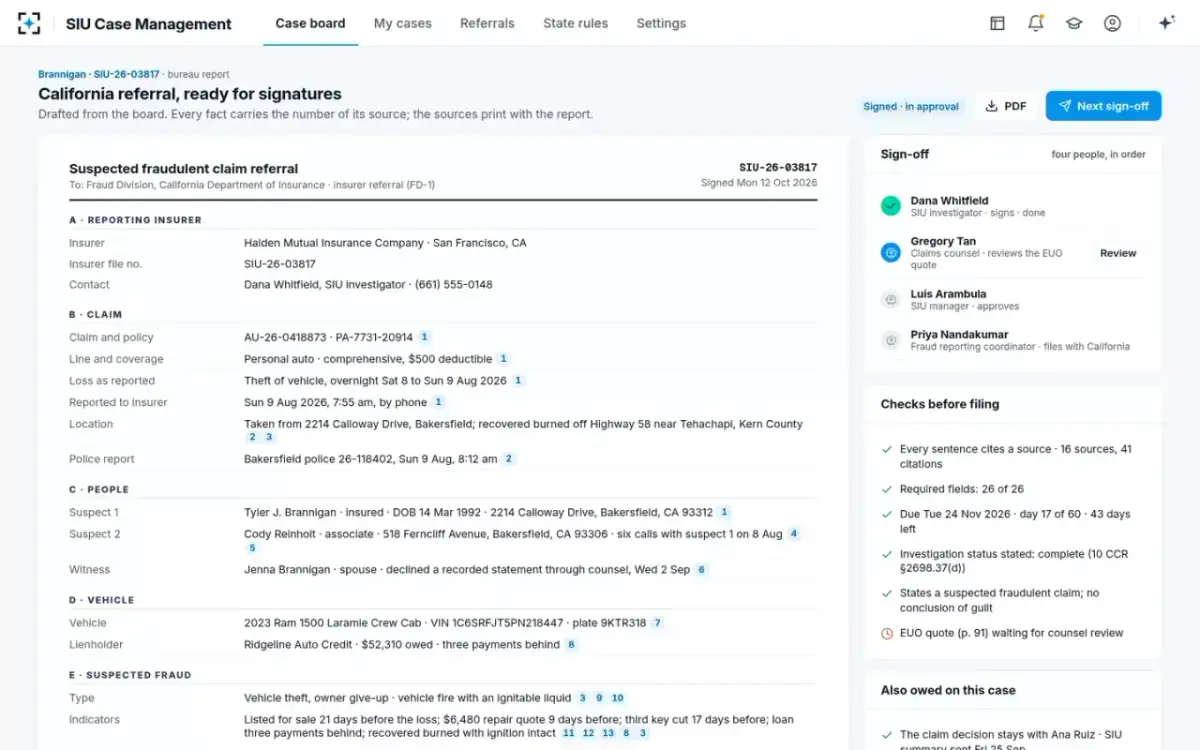
A referral in the state's format, inside its deadline, carrying the investigation summary. In California every referral has to say whether the investigation is finished or still needs work (§ 2698.37(d)), which makes the fourth ending two endings in practice: a complete referral, and one sent on time with work still open, to be followed by an amended referral. Where a case touches several states, each gets its own referral on its own clock, and each referral names the other agencies told. The FD-1 form in California and the uniform suspected insurance fraud reporting form guides cover the two main formats.
A referral ready to file, with the claim decision kept separate
What happens after the state receives a referral?
Most referrals inform the state's picture of fraud and never become state investigations; how often insurance fraud is prosecuted traces California's funnel from report to prosecution. Fraud bureaus review what arrives, select a fraction for investigation and refer a smaller fraction to prosecutors. Texas's Department of Insurance received 23,857 fraud reports in fiscal 2025 and opened 172 investigations (TDI). New York's Insurance Frauds Bureau received 39,676 reports of suspected health-care fraud in 2025, nearly all of them no-fault auto, opened 73 health-care fraud investigations and made 40 arrests (DFS).
Reports received against investigations opened, two states
States say what happens to the rest in different ways. Florida's statute requires the Division of Criminal Investigations to review reports and select those that may require further investigation, then report violations to prosecutors, who must tell the Division why a prosecution was not begun within 60 days or was declined (§ 626.989(6)). California's Department told its Fraud Assessment Commission that it closed 875 cases for lack of resources in fiscal 2022-23, down from 1,102 the year before, and that it communicates with the party that submitted each FD-1 (minutes).
What happens if the state rejects a fraud referral?
The insurer can ask about it, and the case can come back. At the November 2024 meeting, California's Department said that if a case is rejected based on what is in the FD-1, the insurer can contact the Department to discuss it, and the case can be opened after rejection if it merits it. Asked whether a case closed for lack of resources is reopened if staffing increases, the Department said it can be (minutes).
The same meeting explained why the content of the FD-1 matters so much. The Department flags poor-quality FD-1s at intake for its SIU compliance team, has added a check box to record when an FD-1 is lacking information, and reaches out to large insurers when many of their referrals are closed for lack of evidence. A rejected referral is, among other things, a signal about the file behind it. In the solution, every field and sentence of a referral cites its evidence item, and a fact without one is left out and given to the investigator as a task.
Can an SIU case be reopened?
Yes, from either side. An insurer that receives new evidence after filing can send an amended referral; California's referral content includes a new or amended referral indicator for exactly that. The state can reopen a closed case, as California's Department described. And the file can be called for long after it closes: on written request, a California insurer must release claim notes, investigation files and investigator notes within 30 days, or 60 for workers' compensation (§ 2698.34), which is only possible if the closed file is complete and retrievable.
Civil action is the other way a closed case returns. New York's fraud prevention plans must provide for coordination with other units of the insurer for "the investigation and initiation of civil actions based upon information received by or through the special investigation unit", and California's annual report asks how many civil actions alleging insurance fraud each insurer started (§ 2698.40).
Who decides the outcome of an SIU investigation?
Several people, each deciding a different thing, and none of them software. The adjuster decides the claim. The investigator decides the finding. The SIU manager confirms the determination that starts the state's clock and approves the referral. Claims counsel reviews quotations and decides on civil action. The reporting coordinator files. The state's fraud bureau, and then a prosecutor, decide whether there will be a criminal case at all.
Who owns each ending, today and with agents keeping the file
Today
Asks the SIU for what it can share, and still has to decide the claim.
With agents
Receives the SIU summary; the claim stays theirs to pay or deny, in writing.
Still theirs: the claim decision
Today
Writes the closing memo, the summary and the referral, each by hand.
With agents
Reads drafts built from the case board, checks every cited source and signs.
Still theirs: the finding
Today
Needs the date the SIU formed its belief, and what it was based on, when a regulator asks.
With agents
Approves with each fact pointing at its evidence and the clock in view.
Still theirs: the determination and the approval
Today
Reviews EUO quotations when a draft reaches them.
With agents
Reviews every report that quotes an EUO before it is filed.
Still theirs: civil action, and the EUO record
Today
Re-keys facts into each state’s form against the deadline.
With agents
Receives referrals with their fields filled and files each one.
Still theirs: the filing
Keeping those decisions apart is what lets each file stand alone. A claim letter that reads like a fraud finding can draw a complaint; a referral that argues the claim rather than setting out the facts gives a bureau less to act on. What to do if there is an insurance SIU investigation describes the same endings from the claimant's side.
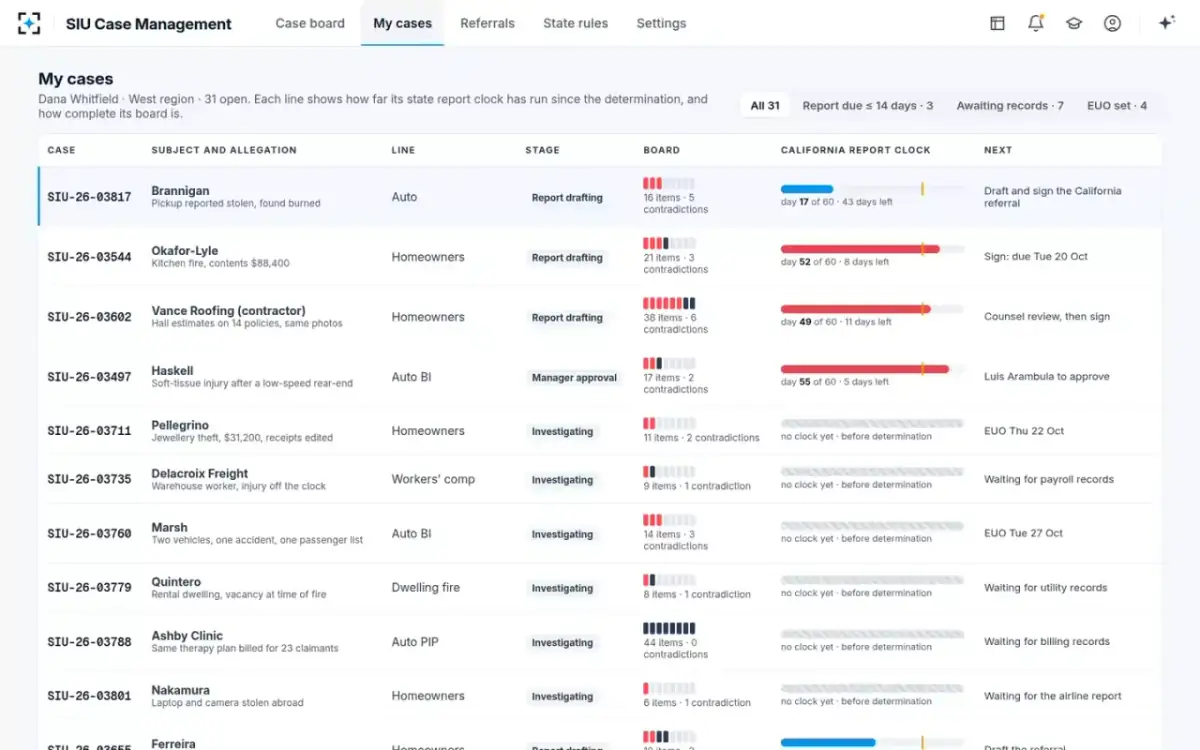
Cases by stage: investigating, drafting, awaiting approval
Questions people ask
What happens after an SIU investigation is complete?
The claim is paid, paid in part or denied by the adjuster, and, if the SIU formed a reasonable belief of fraud, the insurer reports the claim to the state within its deadline. The state's fraud bureau then decides whether to open its own investigation; Texas opened 172 investigations from 23,857 reports in fiscal 2025.
Does the SIU tell the claimant the outcome?
The claimant learns the claim decision, which must be in writing if it is a denial. California's claims rules do not require an insurer to disclose information that could alert a claimant to a fraud investigation, so a claimant may never learn whether a report was made.
How long after an SIU investigation will I hear about my claim?
In California the insurer normally has 40 days from proof of claim to accept or deny it, or 80 where specific information supports a suspicion of fraud, and must send written notice every 30 days if it needs longer. Other states set their own limits.
What happens if the state does not act on a referral?
Many referrals are never investigated by the state; California closed 875 cases for lack of resources in fiscal 2022-23. The Department has said such a case can be reopened if staffing allows, and an insurer can discuss a rejected referral with it.
Can the insurer sue after an SIU investigation?
It can bring a civil action, and the rules expect insurers to be organised for it: New York's fraud prevention plans must provide for initiating civil actions based on SIU information, and California's annual SIU report counts the civil fraud actions each insurer started.