The Uniform Suspected Insurance Fraud Reporting Form is a standard referral form for insurers, written by the NAIC's Antifraud Task Force so that suspected fraud is reported to state fraud bureaus in one format. Its instructions say the current version was "adopted by the NAIC Antifraud Task Force on April 3, 2012", replacing an earlier task force form, and that its purpose is "to provide a standardized reporting platform for use by the insurance industry". Kentucky's regulation incorporates it by reference, Delaware keeps a copy for insurers that do not report online, and the same form sits behind the NAIC's Online Fraud Reporting System. What it does not do is replace every state's own form, or let one referral serve several states.
That gap is a typing problem for any insurer that reports in more than one state, and it is the problem Botminds' SIU Case Management is built around. The software keeps every fact of a case once, on a case board, with its source; its agents draft each state's referral from the board, the uniform form for one state and California's FD-1 for another, so that nothing is typed again; people sign and file. This guide explains the form, the states that use it and the online system, then maps one sample case onto both forms. The carrier and people in the sample are fictional.
One case, two forms: what each asks, block by block
| Block | Uniform form (NAIC, Kentucky 7/2019) | California FD-1 (Rev. 6/2015) |
|---|---|---|
| Reporting insurer | Reporting person, insurance company, NAIC company code | Company, California Certificate of Authority number, contact |
| Claim and loss | Claim and policy numbers, date and address of loss | Claim and policy numbers, date and location of loss |
| Money | Reserve, amount paid and date, loss amount, settlement; NAIC version adds billed amount and a potential-loss band | Premium loss, potential loss, actual paid to date, suspected fraudulent loss to date |
| What happened | Detailed synopsis | Synopsis: who, what, when, where, how, why |
| People | Subject and additional parties: role codes, DOB, SSN, licence, VIN, plate, employer, occupation, aliases | Parties A to J: role, DOB or age, SSN, tax ID, licence, plate, VIN, other names, injury claimed |
| Type of fraud | Insurance type, and a checklist of suspected fraud types | Program and fraud type code |
| Investigation status | SIU investigation completed, yes or no, and the date | A statement in the summary that the investigation is or is not complete |
| Other agencies | Other agency contacted, with contact and case number | District attorney, other law enforcement, NICB, other |
| Evidence gathered | Checklist: statements sworn or recorded, EUO or deposition, receipts, claim history, expert and IME reports, photos and more | Not on the form; attachments optional |
| Health-care services | Dates and description of service, CPT or CDT codes | Not on the form |
| Litigation | Civil litigation pending, with dates | Not on the form |
| Disaster | Not on the form | Disaster box: earthquake, flood, firestorm, wind, other natural, man-made |
Is there a uniform insurance fraud reporting form?
Yes, and it has been replaced once since 2003. Delaware's bulletin records that the NAIC first issued a "Model Uniform Suspected Insurance Fraud Reporting Form" on 11 March 2003, and the NAIC's instructions date the current version to 3 April 2012. States print their own copies: Kentucky's is labelled IFID 7/2019 and its regulation incorporates "Uniform Suspected Insurance Fraud Reporting Form," 7/2019, by reference (806 KAR 47:010); the District of Columbia publishes its own instructions; Delaware keeps a fillable Word copy on its website.
The form's design reflects what fraud bureaus need to open a case. The instructions ask insurers to fill it in around one subject, to list aliases and alternative dates of birth separately so investigators can tell which details belong to which name, and to tick every type of evidence the SIU gathered, because "It is important to indicate all evidence gathered by the SIU so the fraud bureau can make an accurate assessment and prioritize the referral."
What is the NAIC Online Fraud Reporting System?
It is the NAIC's online channel for the same form, known as OFRS. The instructions say "The Form is also used in the NAIC’s Online Fraud Reporting System (OFRS)", that an insurer needs an NAIC company code to submit through it, and that insurers should contact the NAIC to find out which jurisdictions accept it. Delaware's insurance department told insurers in March 2026 that "Most insurers use the NAIC OFRS". The NAIC's antifraud plan guideline lists OFRS alongside the National Insurance Crime Bureau, the National Health Care Anti-Fraud Association and state electronic systems as means an insurer may use to submit reports (GL-1690).
Acceptance is the catch. Kentucky's regulation lets insurers report through intermediaries including OFRS only to supplement a report made on the state's own portal or on the uniform form, and says reports submitted to anyone other than its Division do not satisfy the duty. A multi-state SIU has to know, state by state, whether an OFRS submission counts as the report or only as a copy.
Do all states accept the same fraud report?
No. Some states take the uniform form, but several large states prescribe their own. California's referral content is set by regulation and filed on the FD-1 or through its eFD-1 system. New York requires reports "on a form prescribed by the superintendent". Texas accepts reports "in the format prescribed by the fraud unit or by the National Association of Insurance Commissioners", and its Fraud Unit publishes a Suspected Insurance Fraud Report (SIU) form, FR028, separate from its consumer form (TDI).
Which form each state in this comparison names
| State | Form or channel | Source |
|---|---|---|
| Kentucky | The Division’s electronic portal, or the Uniform Suspected Insurance Fraud Reporting Form; OFRS, NHCAA or NICB only in addition | 806 KAR 47:010 § 6 |
| Delaware | The uniform form, on the Bureau’s prescribed form, or the NAIC OFRS | Bulletin No. 15 |
| Texas | The fraud unit’s format (form FR028) or the NAIC’s | Ins. Code § 701.051; TDI forms page |
| California | FD-1, or the electronic eFD-1 | Ins. Code § 1872.4; 10 CCR § 2698.38 |
| New York | The superintendent’s prescribed form | Ins. Law § 405 |
Can one report satisfy several states?
Not under the form's own instructions. When a referral concerns more than one state, the NAIC asks insurers to file once per state and to tell each state about the others:
If the referral should be sent to more than one state because of jurisdiction, please send a separate referral to each affected state and complete the “Identify Another Agency You Have Contacted Regarding This Referral” portion of the referral form to alert the state fraud agencies so that they may coordinate their investigations.
NAIC, Instructions for the Uniform Suspected Insurance Fraud Reporting Form
The same instructions split referrals in the other direction too. If several claim numbers relate to one investigation, or more than one policy, the insurer is asked to complete an additional form for each claim and each policy. A ring of staged collisions touching three policies in two states can therefore mean six referrals, every one carrying the same subjects, the same synopsis and a list of the others. That is where the typing multiplies, and where inconsistencies between versions creep in.
How much of one case the two forms share
12 blocks of data across the uniform form and California’s FD-1
- On both forms · 67%
- Uniform form only · 25%
- FD-1 only · 8%
What fields are on a fraud referral form?
Four groups, on every form compared here: who is reporting, what claim and money are involved, who the people are, and what happened. The uniform form adds a structured layer on top, with role codes for each person, a checklist of suspected fraud types and a checklist of evidence gathered; Kentucky's printing has role codes from claimant and insured to tow-yard and salvage-yard employees. California's FD-1 asks for less structure and more money detail, splitting the loss into potential loss, paid to date and suspected fraudulent amount paid.
The money block is where one case most often reads differently on two forms. The uniform form's reserve, amount paid, loss amount and settlement do not line up one-for-one with the FD-1's premium loss, potential loss, paid to date and suspected fraudulent loss. Each figure has to come from the claim's payment history with its date, so that the two referrals describe the same money in each form's terms. The guide to the FD-1 form in California covers that form field by field.
Type once, file many: one case, several states
Agent
Keep each fact once, with its sourceSubjects, claim and policy numbers, amounts, dates, statements and documents live on the case board, each with the item it came from.
A person decides
Decide which states are affectedThe SIU manager confirms the determination and the states whose rules apply; each gets its own clock.
Agent
Map the board to each state’s formThe same subject, amount or quotation fills the uniform form for one state and the FD-1 for California, each in that form’s layout.
Never: types a fact that is not on the board
Agent
Note the other agencies toldEach referral lists the other states and agencies already informed, as both forms ask.
A person decides
Sign, review, approve, fileThe investigator signs, counsel reviews any EUO quotation, the manager approves and the reporting coordinator files each referral through its own channel.
How do multi-state insurers report fraud?
Through a named team, on one case file, with a clock per state. The antifraud plan guideline asks every plan to say "which individual(s) or group, within the organization is responsible for reporting suspected fraud on the insurer’s behalf", the insurer's threshold for reporting, and its means of submission. Kentucky requires two primary contacts for the Division, one of them the head of the SIU. The work that remains is mapping: the same facts into each state's form, inside each state's deadline, with each referral naming the others.
Deadlines make the order of work matter. A case determined on the same day can be due in 14 days in Kentucky, 30 in Texas and 60 in California, so the shortest clock decides when the facts must be complete enough to report. Insurance fraud reporting requirements by state compares ten states' deadlines and triggers.
The board mapped to a state form, every field from its source
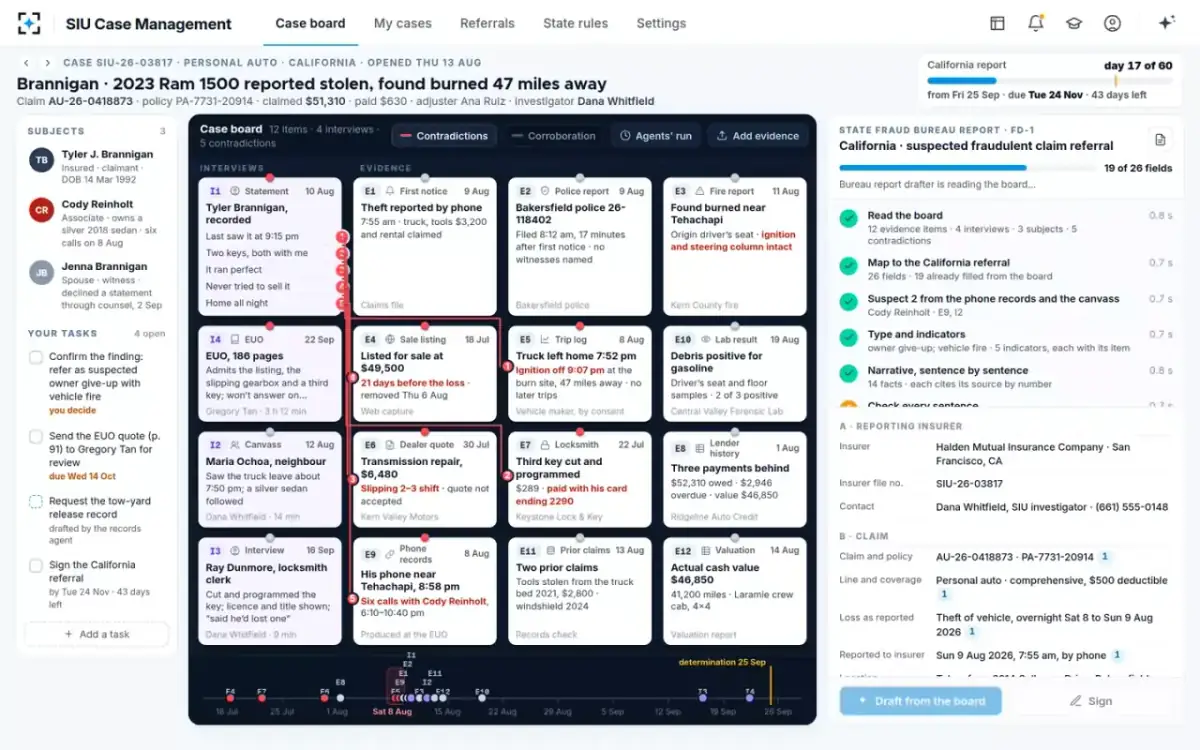
Who files fraud reports for an insurer?
Whoever the antifraud plan names; the NAIC guideline lets a plan name positions rather than people, such as a reporting coordinator in the SIU. California's annual SIU report asks insurers for the names of personnel whose duties include communicating with the Fraud Division, and keeps those names out of the public record. Texas lets a member of an anti-fraud organisation authorise the organisation to report for it, but the insurer keeps the liability if the report is not made properly.
In the solution, the fraud reporting coordinator files every referral, after the investigator has signed, claims counsel has reviewed any EUO quotation and the SIU manager has approved; agents never file. The coordinator receives each referral with its required fields filled from the board, on its own state's clock.
Before filing the same case in a second state
- Confirm the state’s channel
Its own portal, the uniform form, OFRS, or its own prescribed form; and whether OFRS counts as the report.
- Start that state’s clock from its own trigger
Determination, suspicion or discovery, as the state’s rule says.
- One referral per claim and per policy
As the uniform form’s instructions ask.
- Same facts, same sources
Subjects, amounts and quotations drawn from one case file, so versions never disagree.
- Name every other agency told
Other states, the district attorney, NICB; the forms ask so bureaus can coordinate.
- Keep proof of each filing
Date, channel and confirmation, per state.
What is a suspected fraudulent claim form?
It is the general name for an insurer's referral of a claim it believes may be fraudulent, and in California it is the form's actual title: the Suspected Fraudulent Claim (SFC) Referral Form, FD-1. States also publish separate forms for members of the public. Texas, for example, has one form for SIUs, FR028, and another for consumers, FR029, in English and Spanish. An SIU should use the form meant for insurers.
One draft, every fact cited, ready for the state’s format
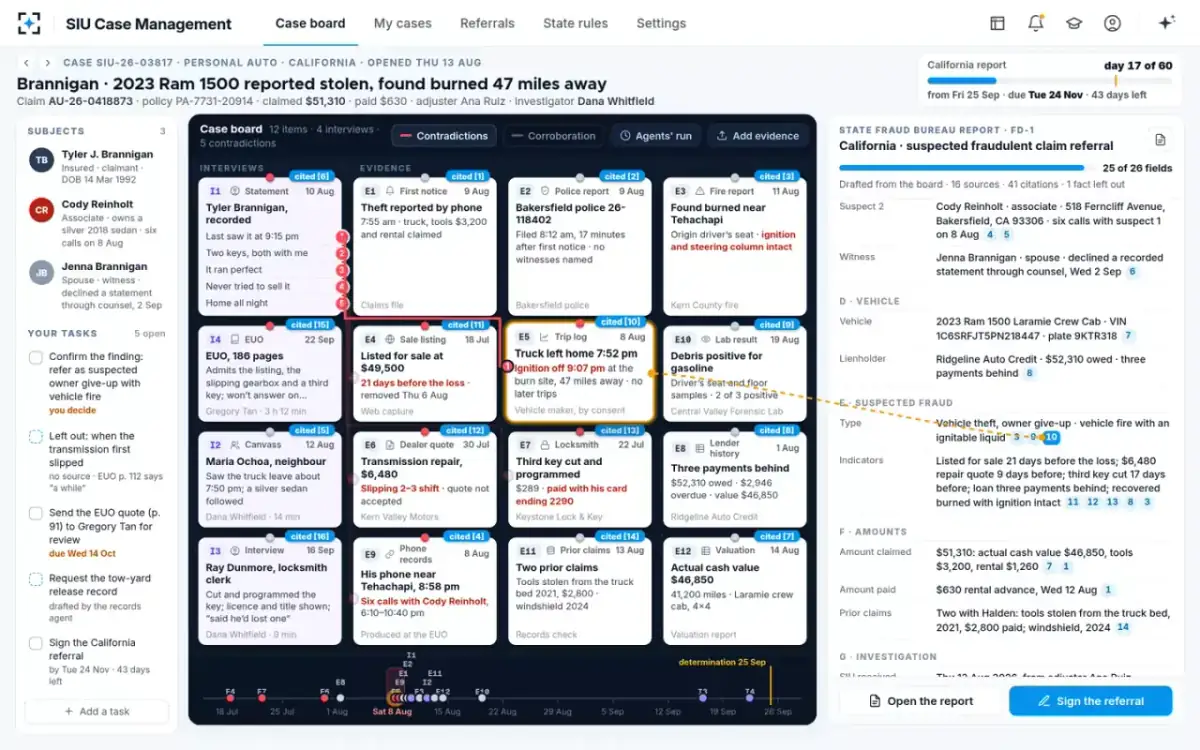
Questions people ask
Who created the uniform suspected insurance fraud reporting form?
The NAIC's Antifraud Task Force. Delaware dates the first model form to 11 March 2003, and the NAIC's instructions say the current version was adopted on 3 April 2012 to replace it. States such as Kentucky print their own editions.
Do I need an NAIC company code to use OFRS?
Yes, according to the NAIC's instructions; an alien insurer without one may submit the form manually only. The same instructions tell insurers to contact the NAIC to find out which jurisdictions accept OFRS.
Can one report satisfy several states?
Not under the uniform form's instructions, which ask for a separate referral to each affected state, with each one naming the other agencies contacted so the bureaus can coordinate. Kentucky also says a report to anyone other than its Division does not satisfy its duty.
Does California accept the uniform form?
California prescribes its own content in 10 CCR § 2698.38 and its own FD-1 form, filed on paper or through the eFD-1 system. An SIU reporting a California claim should use the FD-1, whatever it uses elsewhere.
How many referrals does a multi-claim case need?
Under the uniform form's instructions, one per state, and within each state one per claim number and one per policy number. A case spanning three policies in two states can need six forms, each carrying the same subjects and synopsis.