An insurance SIU investigator works the claims an insurer suspects may be fraudulent. The job is to read the claim file, interview the people involved, pull records, attend the examination under oath, build a chronology, and, when the facts create a reasonable belief of fraud, write the referral a state fraud bureau requires: within 60 days in California and 30 days in Texas and New York. The Bureau of Labor Statistics puts it plainly: "Insurance investigators handle claims in which the company suspects fraudulent or criminal activity such as arson, staged accidents, or unnecessary medical treatments." What the handbook leaves out is how much of the day goes to writing the same facts down several times.
That is the problem SIU Case Management exists for. It is Botminds' case management software for special investigations units: six agents keep the case board, the sourced chronology and the evidence index current, and draft the state fraud bureau referral from the board with every fact cited, while the investigator interviews, decides and signs. To show the work concretely, this guide follows a sample investigator through one Monday. Her name is Dana Whitfield, her carrier is Halden Mutual, and every person, company and claim in the sample is fictional.
The occupation in four numbers
376,100
jobs held by claims adjusters, examiners and investigators in 2025
BLS does not count SIU investigators separately
$78,000
median annual wage for the group, May 2025
−5%
projected change in the group’s employment, 2025–35
5hours
of anti-fraud training a year California requires of SIU staff, at least
What is an SIU investigator, and where does the job sit?
An SIU investigator works in an insurer's special investigations unit, the team that investigates suspected fraud on behalf of the whole company, separate from the adjusters who decide claims. New York makes the separation a legal requirement: insurers writing 3,000 or more auto, workers' compensation or accident and health policies a year must run a full-time unit kept apart from both underwriting and claims (§ 409(b)). California requires most licensed insurers to keep an SIU and spells out its procedures, training and annual reporting in 10 CCR §§ 2698.30–2698.43. Florida requires every admitted insurer to keep an anti-fraud unit or contract the work out, under § 626.9891.
The investigator is not the adjuster and not the police. Claims staff spot red flags and refer files, on an internal SIU referral form; the SIU investigates them and, where the law requires, refers the case on to the state. Patterns across many claims can belong to another seat, the insurance fraud analyst. The state's own fraud investigators are a different job again: in Florida, Division of Criminal Investigations investigators "shall have the power to make arrests", and Texas lets its commissioner commission department investigators as peace officers (§ 701.104). An insurer's SIU investigator has neither power. Their authority comes from the policy, which can require the insured to cooperate, and from the evidence they collect.
Where claims adjusters, examiners and investigators work
Share of the 376,100 jobs in 2025, by employer
- Insurers other than life and health · 35%
- Agencies, brokerages and related · 29%
- Federal government · 13%
- Health and medical carriers · 7%
- State government and all others · 16%
What is a typical day for an SIU investigator? A Monday on the desk
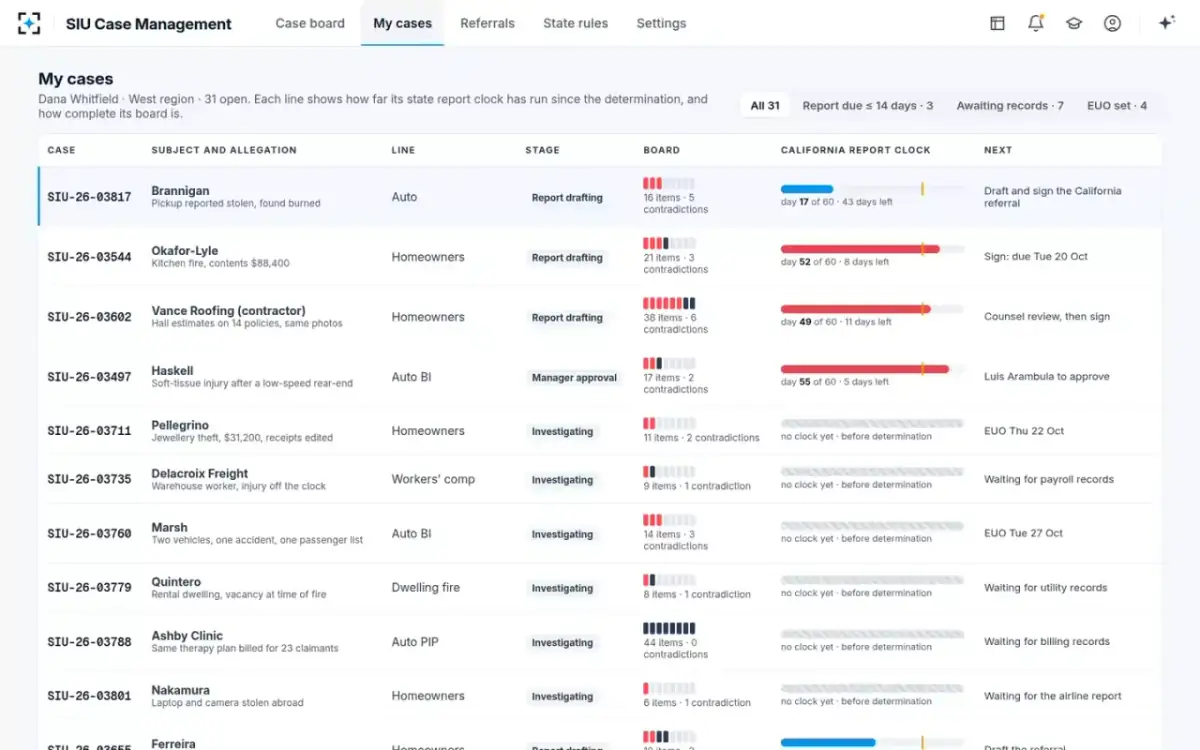
A typical day starts with the clocks, not the cases. On Monday 12 October, Dana's caseload holds 31 open files in the West region, and the first thing she reads is how far each state report clock has run. Okafor-Lyle, a kitchen fire with $88,400 of contents claimed, is on day 52 of California's 60. Haskell, a soft-tissue injury after a low-speed rear-end collision, is on day 55 and waiting for her manager's approval. Brannigan, a pickup reported stolen and found burned, is on day 17. Files still under investigation show no clock at all, because in California the clock runs from the day the insurer determines that a claim appears fraudulent.
Thirty-one files, ranked by the state clock
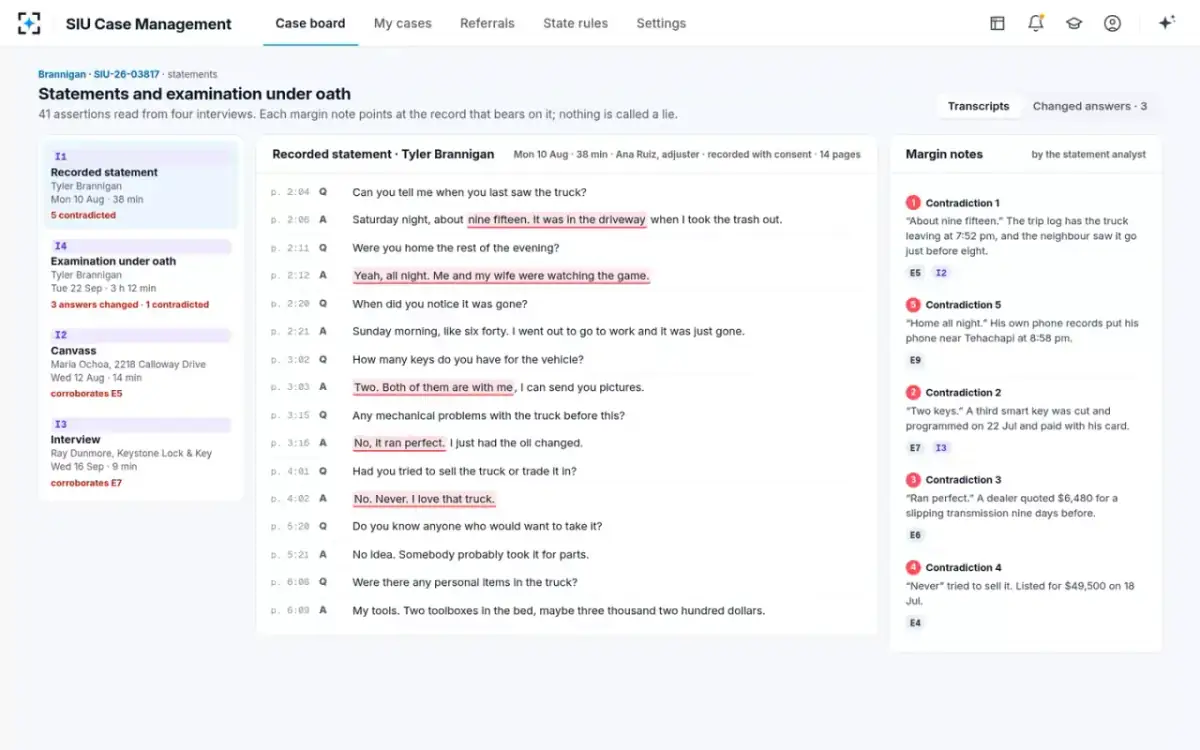
Mid-morning goes to evidence. Brannigan's examination under oath ran to 186 pages, taken on 22 September by claims counsel. Reading it means setting each answer beside what the insured said in his recorded statement in August and beside the records: a vehicle trip log, phone records produced in the claim, a locksmith invoice, a dealer quote, an online sale listing. Three answers changed between August and September: how many keys he had, whether the truck ran perfectly, and whether he had tried to sell it. Finding that by hand means re-reading, page by page.
The afternoon is calls and paper. Pellegrino, a jewellery theft with edited receipts, has an EUO set for Thursday 22 October. Delacroix Freight, a warehouse injury, waits on payroll records. Two records requests on Brannigan are still open. Then comes the clerical part: typing the facts that are already in the file, the timeline and the summary into the state fraud bureau's form, against the clock.
One referable case, written two ways
- Chronology from every source3 h
- Investigation summary2 h
- Re-keying into the state form2 h
- Referral narrative1.5 h
- Check sources, sign0.5 h
- Review drafts, check sources, sign1 h 20
What the law says every SIU investigation must contain
California writes the investigator's method into regulation, which makes it a clear statement of the job. Under 10 CCR § 2698.36, every investigation of suspected insurance fraud includes, where applicable, five things, and the fifth is a written summary that must answer named questions. The Department's SIU compliance examiners review insurers' SIU operations against these rules.
What a California SIU investigation must include
- A thorough analysis of the claim file
Including consideration of factors indicating insurance fraud.
- Identification and interviews of potential witnesses
People who may speak to the accuracy of the claim or application.
- Searches of industry-recognised databases
The ones the SIU has chosen as appropriate for the line of insurance.
- Preservation of documents and evidence
Everything obtained during the investigation.
- A concise and complete written summary
Separate from every other document, with the investigators’ findings and the basis for them.
- A statement that the investigation is, or is not, complete
Required in the summary, and again on the referral to the state.
The summary is where the hours go. It must say what facts caused the belief that fraud occurred, what the suspected misrepresentations are and who made them, how they are material, who the witnesses are, and what documents show it. Those questions then reappear, nearly word for word, in the content California requires of the referral itself. The guide to the FD-1 form in California follows one fact through both documents.
How many cases does an SIU investigator handle?
No regulator publishes a standard caseload; each makes the insurer justify its own. New York requires every fraud prevention plan to explain its staffing, including "an assessment of optimal caseload which can be handled by an investigator on an annual basis". Florida's statute lists the same assessment among the criteria an anti-fraud plan may use to justify its staffing. California judges staffing by results: adequacy depends on the SIU's "demonstrated ability to establish, operate and maintain an SIU that is in compliance with these regulations".
The numbers a carrier needs to answer the question already sit in its own reports. California's annual SIU report asks for the total hours SIU staff spent on California investigations, the claims referred to the SIU, and how many of those became investigations (§ 2698.40). Divide one by the others and a unit has its own caseload and hours per case. The sample investigator's 31 open files are fictional; a real unit's figure depends on line, region and how much of each file is still typed by hand.
Do SIU investigators do surveillance and interviews?
Yes, both, though the mix depends on the line of insurance. BLS notes that "Investigators often do surveillance work", giving the example of watching a workers' compensation claimant whose activity may not match the injury claimed. Interviews are written into California's rule as a required step. An investigator may also sit in on an examination under oath, which counsel may conduct; in the sample, claims counsel examined the insured for 3 hours 12 minutes.
The rest of the work is records. Investigators request police and fire reports, prior claims, lender histories and vendor invoices, and read what the claimant produces. Every item has to be kept as received, because a referral, a denial or a civil action may later turn on it. The difference between an examination under oath and a deposition, and why it matters for how a transcript is used, is covered in examination under oath vs deposition.
Answers read against the record, page and line
What qualifications does an SIU investigator need?
New York sets a floor for qualifications in statute and regulation. An investigator in a New York SIU, or at a vendor working for one, must meet one of the routes below. BLS adds that licensing for claims investigators varies by state, so a candidate has to check the state where they will work.
New York's minimum routes into an SIU investigator role
| Route | What it requires | Typical background |
|---|---|---|
| Education | An associate’s or bachelor’s degree in criminal justice or a related field | Graduates entering from study |
| Claims or police investigation | Five years of insurance claims investigation, or professional investigation with law enforcement agencies | Senior adjusters; former police detectives |
| Financial investigation | Seven years of professional investigation involving economic or insurance matters | Auditors, financial crime investigators |
| Medical review | A licensed or authorised medical professional, to evaluate medical claims | Nurses and clinicians on injury and health files |
Training continues once hired. California requires an anti-fraud orientation within 90 days for every new employee and at least five hours of continuing anti-fraud training a year for SIU staff, with records of each course kept for the Department (§ 2698.39). Florida requires two hours of initial anti-fraud training for its anti-fraud unit staff and a one-hour course every year after.
What does an SIU investigator earn?
BLS does not publish a figure for SIU investigators alone. Its nearest group, claims adjusters, examiners and investigators, had a median annual wage of $78,000 in May 2025; the lowest tenth earned less than $48,850 and the highest tenth more than $117,040 (BLS). BLS projects the group's employment to fall 5 percent between 2025 and 2035, and names faster data processing and AI among the reasons workers will become more productive. Openings will still come, from people retiring or changing occupations.
For an SIU director, the wage matters because hours do. At the median, an investigator costs a carrier about $37.50 an hour in wages alone (our arithmetic: $78,000 over 2,080 hours). Every hour spent typing a fact a second time is an hour not spent on an interview or a records request. Investigation management software pricing works through that cost per case.
What reports does an SIU investigator write?
Three documents carry most of the writing: the chronology, the investigation summary and the state referral. The chronology lays every event in date order with its source. The summary answers the regulator's questions in prose. The referral repackages both into the state bureau's format. California's is the FD-1, which wants the who, what, when, where, how and why behind the suspicion and is due within 60 days of the determination. Texas wants a written report to its fraud unit no later than the 30th day after the determination or reasonable suspicion (§ 701.051). New York gives thirty days from the determination (§ 405).
"The facts are all there. I just type them four times: the file, the timeline, the summary and the state form."
Dana Whitfield, the sample investigator
A multi-state carrier multiplies the problem, because each state's clock starts from a different event and each bureau has its own form. Insurance fraud reporting requirements by state compares ten of them.
Where the hours go, and what changes when agents keep the file
The investigation itself does not shrink. Interviews, surveillance, the EUO and the judgement that a claim appears fraudulent take as long as they took before. What shrinks is the writing, because each fact enters the case once, with its source, and every later document is drafted from it. In the sample case, the statement analyst read the 186-page EUO and listed 27 assertions with page and line, three of them changed since August. The chronology builder laid the night of the loss out hour by hour from four sources. When Dana pressed "Draft from the board", the referral came back with 41 citations to 16 sources, and one fact with no source was left out and handed to her as a task.
What stays hers is the part the law puts on a person: the interviews, every contact with the insured and witnesses, the finding, and the signature. The agents never contact anyone and never file. Her manager confirms the determination, claims counsel reviews any EUO quote, and the fraud reporting coordinator files. AI case management software for an SIU sets out each agent and what none of them may do.
Questions people ask
What does SIU stand for in insurance?
Special investigations unit (California's regulations say "special investigative unit"). It is the insurer's team that investigates suspected fraud on claims, applications and premium. New York requires it to be full-time and separate from claims and underwriting for insurers writing 3,000 or more auto, workers' compensation or accident and health policies a year.
Is an SIU investigator the same as a claims adjuster?
No. The adjuster decides the claim; the SIU investigator investigates suspected fraud on it and decides whether the facts support a referral to the state. In California, claims staff must identify suspected fraud and refer it to the SIU as part of their regular duties; deciding the claim remains their job.
Can an SIU investigator arrest someone?
No. An insurer's investigator has no police powers. State fraud investigators are different: Florida's Division of Criminal Investigations investigators may make arrests under § 626.989(7), and Texas may commission its fraud investigators as peace officers under § 701.104.
Is SIU investigator a good job?
It is a job of evidence, writing and interviews more than field adjusting. BLS projects about 21,600 openings a year across the wider group of claims adjusters, appraisers, examiners and investigators, all of them to replace people retiring or moving on, even as total employment falls.
How long does an SIU investigation take?
There is no single limit, but claim rules constrain it. California normally gives an insurer 40 days to accept or deny a claim and allows 80 where specific information supports a belief that the claim is fraudulent. What to do if there is an insurance SIU investigation explains the timeline from the claimant's side.
Do SIU investigators work in the office or in the field?
Both. BLS notes that investigators work outside more often than adjusters, inspecting property and conducting surveillance, and that early morning, evening and weekend work is common because people must be reached when they are available. Desk time goes to records, transcripts and reports.