Insurance premium finance software covers two jobs that are often confused. A premium finance company needs loan software to quote, book and collect the loans that pay its customers' premiums. An insurer needs something narrower and more urgent: a way to read the notices those finance companies send, such as a notice of the agreement, a request for cancellation, a withdrawal of that request and a request for return premium, check each one against the state's rules, and act on the policy and the refund on time. The insurer's side can go live quickly because its rules are few and statutory: a notice period, a mailing allowance in New York, a deadline for third-party notices and a deadline for returning unearned premium. The work is loading those clocks and the carrier's own list of finance companies, not building a loan system. Botminds' Insurance Billing Exception Management is software for that insurer's side, in which a premium finance reader matches each notice to its agreement and policy and proposes the action, and a premium finance coordinator decides.
This page is for billing operations and IT leads at an insurer. If you run a premium finance company and need loan servicing software, the clocks below still apply to you, but the solution described here is not a loan system. Examples come from the solution's sample data: a fictional carrier, Kestrel Point Mutual, and three fictional finance companies.
Eight weeks from the first file to the daily report: our plan
- Inventorywk 1
- Load ruleswk 2
- Connectwk 3
- Replaywk 4
- Correctwk 5
- One statewk 6
- All stateswk 7
- Sign-offwk 8
What is premium financing, and which software do you mean?
Premium financing is a loan that pays an insurance premium. A premium finance company pays the insurer the premium, or most of it, up front, and the insured repays the finance company in installments with a service charge. The finance company's security is the policy itself: the agreement typically gives it a power of attorney to cancel the policy if the insured stops paying, and a claim on the unearned premium that the insurer returns when it does.
The statutes define the business plainly. In Texas an insurance premium finance company is "a person engaged in the business of making loans under this chapter by entering into premium finance agreements with insureds or prospective insureds" or acquiring such agreements (Tex. Ins. Code §651.001); Florida's definition in §627.826 is similar. Florida caps the price, at "a maximum of $12 per $100 per year plus an additional charge not exceeding $20" (Fla. Stat. §627.840(3)(b)).
Software for the finance company handles the loan: quotes, agreements, payment schedules, late notices and the notices of intent to cancel it must mail. Software for the insurer handles what arrives at the insurer: the finance company's notices and the money, and the insurer's own duties when a financed policy cancels. The two meet at the notice, and the insurer is the one whose policy changes.
How does insurance premium financing work, from the insurer's side?
From the insurer's side, a financed policy produces up to five events, each with a document and most with a deadline. The policy is bound and the finance company pays the premium. The finance company tells the insurer about the agreement; Texas requires that notice "before the 31st day after the date the premium finance agreement is accepted" (Tex. Ins. Code §651.165). If the insured defaults, the finance company mails the insured a notice of intent to cancel and, after the waiting period, sends the insurer a request for cancellation. If the insured catches up first, the finance company may withdraw the request. And if the policy cancels, the insurer returns the unearned premium, to the finance company first.
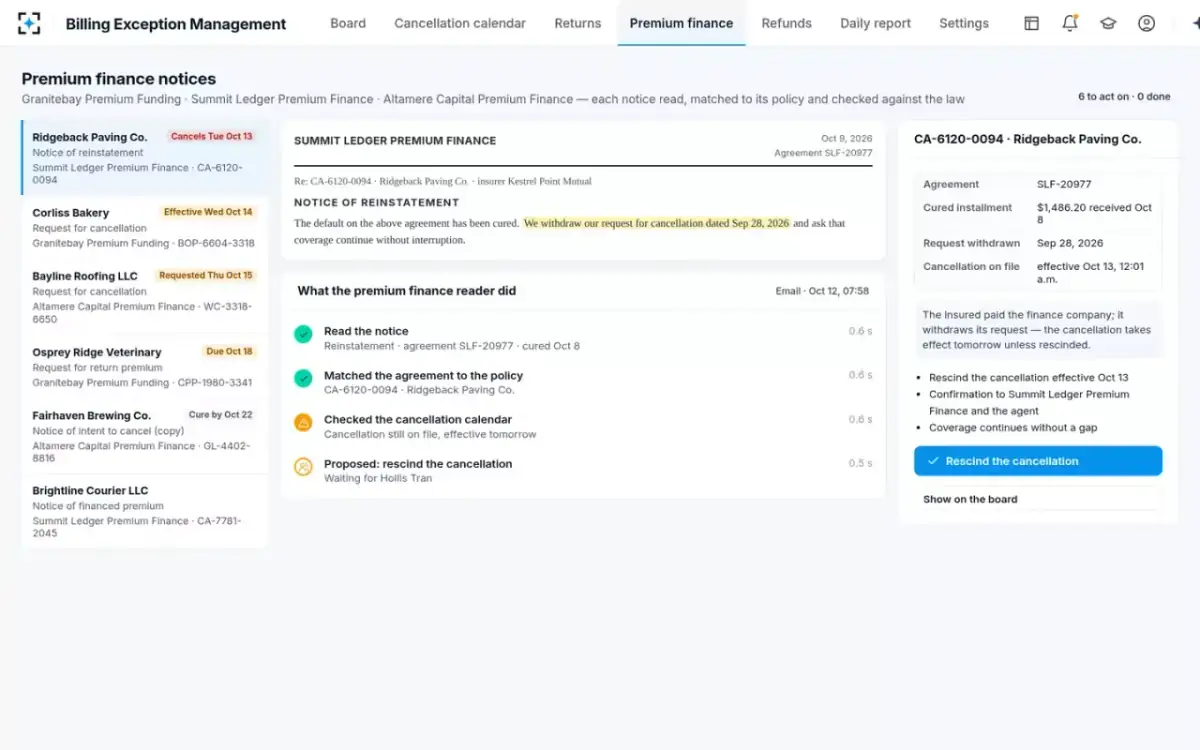
Each of those events reaches the insurer as a letter, an email or a line in a file, from finance companies that each use their own forms. On the sample Monday, the carrier had six finance company notices to act on from three companies: a notice of reinstatement withdrawing a request, two requests for cancellation, a request for return premium, a copy of a notice of intent to cancel, and a notice of financed premium. Each needed a different action, and two of them needed it within two days.
Insurance Billing Exception Management catches a finance company's withdrawal the day before the cancellation
The clocks insurance premium finance software has to know
The rules are short enough to fit on one table per state, which is why this part of billing goes live faster than most. They are also different enough between states that a single default, such as one notice period for everyone, is wrong somewhere.
Premium finance clocks in three states, from the insurer's side
| Clock | Florida | Texas | New York |
|---|---|---|---|
| Notice of intent to the insured | At least 10 days' written notice | Cure time no earlier than the 10th day after mailing | At least 10 days, plus at least 3 days for mailing |
| Copy of the notice to the agent | Not required by §627.848(1)(a) | Yes, to the agent or broker in the agreement | Yes, to the agent or broker |
| When the policy cancels | On the date in the request, "whether or not" the finance company gave proper notice | As if the insured had cancelled | When the finance agency's notice says |
| Insurer's notices to mortgagees and others | Given as required; effective date counted from the day the request arrives | On or before the second business day after the request arrives | Given as the insured's own cancellation would require |
| Unearned premium to the finance company | Within 30 days of the cancellation date | Before the 61st day after the cancellation date | Within a reasonable time, not over 60 days |
Two rows deserve a second read. The third: in Florida the insurer cancels on the date the finance company names even if the finance company's notice to the insured was short, and the insured's remedy is against the finance company, so holding a short-notice request is the insurer's choice, not its duty. The fourth: Texas gives the insurer two business days to notify mortgagees and other third parties after a request arrives, which makes the request a same-week item, not a month-end one. The premium finance notice of intent to cancel, in plain words takes both rules apart.
An eight-week go-live plan, week by week
The plan has three parts: load the rules and connect the documents, replay the past to see whether the rules are right, then go live with people confirming every proposal until the replay and the live results agree. It is our plan, built for the insurer's premium finance notice work alone; adding unapplied cash, returns and refunds to the same board adds connections, not new rules.
Weeks one to three: load and connect. List every finance company that sent a notice in the last year, with the agreement number format each uses. Load each state's clocks from the statute, with the section number on every row, so a reviewer can check them. Connect the mailbox where notices arrive, the mail-scan feed for paper notices, and the billing account and policy data, including mortgagees and loss payees, since a financed cancellation can owe them a notice.
Weeks four and five: replay and correct. Run the last quarter's notices through the solution as if they were new, and compare each proposal with what the carrier actually did. The disagreements are the point. Some will be the solution's rules being wrong for a state; some will be the carrier's past decisions being wrong, such as a cancellation processed on a request that came too early, or a refund paid on day 35 in a 30-day state. Correct the rules, and write down the past errors for compliance.
Weeks six to eight: live, with people confirming. Turn the solution on for one state, with the premium finance coordinator confirming every proposal, then extend it to every state and finance company. In week eight the daily report goes to the finance controller, and the coordinator and compliance sign off on the rules table as the carrier's own.
What you bring in week one
Most of the inputs already exist; the work is gathering them in one place. The longest pole is usually the paper: finance companies that still mail notices need a mail-scan route before anything can read them.
The inputs for an insurer's premium finance go-live
- The list of finance companies, with their agreement number formats
From the last year's notices and remittances. Each one becomes a known sender.
- A quarter of past notices, with what you did about each
Requests, withdrawals, return premium requests and copies of notices of intent. This is the replay set.
- Your state rows: notice periods, mailing allowances, third-party notice timing, refund deadlines
With the statute or rule for each. The sample carrier's clock table runs to 214 rows by state and line.
- Billing account and policy data
Named insureds, mortgagees and loss payees, payment plans and installments, and agreement numbers where you hold them.
- The inbox and the mail-scan route
Where notices arrive today, by email and on paper.
- Authority limits
Who may cancel, rescind or hold at a finance company's request, and who releases refunds by amount.
Who signs off at each step
Four people own the outcome, and each signs a different part. Leaving any of them out of the plan is how a go-live that works technically fails in practice.
The four people a premium finance go-live needs
Today
Reads every notice by hand, checks notice dates against the agreement, finds the policy and keys the cancellation or the rescission.
With agents
Confirms or overrides the reader's proposal for each notice, with the notice period and the split already worked out.
Still theirs: Every cancellation, rescission and hold at a finance company's request.
Today
Learns of a short-notice cancellation from a complaint.
With agents
Signs off the rules table row by row in week two and the replay findings in week five.
Still theirs: The rules, and the decision whether to hold requests the law would let through.
Today
Approves return premium refunds when they reach the lead's queue.
With agents
Receives refunds above the specialists' authority prepared, with the split and the due date.
Still theirs: Refund releases inside the lead's authority.
Today
Sees premium finance only as a refund liability at month-end.
With agents
Gets the daily report, including finance company notices open and refunds due.
Still theirs: The balance, and releases above the lead's limit.
The compliance seat matters most in this part of billing because of a choice the law leaves open. In Florida the policy cancels on a finance company's request whatever notice the finance company gave; in New York the notice must include three days for mailing on top of ten. A carrier can decide to hold every request that arrives too early, as the sample carrier does, or to process them and leave the remedy to the insured. Either is a policy decision, and it should be written down once, by the person accountable for it, not made a hundred times by whoever opens the mail.
Premium finance company license, and why the insurer should check it
A premium finance company needs a state license, and an insurer acting on a request from an unlicensed company is acting on a power of attorney that may not stand. Florida says "no person shall engage in the business of a premium finance company unless licensed by the office", and requires a licensee to keep a net worth of $35,000, or a smaller net worth with a bond (Fla. Stat. §627.828). Texas prohibits anyone without a license from engaging "in the business of insurance premium financing in this state" (Tex. Ins. Code §651.051).
The number of counterparties is manageable. The Texas Department of Insurance reported 176 premium finance company licenses, including additional locations, in its 2025 fiscal year, down from 229 in fiscal 2022 (TDI 2025 annual report). A carrier's own list will be far shorter, which is why a known-sender list with license status is a week-one input rather than a project.
Premium finance company software and the insurer's side: where Insurance Billing Exception Management fits
Insurance Billing Exception Management fits on the insurer's side of premium finance and nowhere else. It does not quote or book loans, collect installments from insureds or mail notices of intent; those are the finance company's jobs and its software's. It reads what the finance companies send, matches the agreement to the policy, checks the notice period against the carrier's state table, works out the unearned premium and its split, and proposes the action to the premium finance coordinator. It never cancels or reinstates a policy itself.
The premium finance lane also shares a board with unapplied cash, returned payments and refunds, which is where the time saving shows up. A finance company's withdrawal and an insured's check in unapplied cash can both cure the same default, and only one board sees both. The broader split of work is set out in billing exception management software, task by task, and the refund at the end of a financed cancellation in the premium finance unearned premium refund.
Questions people ask
What is premium financing in insurance?
A loan that pays the premium. A licensed premium finance company pays the insurer, the insured repays the finance company in installments with a service charge, and the agreement usually lets the finance company cancel the policy if the insured defaults and collect the unearned premium the insurer returns.
Is premium funding software the same as premium finance software?
The two terms describe the same arrangement; the US statutes cited on this page say premium finance. Either way, check whether the software is built for the lender, which books and collects loans, or for the insurer, which reads the lender's notices and returns premium on time.
How long does it take to implement insurance premium finance software on the insurer's side?
Our plan for Insurance Billing Exception Management is eight weeks, three of them loading rules and connecting documents, two replaying a past quarter and three live with people confirming. It is a plan, not a measured time; paper-only notices and many states lengthen the first three weeks.
Does a premium finance company need a license?
Yes, in the states cited here. Florida requires a license from the Office of Insurance Regulation and a $35,000 net worth or a bond, and Texas prohibits premium financing without a Texas Department of Insurance license; Texas listed 176 licenses, counting additional locations, in fiscal 2025.
How does an insurer account for a financed premium?
The insurer is paid by the finance company and treats the premium as paid; the insured's debt is to the finance company, not the insurer. When the policy cancels, the unearned premium the insurer owes goes back to the finance company first, by the state's deadline, and any surplus reaches the insured through the finance company or the agent.