A property tax escrow shortage happens when the property tax the servicer pays from the escrow account is higher than the amount the last analysis projected, so the account falls below its target and the difference has to be repaid. Often the tax really rose. Just as often, the shortage is an input error in the analysis: the servicing system projected last year’s bill after the county had certified a higher one, projected the gross tax where the servicer pays early for a discount, merged two installments into one payment in the wrong month, or never received a supplemental bill at all. Regulation X requires the servicer to use a tax it knows, to pay on time and to advance funds when the account is short. Botminds’ Escrow Analysis Review checks every tax line in an annual analysis against the bill or notice and the servicer’s payment rule for the state, so the shortage the borrower is asked to repay is the one the tax actually created.
This page follows the tax line from the county to the escrow statement: the bills a system misses, the discount and installment rules, the servicer’s duties to pay on time and to advance, delinquent loans, and how to check every tax figure in a cycle. Examples come from a fictional sample servicer, Wrenfield Home Loan Servicing, whose December cycle runs through the solution.
In one sample cycle, the tax line was wrong 149 times
88
analyses projected last year’s tax bill when the new one was available
61
projected the tax in a way it would not be paid: gross instead of discounted, or installments merged
$16,730
a month of payment differences across those 149 analyses
34%
of the cycle’s average escrow increase came from county property tax
Why is there an escrow shortage if my taxes did not change?
Usually because the taxes did change and the analysis did not know it, or because they were paid differently from the way they were projected. Three other causes are worth checking first: last year’s projection may have used an older, lower bill, so last year’s deposits were too small even though this year’s bill is the same; an exemption may have lapsed between bills; or the servicer may have changed when it pays, moving the tax into a different month and the low point with it.
The regulation sets the standard the projection must meet. “If the servicer knows the charge for an escrow item in the next computation year, then the servicer shall use that amount”; only an unknown charge may be estimated from last year’s, or last year’s adjusted by no more than the most recent annual change in the national Consumer Price Index (12 CFR 1024.17(c)(7)). A shortage that appears because a known bill was not used is a shortage the analysis created.
The tax bill the system never saw
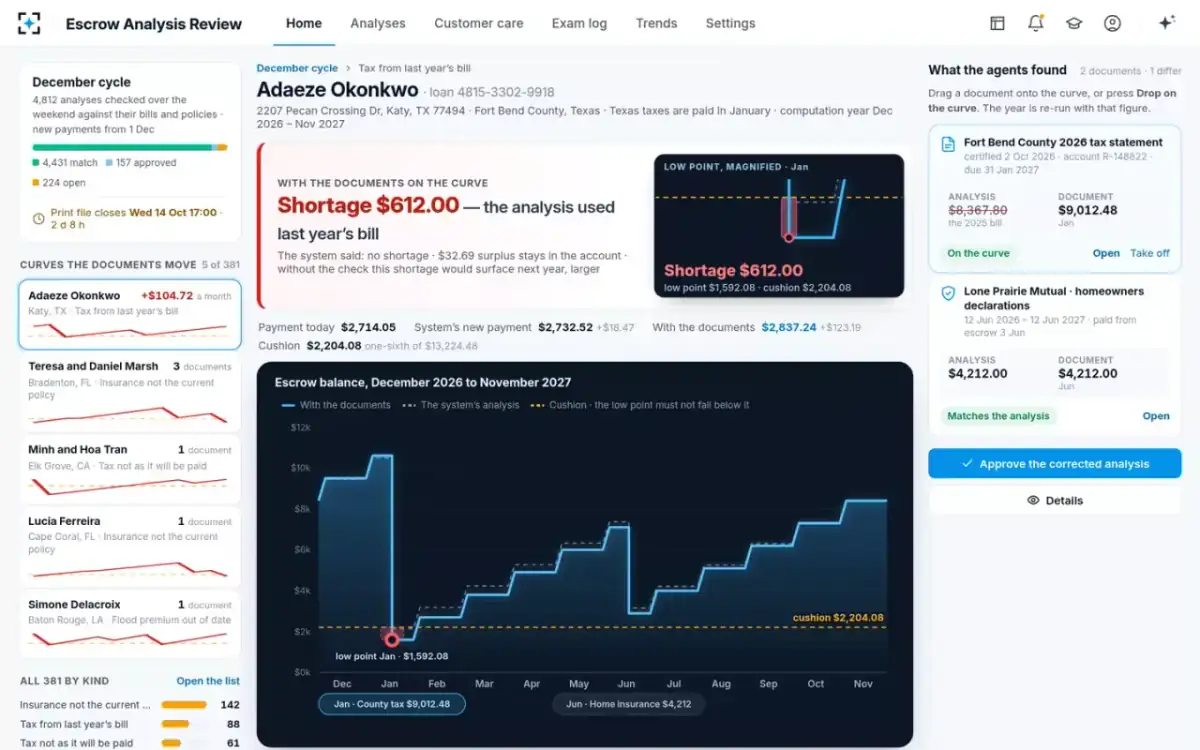
Servicing systems learn about tax bills from tax service files and county downloads, on a schedule that does not match every county’s certification date. A cycle generated a week after a county certifies can easily run on the old figure. In the sample cycle, the 2026 Fort Bend County, Texas, statement for one loan was certified on 2 October, and the December cycle’s analyses were generated on 9 October without it.
The new bill was certified a week before the analysis ran, and the analysis still used the old one
- Missed12 days
- Statement mails, new payment from 1 Dec48 days
- Tax paid from escrow by 31 Jan61 days
Without the check, the borrower would have kept a surplus this year and paid January’s higher tax from deposits sized to the old one. The account would have fallen short by about the full increase, and next year’s analysis would have spread that shortage on top of the higher deposit: the same tax, felt a year late and all at once.
Some bills arrive outside the cycle entirely. California law requires reassessment after a change in ownership or the completion of new construction, which in most cases produces “one or more supplemental tax bills being sent to the property owner in addition to the annual property tax bill.” The county’s own advice is telling: “Property owners who have impound accounts should contact their lender regarding payment of supplemental tax bills” (Sonoma County Tax Collector). Those bills are mailed throughout the year and “may not be due or delinquent at the same time as your annual tax bill” (Sonoma County, due dates). A supplemental bill sent to the owner may never reach the servicer, or be paid by the owner without the servicer knowing; either way the projection is wrong.
The certified bill dropped on the year: a $32.69 surplus becomes a $612.00 shortage
How do property tax discounts affect escrow?
A discount changes both the amount and the month of the tax disbursement, and the analysis has to project both. In Florida, discounts for early payment run “at the rate of 4 percent in the month of November,” 3% in December, 2% in January, 1% in February and nothing in March (Fla. Stat. §197.162). A servicer that pays every Florida bill in November projects a November disbursement at 96% of the bill.
Regulation X lets the servicer take the discount but does not require it. Where a taxing jurisdiction offers a discount for paying the year at once, or charges a fee for installments, the servicer “may, at the servicer’s discretion (but is not required by RESPA to), make lump sum annual disbursements in order to take advantage of the discount for the borrower.” Where it offers neither, the servicer “must make disbursements on an installment basis” (1024.17(k)(3)). And the trial balance must assume each payment is made by “the earlier of the deadline to take advantage of discounts, if available, or the deadline to avoid a penalty” (1024.17(d)(2)(i)(A)).
Which way a servicer may pay property tax from escrow, and what the analysis must project
| The taxing jurisdiction offers | The servicer | The analysis projects |
|---|---|---|
| Annual or installments, no discount for annual, no fee for installments | Must pay in installments | Each installment in its own month, by its penalty date |
| A discount for paying the year at once | May pay the year at once for the discount; not required to | If it takes the discount: the discounted amount, in the discount month |
| A fee or charge for paying in installments | May pay the year at once to avoid it; not required to | The method it will actually use, by the earlier of the discount or penalty date |
| Any of the above, and the borrower agrees otherwise | May use a different basis or date by voluntary, case-by-case agreement | The agreed basis; the loan cannot be conditioned on the agreement |
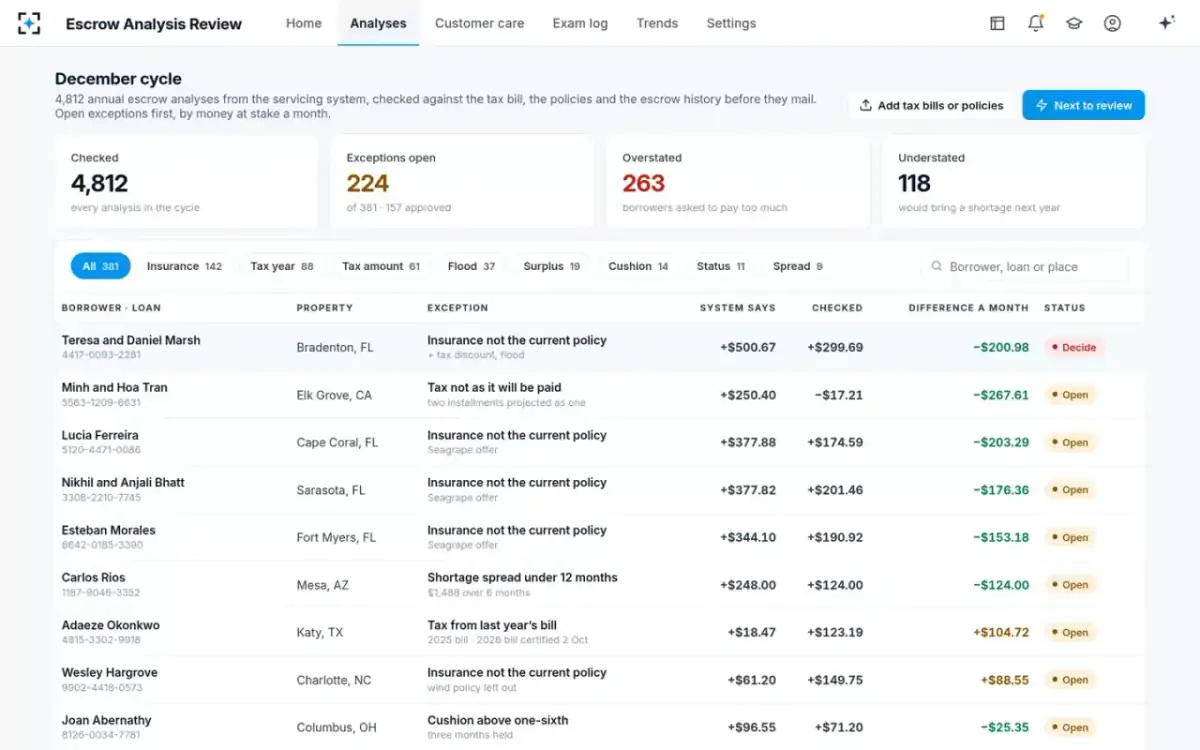
The sample cycle shows what goes wrong when the payment rule and the projection disagree. On a Bradenton, Florida, loan the system projected the gross Manatee County tax of $7,388.00, though the servicer pays in November for the 4% discount: $7,092.48 actually leaves the account, $295.52 less each year. In Elk Grove, California, a two-installment tax projected as one payment turned a small surplus into a projected increase of $250.40 a month; checked, the payment fell by $17.21.
How the tax line went wrong in the sample cycle
Who pays the penalty if the servicer pays taxes late?
The servicer, in the usual case. Regulation X requires the servicer to pay escrow disbursements “on or before the deadline to avoid a penalty, as long as the borrower’s payment is not more than 30 days overdue” (1024.17(k)(1)), so a penalty caused by a late disbursement is the servicer’s failure, not the borrower’s cost. For FHA-insured loans, HUD’s rule is explicit: “Penalties for late payments for items payable from the escrow account must not be charged to the mortgagor unless it can be shown that the penalty was the direct result of the mortgagor’s error or omission” (24 CFR 203.550(a)).
Sending the payment is not the same as paying on time. The CFPB found servicers that “attempted to make timely escrow disbursements, but the payments did not reach the payees,” and “did not resend the payments until months after the initial payment attempts. Some borrowers incurred penalties due to the late payments, which the servicers only reimbursed after the borrowers complained” (CFPB Supervisory Highlights, Issue 33). Because the second payments were late, the servicers violated the timely-payment rule.
A borrower charged a penalty because the servicer paid late has a covered error under Regulation X: the failure to pay taxes “in a timely manner as required by § 1024.34(a)” (12 CFR 1024.35(b)(4)). Send it in writing, with the tax collector’s notice of the penalty. The Nationstar settlement in 2020 included allegations that the servicer “failed to timely disburse borrowers’ tax payments from their escrow accounts” (CFPB, 2020).
Does the servicer have to advance escrow funds?
Yes, while the borrower is no more than 30 days overdue. “The servicer must advance funds to make disbursements in a timely manner as long as the borrower’s payment is not more than 30 days overdue,” and may then seek repayment of the deficiency under the shortage and deficiency rules (1024.17(k)(2)). Before collecting an advance that was not caused by the borrower’s payment default, the servicer must analyse the account to determine the deficiency (1024.17(f)(1)(ii)).
The advance turns a property tax shortage into a deficiency, which has its own repayment menu: for a deficiency of one month’s escrow payment or more, two or more equal monthly payments, or nothing. The thresholds are set out in escrow shortage vs deficiency.
Escrow analysis on delinquent loans
Delinquency changes three escrow rules and leaves the tax bill just as due. Once the borrower is more than 30 days overdue, Regulation X’s duty to pay on time and to advance no longer applies in its own terms, the servicer may retain a surplus or recover a deficiency under the loan documents, and the servicer is exempt from sending the annual statement, as it is during foreclosure or bankruptcy, owing a history within 90 days once the loan is current (1024.17(f)(2)(ii), (f)(4)(iii), (i)(2), (k)).
Investor rules can be stricter. For FHA loans, “it is the mortgagee’s responsibility to make escrow disbursements before bills become delinquent,” and mortgagees “must establish controls to insure that bills payable from the escrow fund or the information needed to pay such bills is obtained on a timely basis” (24 CFR 203.550(a)), with no 30-day condition. Bankruptcy adds its own analysis duties; the Nationstar allegations included failing “to properly conduct escrow analyses for borrowers during their Chapter 13 bankruptcy proceedings.” Delinquent loans are where a tax line is most likely to be stale and least likely to be looked at.
Checking every tax line against its bill
Checking the tax line means four questions on every analysis: is this the bill for the coming tax year, is it this parcel and this owner, how will the servicer pay it under its rule for this jurisdiction, and in which month. Escrow Analysis Review’s tax bill checker reads tax bills, proposed-tax and assessment notices, checks the parcel, owner and tax year, and applies the servicer’s payment rule for the state; it never projects a tax without its bill, or last year’s amount adjusted by more than CPI, and never changes the servicer’s rule. The payment rules are the servicer’s settings: in the sample, Florida taxes are paid in November for the 4% discount, and California, Illinois, Ohio and Texas utility-district bills are projected installment by installment.
Every tax exception in the cycle, with what the system says and what the bill says
Five checks on the tax line before the statement mails
- The bill is for the coming tax year
A certified bill or proposed-tax notice beats last year’s; CPI adjustment only when no new figure exists.
- Parcel, owner and taxing authorities match
One property can have several taxing bodies, each a separate line on the statement.
- The payment basis follows the jurisdiction and the servicer’s rule
Discount month, installments or annual; no installments merged into one.
- Each disbursement sits in its month
By the earlier of the discount or penalty deadline; the low point follows it.
- Last year’s tax payments reached the payee on time
A returned or late payment, and any penalty, belongs to the servicer to fix.
Each corrected figure links to the bill it came from; an escrow analyst approves the correction, and the corrected analysis goes back to the servicing system. The tax calendars behind these rules are compared state by state in escrow analysis schedule by state, and the whole solution is at Escrow Analysis Review.
Questions people ask
What is a supplemental tax bill?
In California, an extra bill that follows the reassessment the state requires after a change in ownership or the completion of new construction. Counties mail them to the owner throughout the year, with due dates of their own, and advise owners with impound accounts to contact their lender, because the escrow analysis projects only the bills the servicer knows about.
Will my servicer pay a late penalty on my property tax?
If the penalty was caused by the servicer paying late while you were no more than 30 days overdue, the late payment is the servicer’s failure under Regulation X, and you can assert it as an error in writing. For FHA loans, HUD bars charging the borrower an escrow late penalty unless the borrower’s own error caused it.
Can I ask my servicer to pay my taxes in installments?
You can ask. Regulation X lets a servicer and borrower agree, case by case and voluntarily, to a different disbursement basis or date, as long as payments stay on time. The CFPB encourages, but does not require, servicers to follow a borrower’s known preference.
Why does my escrow show a shortage every year?
Usually because each analysis projects last year’s tax or premium and each bill comes in higher. If the new bill is certified before the analysis runs but the analysis still uses the old one, the shortage repeats a year late. Compare the projected tax with the latest bill or proposed-tax notice.
Does a Florida early-payment discount lower my escrow payment?
If your servicer pays in November, yes: the tax leaving the account is 4% less than the gross bill, and the analysis should project that amount in November. Regulation X allows, but does not require, the servicer to pay early for the discount.