There is no escrow analysis schedule by state. Every federally related mortgage with an escrow account runs on the same federal schedule: the servicer analyses the account at the end of each 12-month escrow computation year, which starts with the borrower’s first payment date, and mails the annual statement within 30 days of the year’s end. What differs from state to state is the property tax calendar, the date each bill is certified, due and delinquent, and that calendar decides where the account’s low point falls and when the escrow team is busiest. Botminds’ Escrow Analysis Review exists for the few days between a cycle being generated and its print file closing: it checks every analysis in the cycle against the tax bills, the insurance policies and the escrow history, so that the statements that mail are the ones the documents support.
The rest of this page sets out the federal clock, four state tax calendars that move it, the statements with their own deadlines, and the year as an escrow team lives it. The examples come from a fictional sample servicer, Wrenfield Home Loan Servicing, as its December cycle runs through the solution; the rules come from Regulation X, the state statutes and tax offices, linked where they appear.
Four numbers set every escrow calendar, whatever the state
12
months in one escrow computation year, starting with the loan’s first payment date
30days
from the end of that year to deliver the annual statement
2months
of payments and disbursements the servicer may assume to finish the year
60days
to deliver a short year statement after a cycle change, a transfer or a payoff
Is there an escrow analysis schedule by state?
No. The schedule is federal and it belongs to the loan, not to the state. Regulation X defines the escrow account computation year as “a 12-month period that a servicer establishes for the escrow account beginning with the borrower’s initial payment date,” and every later year runs for 12 months after that, unless the servicer resets it with a short year statement (12 CFR 1024.17(b)). A loan whose first payment fell due on 1 December is analysed every autumn for a year that starts in December, whether the house is in Florida or in Washington.
What servicers call a schedule is their own batching. Most group loans into monthly cycles by the month their computation year begins, so a servicer of several hundred thousand escrowed loans runs twelve cycles of very different size: the busy months follow the months in which loans were originated and boarded. That is why one servicer’s “October analysis” and another’s “December analysis” can describe borrowers on the same street.
The state enters through two doors. The first is the tax calendar, which fixes when the largest disbursement leaves the account. The second is the cushion: the rule allows two months of escrow payments, capped at one-sixth of the year’s disbursements, “or a lesser amount specified by state law or the mortgage document” (1024.17(c)(8) and (d)(2)). A state can make the cushion smaller. It cannot move the analysis date.
When is an escrow analysis done? Weeks before the new year starts
The analysis is required “at the completion of the escrow account computation year,” and the annual statement must follow within 30 days, with the analysis done first. In practice servicers run it six to eight weeks earlier, because the rule lets them: in preparing the statement, “the servicer may assume scheduled payments and disbursements will be made for the final 2 months of the escrow account computation year” (1024.17(i)(1)). Running early lets the new payment take effect on the first day of the new year, and gives the borrower a month or more of notice.
The early run has a price. A projection made in early October for a year starting in December has to guess at bills that are certified in October and November, at insurance that renews over the winter, and at the last two months of the old year’s activity. The sample servicer’s December cycle shows the shape.
A December cycle runs seven weeks before the year it projects
- Review7 days
- Borrower’s notice before the new payment on 1 Dec46 days
- Old computation year still running, to 30 Nov52 days
- 30 days after the year ends30 days
Five days separate the analyses being generated from the print file closing. That is the only window in which anyone can compare an analysis with the bill it projects, and it is the window the sample team describes as a few dozen statements opened by hand out of nearly five thousand.
How property tax due dates differ by state
Property tax is where state law reaches the escrow account, and the calendars differ more than most borrowers expect. Some states bill once and offer a discount for paying early; some bill in two halves; some leave the bill payable for months before any penalty. The table shows four large escrow states, each from its statute or its tax office.
Four state tax calendars, and what each does to an escrow analysis
| State | When the bill is due | When it turns delinquent | What it does to the analysis |
|---|---|---|---|
| Florida | Due 1 November, or as soon as the certified roll reaches the tax collector; 4% off in November, 3% in December, 2% in January, 1% in February | 1 April, or 60 days after the original notice is mailed, whichever is later | A servicer that pays for the discount disburses the full year in November, so the account’s low point usually falls in November |
| Texas | Generally payable until 31 January of the following year | 1 February: penalty and interest begin on most unpaid bills | One January disbursement; a new bill can be certified days before the cycle is generated and still be missing from it |
| California | Two installments: 1 November and 1 February; the whole bill may be paid with the first | 5:00 p.m. on 10 December and 10 April | Two disbursements a year, and supplemental bills mailed through the year on their own dates |
| Washington | First half by 30 April, second half by 31 October, where the tax is $50 or more | After 30 April for the first half; after 31 October for the remainder | Two disbursements six months apart, so two dips in the year’s balance |
Regulation X tells the servicer which date to use. In the trial running balance, the servicer “assumes that it will make estimated disbursements on or before the earlier of the deadline to take advantage of discounts, if available, or the deadline to avoid a penalty” (1024.17(d)(2)(i)(A)). Where a jurisdiction offers both annual and installment payment with no discount and no installment fee, the servicer must pay in installments; where it offers a discount for paying the year at once, the servicer may take it but is not required to (1024.17(k)(3)). Each of those choices moves money between months, and each is a place where an analysis can be right in arithmetic and wrong about the month. A property tax escrow shortage from a bill the system never saw works through the most common versions.
When do property taxes hit escrow? The low point follows the bill
Property taxes leave the escrow account on the date the servicer pays them, and that date sets the month in which the account is at its lowest. Under aggregate accounting the servicer sizes the account so that this lowest month-end balance equals the permitted cushion and no more. A Florida loan paid for the November discount bottoms out in November; a Texas loan bottoms out in January; a California or Washington loan dips twice.
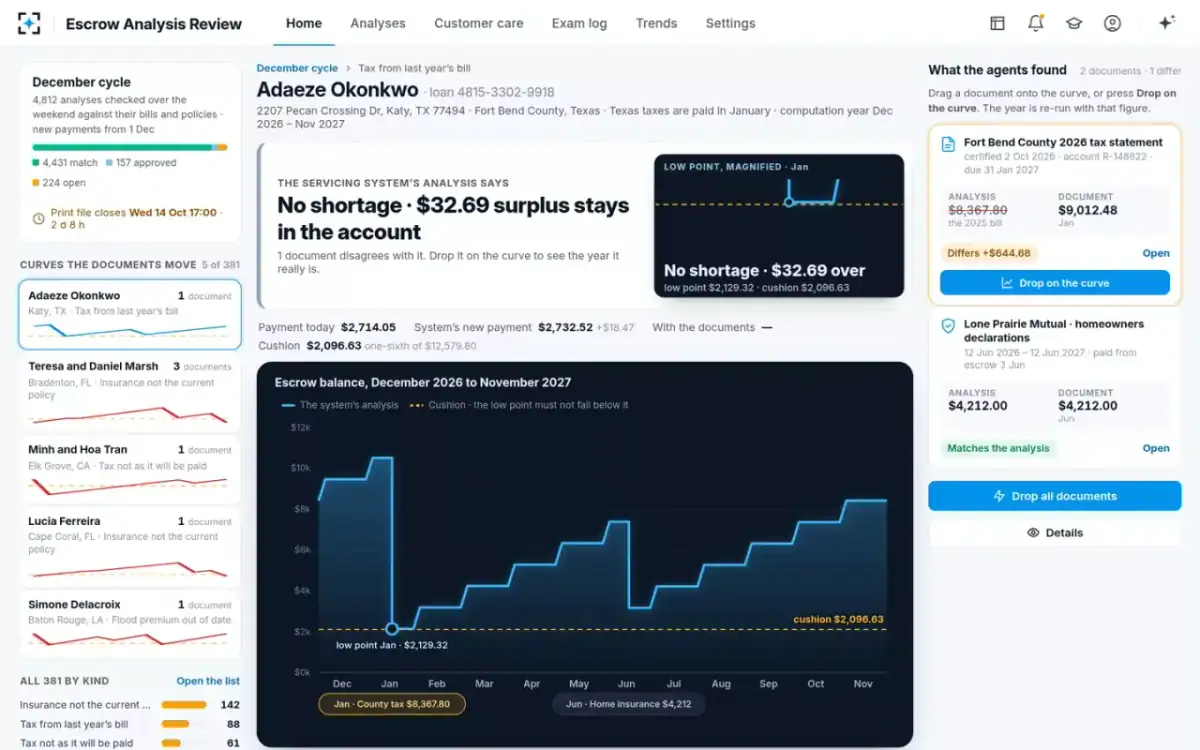
This is why a late bill matters more than its size suggests. If the tax projected for a January disbursement is last year’s amount, the January low point is overstated, and the analysis can report a surplus that does not exist. In the sample cycle, one Katy, Texas, analysis carried the 2025 Fort Bend County bill of $8,367.80 and reported no shortage, with $32.69 to spare. The 2026 statement, certified on 2 October, was $9,012.48. With it, the January low point falls to $1,592.08 against a cushion of $2,204.08: a $612.00 shortage that would otherwise have surfaced, larger, a year later. How to calculate an escrow shortage shows the same arithmetic month by month.
One analysis drawn as its year: the low point sits where the tax leaves
What is an escrow computation year, and what happens when it runs long?
The escrow computation year is the 12-month period each analysis looks back on and projects forward from, and stretching it is one of the commonest escrow violations in the Federal Reserve’s exams. Federal Reserve examiners “observed institutions using an ‘escrow account computation year’ longer than the 12-month period the regulation requires,” which “had a domino effect of triggering violations of other sections” (Consumer Compliance Outlook, 2024).
The article’s own example is a loan whose computation year ran from December 2023 to December 2024 at a servicer that analyses all its loans once a year in March. Analysing that loan in March 2025 overshoots the year by three months, which makes the statement late, makes the surplus or deficiency analysis late, and makes any surplus refund late, all in one decision. The examiners’ fix is the one Regulation X already provides: a short year statement to move the loan onto the servicer’s production schedule.
The lesson for a calendar is that a cycle is a promise about each loan’s year, not a convenience for the print vendor. A servicer that merges cycles to smooth a busy month, or holds a cycle back while a system conversion settles, needs a short year statement for every loan it moves, or it has stretched those loans’ years.
What is a short year escrow statement, and when is one owed?
A short year statement ends a computation year early and starts a new one. Regulation X lets a servicer use it “to change one escrow account computation year to another,” and in doing so “adjust its production schedule,” provided the statement reaches the borrower within 60 days of the end of the short year (1024.17(i)(4)). Two events make it mandatory rather than optional: a servicing transfer, where the old servicer owes a short year statement within 60 days of the transfer date, and a payoff, where the servicer owes one within 60 days of receiving the funds.
Every escrow statement has its own clock
| Statement or step | Deadline | Rule |
|---|---|---|
| Initial escrow statement, account set up as a condition of the loan | At settlement or within 45 calendar days of it | 1024.17(g)(1) |
| Initial escrow statement, account set up after settlement | Within 45 calendar days of the account being established | 1024.17(g)(2) |
| Annual escrow statement | Within 30 days of the end of the computation year, after the analysis | 1024.17(i) |
| Short year statement to change cycles | Within 60 days of the end of the short year | 1024.17(i)(4)(i) |
| Short year statement from the old servicer on a transfer | Within 60 days of the transfer date | 1024.17(i)(4)(ii) |
| Initial statement from the new servicer, if it changes the payment or the accounting method | Within 60 days of the transfer date | 1024.17(e)(1) |
| Short year statement on payoff | Within 60 days of receiving the payoff funds | 1024.17(i)(4)(iii) |
| Refund of the escrow balance on payoff | Within 20 days, excluding weekends and legal public holidays | 1024.34(b)(1) |
| Account history after a delinquency exemption, once the loan is current | Within 90 days of the account becoming current | 1024.17(i)(2) |
Transfers are where these clocks collide. The old servicer owes a short year statement, the new servicer may keep the old computation year or start a new one, and if it changes the payment or the method it owes an initial statement within 60 days. A loan boarded in the weeks before its annual analysis can easily receive three escrow documents in a quarter, and the borrower will compare them.
The escrow team’s year: cycles, peaks and the print file
An escrow team’s year is twelve cycles laid over one tax calendar and one insurance renewal season. The cycles are steady; the documents are not. Tax bills arrive in clusters when counties certify their rolls, so the cycles generated just before certification carry the most stale tax figures. Homeowners renewals and carrier switches pile up in coastal states, so the same cycles carry the most stale premiums. The sample servicer ran 4,620 analyses in September, 4,951 in October, 4,406 in November and 4,812 in December, each with a few days between generation and print.
Four roles share the cycle, and the calendar presses on each differently. The escrow analyst has the five days. The escrow manager signs the release to print. Compliance tests statements against Regulation X, usually on a sample. Customer care takes the calls after the mailing, which in the sample November cycle peaked at 214 calls on the second business day.
Who carries a cycle, and what the calendar asks of each
Today
Has a few days to check nearly five thousand analyses and can open a few dozen by hand.
With agents
Starts with every analysis checked against its bills and policies and the exceptions ranked by money at stake.
Still theirs: approving every corrected analysis and its letter
Today
Releases the print file without knowing which statements carry a stale figure.
With agents
Sees how many statements match their documents, how many were corrected and how many are open before releasing.
Still theirs: the release to print
Today
Tests a hand sample against Regulation X after the cycle has mailed.
With agents
Reads every rule tested on every analysis, and draws a sample of 25 to check the agents.
Still theirs: the sample and the conclusion
Today
Explains each shortage from the statement alone while the calls peak.
With agents
Reads the same explanation the borrower has in hand, with each bill last year and this year.
Still theirs: the conversation with the borrower
How Escrow Analysis Review fits a cycle
The solution works inside the five days, not across the year. When the servicing system generates a cycle, six agents read each annual analysis and its escrow history, find the current tax bill or notice and the bound insurance policies, rerun the account by the aggregate method with the checked figures, test nine Regulation X rules and draft a plain-language explanation. An escrow analyst approves every correction; the agents never change the servicing system’s figures and never send anything.
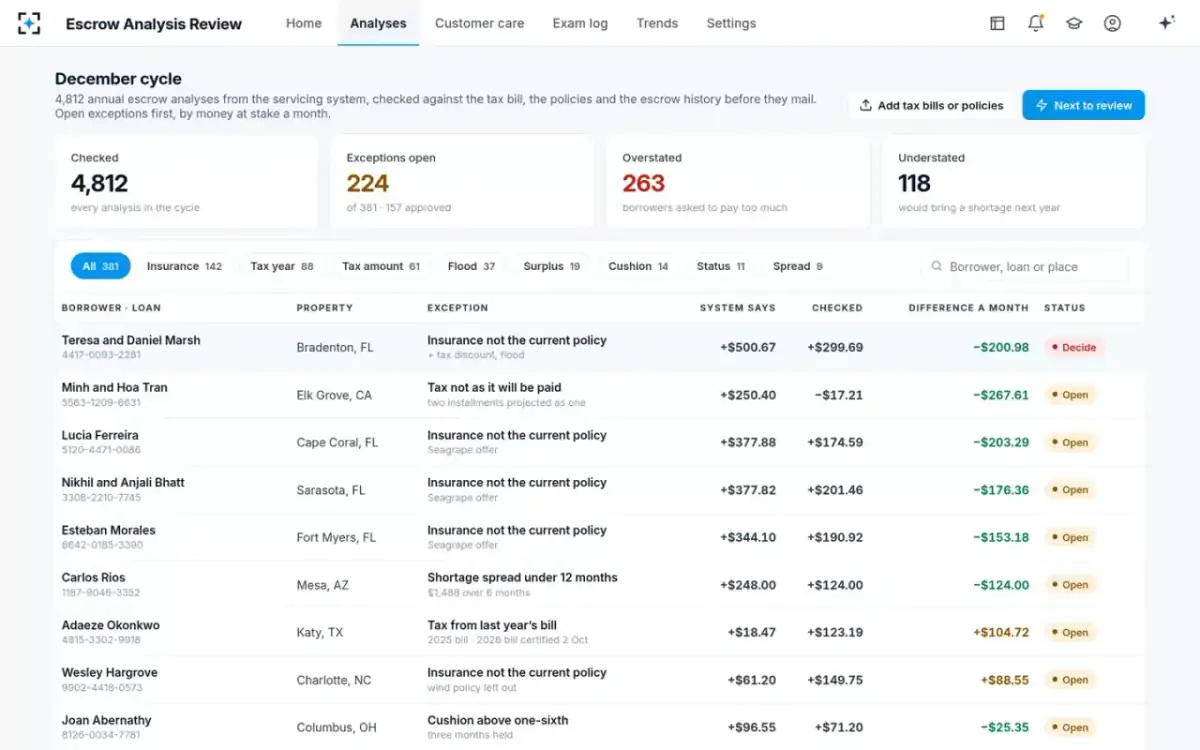
On the sample December cycle, 4,431 of 4,812 analyses matched their documents. The other 381 were exceptions: 263 would have asked the borrower to pay too much and 118 too little. The calendar shows in the mix. Insurance that was not the current policy led with 142, then tax from last year’s bill with 88, tax not as it will be paid with 61 and flood with 37, the first three all products of analyses generated before the documents of the coming year were in.
The cycle’s exceptions, each with the difference it makes a month
The calendar settings live with the escrow team: which month Florida taxes are paid for the discount, which jurisdictions are paid in installments, which bill to project when the new one has not arrived, and how many business days before mailing the print file closes. Each change is versioned and dated, so an examiner can see which rule governed which cycle.
A calendar checklist for the escrow manager
Most calendar failures are visible before the cycle runs. These are the checks that catch them, drawn from the rule and from the failures examiners describe.
Seven calendar checks before a cycle is generated
- Every loan in the cycle has a computation year of exactly 12 months
Loans moved between cycles need a short year statement, or the year has been stretched.
- The statement can reach the borrower within 30 days of the year’s end
Count print and mail time, not just the analysis run.
- Tax bills certified since the last cycle are loaded
Late-certifying counties are where last year’s bill hides.
- Each jurisdiction’s payment basis is set: discount month, installments or annual
The trial balance must use the earlier of the discount or penalty deadline.
- Insurance renewals and carrier changes since the last cycle are matched to bound policies
A renewal offer is not a renewal until it is bound or paid.
- Loans more than 30 days overdue, in foreclosure or in bankruptcy are identified
They may be exempt from the annual statement, and owe a history within 90 days once current.
- Transferred loans show which computation year they are on
A new servicer that changed the payment or method owes an initial statement within 60 days.
For what each threshold then decides, from the $50 surplus to the one-month shortage line, see escrow shortage vs deficiency. To see a full cycle checked before it mails, start from Escrow Analysis Review.
Questions people ask
How often is an escrow analysis done?
At least once a year, at the end of each 12-month computation year, and once when the account is opened. A servicer may also analyse an account at other times, and it must do so before collecting a deficiency created by funds it advanced, unless the advance resulted from the borrower’s payment default.
Why did my escrow statement arrive in October if my payment changes in December?
Because servicers usually run the analysis about two months before the computation year ends. Regulation X allows the statement to assume the final two months of scheduled payments and disbursements, so the new payment can start on the first day of the new year with notice in hand.
When is an initial escrow statement due?
At settlement or within 45 calendar days of it, when the account is a condition of the loan. If the account is set up later, the statement is due within 45 calendar days of the account being established. It must itemize the expected taxes and insurance, their disbursement dates and the cushion chosen.
Does a new servicer redo my escrow analysis after a transfer?
Not necessarily. The old servicer owes a short year statement within 60 days of the transfer. The new servicer may keep the old computation year, but if it changes the monthly payment or the accounting method it must send an initial escrow statement within 60 days and start a new computation year from the transfer date.
Do I get an annual escrow statement if I am behind on payments?
Not always. If the borrower is more than 30 days overdue when the analysis is done, or the loan is in foreclosure or bankruptcy, the servicer is exempt from sending the annual statement. Once the loan becomes current, the servicer must provide a history of the account since the last statement within 90 days.
Can state law change my escrow cushion?
Yes, but only downward. Regulation X allows a cushion of up to one-sixth of the year’s estimated disbursements, about two months of escrow payments, or a lesser amount set by state law or the mortgage documents. Where the loan documents allow more than the federal limit, the federal limit controls.