An escrow analysis calculator takes a year of projected tax and insurance disbursements, the current escrow balance and the payment dates, and runs Regulation X’s aggregate method: a trial running balance, the deposit that brings the lowest month to zero, a cushion of up to one-sixth of the year, and the shortage, surplus or deficiency that results. Built in Excel or inside a servicing system, it gets that arithmetic right, and it gets it right on whatever figures it is given. Checking a servicer’s whole annual cycle needs more than a calculator, and there are three ways to do it: a hand sample, a rules engine that tests the regulation’s thresholds, and a document check that compares each projected figure with its bill or policy. Botminds’ Escrow Analysis Review is the third, with the second built in.
This page shows how an aggregate calculator works, what it takes to build one in a spreadsheet, and how the three approaches compare on one cycle of 4,812 analyses at a fictional sample servicer, Wrenfield Home Loan Servicing.
One cycle, three approaches: what each would have found
≈ 4
errors a random hand sample of 50 would expect to find in the cycle
53
errors a rules engine would find: cushion, refunds, spreads, statement status
381
errors a document check found, including 328 wrong tax or premium inputs
What does an escrow analysis calculator do?
An escrow analysis calculator projects the coming computation year month by month and sizes the account so that it never falls below the permitted cushion. Regulation X calls this a trial running balance and defines its purpose: to determine the target balances, compute the monthly payment and any deposit needed, and determine “whether shortages, surpluses or deficiencies exist” (12 CFR 1024.17(b)). Every servicer must use aggregate accounting, analysing the account as a whole rather than item by item.
The calculator needs five inputs: each disbursement’s amount, each disbursement’s date, the current balance, the computation year’s start, and the cushion the loan documents and state law allow. It produces four outputs: the new monthly escrow payment, the projected low point, the cushion and the shortage or surplus. Everything a borrower sees on the annual statement’s projection follows from those.
How does an aggregate escrow analysis calculator work?
It follows the three steps of Regulation X’s Appendix E. First, project the year with a monthly payment of one-twelfth of the year’s disbursements. Second, add to the opening balance the amount that brings the lowest month to zero. Third, add the cushion, at most one-sixth of the year’s disbursements, to every month (Appendix E to Part 1024). The result is the target balance for each month; comparing the actual opening balance with the target gives the shortage or surplus.
The columns a spreadsheet escrow analysis calculator needs
| Column | What goes in it | Where it goes wrong |
|---|---|---|
| Month | Twelve months from the computation year’s start | A year longer than 12 months, or a start date that is not the loan’s |
| Deposit | One-twelfth of the year’s projected disbursements | Using the old payment instead of the new one |
| Disbursement and date | Each tax installment and premium in the month it will be paid | The penalty date used where the servicer pays early for a discount; installments merged into one |
| Trial balance | Running balance from zero | Pre-accrual: collecting before the disbursement date, which the rule forbids |
| Adjusted balance | Trial balance plus the amount that brings the lowest month to zero | Lowest month found by eye rather than by formula |
| Target with cushion | Adjusted balance plus the cushion | A cushion above one-sixth, or above a lower state or contract limit |
| Comparison | Actual opening balance minus target opening balance | Mixing the shortage (balance below target) with a deficiency (negative balance) |
The regulation’s own example is small enough to check by hand: $1,560 of annual taxes in three disbursements, a monthly deposit of $130, a lowest month of minus $780 before adjustment and a cushion of $260, two months of deposits. How to calculate an escrow shortage walks through it month by month and then through a real-sized sample loan.
Can you do an escrow analysis in Excel?
Yes, and many small servicers and examiners do, but a spreadsheet that reproduces Appendix E handles the easy case. Four details catch spreadsheet calculators out. The cushion is two months of escrow payments “net of any increases or decreases because of prior year shortages or surpluses” (1024.17(d)(2)(i)(C)), so the payment that funds the cushion is not the same as the payment the borrower makes. Items billed for longer than a year, such as a three-year flood premium, must be collected in equal monthly amounts over the full cycle, and the low point then falls on a three-year rhythm (1024.17(c)(9)).
The third detail is the date column. The rule assumes each disbursement is made “on or before the earlier of the deadline to take advantage of discounts, if available, or the deadline to avoid a penalty,” so a Florida loan whose servicer pays in November for the 4% discount must show the tax in November, at the discounted amount. The fourth is the cushion limit itself: the federal one-sixth is a ceiling, and the loan documents or state law may set less (1024.17(c)(8)).
None of those details is hard. Together they are why a spreadsheet calculator is a good way to test a servicing system’s arithmetic on a handful of loans and a poor way to check a cycle. The spreadsheet has the same blind spot as the system: it trusts the amount typed into the disbursement column.
Three ways to check a cycle: sample, rules, documents
Calculators compute one account; a servicer has to check thousands in the few days before printing. Three approaches exist, and they differ in what they read, how much of the cycle they cover and which errors they can see.
Three escrow analysis tools compared on one cycle
| Hand sample with a calculator | Rules engine | Document check | |
|---|---|---|---|
| What it reads | A few dozen analyses, their bills and policies, by hand | Every analysis and the loan’s status | Every analysis, its escrow history, the tax bill or notice and the insurance declarations |
| Coverage of the cycle | About 1% (50 of 4,812) | 100% of analyses, for rules only | 100% of analyses, for rules and inputs |
| Arithmetic errors | Yes, on the sample | Yes, by rerunning | Yes, by rerunning with checked figures |
| Threshold errors: cushion, $50 refund, 12-month spread, statement status | On the sample | Yes: 53 in the sample cycle | Yes: the same 53 |
| Input errors: last year’s bill, gross tax, declined offers, stale flood, PMI | On the sample, if the reviewer pulls documents | No: it takes inputs as given | Yes: 328 in the sample cycle |
| Evidence for an examiner | The sample’s worksheets | Rule results per analysis | Rule results plus the document behind each figure |
| Who decides | The reviewer | The escrow team, on the exceptions | An escrow analyst approves each correction; the manager releases the cycle |
What can a rules engine check in an escrow analysis?
A rules engine can check everything Regulation X states as a threshold or a date, on every analysis, quickly. That includes the cushion against one-sixth, the computation year against 12 months, a surplus of $50 or more against a refund within 30 days, a shortage of a month’s payment or more against a spread of at least 12 months, the repayment options a statement offers, and whether a loan more than 30 days overdue, in foreclosure or in bankruptcy is being sent the right statement.
In the sample cycle those checks found 53 exceptions: 19 surplus refunds of $50 or more not set to go out, 14 cushions above one-sixth, 11 statements whose loan status called for different handling, and 9 shortages spread over fewer than 12 months, including one of $1,488 spread over six. Each is a clear violation and each is worth catching. Together they were 14% of the cycle’s errors. The thresholds themselves are explained in escrow shortage vs deficiency.
What does an escrow analysis calculator miss?
It misses every error that lives in the disbursement column: the wrong tax year, the gross tax where a discount will be taken, installments merged into one payment, a renewal offer the borrower never took, a flood premium from last year’s policy and PMI that ends mid-year. A rules engine misses them for the same reason. Both take the projected amounts as given, and Regulation X’s requirement that a servicer use a charge it knows is a requirement about those amounts.
What each approach would have caught in one cycle of 4,812 analyses
Sample review vs full review of escrow analyses
A sample review tells a servicer roughly how often its analyses are wrong; a full review fixes the ones that are. Both are useful, and they answer different questions. A random sample of 50 from the sample cycle would have found about four wrong analyses, enough to estimate an error rate of several percent, and left about 377 to mail.
The sample keeps its value once every analysis is checked, because it becomes the test of the check. In the sample servicer’s set-up, a compliance analyst draws 25 analyses each cycle and compares her conclusions with the solution’s; September agreed on 24 of 25, October and November on 25 of 25. A disagreement is where the rules or the settings need attention.
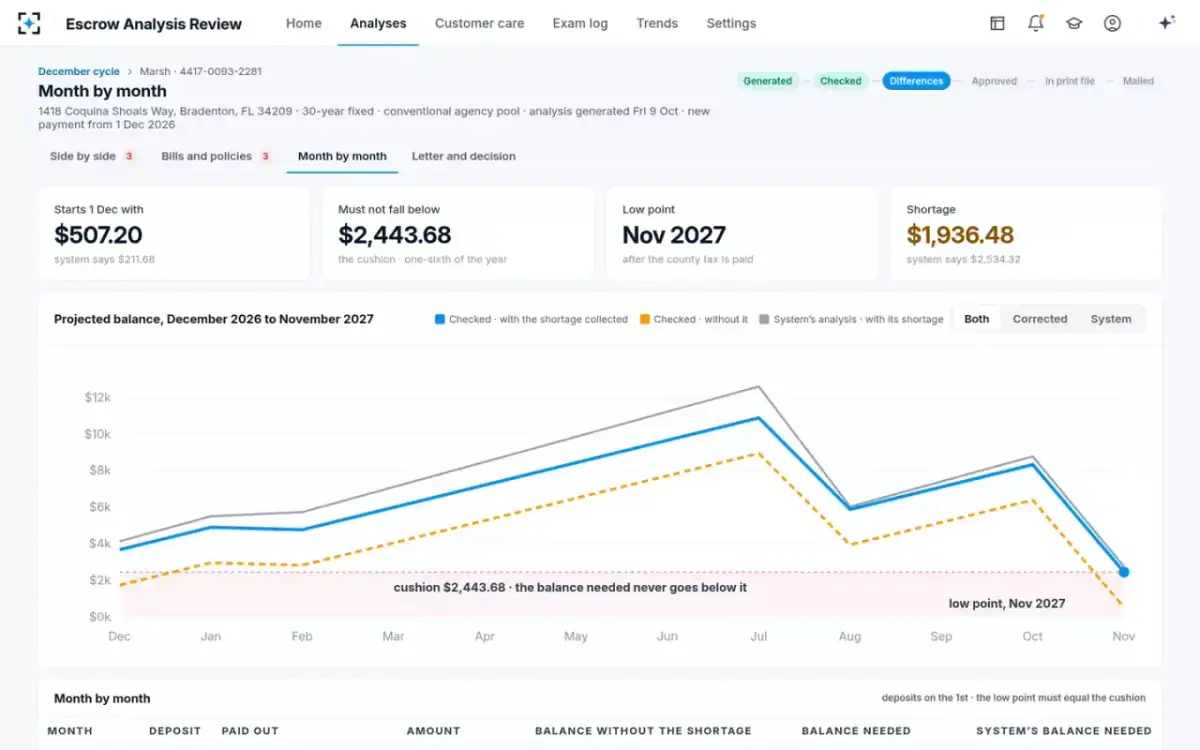
A full review still shows its arithmetic: the account, month by month
How to choose escrow analysis software or a review tool
Choose by what the tool reads, not by what it computes. Every serious option computes the aggregate method correctly; they differ in whether they read source documents, whether their rules are your settings, and whether they leave decisions with your people.
Seven tests for an escrow analysis calculator, rules engine or review tool
- Does it reproduce Appendix E to the cent?
Run the regulation’s own example and two of your loans with known answers.
- Does it handle discounts, installments and multi-year premiums?
Test a Florida November discount, a two-installment county and a three-year flood premium.
- Is the cushion limit configurable by state and by loan document?
One-sixth is the ceiling, not the rule for every loan.
- Does it read the bill and the policy, or only the system’s fields?
Only a document read can find last year’s tax or a declined renewal offer.
- Can you see every rule it tests and the version in force for each cycle?
Examiners ask which rule governed which statement.
- Can it change your servicing system’s figures?
A checker should recommend; a person should approve; the system should stay the source of record.
- Will it run on a cycle you have already mailed?
Compare its exceptions with the complaints and disputes that cycle produced.
When a calculator is enough, and when a cycle needs a check
The solution is not a consumer escrow calculator and not a replacement for the servicing system’s analysis engine. It reads the analysis the system produced, checks every projected tax and premium against the county bill or notice, the declarations and the escrow history, reruns the account by the aggregate method with the checked figures, tests nine Regulation X rules and drafts a plain explanation. An escrow analyst approves every correction; the corrected analysis goes back to the servicing system.
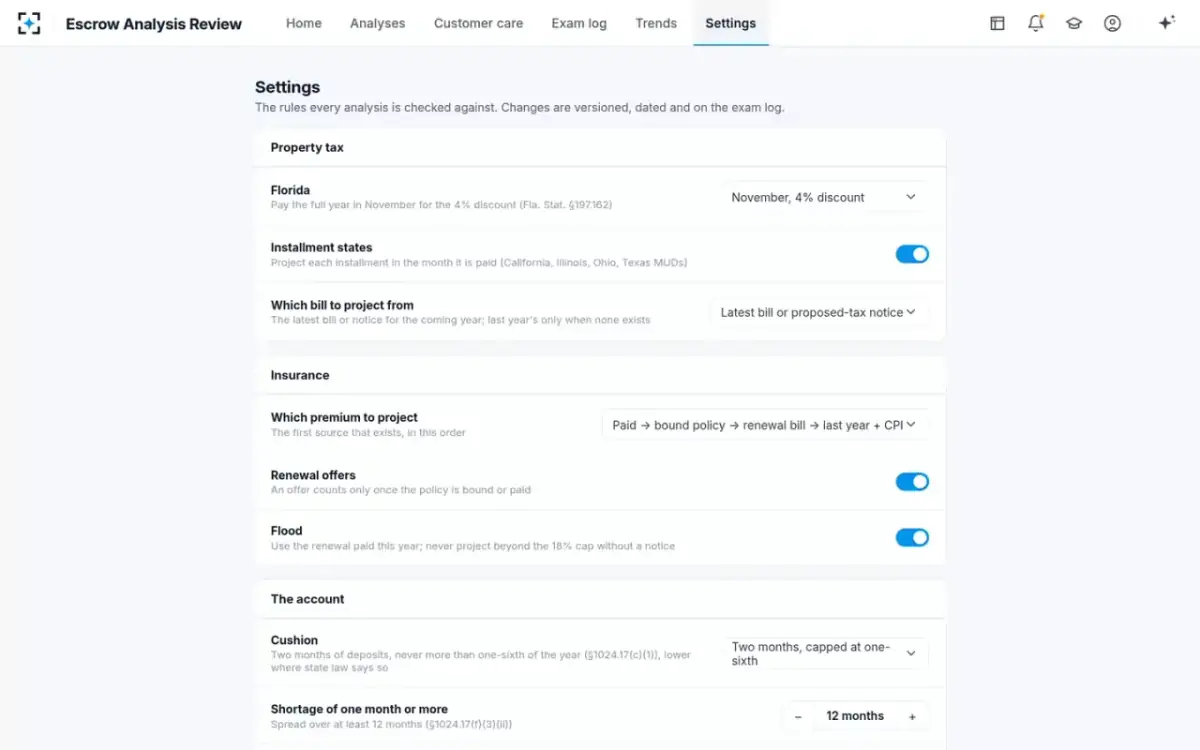
The servicer’s own rules, as settings: tax calendars, premiums, cushion and spreads
Where a servicer needs only to verify its system’s arithmetic on a few loans, a spreadsheet built on Appendix E is enough. Where it needs to know that every statement in a cycle matches the bills and policies before it mails, a calculator cannot do that, and neither can a rules engine. The economics of that choice are in escrow automation, measured; the solution itself is at Escrow Analysis Review.
Questions people ask
Is there an official escrow analysis calculator?
Not as a tool. Regulation X’s Appendix E sets out the aggregate method as a worked example, with an initial trial balance, an adjusted balance and a balance with the cushion, and its public guidance documents give formats for the statements. A calculator that reproduces Appendix E exactly is following the official method.
Why does my escrow calculator disagree with my servicer’s analysis?
Usually because of dates or the cushion. The servicer must assume each bill is paid by the earlier of the discount or penalty deadline, may use a smaller cushion than one-sixth, and nets prior-year shortages and surpluses into the cushion. A different tax or insurance amount explains the rest.
What is the difference between aggregate and single-item escrow analysis?
Aggregate analysis tests the account as a whole; single-item analysis tests each tax and insurance item separately. Single-item analysis needs a larger balance, which is why Regulation X requires every servicer to use aggregate accounting. In Appendix E’s example the aggregate method needs an opening balance of $1,040 against $1,130 for single-item.
Can a borrower check an escrow analysis with a calculator?
Yes, roughly. Add the year’s projected disbursements, divide by twelve for the deposit, run the balance month by month from the opening balance, and compare the lowest month with a cushion of up to one-sixth of the year. The more useful check is whether each projected bill matches the current tax bill and declarations page.
Does a rules engine satisfy the Fed’s call for a secondary review?
Partly. The Federal Reserve’s sound practices ask servicers to verify vendors’ calculations and to review vendor software that analyzes accounts. A rules engine verifies thresholds; it does not verify the tax and premium amounts the software analysed, which is where most errors in the sample cycle were.