Escrow analysis software, whether the escrow module of a mortgage servicing system or a vendor’s analysis engine, does one job well: it runs the aggregate-accounting arithmetic that Regulation X prescribes on the tax, insurance and payment figures it holds. It cannot tell whether those figures are the right ones, and Federal Reserve examiners found a higher risk of escrow violations where institutions relied on third-party software to perform the analysis. Their sound practices ask for a secondary review of vendor output. Botminds’ Escrow Analysis Review is built as that secondary review: six agents check each annual analysis in a cycle against the county tax bill, the insurance declarations and the escrow history before the statements mail, and an escrow analyst approves every correction.
This guide is for escrow managers and the people who buy their tools. It covers what the software takes on trust, what the Fed found, how a maker–checker arrangement works for escrow, what to test in any vendor, and where this solution fits and where it does not. The examples come from a fictional sample servicer, Wrenfield Home Loan Servicing, whose December cycle of 4,812 analyses runs through the solution.
Escrow is everywhere, and in 2023 it was the Fed’s whole Reg X problem
80%+
of residential mortgages have an escrow account, per the National Mortgage Database
All
Reg X violations among the Fed’s top-cited of 2023 were escrow rules
1.2%
of all top violations that year: 7 citations of the annual statement rule, 1024.17(i)
223
Federal Reserve consumer compliance examinations behind the 2023 list
What escrow analysis software does, and what it takes on trust
Escrow analysis software computes a trial running balance for the coming computation year, adds the deposit needed to bring the lowest month to zero, adds the permitted cushion, and compares the result with the account’s actual balance to find a shortage, a surplus or a deficiency. Regulation X spells those steps out and requires aggregate accounting from every servicer (12 CFR 1024.17(c)(4) and (d)(2)). Any competent engine gets them right, and the sample cycle bears that out: across 4,812 analyses, no aggregate-method error and no computation year longer than 12 months.
The engine takes four things on trust. It trusts that the tax amount is this year’s bill, or that last year’s is used only because the new one is unknown, as the rule requires (1024.17(c)(7)). It trusts that the tax will be paid in the month and in the form the servicer actually uses: a discount month, an installment, the full year. It trusts that the insurance premium is the policy in force, not an offer the borrower declined. And it trusts the escrow history it is handed: every deposit and disbursement, each with the right payee and date.
Each of those inputs arrives from somewhere else: a tax service, a carrier feed, a boarding file, a clerk’s keystroke. None of them is the software’s to verify. An analysis can therefore be perfect arithmetic on the wrong premise, which is why the industry phrase “the system calculated it” settles nothing. Can an escrow analysis be wrong when the arithmetic is right? catalogues the inputs that fail most.
What did the Fed find about escrow software?
The Federal Reserve’s 2024 review of its escrow findings names software twice. Errors in disclosing the amounts paid into and out of the account came, in some instances, “from a software vendor that incorrectly interpreted a disclosure term.” And “examiners found increased risk of violations when institutions relied on third-party software to perform the escrow analysis” (Consumer Compliance Outlook, 2024).
Violations of Regulation X were among the Federal Reserve’s top-cited compliance violations in 2023, and all of them pertained to the escrow account requirements.
Consumer Compliance Outlook, Federal Reserve System, 2024
The article’s other root causes are just as instructive: “insufficient oversight and monitoring, problems with recent system updates, and inadequate training.” For systemic or repeat issues involving consumer harm, examiners issued Matters Requiring Attention and Matters Requiring Immediate Attention. Its table of sound practices then turns the findings into controls, and two of them describe a checker in plain terms: “Periodically verify that vendors’ calculations are correct and that vendors are implementing regulatory changes to escrow requirements,” and “Conduct a secondary review of all vendor software that generates disclosures and analyzes accounts.”
Read carefully, the second practice asks for more than a vendor attestation. A secondary review of software that “analyzes accounts” is a review of its output, account by account, which is exactly what an escrow team cannot do by hand for a cycle of thousands in a few days. Most teams answer it with a sample: a few dozen statements opened before the print file closes, and a compliance sample after it mails.
Who checks an escrow analysis? Maker, checker, approver
A sound escrow process separates three jobs: the system that makes the analysis, a checker that tests its inputs and rules, and a person who approves any change and releases the cycle. The maker stays the servicing system. The checker in Escrow Analysis Review is six agents, each with one job and each with things it may not do. The approvers are people.
Escrow Analysis Review: who does each step of the check, and what none of them may do
Agent
Analysis readerReads the system’s annual analysis and statement and the escrow history for the computation year: every projected disbursement, deposit, cushion and shortage.
Never: Changes the system’s figures; every value cites its line.
Agent
Tax bill checkerReads tax bills, proposed-tax and assessment notices; checks parcel, owner and tax year; applies the servicer’s payment rule for the state.
Never: Projects a tax without its bill, or last year’s amount adjusted by more than CPI.
Agent
Insurance checkerMatches each homeowners, wind and flood item to a bound policy naming the servicer as mortgagee, with its term, premium and payment.
Never: Accepts a renewal offer as a renewal.
Agent
Escrow recomputerReruns the account by the aggregate method with the checked figures and shows every month.
Never: Uses a cushion above one-sixth of the year.
Agent
Rule checkerTests nine Regulation X §1024.17 rules and the investor’s rules on every analysis, and writes the exam log.
Never: Passes a rule without the data that proves it.
Agent
Explanation writerDrafts the borrower letter at reading grade 7 or lower, in the language on file, and a prepared answer for customer care.
Never: Sends anything, or uses a figure that was not checked.
A person decides
Escrow analyst approvesApproves each corrected analysis and letter; a second analyst approves any change above $250 a month.
A person decides
Escrow manager releasesReleases the print file only when every exception is approved, held or sent back.
The separation matters more than the speed. A checker that could edit the servicing system’s figures would be a second maker, and the bank would have two sources of truth to reconcile. Here the corrected analysis goes back to the servicing system only after an analyst approves it, so the system of record stays the system of record.
The checker reads documents; the system keeps its figures
The difference between software and a checker is the question each answers. The software answers “given these inputs, what is the account?” The checker answers “are these the inputs?”, and it answers from documents rather than from another feed.
Two jobs on one analysis: what the software does, and what the second reader does
Escrow analysis software: Projects the amount and date held in the tax field, often loaded from a tax service.
The second reader: Reads the bill or proposed-tax notice for the coming year, checks parcel, owner and tax year, and applies the discount or installment rule.
Escrow analysis software: Projects the premium the carrier feed or the last disbursement supplied.
The second reader: Requires a bound policy naming the servicer as mortgagee, or a payment from escrow; an offer stays an offer.
Escrow analysis software: Carries the premium on the policy screen, often last year’s.
The second reader: Reads the renewal declarations and the payment in the escrow history.
Escrow analysis software: Projects the monthly premium for twelve months unless someone ends it.
The second reader: Checks whether the loan reaches its automatic termination date inside the year.
Escrow analysis software: Runs the aggregate method correctly on the figures above.
The second reader: Reruns it with the checked figures and shows each month beside the system’s.
Escrow analysis software: Applies the servicer’s configured options for spreads, refunds and statements.
The second reader: Tests each option against Regulation X and the investor’s rules, analysis by analysis, and logs the result.
One check, step by step: six agents, nine documents, 47 seconds
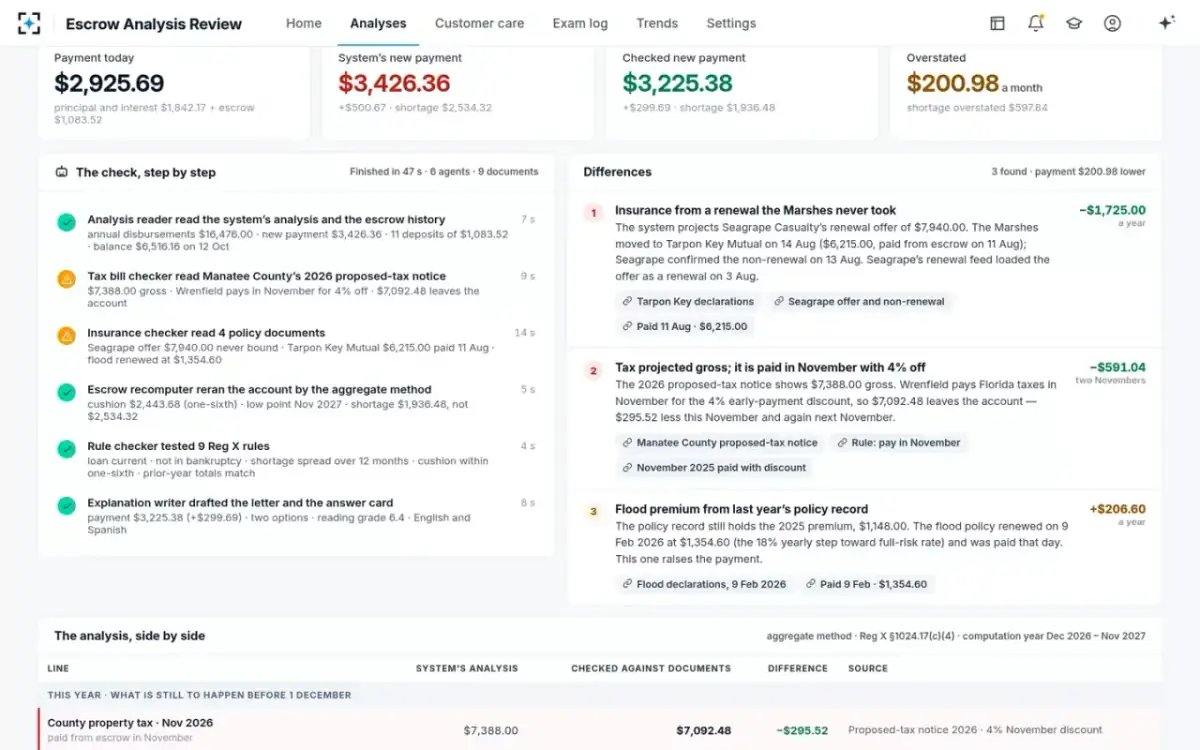
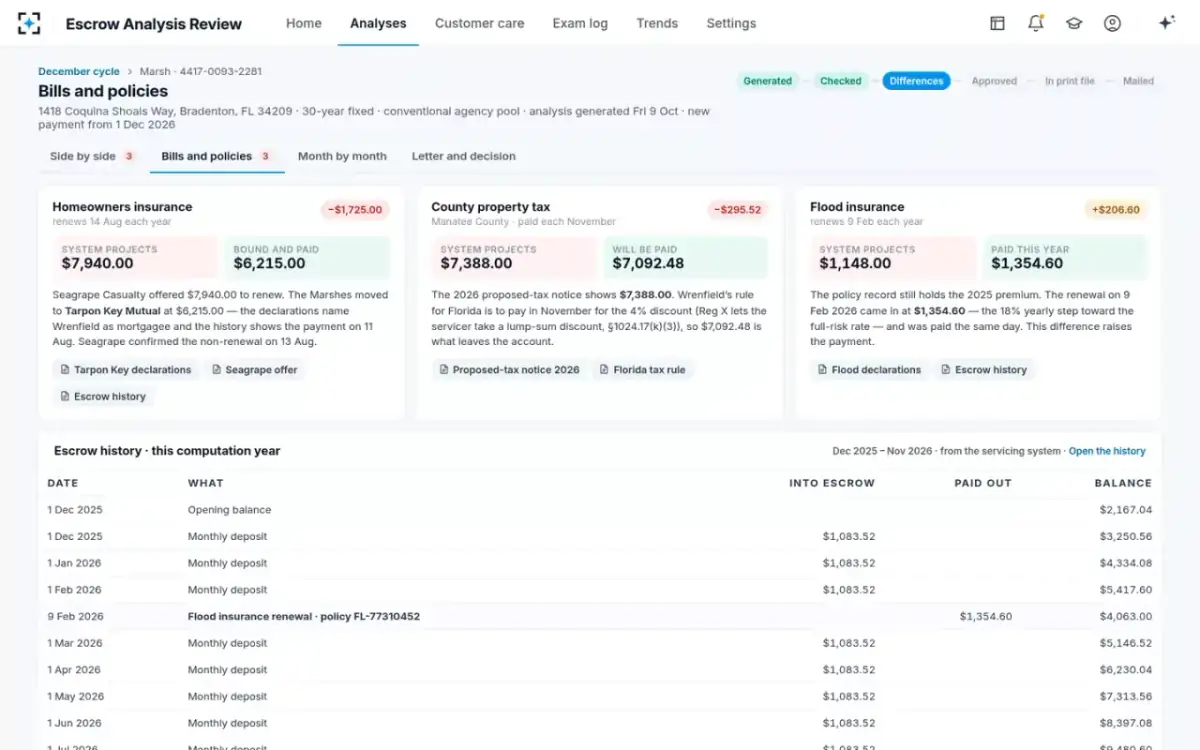
On the sample loan, the servicing system projected a homeowners premium of $7,940.00, Seagrape Casualty’s renewal offer. The borrowers had moved to Tarpon Key Mutual at $6,215.00, paid from escrow on 11 August. The same carrier feed had loaded offers as renewals on 23 other loans in the cycle, overstating payments by $3,912 a month in all. No arithmetic check would find that; a document check finds it on the first loan and a query finds the other 23.
What a secondary review of vendor escrow software should test
A secondary review should test the output against documents and rules on every analysis, keep the evidence, and measure its own agreement with people. The table turns each of the Fed’s sound practices into a test and the evidence an examiner would expect to see.
From the Fed’s sound practices to tests an escrow team can run each cycle
| Sound practice (Fed, 2024) | What to test | Evidence to keep |
|---|---|---|
| Periodically verify that vendors’ calculations are correct | Rerun each account by the aggregate method and compare deposit, cushion, low point and shortage with the system’s | The month-by-month rerun beside the system’s projection |
| Verify vendors are implementing regulatory changes | Test each analysis against the current rule set: cushion within one-sixth, 12-month year, $50 surplus refund, shortage spreads | Which rule version governed the cycle, and every pass and fail |
| Secondary review of software that generates disclosures | Check the statement’s prior-year totals against the escrow history; check the repayment options offered | The statement lines and the history lines they were matched to |
| Secondary review of software that analyzes accounts | Match every projected tax and premium to its bill, policy or payment | The document each figure came from |
| Frequent audits of analyses | A human sample of each cycle against the checker’s results | Sample size, agreement and every disagreement |
| Review complaints for control weaknesses | Tag escrow complaints that cite a wrong figure and trace them to the input that caused it | The complaint, the input and the correction |
The last two rows are where most programmes stop short. A secondary review that cannot say how often it agrees with a person is a second opinion with no track record. In the sample, a compliance analyst draws 25 analyses each cycle and compares her conclusion with the agents’; the November cycle agreed 25 of 25. That is a small sample and a fictional bank, and it is the shape of evidence to ask for, not a result to quote.
Bills and policies: what the system projects beside what is bound and paid
Can AI review escrow analyses? What to ask before you buy
Yes, if the review reads source documents, cites them, cannot change the system of record and leaves every decision with a person. We know of no regulator statement endorsing a tool for the job, and responsibility stays with the servicer. The CFPB’s service-provider guidance is blunt that using a provider “does not absolve the supervised bank or nonbank of responsibility for complying with Federal consumer financial law to avoid consumer harm” (CFPB Bulletin 2016-02). A tool that checks escrow is a service the servicer must oversee like any other.
Eight questions for any escrow analysis software or review tool
- Does it read the bill and the policy, or another feed?
A check against the same tax service or carrier feed that loaded the error will agree with the error.
- Does every corrected figure cite its document?
An analyst should be able to open the source in one step and disagree with it.
- Can it change the servicing system’s figures?
It should not. Corrections go back only after a person approves them.
- Which Regulation X rules does it test, and on how many analyses?
Ask for the rule list, the version in force for each cycle and the count tested.
- Are your payment rules settings, or its assumptions?
Discount months, installments, the cushion and the projection order should be yours, versioned and dated.
- How is its agreement with people measured?
A sample per cycle, with the disagreements kept, is the minimum.
- What happens when the document is missing?
It should say so and fall back only as the rule allows: last year’s charge, or last year’s adjusted by no more than CPI.
- Can you see it on your own past cycle first?
A cycle that already mailed, with complaints you know about, is the fairest test.
For the economics of the choice, including what to measure after go-live, see escrow automation, measured; for a side-by-side of calculators, rules engines and document checks, see escrow analysis calculator, rules engine or document check.
Where Escrow Analysis Review fits, and where it does not
The solution fits between the servicing system generating an annual cycle and the print file closing. It reads the system’s analysis export, the escrow history, county tax documents and carrier declarations; it returns a corrected analysis for each approved exception, a plain-language letter, an exception list ranked by money at stake and a log of every rule tested. On the sample December cycle that meant 4,431 analyses confirmed against their documents and 381 exceptions found before mailing, 263 of them asking the borrower to pay too much.
It does not replace escrow analysis software: the analysis still comes from the servicing system, and the corrected one goes back to it. It does not pay tax bills or premiums, and it is not a tax service; it reads what the tax service and the counties produce. It does not interpret the law for the servicer: the rules it tests are settings that compliance owns, from the Florida discount month to the second-approval threshold. And it does not remove the human sample; it makes the sample a test of the checker rather than the only check.
The time it gives back is the escrow team’s. By our estimate for a monthly cycle, the hand work of pulling tax bills and confirming premiums falls from about four days each to half a day each, and rerunning corrected analyses and writing explanations from about two days each to half a day; approval and release stay at a day, because that is the part that should stay human. Those are Botminds estimates, not a measured result, and the place to measure them is your own cycle.
Questions people ask
What is the difference between escrow administration software and escrow analysis software?
Escrow administration usually means the servicing system’s whole escrow function: collecting deposits, tracking tax and insurance items, paying bills and keeping the account history. Escrow analysis software is the part that projects the coming year and computes the shortage, surplus or deficiency. Both depend on the same inputs, which is where a second review looks.
Is a secondary review of escrow software required by law?
No rule names it. Regulation X requires accurate analyses and statements, and the CFPB’s Bulletin 2016-02 keeps the servicer responsible for what its providers do. The Federal Reserve lists a secondary review of vendor software that analyzes accounts among the sound practices its examiners observed.
Who is responsible when the escrow vendor’s software is wrong?
The servicer. The CFPB’s service-provider bulletin says using a provider does not absolve the supervised institution of responsibility for complying with consumer financial law. In the Fed’s 2023 findings, a vendor’s misreading of a disclosure term produced the institution’s violation.
Do we have to replace our servicing system to use Escrow Analysis Review?
No. The solution reads the system’s analysis export and the escrow history, and sends a corrected analysis back only after an escrow analyst approves it. The agents never change the system’s figures.
How long does a check take per loan?
On the fictional sample loan, six agents read nine documents, reran the account and tested the rules in 47 seconds. A cycle of 4,812 analyses was checked over a weekend, so the escrow team started Monday with the exceptions already ranked.
Does an automated check replace the compliance sample?
It should not. The sample changes purpose: instead of being the only test of a few dozen statements, it tests the checker’s conclusions, cycle after cycle. Keep its size, its agreement rate and every disagreement as evidence.