An escrow shortage and an escrow deficiency are different things. A shortage is the amount by which the escrow balance falls short of its target balance when the annual analysis is done; the account still has money, just not enough to cover the coming year and the cushion. A deficiency is a negative balance: the servicer has already paid out more than the account held, usually by advancing funds to pay a tax bill or premium on time. Regulation X gives each a closed menu of remedies, and the menu depends on four thresholds: $50, which decides whether a surplus must be refunded; one month’s escrow payment, which splits each menu; twelve months, the shortest permitted spread for a large shortage; and thirty days, which recurs in four different places. Botminds’ Escrow Analysis Review tests each threshold on every annual analysis in a servicer’s cycle before the statements mail.
The thresholds sound simple and are often misapplied, because each sits on a different quantity: the surplus, the shortage, the deficiency, or the borrower’s payment status. This page sets them out in one ladder, with the regulation’s words and examples from a fictional sample servicer, Wrenfield Home Loan Servicing.
Four thresholds decide every escrow remedy
$50
a surplus at or above it must be refunded within 30 days, if the borrower is current
1month
of escrow payment: the line that splits the shortage and the deficiency menus
12
months: the shortest spread for a shortage of one month’s payment or more
30days
to refund a surplus, to collect a small shortage, to define “current”, to send the statement
What is the difference between an escrow shortage and a deficiency?
A shortage is a gap against a target; a deficiency is a hole below zero. Regulation X defines a shortage as “an amount by which a current escrow account balance falls short of the target balance at the time of escrow analysis,” and a deficiency as “the amount of a negative balance in an escrow account” (12 CFR 1024.17(b)). An account can have both at once: a negative balance today and, separately, a projected year that needs more than the account will hold.
Escrow shortage vs deficiency, side by side
Shortage: The balance is below the target balance for the coming year, cushion included.
Deficiency: The balance is below zero.
Shortage: Bills rose during the year, or last year’s projection used an amount that was too low.
Deficiency: The servicer paid a bill on time from an account without enough money, advancing its own funds.
Shortage: At the annual analysis, by comparing the projection with the target.
Deficiency: When the account goes negative; the servicer must analyse the account before seeking repayment of an advance.
Shortage: Leave it, require it within 30 days, or spread it over at least 12 months.
Deficiency: Leave it, require it within 30 days, or require 2 or more equal monthly payments.
Shortage: Leave it, or spread it in equal monthly payments over at least 12 months.
Deficiency: Leave it, or require 2 or more equal monthly payments.
Shortage: Annual statement may be exempt; collection follows the menu at the next analysis.
Deficiency: Recoverable under the terms of the loan documents.
The practical difference is speed. A large shortage must be spread over a year at least; a large deficiency can be collected in as few as two monthly payments. That asymmetry reflects who is out of pocket: with a deficiency, the servicer has already paid the borrower’s bill with its own money.
Escrow shortage vs surplus
A surplus is the opposite of a shortage: “an amount by which the current escrow account balance exceeds the target balance for the account” (1024.17(b)). Both come out of the same comparison. Run the coming year from the actual balance; if the lowest month sits above the cushion, the excess is a surplus, and if it sits below, the gap is a shortage. The calculation is worked step by step in how to calculate an escrow shortage.
One wrong input can flip the result. A sample Texas loan showed a $32.69 surplus when the analysis used last year’s county bill, and a $612.00 shortage when it used the new one. Under $50, that surplus would have stayed in the account, so the borrower would have seen no change this year and a larger shortage the next.
When must an escrow surplus be refunded?
Within 30 days of the analysis, if the surplus is $50 or more and the borrower is current. Regulation X: “If an escrow account analysis discloses a surplus, the servicer shall, within 30 days from the date of the analysis, refund the surplus to the borrower if the surplus is greater than or equal to 50 dollars ($50).” A surplus under $50 may be refunded or credited against next year’s payments (1024.17(f)(2)(i)).
“Current” has a definition: the servicer received the borrower’s payments within 30 days of the due date. If not, the servicer “may retain the surplus in the escrow account pursuant to the terms of the federally related mortgage loan documents” (1024.17(f)(2)(ii)). A borrower and servicer may also agree, for one year at a time and only after an analysis, that the borrower will deposit more than the limits; that agreement cannot change how the next surplus is treated.
Surplus refunds are the threshold most often missed in the sample cycle: 19 analyses disclosed a surplus of $50 or more that was not set to go back, $6,870 in all. A missed refund is a small sum per borrower and an easy finding for an examiner, because the test is mechanical.
What is one month’s escrow payment? The line that splits each menu
One month’s escrow payment is the escrow part of the monthly mortgage payment, the deposit for taxes and insurance, not the whole payment including principal and interest. It matters because Regulation X splits both the shortage menu and the deficiency menu at that line: below it the servicer has three options, at or above it only two.
The line can move with the analysis. In the sample Texas loan, the corrected shortage of $612.00 sat well under one month’s escrow deposit of about $1,102, so all three shortage options were open. In a sample Florida loan, the corrected shortage of $1,936.48 was above one month’s escrow deposit of about $1,222, so only two were. A servicer should document which month’s escrow payment it compares against, and use it consistently; the regulation does not spell it out further.
How long do I have to repay an escrow shortage?
At least 12 months if the shortage is one month’s escrow payment or more; it can be as little as 30 days if the shortage is smaller and the servicer chooses that option. The servicer may also leave a shortage in place and collect nothing. The ladder below sets out every threshold in one place.
The escrow threshold ladder: what each amount and each date permits
| If the analysis finds | Threshold | What the servicer may do | Rule |
|---|---|---|---|
| A surplus | $50 or more, borrower current | Must refund within 30 days of the analysis | 1024.17(f)(2)(i) |
| A surplus | Under $50, borrower current | Refund it, or credit it against next year’s payments | 1024.17(f)(2)(i) |
| A surplus | Borrower more than 30 days late | May retain it under the loan documents | 1024.17(f)(2)(ii) |
| A shortage | Under one month’s escrow payment | Leave it; require it within 30 days; or spread it over at least 12 months | 1024.17(f)(3)(i) |
| A shortage | One month’s escrow payment or more | Leave it; or spread it in equal monthly payments over at least 12 months | 1024.17(f)(3)(ii) |
| A deficiency | Under one month’s escrow payment | Leave it; require it within 30 days; or require 2 or more equal monthly payments | 1024.17(f)(4)(i) |
| A deficiency | One month’s escrow payment or more | Leave it; or require 2 or more equal monthly payments | 1024.17(f)(4)(ii) |
| A deficiency | Borrower more than 30 days late | May recover it under the loan documents | 1024.17(f)(4)(iii) |
| A shortage or deficiency | Any amount | Notify the borrower at least once in the computation year | 1024.17(f)(5) |
The lists are closed. A servicer that offers an option not on them is not being generous; it is offering something the rule does not allow it to require. What happened when servicers listed a lump sum for large shortages is the subject of the escrow shortage payment letter regulators cited.
What is an escrow deficiency, and how is it repaid?
A deficiency is a negative escrow balance, and it usually means the servicer paid a bill the account could not cover. Regulation X requires that: as long as the borrower’s payment is not more than 30 days overdue, the servicer “must advance funds to make disbursements in a timely manner,” and may then seek repayment of the deficiency (1024.17(k)(2)).
Before seeking repayment of an advance that was not caused by the borrower’s payment default, the servicer must analyse the account to determine the extent of the deficiency (1024.17(f)(1)(ii)). The repayment then follows the deficiency menu: for a deficiency of one month’s escrow payment or more, the servicer may leave it or require two or more equal monthly payments. If the borrower is not current, the servicer may recover it under the loan documents.
What happens to an escrow surplus if I am behind on payments?
The servicer may keep it. A borrower whose payment the servicer has not received within 30 days of the due date is not current for the surplus rule, and the servicer may retain the surplus in the account under the loan documents. The same 30-day line governs three other things: the servicer’s duty to pay bills on time and advance funds applies while the borrower is no more than 30 days overdue; a deficiency may be recovered under the loan documents once the borrower is more than 30 days late; and the annual statement may be skipped if the borrower is more than 30 days overdue at the analysis, or in foreclosure or bankruptcy, with a history owed within 90 days of the loan becoming current (1024.17(i)(2)).
Payoff has its own rule. When a loan is paid in full, the servicer must return any escrow balance within 20 days, excluding weekends and legal public holidays, unless the borrower agrees to move it to a new loan with the same lender, owner or servicer (12 CFR 1024.34(b)).
One account through every threshold
The thresholds are easiest to see on one account whose balance changes and nothing else. Take the regulation’s own example from Appendix E: $1,560 of taxes a year, a deposit of $130 a month, a $260 cushion and a target opening balance of $1,040. Hold the bills fixed and vary only what the account holds when the analysis runs; each balance lands on a different rung of the ladder.
The same account at five balances: which threshold each one meets
| Opening balance | Result against the $1,040 target | Threshold it meets | What the servicer may do |
|---|---|---|---|
| $1,100 | Surplus of $60 | $50 or more | Refund $60 within 30 days of the analysis, if the borrower is current |
| $1,080 | Surplus of $40 | Under $50 | Refund it, or credit it against next year’s payments |
| $1,000 | Shortage of $40 | Under one month’s $130 deposit | Leave it, ask for it within 30 days, or spread it over 12 months or more |
| $880 | Shortage of $160 | One month’s deposit or more | Leave it, or spread it over 12 months or more: about $13.33 a month |
| −$150 | Deficiency of $150, plus the shortage to the target | One month’s deposit or more | Deficiency: leave it or require two or more equal monthly payments; the shortage follows its own menu |
The fourth and fifth rows show why a servicer should never apply a single “shortage letter” to every account. The $160 shortage and the $150 deficiency are almost the same amount, and the rule treats them differently: one must be spread over at least a year, the other may be collected in two months. A template that does not know which it is handling will get one of them wrong.
Testing every threshold on every analysis
Each threshold is a mechanical test, which is why each can be checked on every analysis rather than a sample. Escrow Analysis Review’s rule checker tests nine Regulation X rules on each analysis in a cycle, from the cushion and the 12-month year to the surplus refund and the shortage spread, and records each pass and failure with the data that proves it.
Threshold failures in one sample cycle, before correction
Every threshold, tested on every analysis, on one log
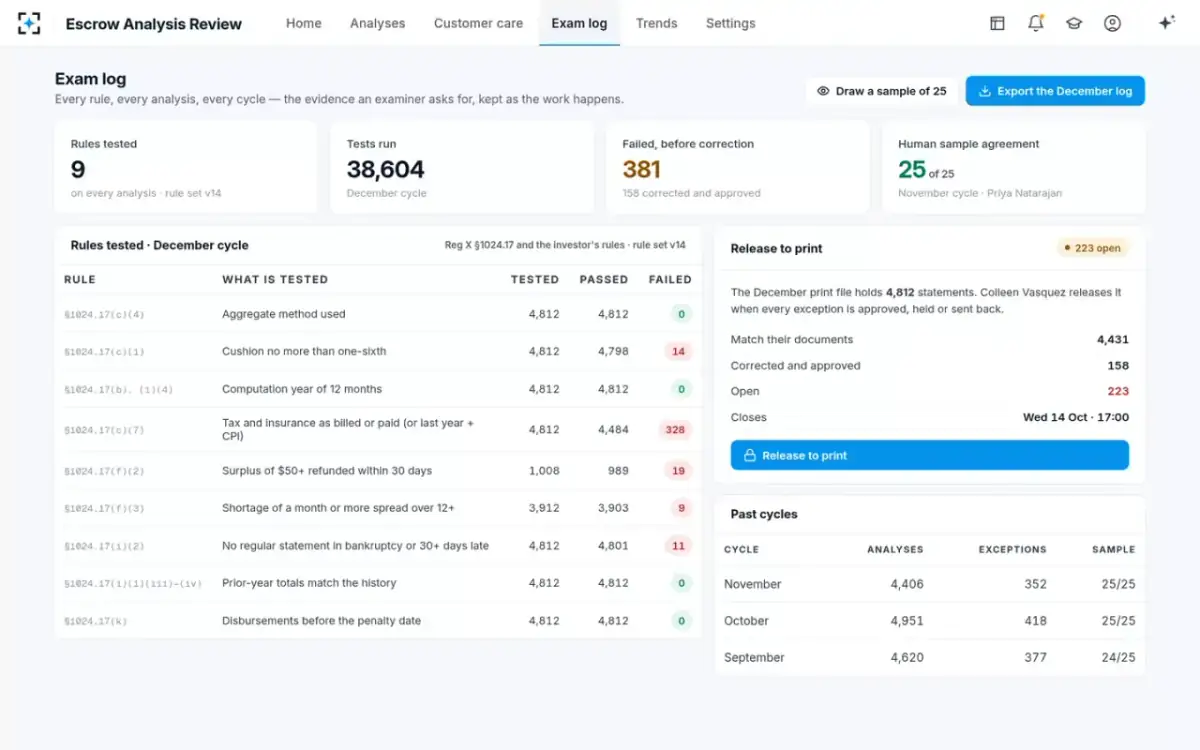
The thresholds only work on the right inputs. A shortage computed from last year’s tax bill can sit on the wrong side of the one-month line, or turn out to be a surplus, which is why the solution checks each projected figure against its bill or policy before it tests the rules. The input side is covered in can an escrow analysis be wrong; the whole solution is at Escrow Analysis Review.
Questions people ask
Is an escrow shortage the same as a negative escrow balance?
No. A negative balance is a deficiency. A shortage means the balance, while possibly still positive, is below the target the coming year needs, including the cushion. Many shortage notices are sent on accounts with thousands of dollars in them.
Do I get my escrow surplus back if it is under $50?
Not necessarily. For a surplus under $50, the servicer may refund it or credit it against next year’s escrow payments. At $50 or more, it must be refunded within 30 days of the analysis, as long as you are current.
Can a servicer make me repay a deficiency all at once?
Only a small one. If the deficiency is less than one month’s escrow payment, the servicer may require repayment within 30 days. If it is one month’s payment or more, the servicer may leave it or require two or more equal monthly payments.
What does “current” mean for escrow?
For the surplus and deficiency rules, a borrower is current if the servicer receives the payments within 30 days of the due date. A borrower who is not current may have a surplus retained, or a deficiency recovered, under the loan documents.
What happens to my escrow balance when I pay off the loan?
The servicer must return it within 20 days of payoff, excluding weekends and legal public holidays. If the borrower agrees, it may instead be credited to an escrow account on a new loan with the same lender, owner or servicer. A short year statement follows within 60 days.