Yes, an escrow analysis can be wrong, and most wrong escrow analyses have correct arithmetic. The servicing system runs Regulation X’s aggregate method faithfully on whatever tax, insurance and mortgage insurance figures it holds; when those figures are last year’s tax bill, the gross tax instead of the discounted amount the servicer will actually pay, an insurance renewal offer the borrower declined, or private mortgage insurance that ends before the year does, the analysis is valid in form and wrong in substance, and the shortage or surplus it reports is wrong with it. Botminds’ Escrow Analysis Review was built on that observation: it checks each projected figure in an annual analysis against the bill, the policy or the payment it should come from, and reruns the account only after the inputs are right.
This page catalogues the errors regulators have cited and the ones that show up most in practice, explains the one rule all of them break, and sets out how to measure accuracy so that it means something. The examples come from a fictional sample servicer, Wrenfield Home Loan Servicing, as its December cycle runs through the solution.
One sample cycle: 7.9% of analyses wrong before the check, almost all in their inputs
381
of 4,812 annual analyses disagreed with their documents
328
of those were a projected tax or premium, not a rule or a sum
263
would have asked the borrower to pay too much
118
would have asked too little, and brought a larger shortage next year
Can an escrow analysis be wrong? Yes, usually in its inputs
An escrow analysis is a projection, and a projection is only as good as the figures fed into it. The arithmetic itself is mechanical: Regulation X lays out the trial running balance, the adjustment that brings the lowest month to zero and the cushion added on top, and requires every servicer to use the aggregate method (12 CFR 1024.17(c)(4), (d)(2)). In the sample cycle, all 4,812 analyses passed the aggregate-method test and none ran a computation year longer than 12 months. The arithmetic was not the problem.
The inputs were. Of the 381 analyses that disagreed with their documents, 328 projected a tax or premium that was not the one that would leave the account. The remaining 53 broke a rule: a cushion above one-sixth, a surplus not set for refund, a shortage spread over too few months, or a statement prepared for a loan whose status called for something else. Rules are what most quality programmes test. The inputs are where the money was.
The rule every input answers to: “if the servicer knows the charge”
One sentence of Regulation X governs almost every input error. “If the servicer knows the charge for an escrow item in the next computation year, then the servicer shall use that amount in estimating disbursement amounts.” Only if the charge is unknown may the servicer base the estimate on the preceding year’s charge, or that charge adjusted by no more than the most recent year’s change in the national Consumer Price Index (1024.17(c)(7)).
The rule turns an accuracy question into a compliance question. A servicer that holds the new tax bill, or whose system holds the date PMI will end, and projects something else has not made a forecasting error; it has used the wrong amount when it knew the right one. The CFPB has applied exactly that reading, as the PMI finding below shows. The practical consequence is that “the system didn’t have it” only helps if the servicer could not reasonably have had it.
What are the most common escrow analysis errors?
The common escrow analysis errors fall into five families: the wrong tax year, the wrong tax amount or timing, the wrong insurance policy, a premium that ends or starts mid-year, and history that was wrong before the projection began. The table pairs each with the rule it breaks and where it has been found.
Escrow analysis errors, the rule each breaks, and who has found it
| Error | What happens in the analysis | Rule | Found by |
|---|---|---|---|
| Last year’s tax bill projected after the new one is certified | Low point overstated; a shortage reported as a surplus or understated | 1024.17(c)(7) | 88 sample analyses |
| Gross tax projected where the servicer pays early for a discount | Disbursement overstated; payment and shortage too high | 1024.17(c)(7), (d)(2)(i)(A) | 61 sample analyses, with installment errors |
| Installments projected as one payment, or in the wrong months | Low point in the wrong month; shortage wrong in either direction | 1024.17(d)(2), (k)(3) | Sample analyses in California installment counties |
| A renewal offer loaded as the renewal; a carrier switch missed | Premium overstated, sometimes by thousands | 1024.17(c)(7) | 142 sample analyses, 24 from one carrier feed |
| Flood or wind premium from last year’s policy, or a policy left out | Premium understated; the shortage comes next year, larger | 1024.17(c)(7) | 37 sample flood analyses |
| PMI projected for 12 months though it terminates mid-year | Disbursements overstated | 1024.17(c)(7) | CFPB, Supervisory Highlights 24 (2021) |
| Taxes and insurance already paid at closing included in the initial analysis | Initial deposit and payment overstated | 1024.17(c)(2), (g) | Federal Reserve examiners (2024 article) |
| Another borrower’s premium paid from this account | Shortage created that the borrower could not avoid | Cited as unfair | CFPB, Supervisory Highlights 15 (2017) |
The last row is the bluntest. CFPB examiners found servicers that “disbursed funds from some borrowers’ escrow accounts to pay insurance premiums owed by other borrowers,” which “created escrow shortages and increased monthly payments that consumers with affected escrow accounts could not avoid,” and cited the practice as unfair (Supervisory Highlights, Spring 2017). The analysis computed correctly on a history that was wrong.
The Federal Reserve’s examiners found the same pattern at the start of a loan’s life: “initial escrow account analyses that incorrectly included payments of taxes and insurance when those obligations had already been paid by the borrower at loan closing” (Consumer Compliance Outlook, 2024). Tax errors have their own guide, property tax escrow shortage from a bill the system never saw, because they turn on state calendars.
Can PMI be projected after it terminates?
No, not when the servicer knows the termination date. The CFPB found that servicers violated Regulation X “by conducting an annual escrow analysis that assumed that private mortgage insurance (PMI) payments would continue for the entire escrow analysis period, despite the servicers’ knowledge that PMI would be automatically terminated before the end of the escrow analysis period” (Supervisory Highlights, Issue 24).
The reasoning is the “knows the charge” rule. PMI terminates automatically when the principal balance reaches 78% of the original value on the amortization schedule, if the borrower is current, and the examiners found that the servicers’ “systems maintain all relevant information to determine the termination date.” The servicers therefore knew the charge would stop, and projecting twelve months of it overstated the borrower’s payment. The servicers’ response is the template for every input: they “began considering the PMI termination information in their systems while conducting the annual escrow analysis.”
Errors by source in one sample cycle
Measured by where they came from, the sample cycle’s errors cluster in insurance first and tax second, with rules a distant third. That ordering is the argument for testing inputs rather than arithmetic.
Insurance and tax inputs, not the arithmetic, produced most of the cycle’s errors
Insurance leads for a reason the research explains: premiums are the fastest-moving line in escrow. Researchers inferring premiums from mortgage escrow payments found average nominal homeowners premiums rose 33% from 2020 to 2023 (Keys and Mulder, NBER Reporter 2025), and the carrier switching that follows rising premiums is exactly what a renewal feed mishandles.
Three wrong inputs on one loan, each answered by a document
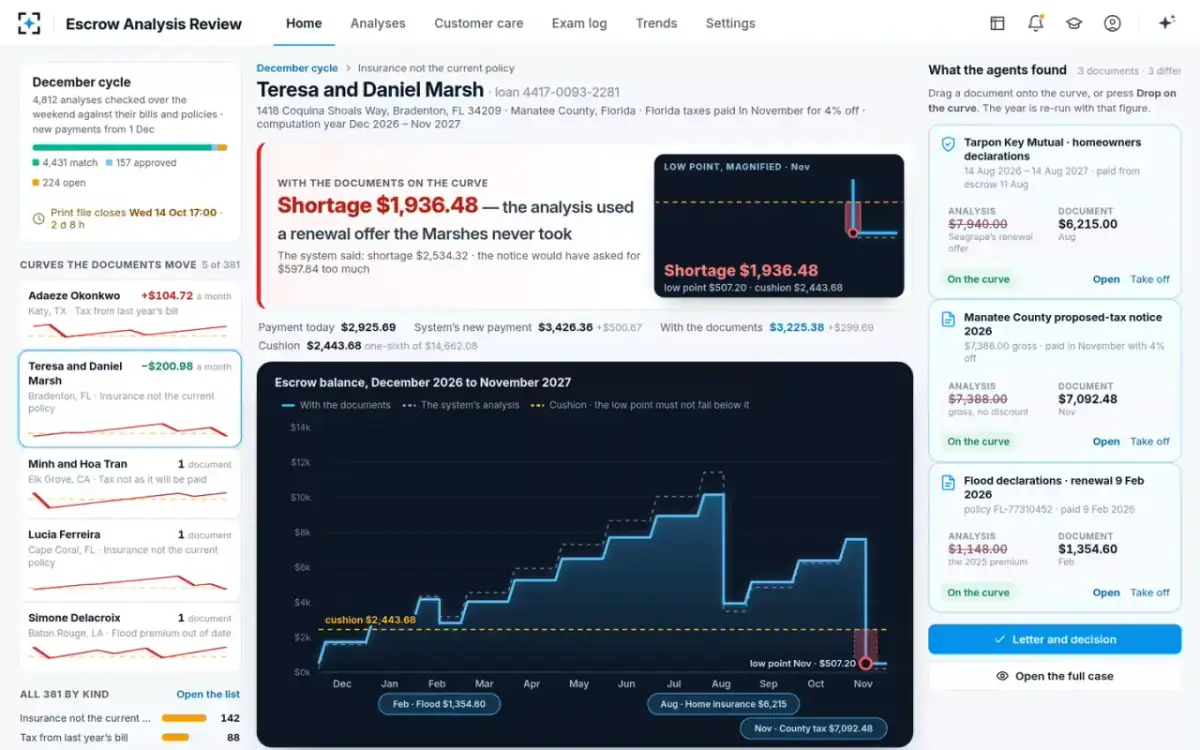
Can an escrow analysis understate the payment? Yes, and it costs more later
An error that lowers the payment is still an error, and usually a more expensive one for the borrower. In the sample cycle, 118 of the 381 exceptions understated the new payment. A wind policy left out of a Charlotte, North Carolina, analysis understated the payment by $88.55 a month. Nobody calls to complain about a payment that went up too little. The money is simply not collected, the account falls short when the premium is paid, and next year’s analysis carries a shortage to be spread on top of the higher premium.
This is why a quality programme that counts complaints undercounts errors. Overstated payments generate calls; understated ones generate next year’s calls. A measure of accuracy has to count both directions.
Valid is not accurate: why passing every rule proves little
A rule check tells you an analysis is valid: the cushion is within one-sixth, the year is 12 months, the shortage spread is 12 months or more. It cannot tell you the analysis is accurate, because a rule takes the inputs as given. The two tests answer different questions and catch different errors.
Two kinds of check on the same analysis
A rule check: Does the analysis follow Regulation X given its figures?
An input check: Are its figures the charges that will leave the account?
A rule check: The analysis and the loan’s status.
An input check: The bill, the declarations page, the renewal and the escrow history.
A rule check: Cushion over one-sixth, short spreads, surplus refunds missed, a stretched year.
An input check: Last year’s bill, gross instead of discounted tax, a declined offer, stale flood, PMI past its end.
A rule check: 53 exceptions
An input check: 328 exceptions
A rule check: The form is right.
An input check: The money is right.
How to test escrow analysis accuracy
Test accuracy input by input, against documents, on every analysis, and report it by source. A single pass rate for “escrow accuracy” hides the one carrier feed or the one late-certifying county that produces most errors. The measures below are the ones that point at a fix.
Five measures of escrow analysis accuracy, and what each points to
| Measure | How to compute it | What a bad number points to |
|---|---|---|
| Input mismatch rate by source | Analyses whose projected item differs from its document ÷ analyses with that item, for tax, homeowners, wind, flood and PMI | The feed or step that loads that item |
| Mismatch by feed or county | The same rate, grouped by carrier feed, tax service file or county | One partner or one certification date |
| Dollar impact by direction | Monthly payment difference, overstated and understated kept separate | Calls now (over) or shortages next year (under) |
| Rule failures by rule | Fails ÷ analyses tested, per Regulation X rule | A configuration or a status flag |
| Agreement with a human sample | Sample analyses where the reviewer and the check agree ÷ sample size | Whether to trust the other measures |
The fifth measure is the one that keeps the others honest. In the sample, a compliance analyst draws 25 analyses a cycle and compares her conclusions with the check’s. For what these measures look like as programme KPIs, see escrow automation, measured.
What a servicer must do when a borrower says the escrow analysis is wrong
A borrower who believes an analysis is wrong can send the servicer a written notice of error. Regulation X covers the failure to pay taxes and insurance on time from escrow by name, and “any other error relating to the servicing of a borrower’s mortgage loan” as a catch-all (12 CFR 1024.35(b)(4), (b)(11)). If the servicer has designated an address for notices of error, the notice must go there. For most errors the servicer must correct the error or explain, after a reasonable investigation, why there is none, within 30 business days, extendable by 15.
One provision makes the notice more powerful than borrowers expect. If, while investigating, the servicer “concludes that errors occurred other than, or in addition to, the error or errors alleged by the borrower,” it must correct those too and say so in writing (1024.35(e)(1)(ii)). A borrower who disputes the tax line of an analysis whose insurance line is also wrong is owed both corrections. For a servicer, that is one more reason to find both before the statement mails.
Escrow Analysis Review is the servicer-side version of that investigation, done before the notice exists. On the sample loan it found three wrong inputs, reran the account, and an analyst approved a payment of $3,225.38 instead of $3,426.36. See it on a full cycle at Escrow Analysis Review.
Questions people ask
How do servicers QC escrow analysis inputs?
By comparing each projected disbursement with its source before the statement mails: the current tax bill, the current declarations page, the mortgage insurance termination date. Most errors are a figure out of date — last year’s tax bill, an old premium, a renewal the borrower did not take — and the analysis must use a known charge.
Must a servicer rerun an escrow analysis when a borrower asks?
Not on request alone, though a servicer may analyse an account at any time during the year. Regulation X does not give the borrower a right to demand one, but a written notice of error about a wrong figure obliges the servicer to investigate and correct any error it finds.
Is a wrong escrow analysis a violation of RESPA?
It can be. Regulation X requires the servicer to use a charge it knows, and the CFPB cited servicers that projected PMI past a termination date their systems held. An honest estimate of an unknown charge, based on last year’s amount or adjusted by no more than CPI, is permitted.
How often are escrow analyses wrong?
No regulator publishes an industry error rate. In one fictional sample cycle, 381 of 4,812 analyses, 7.9%, disagreed with their documents before the check. A servicer can measure its own rate the same way: every projected input against its source, by source.
Does an error in the borrower’s favour come back later?
Usually, yes. An understated payment leaves the account short when the bill is paid, and the next analysis spreads that shortage over at least 12 months if it is one month’s payment or more. Catching it in the current analysis keeps the increase smaller.