An escrow shortage payment is how the borrower makes up a shortage the annual escrow analysis found, and Regulation X fixes the options by the size of the shortage. If the shortage is less than one month’s escrow payment, the servicer may leave it, require it within 30 days, or spread it in equal monthly payments over at least 12 months. If it is one month’s escrow payment or more, the servicer may only leave it or spread it over at least 12 months. Those lists are closed, and the CFPB has cited servicers whose annual statements offered borrowers with large shortages a lump-sum payment as one of two choices. Botminds’ Escrow Analysis Review checks the tax and insurance figures that decide which menu applies, and tests the shortage spread on every analysis in a cycle, before the statement and its letter go to print.
This page is for compliance teams and the people who own escrow letters, and for borrowers deciding what to do with a shortage notice. It sets out the options, the finding, what a notice must contain, the FHA rule on lump sums, and how to test every notice. Examples come from a fictional sample servicer, Wrenfield Home Loan Servicing.
The shortage menu, in four numbers
3options
for a shortage under one month’s escrow payment: leave it, 30 days, or 12+ months
2options
for a shortage of one month’s payment or more: leave it, or 12+ months
12
months: the shortest spread allowed for a large shortage, in equal monthly payments
1notice
of any shortage or deficiency, at least once in each computation year
What are the escrow shortage payment options?
The options depend on one comparison: the shortage against one month’s escrow payment, meaning the escrow part of the monthly payment rather than the whole payment. Regulation X: “If an escrow account analysis discloses a shortage of less than one month’s escrow account payment, then the servicer has three possible courses of action”: allow the shortage to exist, require repayment within 30 days, or require repayment in equal monthly payments over at least a 12-month period. For a shortage “greater than or equal to one month’s escrow account payment,” the servicer “has two possible courses of action”: allow it to exist, or require repayment in equal monthly payments over at least 12 months (12 CFR 1024.17(f)(3)).
Escrow shortage payment options by size, with two sample loans
| Shortage | What the servicer may require | Sample loan | What that allows |
|---|---|---|---|
| Under one month’s escrow payment | Nothing; repayment within 30 days; or equal monthly payments over 12 months or more | Katy, Texas: $612.00 against a deposit of about $1,102 | Any of the three; at 12 months, $51.00 a month |
| One month’s escrow payment or more | Nothing; or equal monthly payments over 12 months or more | Bradenton, Florida: $1,936.48 against a deposit of about $1,222 | Leave it, or $161.37 a month over 12 months (less over a longer spread) |
Can a servicer require an escrow shortage to be paid in full?
Only if the shortage is less than one month’s escrow payment, and then within 30 days. For anything larger, Regulation X allows the servicer to require repayment only in equal monthly payments over at least 12 months, or to leave the shortage in place. The rule is about what the servicer may require; it leaves no room to require a lump sum for a large shortage, and the CFPB has read it to bar offering one as a repayment option.
FHA-insured loans carry an extra protection. HUD’s rule says the lender “shall not institute foreclosure when the only default of the mortgagor occupant is a present inability to pay a substantial escrow shortage, resulting from an adjustment pursuant to this section, in a lump sum” (24 CFR 203.550(d)).
The lump-sum letter the CFPB cited
In its summer 2020 Supervisory Highlights, the CFPB described annual escrow statements that gave borrowers with a shortage or deficiency of one month’s escrow payment or more two choices: equal monthly payments over 12 months, or a lump sum. “The first option is a permitted repayment option under Regulation X, while the second option is not” (CFPB Supervisory Highlights, Issue 22).
Because the enumerated repayment options are exclusive, the servicers violated the regulatory requirements by sending disclosures that provided borrowers with repayment options that they cannot require under Regulation X.
CFPB, Supervisory Highlights Issue 22, Summer 2020
The reasoning runs through the statement rule. The annual escrow statement must include “an explanation of how any shortage or deficiency is to be paid by the borrower” (1024.17(i)(1)(vii)). A statement that explains payment by listing an option the servicer cannot require has explained it wrongly. The servicers’ response was to amend their annual escrow disclosures “to only include repayment options they are permitted to require under Regulation X.”
The finding is narrow and precise. It concerns the options a statement lists for shortages and deficiencies of one month’s escrow payment or more. It does not say a borrower can never send extra money; it says the servicer’s disclosure may not present a lump sum as one of the ways the shortage is to be repaid.
Two versions of the same shortage notice: the option list the CFPB cited, and one that follows the menu
The pattern cited
Your escrow account is short $1,936.48. Choose one:
- Pay $161.37 more each month for 12 months.
- Pay $1,936.48 now and keep your payment lower.
Option 2 is a repayment option the servicer cannot require for a shortage of one month’s escrow payment or more.
Within the menu
Your escrow account is short $1,936.48. How it will be repaid:
- Your new payment includes $161.37 a month for 12 months to repay the shortage.
Spread over at least 12 months, in equal payments. A servicer may instead choose to leave the shortage in place and say so.
Why “pay it now” keeps appearing on shortage notices
The lump sum appears because borrowers ask for it and templates are written for the general case. In the sample servicer’s November mailing, 164 of 1,072 escrow calls asked whether the shortage could be paid now instead. A letter template that answers that question in advance seems helpful, and for a shortage under one month’s payment a 30-day repayment is a permitted option. The template fails on the larger shortages, where the same sentence becomes an option the rule does not allow the servicer to present.
The failure is easy to make at scale because the threshold moves with the inputs. A shortage computed from last year’s tax bill may sit under one month’s payment; corrected, it may sit above it. A notice whose option list was right for the system’s figures can be wrong for the true ones, which is why the option list has to be tested after the figures are checked, not before.
What options must an escrow shortage notice give?
The notice must explain how the shortage is to be paid, using only options on Regulation X’s list for that size of shortage. The servicer must notify the borrower of any shortage or deficiency at least once in each computation year, and the notice “may be part of the annual escrow account statement or it may be a separate document” (1024.17(f)(5)). RESPA itself requires notice of any shortage “not less than annually” (12 U.S.C. 2609(b)).
The annual statement around the notice has its own required contents: the current and past payment and their escrow portions, last year’s totals in and out, the year-end balance, how any surplus is handled and how any shortage or deficiency is to be paid (1024.17(i)(1)). A notice that states the shortage, the spread and the new payment, and lists only permitted options, satisfies the part the CFPB examined.
Six tests for every shortage notice’s option list
- Compare the corrected shortage with one month’s escrow payment
Use the checked figures; the line can move when an input is corrected.
- At or above one month: only “leave it” or “12 months or more”
No lump sum, no 30-day repayment, no spread shorter than 12 months.
- Under one month: no more than three options
Leave it, within 30 days, or 12 months or more.
- Spreads are in equal monthly payments
An uneven spread is not on the list.
- The explanation matches the option chosen
The new payment shown should include exactly the spread amount stated.
- Deficiencies use their own menu
Two or more equal payments for a large deficiency, not the shortage menu.
Writing letter templates that cannot offer the wrong option
The safest template chooses its option list from the corrected numbers, not from a fixed paragraph. That means one list for each case the rule distinguishes, selected after the shortage or deficiency has been compared with one month’s escrow payment.
Option wording by case: what a letter template may offer
| Case | Options the letter may present | Wording to leave out |
|---|---|---|
| Shortage under one month’s escrow payment | No change; repay within 30 days; or repay in equal monthly amounts over 12 months or more, as the servicer chooses to offer | Any spread shorter than 12 months |
| Shortage of one month’s escrow payment or more | No change; or repay in equal monthly amounts over 12 months or more | “Pay it now”, “pay in full”, any 30-day repayment, any spread under 12 months |
| Deficiency under one month’s escrow payment | No change; repay within 30 days; or two or more equal monthly payments | Unequal installments |
| Deficiency of one month’s escrow payment or more | No change; or two or more equal monthly payments | A single payment |
| Borrower more than 30 days late | Treatment under the loan documents, stated plainly | Options that assume the borrower is current |
Selection only works if the comparison runs on the right figures. A Florida shortage computed with a declined renewal offer and the gross tax may land on the far side of the one-month line from the true shortage, so the template choice belongs after the figures are checked.
What should a servicer tell a borrower who wants to pay a shortage in full?
The answer starts with what the servicer’s notice is allowed to offer. For a shortage under one month’s escrow payment, the servicer may give a 30-day repayment as an option, and paying it removes the spread from the new payment. For a larger shortage, the notice should present only the 12-month spread or no repayment at all; a borrower who wants to send money early should ask the servicer how a voluntary payment would be applied, and get the answer in writing.
Two facts help the decision. Paying a shortage early lowers only the repayment part of the new payment; the higher monthly deposit that covers this year’s bills stays. And if the shortage came from a wrong figure, paying it settles nothing; the next step is to check the figures, as can an escrow analysis be wrong describes.
How borrowers dispute an escrow shortage, and what the servicer owes
A borrower disputes an escrow shortage in writing, as a notice of error, at the address the servicer designates for notices of error if it has one. Regulation X covers the failure to pay taxes or insurance on time from escrow by name, and any other servicing error under its catch-all (12 CFR 1024.35(b)(4), (b)(11)). The notice names the loan and the line the borrower believes is wrong, usually with the tax bill or declarations page that shows the right figure. For most errors, the servicer must correct it or explain why there is none within 30 business days, and correct any other error its investigation finds.
A dispute of the option list itself, such as a statement requiring a large shortage within 30 days, is a dispute about how the servicer applied the escrow rule, and the same channel applies.
Where Escrow Analysis Review fits: the figures first, then the spread
The solution checks the shortage’s size only after it has checked the inputs, then tests the spread against the rule. Its rule checker tests the shortage spread on every analysis, and the servicer’s choices sit in settings: how a shortage of one month or more is spread, at least 12 months, and how a shortage under one month is handled. In the sample December cycle, nine analyses spread a large shortage over fewer than 12 months, one of them $1,488 over six; each was an exception for an analyst to decide.
The servicer’s shortage rules, as dated settings
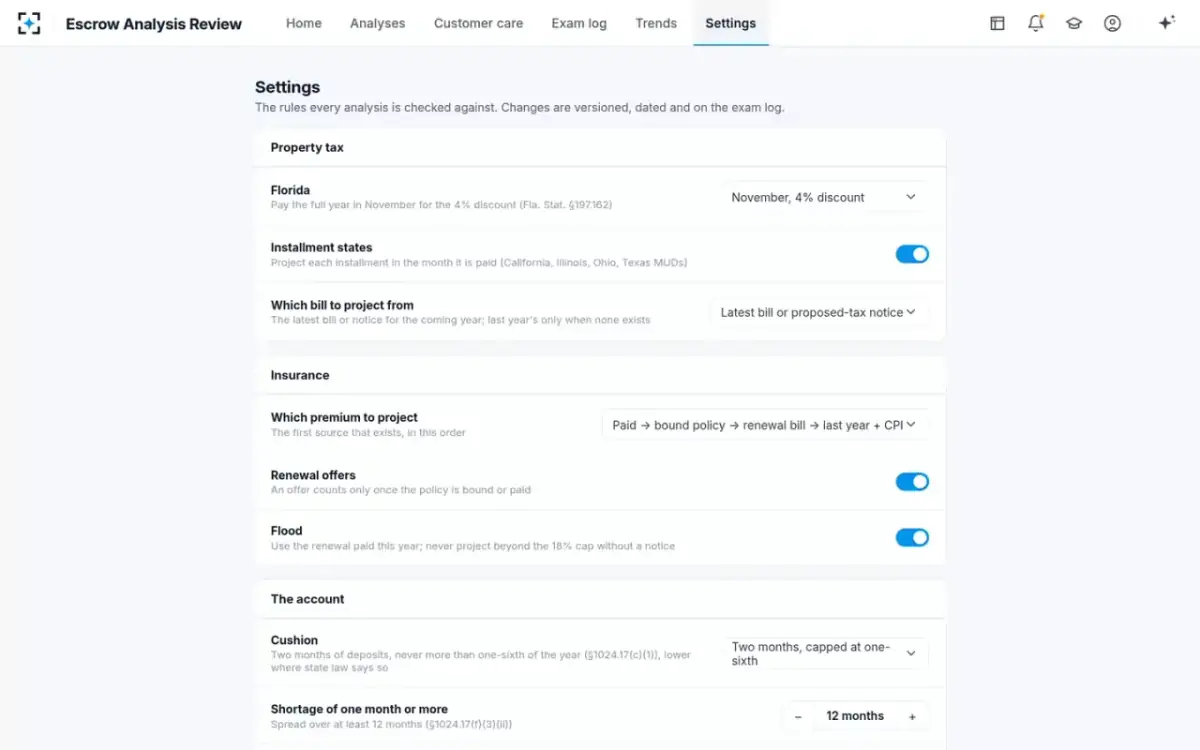
The explanation writer drafts each letter from the approved figures, at reading grade 7 or lower and in the borrower’s language on file, and an escrow analyst approves the letter with the corrected analysis; the agents never send. Customer care sees the same numbers in a prepared answer. The wording of the options in each letter is the servicer’s own, so the six tests above belong in the analyst’s approval and in compliance’s sample of every cycle.
What borrowers ask after a shortage notice
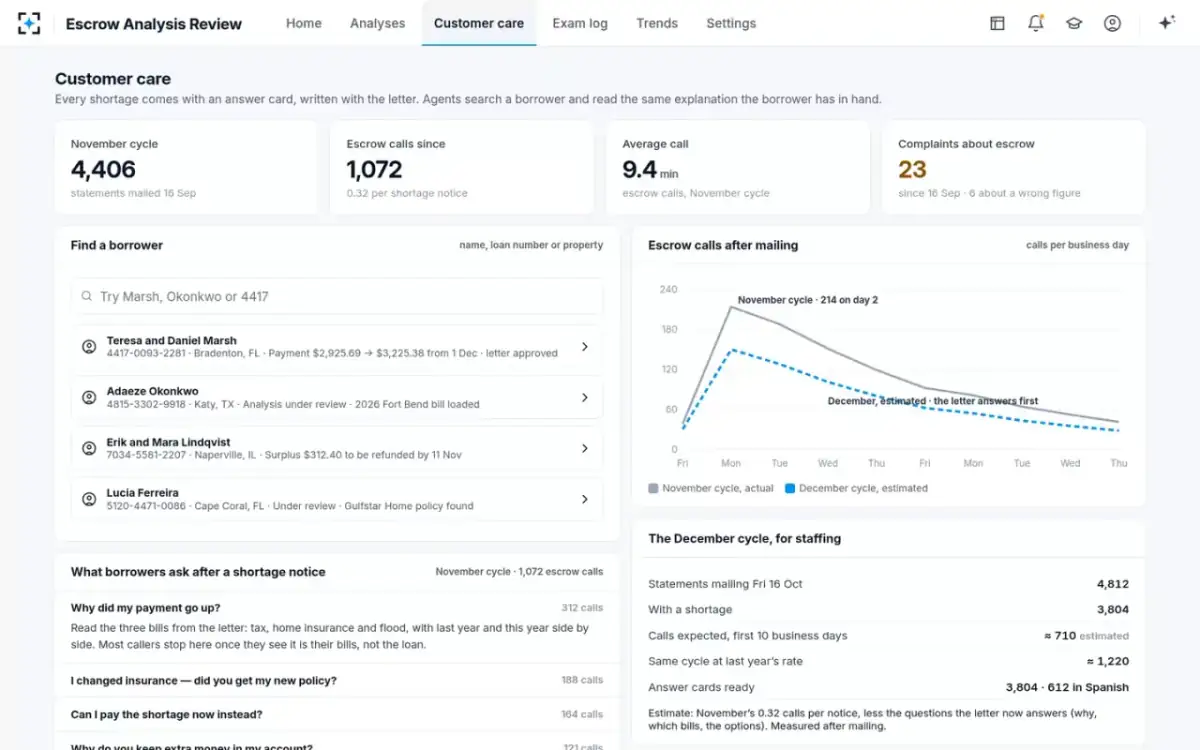
For the thresholds that decide which menu applies, see escrow shortage vs deficiency; for the solution on a full cycle, Escrow Analysis Review.
Questions people ask
May a servicer accept an escrow shortage in a lump sum?
If the shortage is under one month’s escrow payment, the servicer may offer repayment within 30 days. For a larger shortage, Regulation X lets the servicer only leave it or spread it over at least 12 months, and the CFPB cited statements that listed a lump sum as an option. A servicer should say in writing how it would apply a voluntary payment.
How long must a servicer give a borrower to repay an escrow shortage?
For a shortage of one month’s escrow payment or more, at least 12 months in equal monthly payments, unless the servicer leaves the shortage in place. For a smaller shortage, the servicer may also ask for it within 30 days.
Can a servicer spread an escrow shortage over more than 12 months?
Yes. Twelve months is the minimum, not the maximum: the rule requires equal monthly payments “over at least a 12-month period.” A longer spread lowers the monthly amount; a shorter one is not allowed for a shortage of one month’s payment or more.
Can an FHA servicer foreclose over a shortage the borrower cannot pay at once?
Not for that reason alone. HUD’s rule bars instituting foreclosure when the occupant’s only default is a present inability to pay a substantial escrow shortage, resulting from an escrow adjustment, in a lump sum.
Does an escrow shortage notice have to be separate from the annual statement?
No. The servicer must notify the borrower of any shortage or deficiency at least once in each computation year, and the notice may be part of the annual escrow statement or a separate document. Either way, it must explain how the shortage is to be paid.