To calculate an escrow shortage, project every tax and insurance payment the servicer will make from the account in the coming 12-month computation year, add one-twelfth of the year’s total as the monthly deposit, and run the balance month by month from the account’s opening balance. Find the lowest month-end balance. The account is allowed to fall no lower than the cushion, which Regulation X caps at one-sixth of the year’s estimated disbursements, about two months of escrow deposits. If the lowest balance is below the cushion, the difference is the escrow shortage; if it is above, the difference is a surplus. Botminds’ Escrow Analysis Review performs this calculation again for every analysis in a servicer’s cycle, using the tax bills and insurance policies rather than the figures the system held, because most wrong shortages come from wrong inputs rather than wrong arithmetic.
This guide follows the aggregate method in the order the regulation sets it out, works the regulation’s own example, and then works a sample loan from a fictional servicer, Wrenfield Home Loan Servicing, where one late tax bill turned a reported surplus into a $612.00 shortage.
Four quantities decide every escrow shortage
1/12
of the year’s estimated disbursements: the monthly deposit
1/6
of the year’s estimated disbursements: the most the cushion may be
Low point
the lowest projected month-end balance, which must not fall below the cushion
12
months: the least a shortage of one month’s payment or more may be spread over
How do you calculate an escrow shortage?
An escrow shortage is the amount by which the account’s balance falls short of its target balance when the analysis is done. Regulation X defines it that way, and defines the target balance as the month-end balance “just sufficient to cover the remaining disbursements” in the computation year, “taking into account the remaining scheduled periodic payments, and a cushion, if any” (12 CFR 1024.17(b)). In practice the calculation reduces to one comparison: run the year from the actual opening balance with the new deposit, and subtract the lowest month from the cushion.
An escrow shortage, line by line, on the regulation’s own example
| Quantity | How to get it | Regulation X’s example, with $900 in the account |
|---|---|---|
| The year’s disbursements | Every tax installment and premium due in the next 12 months, each in the month it will be paid; a known charge must be used | $500 + $360 + $700 = $1,560 |
| Monthly deposit | The year’s disbursements ÷ 12, before any shortage repayment | $130 |
| Projected low point | The lowest month-end balance, running the year from the actual opening balance with that deposit | December: $900 − $780 = $120 |
| Cushion limit | At most one-sixth of the year’s disbursements, or less where state law or the mortgage says so | $260 |
| Shortage | Cushion − projected low point, if positive (if negative, a surplus) | $260 − $120 = $140 |
Step 1: project the year’s disbursements, in the right months
Every calculation starts with a list of what will leave the account in the next 12 months, and when. Two rules govern the list. The amount must be the known charge if the servicer knows it; otherwise the servicer may use the preceding year’s charge, or that charge adjusted by no more than the most recent year’s change in the national Consumer Price Index (1024.17(c)(7)). The date must be the earlier of the deadline to take advantage of a discount, if one is available, or the deadline to avoid a penalty (1024.17(d)(2)(i)(A)).
Installments stay separate. A tax payable in two halves is one escrow item with two disbursement dates, and projecting it as one payment moves the low point to the wrong month. A premium billed every three years, such as some flood policies, is collected in 36 equal monthly amounts, and the low point then falls on a three-year cycle (1024.17(c)(9)).
Step 2: set the monthly deposit at one-twelfth
The monthly escrow deposit is one-twelfth of the year’s estimated disbursements, before any shortage repayment. RESPA itself sets that ceiling: the servicer may require each month no more than “one-twelfth of the total amount of the estimated taxes, insurance premiums and other charges” for the ensuing twelve months, plus what is needed to maintain the cushion (12 U.S.C. 2609(a)(2)). The servicer may not collect ahead of a disbursement date; Regulation X forbids pre-accrual (1024.17(c)(6)).
Step 3: find the lowest monthly balance
Run the balance month by month from zero: add the deposit, subtract that month’s disbursements. The lowest month in this trial running balance tells you how much the account must hold at the start for the balance never to go negative. Regulation X’s instruction is to add “to the first monthly balance an amount just sufficient to bring the lowest monthly trial balance to zero, and adjust all other monthly balances accordingly” (1024.17(d)(2)(i)(B)).
What is the lowest monthly balance, and how much cushion can a lender require?
The lowest monthly balance is the low point the account reaches in the year, and the cushion is the floor it may not be planned to fall below. A lender or servicer may require a cushion of no more than one-sixth of the estimated total annual disbursements, which the regulation also describes as “two months of the borrower’s escrow payments to the servicer or a lesser amount specified by state law or the mortgage document.” Under aggregate analysis, “the lowest monthly target balance for the account shall be less than or equal to one-sixth of the estimated total annual escrow account disbursements” (1024.17(c)(1), (d)(2)(i)(C), (d)(2)(ii)).
The cushion is a maximum, not a requirement. “This section does not require the use of a cushion,” the regulation says, and servicers “may use a cushion less than the permissible cushion or no cushion at all” (1024.17(d)(1)). The cushion also excludes prior-year shortages and surpluses: it is two months of escrow payments “net of any increases or decreases because of prior year shortages or surpluses.”
Escrow cushion requirements by state
State law can lower the cushion, never raise it. Regulation X sets one-sixth as the ceiling for every federally related mortgage, "or a lesser amount specified by state law or the mortgage document" (1024.17(d)(2)(i)(C) and (d)(2)(ii)); where the loan documents allow more, the federal limit controls (1024.17(c)(8)). We have not found an official list of states with a lower cushion, so a servicer has to read each state’s escrow statute and each security instrument; the loan documents are the more common source of a lower limit.
For a servicer, the practical rule is to store the cushion per loan, not per portfolio, and to test it on every analysis. In the sample cycle, 14 analyses carried a cushion above one-sixth, including one Ohio loan holding three months.
Step 4: add the cushion and compare: a worked example from Regulation X
Regulation X’s Appendix E works the method on a small account: county property taxes of $1,200 paid in two installments, $500 on 25 July and $700 on 10 December, and school taxes of $360 on 20 September, with the first payment on 1 July (Appendix E to Part 1024). The year’s disbursements are $1,560, so the deposit is $130 a month and the most the cushion can be is $260, exactly two deposits.
Regulation X’s own example: the trial balance, the adjustment and the cushion
| Month | Deposit | Paid out | Step 1: trial balance | Step 2: lowest month brought to zero | Step 3: with the $260 cushion |
|---|---|---|---|---|---|
| Jun | $0 | $0 | $0 | $780 | $1,040 |
| Jul | $130 | $500 county | −$370 | $410 | $670 |
| Aug | $130 | $0 | −$240 | $540 | $800 |
| Sep | $130 | $360 school | −$470 | $310 | $570 |
| Oct | $130 | $0 | −$340 | $440 | $700 |
| Nov | $130 | $0 | −$210 | $570 | $830 |
| Dec | $130 | $700 county | −$780 (lowest) | $0 | $260 (= cushion) |
| Jan | $130 | $0 | −$650 | $130 | $390 |
| Feb | $130 | $0 | −$520 | $260 | $520 |
| Mar | $130 | $0 | −$390 | $390 | $650 |
| Apr | $130 | $0 | −$260 | $520 | $780 |
| May | $130 | $0 | −$130 | $650 | $910 |
| Jun | $130 | $0 | $0 | $780 | $1,040 |
The table is the whole method. The trial balance falls to −$780 in December, after the second county installment. Adding $780 to every month brings December to zero; adding the $260 cushion brings December to $260, which is the cushion, and sets the target opening balance at $1,040. If the account actually held $1,040 at the start, there would be no shortage and no surplus.
Now suppose, as our own illustration, that the account held $900. The shortage is $1,040 − $900 = $140. That is more than one month’s deposit of $130, so under Regulation X the servicer may only leave the shortage in place or spread it over at least 12 months, which adds about $11.67 a month (1024.17(f)(3)(ii)). Had the shortage been $100, under one month’s payment, the servicer could also have asked for it within 30 days. Escrow shortage vs deficiency sets out every threshold that follows from this number.
What is an aggregate escrow analysis, and why it needs less money
An aggregate escrow analysis tests the account as a whole; a single-item analysis tests each tax and insurance item as if it had its own account. Regulation X requires aggregate accounting from all servicers (1024.17(c)(4)), and Appendix E shows why it matters to the borrower: with the same taxes and the same cushion rule, the aggregate method needs a target opening balance of $1,040, the single-item method $1,130. Items whose bills fall in different months cover for each other in one account.
A sample loan: one late tax bill, $612.00 short
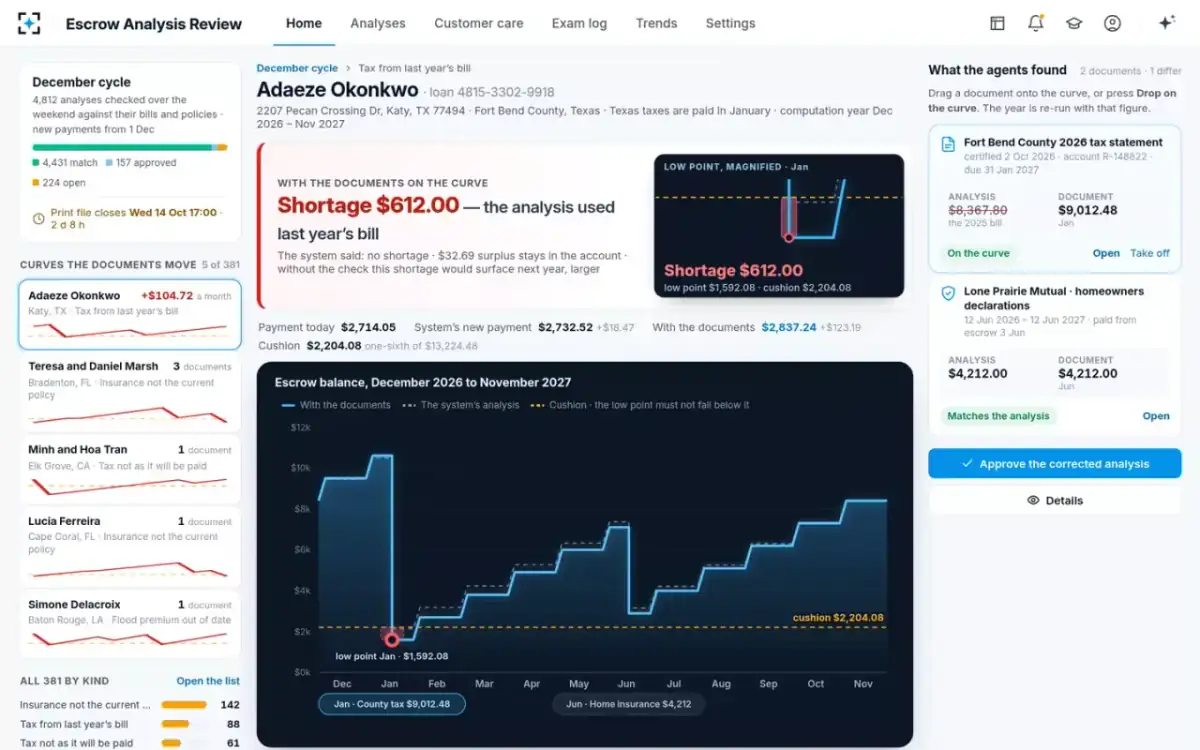
Take a sample Texas loan as it runs through the solution: fictional borrower Adaeze Okonkwo in Katy, Fort Bend County, computation year December 2026 to November 2027. Texas taxes are paid in January. The servicing system’s analysis projected the 2025 county bill of $8,367.80 and found no shortage: the January low point of $2,129.32 sat $32.69 above a cushion of $2,096.63, one-sixth of $12,579.80.
The same loan, calculated twice: last year’s tax bill and this year’s
| With the 2025 bill (the system) | With the 2026 bill (checked) | |
|---|---|---|
| County tax projected for January | $8,367.80 | $9,012.48 |
| Year’s estimated disbursements | $12,579.80 | $13,224.48 |
| Cushion: one-sixth of the year | $2,096.63 | $2,204.08 |
| Projected low point, January | $2,129.32 | $1,592.08 |
| Result | Surplus of $32.69 | Shortage of $612.00 |
| New monthly payment | $2,732.52 (+$18.47) | $2,837.24 (+$123.19) |
The arithmetic was right both times. The difference is one input: last year’s bill used when the new one was known. Without the check, the borrower would have kept a $32.69 surplus this year (under $50, so the servicer could credit it rather than refund it) and met a larger shortage next year, after a whole year of deposits sized to the old bill. With it, the shortage is $612.00, under one month’s escrow deposit, so the servicer may leave it, ask for it within 30 days or spread it over 12 months.
The 2026 tax statement dropped on the curve: the January low point falls through the cushion
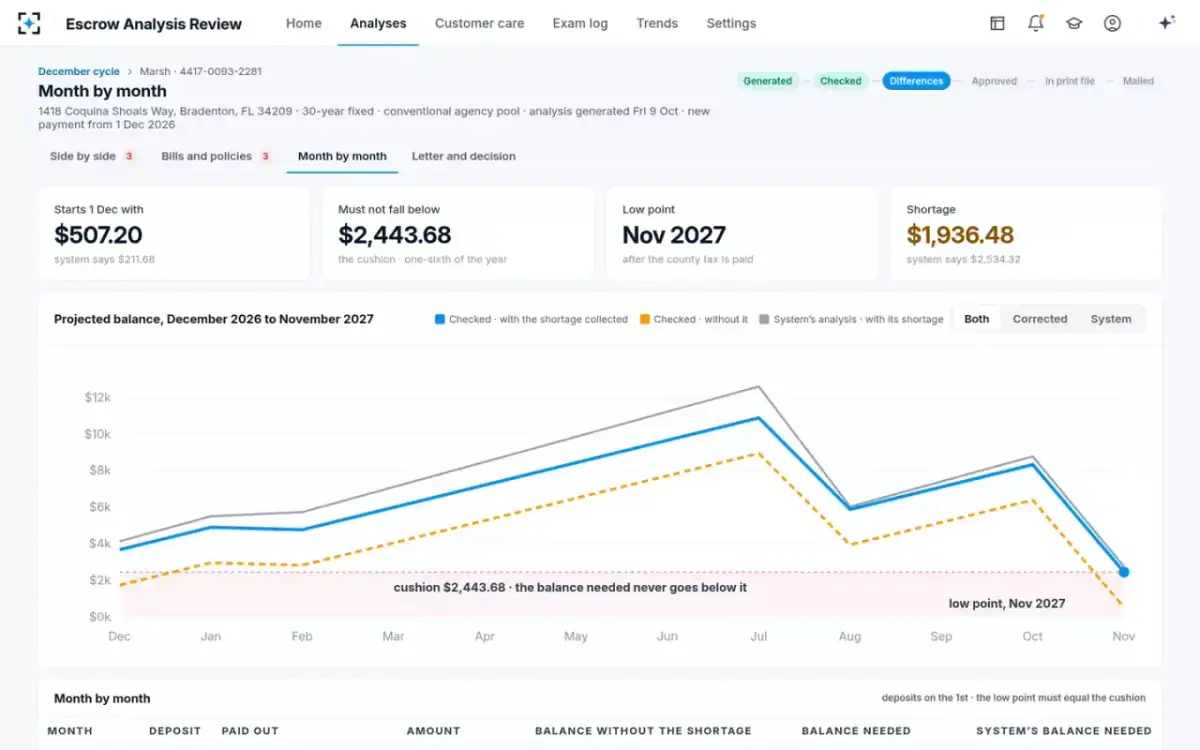
The same calculation, done for a Florida loan with three wrong inputs, is shown month by month below: the account must not fall below $2,443.68, one-sixth of $14,662.08, and with the checked figures it reaches $507.20 in November, after the county tax is paid. The shortage is $1,936.48, not the $2,534.32 the system computed. The inputs behind the difference are traced in can an escrow analysis be wrong.
Month by month: the checked year against the system’s, and the cushion line
Checking the shortage against the annual escrow statement
An annual escrow statement contains everything needed to check the shortage: last year’s history, the coming year’s projection, the cushion and the low point. Regulation X requires it to show, among other things, the current and past monthly payment and their escrow portions, the totals paid in and out last year with taxes and insurance separately identified, the year-end balance, and how any shortage or deficiency is to be paid (1024.17(i)(1)).
Checking the shortage on a statement in six steps
- Add up the projected disbursements
Each tax and premium should be this year’s figure and in the month it will be paid.
- Divide by twelve
That is the new deposit before any shortage repayment.
- Find the projected low point
Usually the month after the largest tax payment; the statement often marks it.
- Compute the cushion limit
One-sixth of the projected disbursements; check that the statement’s cushion is not higher.
- Subtract the low point from the cushion
A positive answer is the shortage; a negative one is a surplus.
- Check the repayment
A shortage of a month’s deposit or more may only be left alone or spread over at least 12 months.
Escrow Analysis Review runs this calculation on every analysis in a cycle with the checked figures, shows every month, and never uses a cushion above one-sixth. An escrow analyst approves each corrected analysis before it goes back to the servicing system. See the full cycle at Escrow Analysis Review.
Questions people ask
How is the monthly escrow payment calculated?
One-twelfth of the taxes and insurance the servicer expects to pay in the coming year, plus, if there is a shortage being spread, the shortage divided by the number of months it is spread over. Any cushion is built into the target balance, not added as a separate monthly charge.
Is the escrow cushion always two months?
No. Two months, or one-sixth of the year’s disbursements, is the maximum Regulation X allows. A servicer may hold less or none, and state law or the mortgage documents may set a lower limit.
What happens if the shortage is less than one month’s escrow payment?
The servicer has three choices: leave it, require repayment within 30 days, or spread it in equal monthly payments over at least 12 months. For a shortage of one month’s payment or more, only the first and the last are allowed.
Why does the low point fall in a particular month?
Because that is when the largest bill leaves the account relative to the deposits collected so far, usually right after the property tax is paid. A Florida loan paid for the November discount usually bottoms out in November; a Texas loan, in January.
Can a servicer use a computation year longer than 12 months?
No. The computation year is 12 months from the first payment date, and a servicer that wants to move a loan to a different cycle must issue a short year statement. Federal Reserve examiners found servicers stretching the year, which made statements and refunds late.