An insurance licensing coordinator keeps every producer legally able to sell. The job description, at any carrier, MGA or agency, comes down to five duties: get and renew each producer's resident and nonresident licenses with the right lines of authority, file carrier appointments and terminations inside each state's deadline, track continuing education against every renewal date, keep the agency's own entity licenses and its designated responsible producer current, and prove all of it when a carrier or an examiner asks. The work is hard because it grows with states and carriers, not with headcount: one producer in 12 states, appointed by five carriers, is 12 licenses and up to 60 appointments, each renewing on its own calendar. Botminds' Producer Licensing & Appointment Management exists for that desk. Its agents read the national producer database every morning, age every license forward, prepare the filings and match each sale to a license; the coordinator decides and signs.
The examples come from a fictional sample agency, Tolland Grove Insurance Partners in Dallas, as it runs through the solution. Every rule and statistic comes from a regulator, the NAIC or the National Insurance Producer Registry (NIPR), the NAIC's non-profit affiliate, and is linked where it appears.
The license grid every coordinator works inside
12.5M
individuals and entities licensed to provide insurance services in the US, 2022
9.5M
nonresident individual producer licenses, against 2.3 million resident ones
185.9M
transactions run through NIPR for states and industry in 2025, up 29%
9.2M
producer records in NIPR’s database at the end of 2025
What does an insurance licensing coordinator do?
An insurance licensing coordinator files, renews and proves the state permissions that let producers sell. The role exists at carriers, MGAs and agencies; at a small agency it may be one person who also does other work. The title varies (licensing coordinator, licensing specialist, producer compliance analyst), but the duties are set by the same law in every state.
That law starts with one sentence of the NAIC's Producer Licensing Model Act (#218), the model that state regulators urge every state to adopt without deviation: a person "shall not sell, solicit or negotiate insurance in this state for any class or classes of insurance unless the person is licensed for that line of authority" (Model #218, §3). Every duty on the desk follows from it. A license is needed per state and per line, so the coordinator tracks a grid. In states that require appointments, a carrier must file one before, or within days of, a producer's first sale for it, so the coordinator tracks a second grid. And the agency itself is a licensed producer, so there is a third.
The task list follows: license applications through NIPR, appointment and termination requests, renewal tracking, CE monitoring, address and name changes, and reports for carriers and examiners. Almost every one of those tasks has a statutory deadline measured in days, which is what makes the job a compliance role rather than an administrative one.
Insurance licensing coordinator duties and responsibilities, clock by clock
Each duty below carries its own legal clock. The model act sets most of them, states adopt them with variations, and the coordinator is the person who has to know which version applies where.
Licensing coordinator duties, and the deadline behind each one
| Duty | The clock under the NAIC model | Variations and details |
|---|---|---|
| File a carrier appointment | 15 days from the agency contract or the first application, whichever comes first (§14B) | Texas allows 30 days from the appointment’s effective date; Colorado has no appointments at all |
| Report a termination | 30 days after it takes effect; a copy to the producer within 15 days after that (§15) | For cause, the copy goes by certified mail or overnight carrier |
| Renew each license and match CE | By the renewal due date; 24 CE credits every two years, 3 in ethics (NAIC Uniform Licensing Standards) | Florida varies the hours with years licensed; New York’s statute sets 15 credit hours |
| Reinstate a lapsed license | Within 12 months of the renewal due date, at double the renewal fee, no exam (§7C) | Texas inactivates a license 90 days after expiry if CE is still short |
| Report an address change | Within 30 days of the change (§7F) | Texas wants an officer or partner to sign an agency’s change |
| Report actions against a producer | 30 days after an administrative action is final; 30 days after the first pretrial hearing in a prosecution (§17) | One NIPR filing can reach every state the producer holds a license in |
| Keep the agency license and its responsible producer | A business entity needs its own license and a designated licensed producer (§6B) | Texas: an officer or active partner must be individually licensed; officer changes within 30 days |
Two rows deserve a second look. The termination clock runs from the date the relationship ends, not the date someone notices, so a producer who quietly stops writing for a carrier can put the carrier out of time without anyone on the licensing desk being told. And the reporting-of-actions duty belongs to the producer, but it lands on the coordinator in practice. The NAIC's own handbook concedes the problem: "it can be difficult to ensure that all relevant states received the report" (State Licensing Handbook, ch. 15).
Why the workload grows with states and carriers, not with headcount
The licensing workload is the number of producers multiplied by the states each sells in, multiplied again by the carriers that appoint them. A ten-person agency that writes in 30 states has more licensing work than a 40-person agency that stays at home, which is why the smallest teams often feel it most.
The national counts show the shape. In 2022 states issued 2.3 million resident licenses to individual producers and 9.5 million nonresident ones, about four nonresident licenses for every resident license (NAIC, Insurance Department Resources Report, our arithmetic). Each of those nonresident licenses is a separate renewal date and a separate fee, even where CE follows the home state under reciprocity.
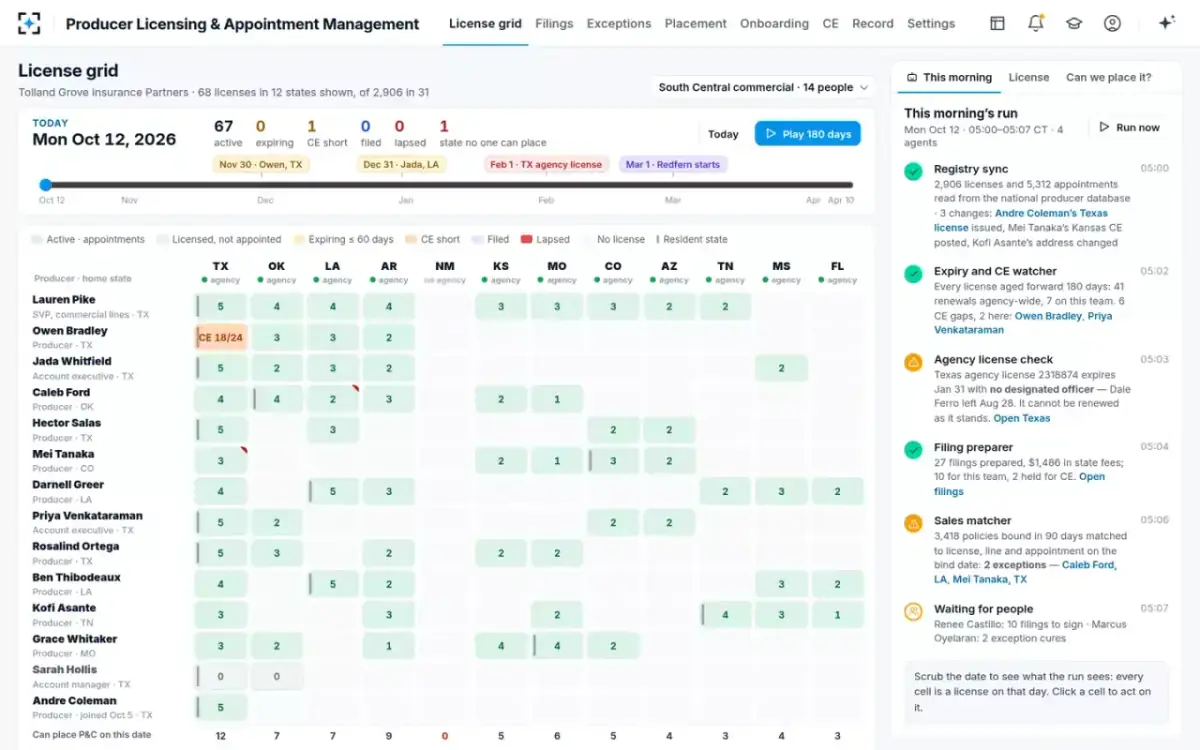
The fictional sample agency makes the multiplication concrete. Tolland Grove keeps 214 licensed people across 31 states. The morning read in the solution finds 2,906 licenses and 5,312 carrier appointments on the national producer database: on average about 13.6 licenses and 25 appointments per person, every one with its own expiry or renewal invoice. One regional team of 14 people holds 68 licenses in 12 states.
The coordinator's grid: producers down the side, states across, each cell a license
How many producers can one licensing coordinator manage?
No regulator, university or non-profit publishes a producers-per-coordinator ratio, and a ratio would mislead anyway, because a producer licensed in two states is a different load from one licensed in twenty. A better way to size the desk is to count the events a roster generates in a year and price each one in minutes.
A workload count to run on your own roster
| Event a year | How to count it | The sample agency’s average per person |
|---|---|---|
| License renewals | Licenses held ÷ years in each state’s term (one to four years, NIPR says; two in Texas, Illinois and Pennsylvania) | About 6.8 (13.6 licenses ÷ 2) |
| CE checks | One per resident renewal, plus any nonresident state whose home-state CE is not accepted | At least 1 every two years |
| Appointment renewals | Appointments in states that invoice renewals, by each state’s cycle (annual or biennial) | Up to 25, depending on the states |
| New appointments and terminations | Carrier additions, producer moves and departures | Varies with hiring and turnover |
| Address, name and action reports | Each change, filed within 30 days in every state that licenses the person | 1 change × up to 14 states |
Multiply each count by the minutes your team spends on it today, and the hours fall out. Botminds' own design estimate, for one producer licensed in several states, is about 11.5 hours a year by hand: three on expiry dates and CE, four on preparing and filing renewals, two on appointments and terminations, one on onboarding documents and one and a half on audit proof. It is an estimate, not a measurement, and the useful version is the one you build from your own roster.
Where a producer's licensing hours go in a year, by hand
One producer, several states · about 11.5 hours (estimate)
- Renewals in state portals · 35%
- Expiry dates and CE · 26%
- Appointments, terminations · 17%
- Audit proof · 13%
- Onboarding papers · 9%
What are the busiest times of year for an insurance licensing team?
The busy season is the appointment renewal calendar, and it never quite ends. States that renew appointments send insurers an invoice once a year or once every two years, through NIPR, and each invoice comes with a termination cut-off a week or more before it opens. An appointment not terminated by the cut-off is billed, and once the list is generated it cannot be changed.
When the appointment renewal invoices open on NIPR
| Months | Jurisdictions invoicing through NIPR | What to finish first |
|---|---|---|
| January to March | Rhode Island, New Mexico, Iowa, Kentucky (2026 cycle), Alabama and Wisconsin (2027), North Carolina from 3 February, North Dakota and DC from March 2027 | Terminations before each cut-off: Rhode Island 25 December, New Mexico 26 December |
| April to June | New Jersey, South Dakota, Connecticut (even years), Nebraska, Arkansas, Vermont, West Virginia from 8 June | Connecticut stops accepting terminations on 15 April |
| July to September | Louisiana business entities, Massachusetts, South Carolina (even years, from 1 September) | Massachusetts bills every appointment active on 1 July |
| October to December | Illinois (limited lines only) from 2 November, Oklahoma from 25 November, Louisiana individuals from 1 December | Oklahoma terminations by 14 November |
Individual license renewals add a second, flatter peak. The NAIC's standards tie the CE compliance period to the renewal and say "the license term should be tied to the birth date or birth month" (State Licensing Handbook, ch. 14), which spreads renewals across the year for a large roster but bunches them unpredictably for a small one. What the appointment fees cost, state by state, is set out in insurance appointment fees by state.
Does a licensing coordinator need an insurance license?
Usually not, as long as the coordinator does not sell, solicit or negotiate and is not paid commission. The model act exempts officers and employees of insurers and producers whose work is administrative or clerical and who receive no commission on the policies written (Model #218, §4B(1)). Filing an appointment is administrative; telling a client what a policy covers is not.
Two situations change the answer. If the coordinator is also the person the agency names as its designated responsible licensed producer, that person must hold a license, because the model requires the business entity to name a licensed producer as responsible for its compliance (§6B(2)). And where a coordinator also answers client calls, the line between service and selling becomes a state-by-state question, which the guide on what an unlicensed insurance CSR can do works through for Florida, Texas and California.
Licensing coordinator, licensing specialist, compliance officer: who signs what
In a team of more than one, the difference between a licensing coordinator and a licensing specialist is usually scope and signature. The specialist prepares and checks individual filings; the coordinator or licensing lead owns the calendar, signs filings and answers for the grid; the compliance officer decides what happens when a sale went through without the right license or appointment. In a one-person shop, all three hats sit on one desk, which is the strongest argument for writing the split down anyway.
Four people around one license grid, before and with agents doing the reading
Today
Keeps 214 people legal in 31 states from spreadsheets and state portals, and learns of a lapse after it has happened.
With agents
Moves the grid 180 days forward to see what will lapse, and signs filings already prepared, with each state fee shown.
Still theirs: The signature on every producer renewal and appointment.
Today
Types the same producer number into the same portals for each renewal and appointment, and chases CE certificates.
With agents
Works a list of prepared filings, each with its form, fee, due date and the reason any is held.
Still theirs: The checking: does the prepared filing match the producer and the state?
Today
Hears about a sale through an unappointed producer when a carrier or a regulator asks.
With agents
Sees every bound policy checked on its bind date and decides each cure and any commission hold.
Still theirs: Cures, commission holds and the second signature on agency filings.
Today
Quotes a multi-state account, then finds a state no one on the team can place.
With agents
Knows before quoting which locations can be placed on the start date, and what would fix the rest.
Still theirs: Their own CE hours and their own license application.
What systems do insurance licensing coordinators use?
Most coordinators work across four kinds of system, none of which talks to the others without help. NIPR's Producer Database shows every state's license and appointment record for a producer, and its gateway carries applications, appointments and terminations to the states. State portals, or the vendors states use, hold CE transcripts and some filings. Carriers keep their own appointment lists. And the agency or policy system holds the sales, which is the one record that shows whether anyone sold where they should not have.
The coordinator's spreadsheet usually exists to join these. The weakness of a spreadsheet is not that it is wrong on the day it is built; it is that it describes yesterday. How a license layer can read NIPR and the agency system directly, without becoming another copy of record, is set out in insurance license management software.
Where agents take the reading, and the coordinator keeps the signature
The part of the job that agents can do is reading and preparing. In the solution, a registry agent reads every license, line of authority and appointment each morning; a watcher ages each one forward 180 days, the design target, and compares CE transcripts with each state's rule; a filing agent prepares renewals, appointments, terminations and agency changes with the form and the state fee; a sales matcher checks each bound policy against the license on its bind date. The part that stays with people is everything that carries legal weight: signing filings, naming an agency's responsible officer, deciding a cure.
Prepared filings, each with its form, fee, due date and the reason any is held
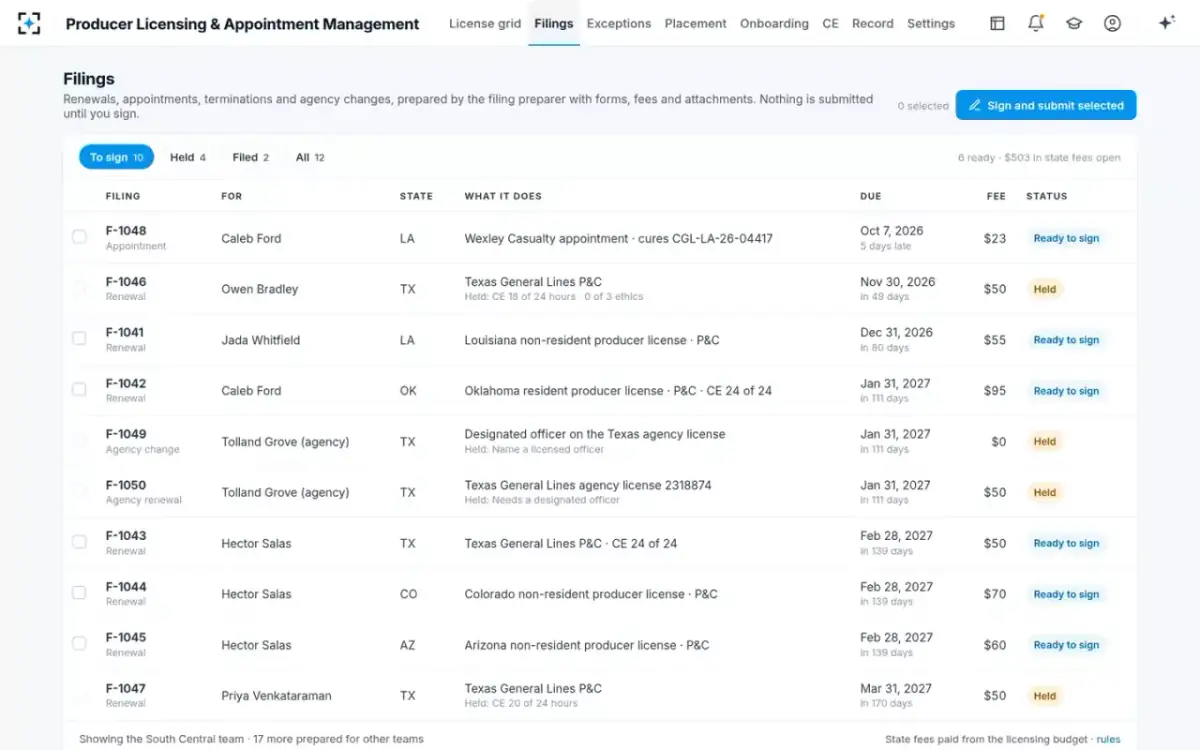
In the sample, the licensing lead's Monday starts with ten filings for her team, six of them ready, and two exceptions for the compliance officer. Nothing reaches a state until a person signs. That boundary, filing by filing, is the subject of licensing compliance software; the full workflow is on the Producer Licensing & Appointment Management page.
Questions people ask
What skills does an insurance licensing coordinator need?
Attention to dates across many jurisdictions, comfort with NIPR and state portals, and enough knowledge of the model act to spot when a state differs. The harder skill is judgment about escalation: a late appointment or a sale on the wrong line of authority goes to compliance, not into a spreadsheet note.
What is a National Producer Number?
NIPR describes it as "a unique NAIC identifier assigned during the licensing application process", given to individuals and business entities in the Producer Database (NIPR, state information). The coordinator uses it to pull one producer's licenses and appointments from every state at once.
Do nonresident licenses need their own letter of certification from the home state?
Generally no. The NAIC's uniform application tells applicants that the state "will rely on an electronic verification of an Applicant's resident license through the NAIC's State Producer Licensing Database in lieu of requiring an original Letter of Certification" (NAIC Uniform Application for Individual License/Registration). The resident license still has to be active and in good standing for the lines requested.
How far ahead should a licensing coordinator look?
At least past the next appointment renewal cut-off in every state the roster touches, which can be three months ahead of the invoice itself. The sample agency's design target is 180 days, so that a CE shortfall, an agency license without a responsible officer or a new account in an unlicensed state shows up while there is time to fix it.
Who should own terminations when a producer leaves?
The carrier must report the termination to the state within 30 days and send the producer a copy within 15 days after that, under the model act. In practice the coordinator should own the trigger, because the producer's agency, not the carrier, usually knows first.