Insurance appointment fees by state range from nothing to $75 or more a year for each appointment, and the total, not the rate, is what matters: the fee is charged for each producer, by each insurer, in each state, and states that renew appointments bill it again every year or two. Florida charges $60 every two years for a property and casualty agent appointment, Massachusetts bills $75 a year per license class, Pennsylvania $15 a year, North Carolina $11 per line of authority a year, Texas $10 once, and New York renews nothing because its appointments run until they are ended. For one commercial producer appointed by four insurers in eight states, the appointments alone come to about $900 a year, before the producer's own resident and nonresident license fees are counted. Botminds' Producer Licensing & Appointment Management exists to keep that cost visible and deliberate: its agents prepare each filing with the form, fee and attachments, show every state fee before the licensing lead signs, and flag appointments nobody uses before the next invoice is cut.
Fees below are read from state statutes, insurance department pages and the National Insurance Producer Registry (NIPR), the NAIC's non-profit affiliate that runs appointment renewal billing for many states, as of 27 October 2026. Screens show the solution on a fictional sample agency.
What one appointment costs an insurer each year, by state
How much does an insurance appointment cost?
In the states on this page, the first appointment costs between $10 and $60 in state fees, and renewals cost the same again each cycle where a state renews. The range is wide because each state writes its own fee schedule, and the model act leaves the amount blank: "An insurer shall pay an appointment fee, in the amount and method of payment set forth in [insert appropriate reference to state law or regulation], for each insurance producer appointed by the insurer" (Model #218, §14D).
Florida's schedule shows how a fee can be built up. A property, marine, casualty and surety agent's "original appointment and biennial renewal or continuation thereof" costs $60, made of a $42 appointment fee, $12 of state tax and $6 of county tax; a nonresident agent's appointment is also $60 (Fla. Stat. §624.501(6)). California charges $32 to file an appointment and another $32 to file a termination (California Department of Insurance, fee schedule effective 3 March 2019). Texas charges $10 for each additional appointment and lists no appointment renewal fee in its rule (28 Tex. Admin. Code §19.802).
Per-line billing changes the arithmetic. North Carolina's statute says "there shall be one appointment for each line of authority for which the appointed insurance producer is licensed in this State" (N.C. Gen. Stat. §58-33-40(b)), and its fee is $11 per individual appointment a year (§58-33-125), so a property and casualty producer costs $22 a year per insurer. Louisiana and New Mexico also bill renewals per line of authority through NIPR.
Who pays insurance appointment fees?
The insurer pays, in almost every case. The model act puts the fee on the appointing insurer, and state billing follows: Pennsylvania's department says "An appointment fee of $15.00 will be billed annually to the insurance company for each producer appointed by the insurance company during the preceding calendar year regardless of the length of time the producer held the appointment" (Pennsylvania Insurance Department). Florida also allows an "unaffiliated agent making an appointment" to be the payer, and contracts between insurers and agencies can move the cost around, but the state's invoice goes to the appointing company.
What the insurer pays can depend on where the insurer is domiciled. Several states charge a retaliatory fee: Iowa's NIPR page says "A retaliatory fee is charged based on the appointer's state of domicile" (NIPR, Iowa renewals). Nebraska charges its own insurers $8 per appointment and Massachusetts insurers $75; Connecticut bills its own insurers $100, most others $80, and does not invoice insurers domiciled in twelve states, including New York (NIPR, Connecticut renewals). A carrier's appointment budget is therefore its own, not a published average.
How often do insurance appointments renew?
Every year in some states, every two years in others, and never in states where an appointment lasts until it is ended. The NAIC's uniform appointment process lets states that renew send each insurer one invoice per cycle, and "The invoice may not be altered, amended, or used for appointing or terminating producers" (State Licensing Handbook, ch. 11).
Renewal cycles, cut-offs and what happens to an unpaid invoice
| State | Cycle and fee | Terminations must be in by | If the invoice is not paid |
|---|---|---|---|
| Alabama | $25 per producer appointment; invoice Jan–Feb 2027 | 31 Dec 2026 | Late periods at $250, $500 and $750 plus the invoice fee |
| Connecticut | Even years; $80 for most insurers | 15 Apr 2026 | Late fee of 10% of the invoice from 1 June |
| Kentucky | Every two years (next cycle 2028); $40 resident, $50 nonresident producer | 31 December before the cycle | Late renewals to 30 June at double the fee, then all appointments terminated |
| North Carolina | Yearly, before 1 April; $11 per line | Before the invoice | All appointments cancelled if unpaid by 14 May 2026 |
| North Dakota | $25; invoice Mar–Apr 2027 | 20 Feb 2027 | “There is no grace period”: appointments cancelled |
| South Carolina | Even years, for two years; $100 general | 27 Aug 2026 | $250 late fee (general), on top of the fee |
| Wisconsin | Yearly; $16 resident, $30 nonresident | 15 December | All terminated; re-appointing costs the initial fees again |
| Florida | Every two years; $60 P&C agent | — | $20 per appointment for late filing of renewals |
| New York | No renewal: valid until terminated, suspended or the license lapses | — | Not applicable |
What happens if an appointment renewal invoice is not paid?
The appointments on it end, and a producer without an appointment cannot write for that insurer in that state. NIPR's state pages carry the same rule for every state it bills: "Failure to remit payment by the due date or late renewal date (if applicable) will result in termination of appointments. The company must submit new appointment requests for each producer they would like appointed with their company" (NIPR, company appointment renewals).
Re-appointing is not just paperwork. Wisconsin's page warns that the company "will need to re-appoint and pay the initial appointment fees" (NIPR, Wisconsin renewals), and every sale written between the lapse and the new appointment is a sale through an unappointed producer, which is exactly what market conduct examiners test. What a lapse does to the producer's own license is the subject of what happens if your insurance license expires.
Should carriers terminate unused appointments?
Yes, before each state's cut-off, because once the invoice is generated it cannot be changed. NIPR's pages say plainly that "Once the invoice and list have been generated and made available to the company, the company will not be allowed to terminate any appointments on the list." An appointment for a producer who left two years ago costs the same as one for the top writer.
What appointments are worth to one state, and to the national rail
$41M
from biennial producer appointment fees in Connecticut, fiscal year 2026
328,249
resident and nonresident insurance professionals licensed by Connecticut that year
$1.38B
processed by NIPR on behalf of states and territories in 2025
The saving from a clean-up is simple to estimate. A carrier with 1,000 appointments in Connecticut that no producer has used in a year pays $80,000 for them every second May at the $80 rate. In Pennsylvania the timing works differently: the $15 is billed for anyone appointed at any point in the preceding calendar year, so a termination saves money only from the following year's bill.
Terminating is not always free either. California charges $32 to file a termination, and North Carolina's fee table lists an "Insurance producer cancellation (paid by insurer)" at $10, even though the NAIC recommends that states "Eliminate fees for appointment terminations and instead assess all charges at the time of an appointment" (State Licensing Handbook, ch. 11). The right test is usage: no business in the state for a set period, no pending application, no reason to expect one.
Non resident insurance license fees by state: the license half of the cost
The producer's own licenses are the other half, and nonresident fees vary as much as appointment fees. Texas charges $50 for an original license and $50 to renew, and "All fees are the same for both residents and nonresidents" (28 Tex. Admin. Code §19.802(d)). California's property and casualty broker-agent license is $188 to file and $188 to renew, with the same fee for nonresidents and $282 for a late renewal (CDI fee schedule). Illinois charges "$215 for a person who is a resident of Illinois, and $380 for a person who is not a resident of Illinois, payable once every 2 years" (215 ILCS 5/500-135).
Two things follow. A producer licensed in many states pays a recurring license bill that dwarfs any one state's fee, and some states charge nonresidents more than their own residents. Whether the agency or the producer pays is a matter of contract; the model act simply requires the applicant to have paid the fees before the license issues.
What one producer costs a year: a worked example
Take a commercial producer resident in Texas, licensed in eight states and appointed by four insurers in each. Using the annualised fees above, the sum runs as follows; the licenses add their own line, Texas at $25 a year and each of the other seven states at its own nonresident fee.
The yearly cost of keeping one producer able to sell in eight states
Appointments, renewing states
4 insurers × (FL $30 + LA $40 + OK $30 + NC $22 + PA $15 + CT $40 + SC $50)
4 × $227 = $908 a year
Insurers, through NIPR or the state
Appointments, Texas
4 insurers × $10, once
$40 in the first year, then nothing
Insurers
Licenses
Texas resident $50 ÷ 2 years, plus each nonresident state’s renewal fee ÷ its term
Texas $25 a year, plus seven nonresident fees; for scale, Illinois charges nonresidents $380 every two years
The producer or the agency, by contract
Processing
NIPR renewal fee: 1% of the state fees on each invoice, minimum $5, maximum $1,000
Per invoice, not per appointment
Insurers
The number that moves the total is the count of appointments, not any one fee. Four insurers in eight states is 32 appointments; a producer who actually writes for two of those insurers in five states needs ten. Most of the saving in a licensing budget comes from matching appointments to real business, which is also what keeps the 15-day appointment window from becoming a reason to appoint everyone everywhere in advance.
Each state's appointment rule, window, fee and renewal cycle, set once
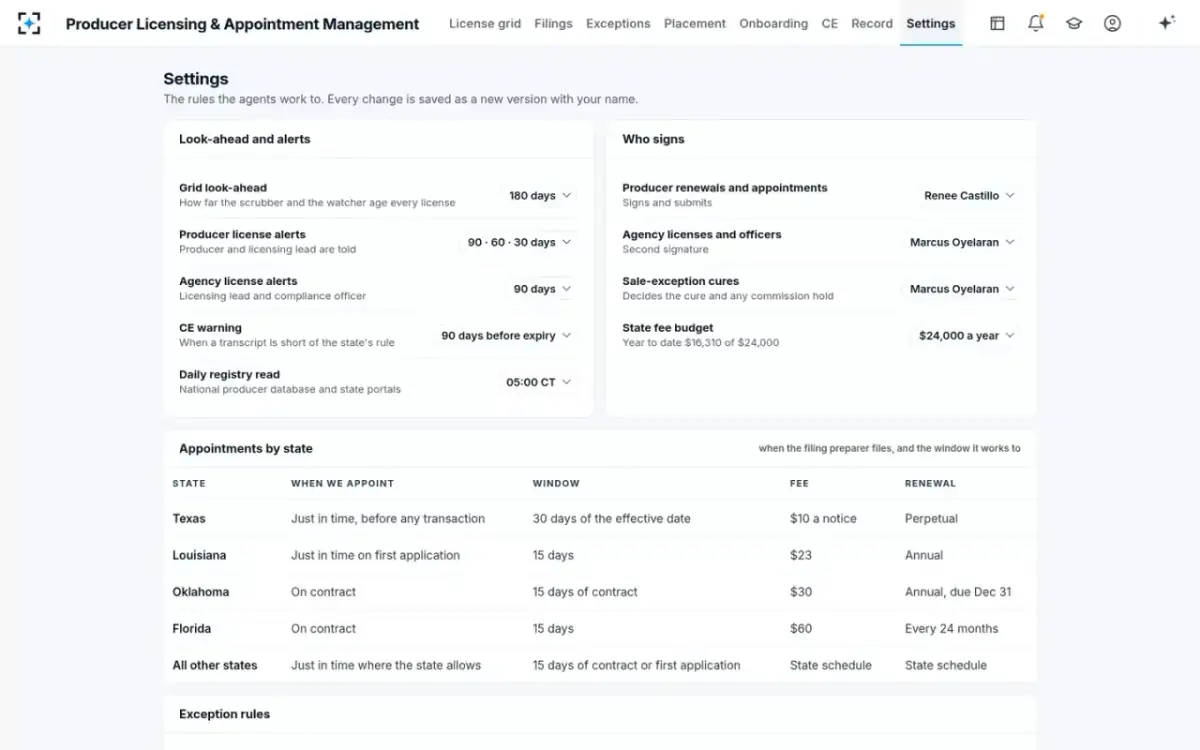
Seeing every state fee before signing, in Producer Licensing & Appointment Management
The solution makes fees a line on every filing rather than a surprise on a card statement. Its filing preparer attaches the state fee to each renewal, appointment and agency change; the licensing lead sees the total before signing; the agency's fee budget sits in the settings beside the signers. In the sample agency, one team's open filings carry $503 in state fees, and one set of seven fixes for a new account comes to $520.
Prepared filings with the state fee on every line
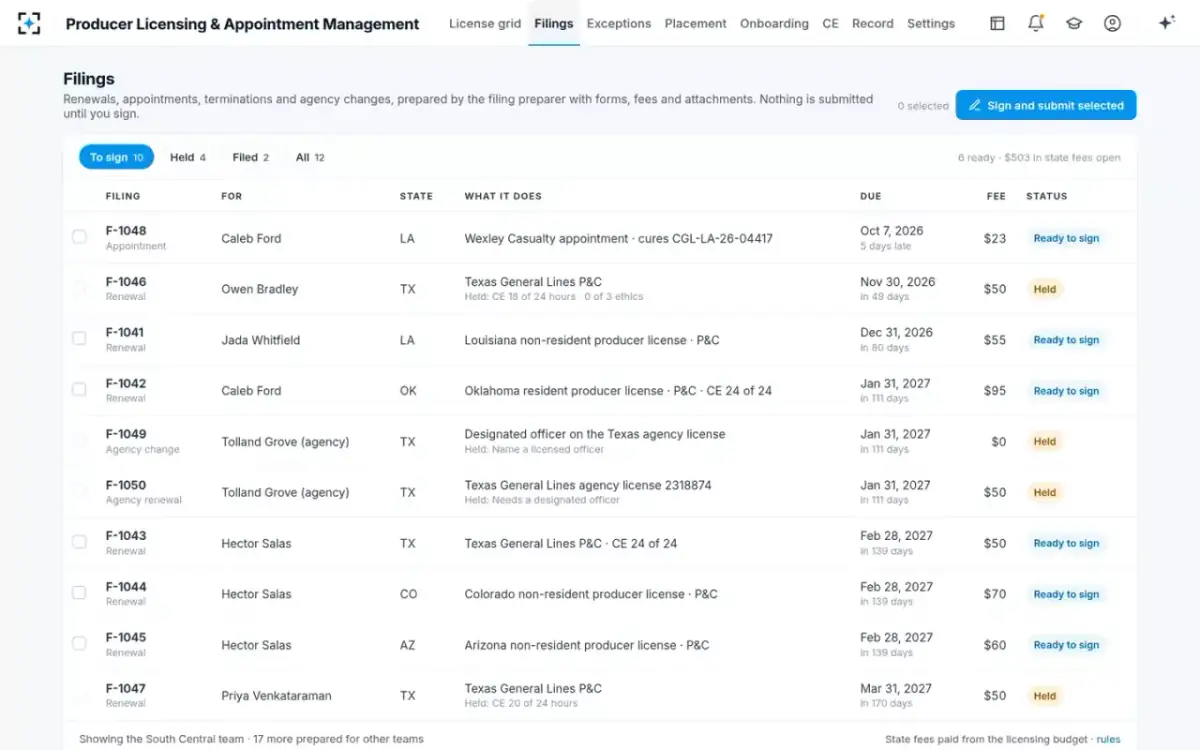
What it does not do is decide which appointments to keep. It can show which producers have written nothing in a state for a year and which invoices are coming, so the person who owns the budget can terminate before the cut-off. The daily grid that makes that visible is described in insurance licensing coordinator job description, and the rest of the workflow on the Producer Licensing & Appointment Management page.
Questions people ask
Are appointment fees charged per carrier or per producer?
Both: one fee for each producer each insurer appoints, in each state. North Carolina goes further and counts one appointment per line of authority, so a property and casualty producer is two appointments for each insurer.
Are insurance appointment fees refundable?
Generally not. California's statute says filing fees are not refunded whether or not the application is acted on, and NIPR's renewal pages state that renewal payments and processing fees are non-refundable. Pennsylvania bills a full year's fee for anyone appointed at any point in the prior year.
Do brokers pay appointment fees?
Not as brokers. The NAIC's model act requires an appointment only for a producer acting as an insurer's agent, and the NAIC handbook concludes that no appointment notice is needed for a broker. A producer who acts as an agent for some insurers and a broker for other clients pays, through those insurers, only for the agency appointments.
How much does NIPR add to an appointment renewal?
NIPR's renewal processing fee is 1% of the total state fee on the invoice, with a minimum of $5 and a maximum of $1,000. Payment is by card up to $60,000 or by electronic check above that.
Why do some states charge different insurers different fees?
Several states set the fee by the appointing insurer's home state; Iowa's NIPR page calls it a retaliatory fee. That is why Nebraska's list runs from $8 per appointment for its own insurers to $75 for insurers from Massachusetts, and why a carrier's appointment budget cannot be copied from another carrier's.