Licensing compliance software, in insurance, keeps producers' licenses, carrier appointments and continuing education current across every state and proves it: it reads the state records, prepares renewal, appointment and termination filings, and checks each sale against the license that was in force when the policy was bound. The question that separates useful software from risky software is not how much it automates but who signs. A license application is the applicant's own statement under penalty of perjury; an appointment is the insurer's certification to the state; a termination for cause is an officer's judgment about a person. Botminds' Producer Licensing & Appointment Management is built on that line: its agents read and prepare, a named licensing lead signs every filing, and a compliance officer decides what happens when a sale went through without the right permission.
The screens and figures below come from the solution running on a fictional sample agency. The rules come from the NAIC's Producer Licensing Model Act (#218), the NAIC State Licensing Handbook, state statutes and the U.S. Code, linked where they are used.
A licensing filing in Producer Licensing & Appointment Management: agents prepare, people sign
Agent
Registry syncReads each license, line of authority, appointment and CE record from the national producer database and state portals every morning, and records what changed.
Never: edits a state record.
Agent
Expiry and CE watcherAges every license and appointment forward and compares each CE transcript with the state’s rule.
Never: extends or waives a deadline.
Agent
Filing preparerPrepares the renewal, appointment, termination or agency change with its form, fee and attachments, and holds any that are blocked, with the reason.
Never: submits without a signature.
A person decides
Licensing lead and compliance officerThe licensing lead reviews the filings and fees and signs, with the meaning of the signature recorded; the compliance officer adds a second signature to agency filings and decides cures.
Agent
Submission and read-backSends the signed filing to the state through its channel and reads the state record back the next morning to confirm it landed.
What is licensing compliance software, in insurance?
It is software that keeps the three permissions behind every sale current and provable: each producer's license for the line in the state, the carrier's appointment where the state requires one, and the agency's own license. It sits between the national licensing rail and the agency's or carrier's own systems.
The rail already exists. The NAIC describes how state regulators use the National Insurance Producer Registry (NIPR): "Applicants and licensees can transmit licensing applications, insurers can transmit appointments and terminations, and both can transmit other information to state insurance regulators in multiple states" (State Licensing Handbook, ch. 1). Compliance software does not replace that channel. It decides what should travel down it, prepares it, and keeps the evidence of what was sent and why.
The term covers a wide range of products. At one end are trackers that store expiry dates and send reminders. At the other are systems that read the state records themselves, prepare the filings, match sales to licenses and produce an examiner's file. The more a system does, the more it matters that it stops at the right place.
Which licensing filings can software prepare, and which must a person sign?
Software can prepare every licensing filing; the law decides who answers for each one. The table puts the two side by side, filing by filing, using the model act, the NAIC uniform application and two state statutes as the reference.
Who answers for each licensing filing, and what an agent may do with it
| Filing | Who the law makes answer for it | What an agent can do | What stays with a person |
|---|---|---|---|
| Individual license application or renewal | The applicant, who certifies the application “under penalty of perjury” (NAIC uniform application) | Pre-fill from the registry, check CE has posted, show the fee | The applicant’s attestation and every background answer |
| Notice of appointment | The insurer, within 15 days of the contract or first application (Model #218, §14B); in Florida the appointing entity certifies it investigated the licensee | Prepare the filing, start and watch the clock, show the fee | The insurer’s decision to appoint, by someone it authorizes |
| Termination without cause | The insurer, within 30 days of the effective date; copy to the producer within 15 days after (§15) | Prepare both, from the effective date the business gives it | Confirming the effective date and that the relationship has ended |
| Termination for cause | The insurer, reporting the Section 12 reason within 30 days; telling other insurers about it is protected only with an officer’s written certification (§15A, §15E) | Assemble the dates and documents | The finding of cause and the certification |
| Agency license and its responsible producer | The business entity, which must designate a licensed producer responsible for compliance (§6B) | Spot a departed or unlicensed designee and draft the change | Naming the person |
| 1033 consent | The individual, who applies to the home-state regulator; anyone in the insurance business who willfully permits an ineligible person to take part commits a federal crime | Flag a “yes” to the felony question and the missing consent | Whether to proceed, decided by compliance |
| Report of an action against the producer | The producer, within 30 days of the final disposition (§17) | Detect a regulatory action on the registry and draft the report | The producer’s filing |
The right-hand column is short, and that is the point. Almost all of the hours in licensing are in the middle column: finding the record, counting the days, filling the form, computing the fee. Almost all of the liability is in the right-hand one.
Can software file insurance license renewals?
Software can transmit a renewal, but the renewal is the licensee's. Many states already renew electronically: the NAIC notes that the electronic process "automatically checks the NAIC and National Insurance Producer Registry (NIPR) databases to verify the producer's standing in the home/resident state" (State Licensing Handbook, ch. 16). What no system can do is make the statements on the renewal application for the producer.
"I hereby certify that, under penalty of perjury, all of the information submitted in this application and attachments is true and complete."
NAIC Uniform Application for Individual License/Registration, applicant's certification and attestation, item 1
The useful job for software is everything before that signature. It can see that a renewal is due, that the CE transcript is six hours short, that ethics hours are missing, and that the state fee is $50, and it can hold the renewal with that reason on it instead of letting a producer sign something the state will reject. In the sample agency, a Texas renewal sits prepared and held at 18 of 24 CE hours and none of the 3 ethics hours, so that the filing is ready the day the hours post.
Can insurance appointments be filed automatically?
The transmission can be automatic; the decision to appoint cannot. An appointment is not paperwork about a producer. It is the insurer telling the state that this person acts for it.
Florida's statute makes that explicit. By authorizing an appointment, "the appointing entity is thereby certifying to the department that an investigation of the licensee has been made and that in the appointing entity's opinion and to the best of its knowledge and belief, the licensee is of good moral character and reputation, and is fit to engage in the insurance business" (Fla. Stat. §626.451(2)). The same section adds that the insurer certifies it "is willing to be bound by the acts of the agent". Software can prepare that filing in seconds. A person at the insurer has to be the one who means it.
Where automation earns its keep is the clock. Under the model act the insurer has 15 days from the agency contract or the first application, whichever comes first, and the NAIC reads "submitted" as the date the insurer received the application. A system that sees every new application can start that clock on the right day and raise it to a person well before it runs out. How that window works, and how states differ on it, is in just in time appointment states.
How does license software match sales to licenses?
It takes each bound policy and asks three questions as of the bind date: was the producer's license in that state active, did its line of authority cover the product, and was the carrier's appointment on file or still inside the state's filing window? A sale that fails any of the three becomes an exception with its evidence attached.
The bind date matters because licenses and appointments change. A license that is active today may have been lapsed in August; an appointment filed today may have been five days late for a policy bound last month. Checking against today's grid finds neither.
Two sales out of 3,418 failed the bind-date check, each with its evidence and a proposed cure
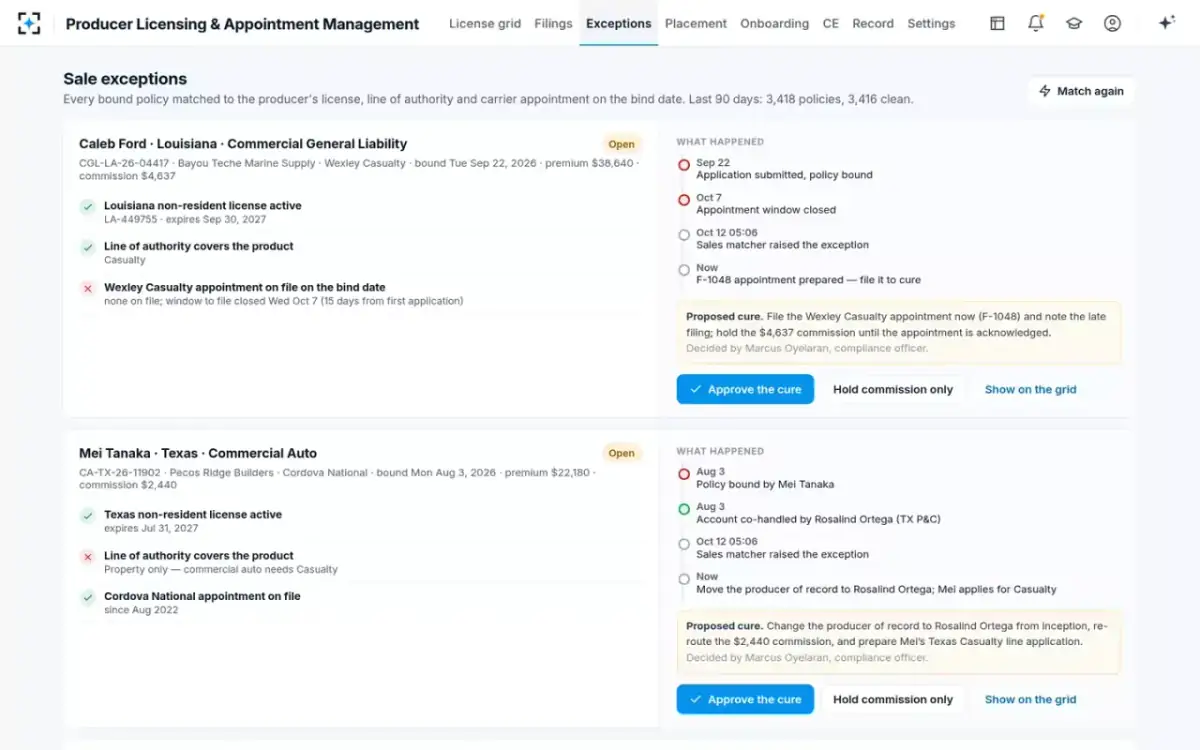
Neither sample exception is unusual. One is a filing that missed its window; the other is a producer licensed in the state but for the wrong line. What an examiner looks for in the same records is set out in insurance license compliance: the file an examiner asks for.
Who decides a termination for cause?
A person at the insurer, and the model act makes that person's role formal. When an insurer ends a producer's appointment for one of the 14 grounds in Section 12, such as misappropriating premium or forging a signature, it must notify the commissioner within 30 days and, within 15 days after that, send the producer a copy "by certified mail, return receipt requested, postage prepaid or by overnight delivery using a nationally recognized carrier" (Model #218, §15D).
The model also shields the insurer from civil suits over the report, absent actual malice, and extends that shield to telling another insurer or producer whether a termination for cause was reported, "provided that the propriety of any termination for cause under Subsection A is certified in writing by an officer or authorized representative of the insurer or producer terminating the relationship" (§15E(1)). New York keeps the same structure and treats each statement as "a privileged communication" (N.Y. Ins. Law §2112(d)). A system can assemble the dates; it cannot find cause or certify it.
What should licensing compliance software never do?
The safe boundary is easy to write down and easy to test in a demonstration. These are the eight questions to put to any product, including ours.
Eight things licensing compliance software should never do
- Sign or attest for a producer
The application’s certification is the applicant’s, under penalty of perjury. Pre-filling it is fine; clicking it is not.
- Submit a filing nobody signed
Every renewal, appointment and termination should carry a named signer and the meaning of the signature.
- Edit a state record
Reading the producer database and state portals is safe. Changing them is the state’s job, through a filing.
- Extend, waive or reinterpret a deadline
A 15-day or 30-day clock is set by statute. The software counts it; a person decides what to do when it is missed.
- Decide a cure or hold commission
Whether to file late, change the producer of record or hold pay is a compliance decision with money attached.
- Find cause in a termination
Cause is a judgment about a person, and the model act asks an officer to certify it in writing before the insurer passes it on.
- Clear a 1033 question on its own
A felony involving dishonesty needs written regulatory consent before the person works in insurance; anyone who willfully permits otherwise is exposed too.
- Tell a producer to quote where no one can place the risk
A placement check should say which states are missing and which filings would close the gap, then stop.
How do you audit automated licensing filings?
You audit the evidence, not the software. For every filing, an auditor should be able to see the state record it was prepared from, the rule it applied, who signed, what they were told the signature meant, and what the state record showed afterwards. If any of those lives only inside a vendor's screen, the carrier cannot show it to an examiner.
Electronic signatures are not the issue. The federal E-SIGN Act expressly applies to the business of insurance (15 U.S.C. §7001(i)), so a signed electronic filing carries the same weight as paper. The issue is attribution: the signature has to be the right person's, and the record has to show that it was.
Seven filings, $520 in state fees, one signature with its meaning recorded
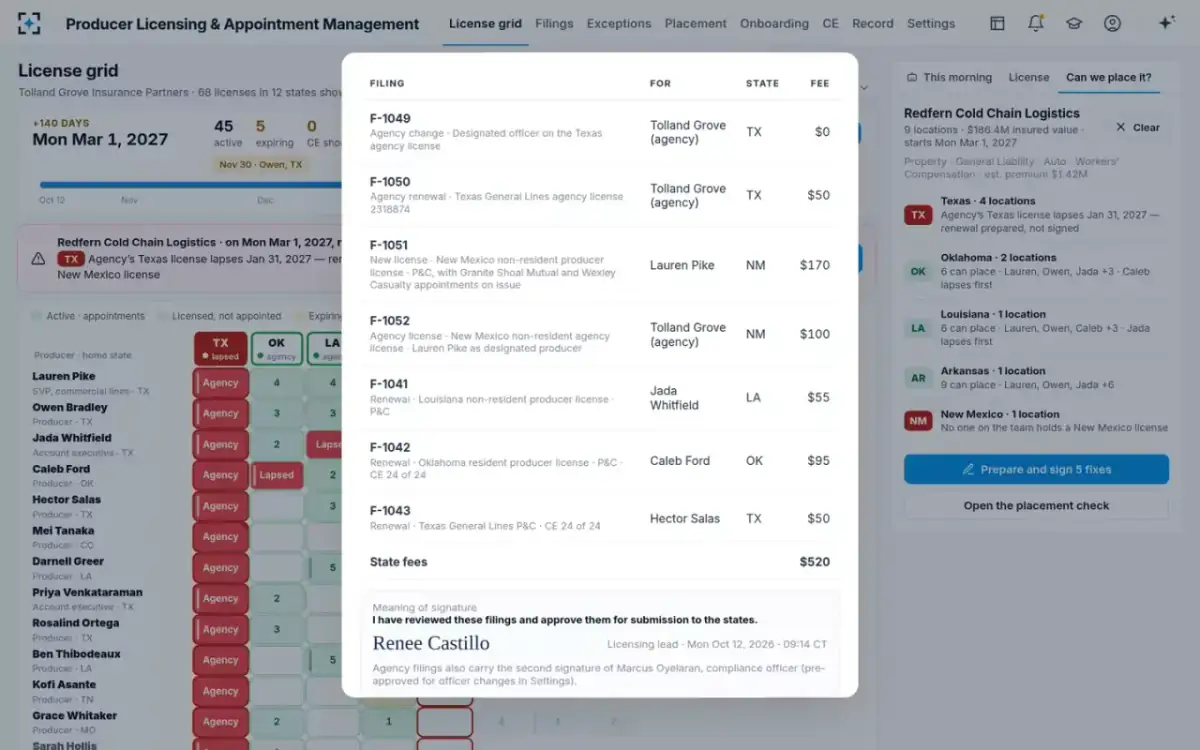
Two further tests catch most weak systems. Ask for the rule set as of a past date: what look-ahead, alert windows, signers and appointment rules applied on the day a filing was prepared. And ask the system to replay last quarter's sales against the licenses as they stood on each bind date; a tool that can only check today's grid will pass sales an examiner would fail.
Where Producer Licensing & Appointment Management fits, and where it does not
It fits between the national producer database and state portals on one side and the agency or policy system on the other. It reads both, prepares the filings, matches sales to licenses and keeps the evidence. It does not replace NIPR or a state's own filing channel, it does not hire or appoint anyone, it does not give legal opinions on a state's variant of the model act, and it does not decide cures. Every one of those stays with the licensing lead or the compliance officer.
The honest test is your own roster. We run the solution on a sample of your producers and states first, so the prepared filings, held renewals and sale exceptions can be checked against what your team already knows. What a new producer needs before that first sale is listed in the insurance agent onboarding checklist; the whole workflow is on the Producer Licensing & Appointment Management page.
Questions people ask
Is licensing compliance software the same as license tracking software?
Not quite. A tracker stores expiry dates and sends reminders; compliance software also prepares the filings, checks each sale against the license on its bind date and produces the evidence an examiner asks for. The second job is where most exam findings come from, because a reminder cannot tell you a policy was bound through an unappointed producer.
Can an AI agent sign a licensing filing electronically?
It should not. Electronic signatures are valid in insurance, but the uniform application's certification is the applicant's own, under penalty of perjury, and an appointment is the insurer's certification to the state. An agent can prepare the filing and present it; a named person signs.
Does a termination have to go to the producer as well as the state?
Yes, under the model act. The insurer notifies the state within 30 days of the effective date and mails the producer a copy within 15 days of that notice; for a termination for cause the copy goes by certified mail or overnight delivery. The producer then has 30 days to send written comments to the state.
What happens if the software misses a filing deadline?
The insurer is still the one that missed it. In a 2020 consent order, Kansas imposed a $60,000 penalty, half of it suspended, after finding 670 policies issued over three years through producers not appointed at the time of sale; the insurer neither admitted nor denied the violations. A system that counts the clock reduces that risk only if a person acts on what it raises.
How long does it take to set up licensing compliance software?
No independent study gives a figure, so measure it on a pilot: the time to load your roster's producer numbers, your carriers' appointment lists, your state rules and three months of bound policies, and the time until the prepared filings agree with what your team would have filed. That second number is the one that matters.