A commission split for an insurance agent is an agreement to share the commission on a policy between two or more people: two producers who worked an account, a producer and the agency, an agency and a co-broker, or a producer and someone who referred the client. Most of the arithmetic is simple. The rules are not: under the NAIC's Producer Licensing Model Act, which states adapt in their own producer laws, no commission may be paid to or accepted by anyone who needed a licence for the sale and did not have one, and renewal commissions may go only to someone who was licensed when the policy was sold. So every split is first a question of who was licensed for what, in which state, at the time of sale. Botminds' Insurance Commission Reconciliation computes producer splits on the commission carriers actually paid, under each producer's agreement, and never changes a split percentage itself.
This page states the rules from the NAIC models and named state laws; state enactments differ, so check your own state's statute before relying on a model's wording. Product examples are fictional sample data.
Who may be paid a share of commission, case by case
- A producer licensed for the line in the state where the business was sold
Yes, under the split agreement. The licence is what makes the payment lawful (NAIC Model #218 §13A–B).
- An unlicensed employee who sold, solicited or negotiated the policy
No. Neither the agency nor the carrier may pay it, and the employee may not accept it (§13A–B).
- A referral source who does not sell, solicit or negotiate
Often yes, within limits: the model allows payment to people who do not sell, solicit or negotiate, unless it breaks the state's anti-rebating law (§13D); New York adds conditions (§2115).
- A producer who has left, on renewals of policies they sold
The law allows it if they were licensed at the time of sale (§13C); whether they are owed it is a matter for their agreement.
- Another licensed agency or co-broker
Yes: the model expressly allows payment to an insurance agency (§13D).
- The client, as a share of your commission
Generally no: a rebate offered as an inducement is an unfair trade practice under the NAIC model, with narrow exceptions (Model #880 §4I).
- Anyone, where the producer is also paid a fee by the client
Only with disclosure: the model requires the client's documented acknowledgment and the amount or method (Model #218 §18).
How do commission splits work between insurance agents?
A split takes the commission the agency received on a policy and divides it under a written agreement: typically a percentage to the producer, different for new business and renewals, with the rest kept by the agency, or a share to a second producer who worked the account. The agency is paid by the carrier; producers are paid by the agency. That ordering is the source of most split disputes, because a producer's share is only as good as the reconciliation of the carrier's payment behind it.
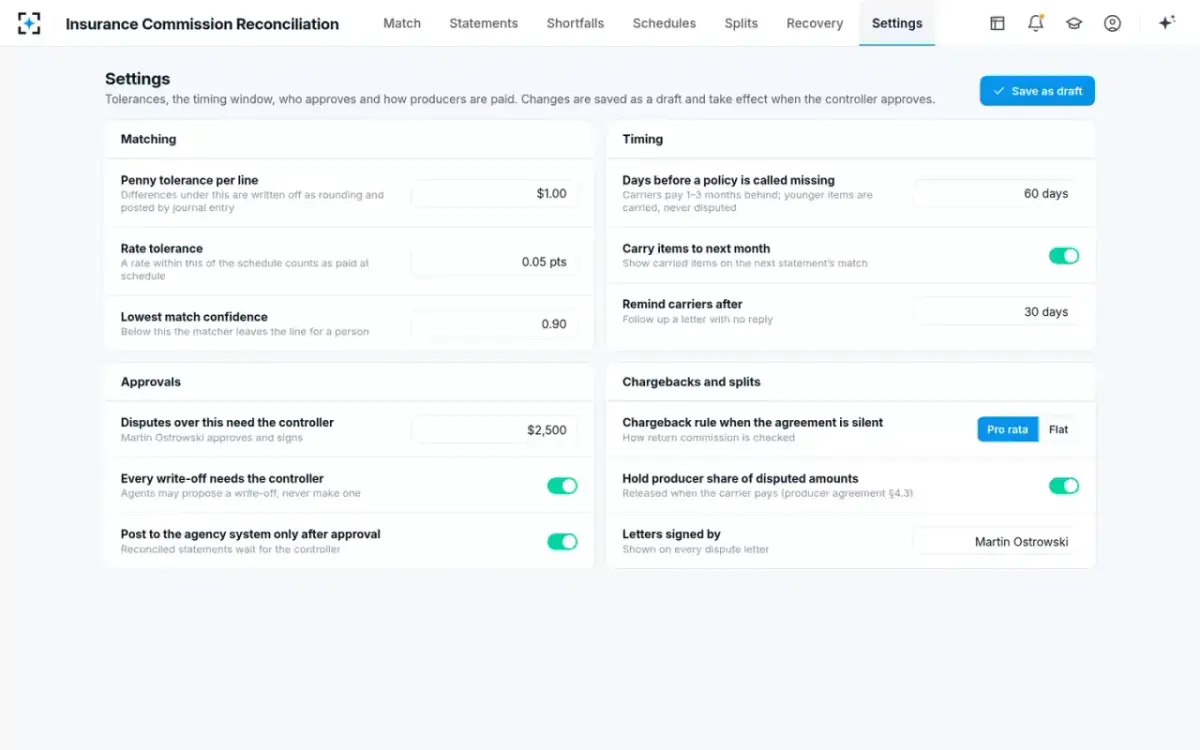
The split agreement should say four things: the percentages by transaction type, what the percentage applies to (commission received, or commission expected), what happens to the producer's share when a carrier pays short or charges back, and what happens on departure. The second and third are where agencies differ most, and where the producer's statement either holds or invites a dispute.
Can an insurance agent split commission with an unlicensed person?
Not for selling, soliciting or negotiating insurance. The NAIC model puts the rule on both sides of the payment: the payer may not pay, and the recipient may not accept.
"An insurance company or insurance producer shall not pay a commission, service fee, brokerage or other valuable consideration to a person for selling, soliciting or negotiating insurance in this state if that person is required to be licensed under this Act and is not so licensed."
NAIC Producer Licensing Model Act (#218), Section 13A
The licence has to fit the sale: the right line of authority, in the state where the business is transacted, at the time it was transacted. A producer licensed in one state who works an account in another needs a nonresident licence there before any split on that account is lawful. The model also lets a commissioner act against the licence of a producer who knowingly accepts business from an unlicensed individual (§12A(12)), one rung of the ladder in what happens if your insurance license expires. How a licence differs from an appointment is set out in insurance license vs appointment.
Can I pay a referral fee to an unlicensed person for insurance?
Often yes, if the person only refers and the fee does not depend on a sale, but the conditions are the state's. The NAIC model allows an insurer or producer to "pay or assign commissions, service fees, brokerages or other valuable consideration to an insurance agency or to persons who do not sell, solicit or negotiate insurance in this state," unless the payment would break the state's anti-rebating law (§13D). New York writes the line more precisely. For the purposes of its agent-commission rule, "acting as insurance agent" shall not include "the referral of a person to a licensed insurance agent or broker that does not include a discussion of specific insurance policy terms and conditions and where the compensation for referral is not based upon the purchase of insurance by such person" (N.Y. Ins. Law § 2115).
Two details in New York are easy to miss. The fee cannot depend on whether the client buys, so a "per bound policy" referral fee to an unlicensed person fails the test. And the official text shows a later version of § 2115, effective 10 September 2029, without the referral sentence; an agency paying referral fees in New York should watch for that change. The parallel broker section, § 2116, carries the same sentence and the same two versions.
Do departing producers keep renewal commissions?
The law permits it; the contract decides it. The NAIC model allows renewal and deferred commissions to be paid "to a person for selling, soliciting or negotiating insurance in this state if the person was required to be licensed under this Act at the time of the sale, solicitation or negotiation and was so licensed at that time" (§13C). A producer who leaves, or whose licence later lapses, may therefore still be paid renewals on business written while licensed, if the producer agreement provides for it.
The reconciliation consequence is practical: every renewal paid to a departed producer needs two records joined to it, the producer's licence status on the original sale date and the agreement clause that grants the renewal. Without them, an agency can neither defend the payment nor stop it.
From the carrier's statement to a lawful split: the checks in order
Agent
Reconcile the carrier lineCommission paid against the schedule; any shortfall disputed, any chargeback checked.
Never: pays a split on commission not yet received
Agent
Identify who sold itThe producer of record on the policy, and any co-producer or referral on the account.
A person decides
Confirm the licence at the time of saleLine of authority and state, on the transaction date; for renewals, on the original sale date.
Agent
Apply the split agreementPercentage by transaction type, on the reconciled commission; disputed amounts held.
Never: changes a split percentage
A person decides
Approve and payThe controller releases the split statement and payroll file.
Can an agency pay commission to another agency?
Yes, if the other agency is licensed for the business; the model's §13D names "an insurance agency" among those who may be paid. Co-brokerage between agencies, a wholesaler's share to a retail agency and a sub-producer arrangement all rest on this. What the paying agency must still check is the licence of the receiving entity in the state concerned, and that the receiving agency's own producers were licensed for the sale.
Is rebating commission legal?
Sharing commission with the client as an inducement to buy is generally prohibited. The NAIC's Unfair Trade Practices Act defines as an unfair practice paying or allowing, "directly or indirectly, as inducement to such policy, any rebate of premiums payable on the policy," or any "valuable consideration or inducement whatever not specified in the policy" (NAIC Model #880, §4I). Examiners test for it: one of the NAIC's underwriting and rating exam standards is that "The regulated entity does not permit illegal rebating, commission-cutting or inducements" (NAIC, 2024 Market Regulation Handbook Examination Standards Summary).
The current model carves out value-added products or services that relate to the coverage and are designed for purposes such as loss control, risk education or post-loss services, at reasonable cost and offered without unfair discrimination, and allows modest gifts up to an amount the commissioner sets. Those are not commission splits with the client. A producer who discounts a client's premium out of their own commission is rebating unless the state's law expressly allows it.
What is a producer commission split agreement?
It is the written contract that sets a producer's share: percentages for new business and renewals, the base the percentage applies to, how chargebacks and short payments are passed on or held, when shares are paid, what happens to renewals on departure, and any house accounts excluded from splits. For employed producers, some states also require the commission terms in writing; New York's rule for commission salespeople is covered in how insurance agents are paid.
Splits on commission received, with disputed shares held
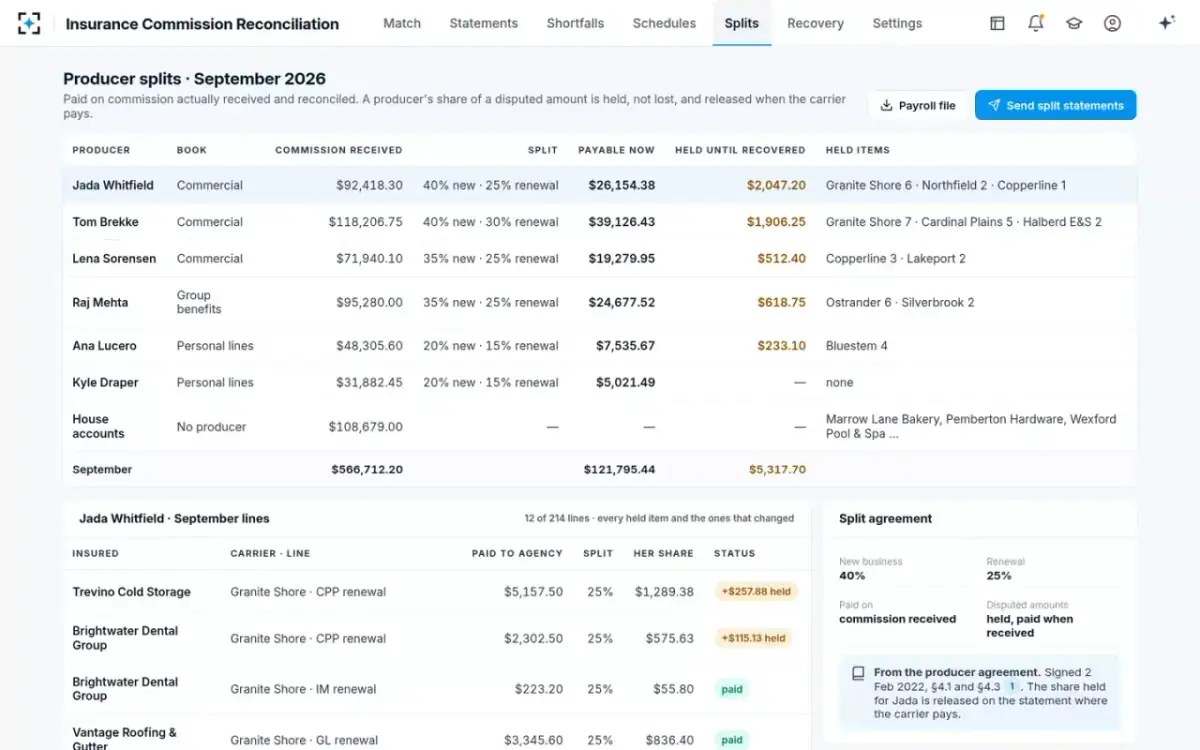
The split rules an agent may not change, written down as settings
What must be disclosed about commission, in the US and the UK?
Disclosure rules run alongside split rules: they govern what the client is told about the commission being split. In New York, Regulation 194 "requires an insurance producer to provide in all cases a mandatory initial disclosure to a purchaser," and "a producer need only disclose the amount of the compensation if the purchaser asks for additional information" (DFS, Regulation 194 FAQ). In the UK, the FCA's guidance on commercial customers' requests says an intermediary "should include all forms of remuneration from any arrangements it may have," including "arrangements for sharing profits, for payments relating to the volume of sales, and for payments from premium finance companies in connection with arranging finance" (FCA Handbook, ICOBS 4.4.2G).
Commission disclosure: New York, the NAIC model and the UK
United States: New York: every sale gets an initial disclosure (Regulation 194). NAIC model: when the producer is also paid by, or represents, the customer (§18).
United Kingdom: Commercial customers: on request (ICOBS 4.4).
United States: New York: the amount only if the purchaser asks. NAIC model: the amount, or the method and a reasonable estimate, with the customer's documented acknowledgment.
United Kingdom: The commission received by the firm and any associate, in cash terms, estimated if necessary.
United States: NAIC model: commissions, fees, overrides, bonuses, contingent commissions and other valuable consideration.
United Kingdom: All remuneration, including profit-sharing, volume payments and premium finance payments.
United States: New York: written disclosures kept at least three years.
United Kingdom: Disclosure in writing or another durable medium.
What happens if commission is paid to an unlicensed agent?
Under the model, both sides break the law: the payer under §13A and the recipient under §13B. Regulators can act on the payer's licence for violating insurance laws, and the model separately names knowingly accepting business from an unlicensed individual as a ground (§12A). Enforcement is common enough to matter: in 2022, state regulators levied 44,876 fines against insurance producers and revoked 4,663 licences, according to the NAIC's Insurance Department Resources Report, though those figures cover every kind of violation, not unlicensed commission alone.
For the agency, the fix is in the order of work: confirm the licence before the first split is paid, not after a carrier's audit asks. A split run on reconciled commission and checked against licence records at the time of sale is what an examiner can test. What insurers spend on commission by line shows how much money rides on getting it right.
To see producer splits computed on reconciled commission, start from Insurance Commission Reconciliation.
Questions people ask
Can a licensed agent split commission with a licensed agent in another state?
Only if the other agent is licensed in the state where the business is transacted, for the line sold; a home-state licence alone is not enough. That is what nonresident licences are for: in 2022 there were 9.5 million nonresident individual producer licences against 2.3 million resident ones, according to the NAIC.
Can an agency pay a bonus to an unlicensed customer service representative?
A salary or a bonus not tied to selling, soliciting or negotiating is a different question from a commission split. The model exempts employees whose work is administrative or clerical and who receive no commission on policies sold; a bonus per policy sold to an unlicensed employee is the risk.
Is a referral fee the same as a commission split?
No. A referral fee pays for an introduction; a split shares commission on a sale. In New York a referral fee to an unlicensed person must not depend on the client buying and must not involve discussing specific policy terms.
Do commission split percentages have to be the same for every producer?
No. Splits are set by each producer's agreement and often differ by book and by new business and renewal; in the solution's sample, commercial producers were on 40% or 35% of new business and personal lines producers on 20%.
Who pays a producer's split when the carrier pays short?
That depends on the agreement. Paying on expected commission means the agency fronts the shortfall and claws it back later; paying on received commission, with the disputed share held, means the producer waits but is not clawed back.