A direct bill commission specialist is the person in an insurance agency who reconciles the commission statements carriers send for policies they bill directly: reading each statement, matching every line to the policy in the agency management system, checking the rate against the carrier's commission schedule, posting what was received and chasing what was not. Agencies give the seat several names: commission accountant, accounting specialist, or simply "commissions". The work is hard because an agency with a dozen or more carriers gets a dozen or more statements a month, in different formats, with different policy-number styles, and the only way to know a line is right is to check it against a schedule nobody keeps beside the statement. Botminds' Insurance Commission Reconciliation exists for that desk: six agents read, match and explain every line, and the specialist decides what to chase.
This page follows one month-end from the specialist's chair. The examples come from the solution's sample agency, Tallis Kerr Insurance Group, closing 14 fictional carriers' September 2026 statements; the hours are our estimate, and the two-day close is a design target, not a measured result.
Where nine days of month-end go, and the two-day target
- Collect and key2 d
- Match to policies3 d
- Tie the totals1.5 d
- Missing, chargebacks1 d
- Letters, splits1 d
- Review0.5 d
- Collect, match, tie0.75 d
- Gaps, letters, splits0.75 d
- Review0.5 d
What does a direct bill commission specialist do?
The specialist turns carriers' direct bill statements into posted, checked commission income. On direct bill business the carrier collects the premium from the insured and pays the agency its commission on a statement, so the agency never touches the premium; what it has to prove is that each commission line is the right amount, on the right policy, at the rate the carrier agreed to pay. The job has five parts, and they repeat every month.
First, gather: download portal exports, pick up commission downloads, open the PDFs that arrive by email. Second, match: find each line's policy in the agency system, often under a different number. Third, check: is the premium the written premium the schedule pays on, is the rate the one in force, is a cancellation charged back on the premium actually returned? Fourth, chase: write to the carrier's agency accounting about what is short or missing, and track the reply. Fifth, pay out: work out producer splits on what came in. The producer's side of that last step is a reconciliation in its own right.
The federal statistics have no "commission specialist" occupation. The nearest is the one the Bureau of Labor Statistics calls bookkeeping, accounting and auditing clerks, whose listed duties include to "Reconcile or note and report any differences they find in the records" (BLS Occupational Outlook Handbook). In an agency the role sits closer to staff accountant than clerk, because the differences it finds are money owed to the agency and the letters it writes cite contracts.
Month-end, hour by hour: where nine days go
By hand, about two-thirds of the close is spent getting statements into a shape that can be compared at all. In our estimate for an agency closing 14 direct bill statements, 6.5 of 9 working days go on collecting and keying, matching and chasing totals that do not tie; 2 days go on missing policies, chargebacks, letters and splits, where the money actually is; half a day is the controller's review.
Days one and two are collection. Statements land on different days of the month, in different places: a carrier portal that needs a login, a commission download, a PDF in a shared mailbox, a spreadsheet attached to a carrier accountant's email. Each has to be opened, totalled and, if it cannot be imported, keyed. Days three to five are matching: one statement line at a time, find the policy, confirm the insured, the effective date and the transaction type, and tick it. Day six is the totals that do not tie: a line keyed twice, say, or a transaction code read the wrong way. Day seven goes on what is missing and what was taken back, day eight on letters and producer splits, and on day nine the controller reviews and the statements are posted.
Where the estimated days go: mechanical work crowds out judgement
By hand · 9 days
- Keying, matching, tying totals · 72%
- Finding gaps · 11%
- Letters, splits · 11%
- Review · 6%
Target · 2 days
- Keying, matching, tying totals · 37%
- Finding gaps · 13%
- Letters, splits · 25%
- Review · 25%
The matching days hide the real constraint. Three days is 24 working hours; across the sample month's 2,984 statement lines that is about 29 seconds a line. Twenty-nine seconds is enough to find a policy and tick it. It is not enough to open the carrier's schedule, find the line of business and the transaction type, and confirm the rate. That is why, by hand, the specialist matches every line and checks the rate only on lines that already look wrong, and why the sample agency's accountant puts it as: "I can match it. I can't also check every rate against every schedule."
What are direct bill commission statements, and why does every carrier's look different?
A direct bill commission statement is the carrier's monthly account of the commission it owes the agency on policies it billed directly: one line per transaction, with the policy number, the insured, the line of business, the transaction (new, renewal, endorsement, cancellation), the premium, the rate and the commission. No two carriers lay it out the same way, which is why the first two days of the close are about format, not money.
Four formats, four ways to slow a reconciliation down
| Format | How it usually arrives | What makes it slow | What to check before matching |
|---|---|---|---|
| PDF statement | Emailed or downloaded, often many pages | Lines have to be read or keyed; totals sit on the last page | That the lines add up to the printed statement total |
| Spreadsheet | Attached to an email from carrier accounting | Column names and transaction codes differ by carrier | That no rows are hidden, filtered or subtotalled twice |
| Portal export | Downloaded from the carrier's agent site | Needs a login and a date range; easy to export the wrong month | That the period matches the statement being closed |
| Commission download | Delivered into the agency system electronically | Can arrive alongside an emailed copy of the same month | That the month is read once, not twice |
Policy numbers are the second source of friction. A carrier may print GSC-CPP-0048817 where the agency system holds CPP0048817, drop leading zeros, or add a term suffix. Transaction codes vary too: one carrier's "XLC" is another's "CAN". None of this is hard for a person who knows the carrier, which is exactly why it stays in one person's head.
How do you match carrier statements to the agency system?
You match on four keys, not one: policy number, insured name, effective date and transaction type. A policy-number match alone can join a renewal to last year's term or an endorsement to the original issue; the other three keys confirm it is the same transaction. A careful specialist also checks the statement adds up to its own printed total before matching anything, because a misread line poisons every comparison after it.
In the solution the matcher normalises policy numbers across the carrier's and the agency's formats, scores each candidate on all four keys and never forces a match below a confidence the agency sets (0.90 in the sample); anything under it waits for the accountant. On the sample agency's last statement, from Granite Shore Insurance, 211 of 212 lines were found in the agency system and 187 matched exactly. The 212th line was a policy the agency had no record of, paid all the same.
The month's statements on one screen, with what each left on the table
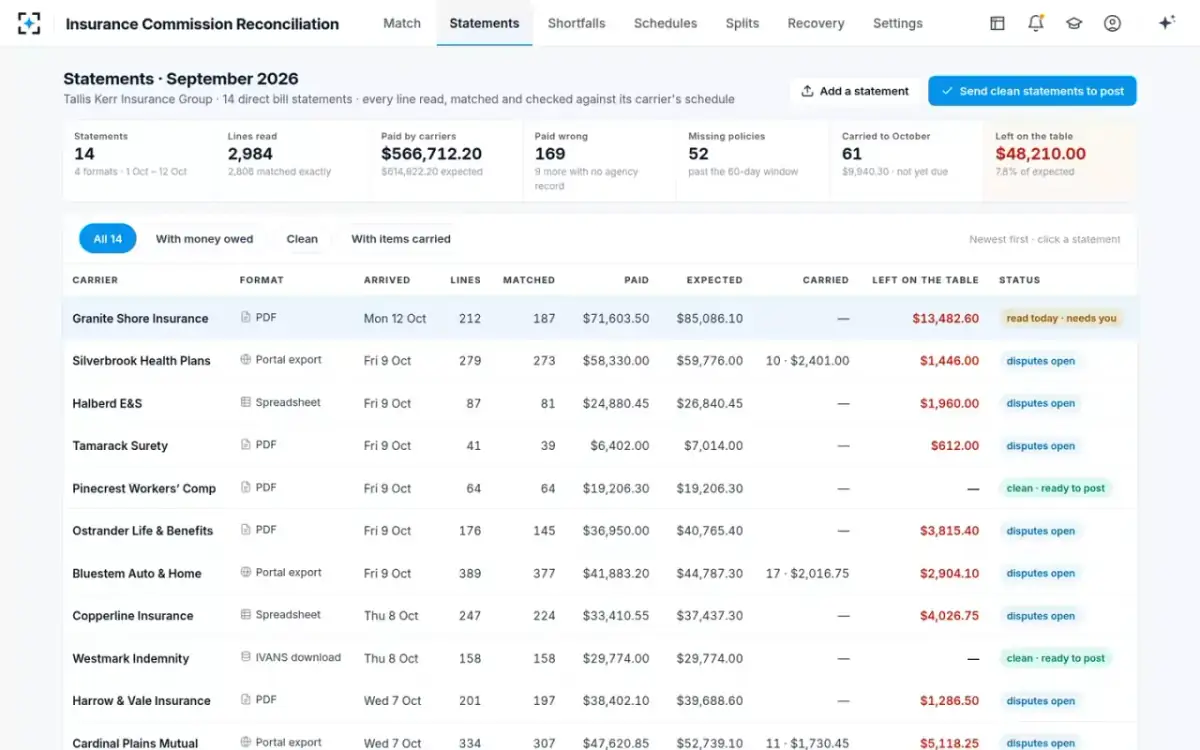
What is the hardest part of commission reconciliation?
The hardest part is not matching; it is deciding which differences are real. A gap can be timing, rounding, a rate change, a missing policy, a wrong premium base or a chargeback calculated the wrong way, and each needs a different answer. Calling a timing difference a shortfall wastes a carrier's goodwill; calling a real shortfall timing loses the money.
Three judgement calls recur. The first is the rate: a renewal paid at last year's rate looks paid unless someone opens this year's schedule. In the sample, 23 commercial package and businessowners renewals were paid at 12.5% when the carrier's schedule, revised on 1 January, paid 15.0%: $8,147.50 on one statement. The second is the chargeback: when a policy cancels mid-term, an agency agreement may return commission only on the premium returned (the sample carrier's does), and a carrier that takes back the full term's commission is over-charging; how a chargeback should be calculated has its own worked example. The third is the missing policy: a policy bound in July and absent from three statements is either late or lost, and only a rule (the sample agency uses 60 days past the effective date) separates the two.
One statement, four kinds of gap
$8,147.50
23 renewals paid at last year's rate
$3,518.74
four July policies on no statement
$1,816.36
one chargeback larger than the return premium
1line
paid with no agency record: add the policy before posting
Why the specialist's work is a fiduciary record, not just bookkeeping
Commission reconciliation sits inside rules written for money held in trust, so its records are evidence, not working papers. New York treats every dollar an agent or broker receives as held for its principal, and lets one account serve several insurers only while the books show whose money is whose (N.Y. Ins. Law § 2120). Florida requires every licensee to keep the books on a premium payment "for at least 3 years after payment" (Fla. Stat. § 626.561(2)).
The carriers' examiners look from the other side. The NAIC's market conduct standards for producer licensing include a test that producer account balances follow the producer's contract with the insurer (NAIC, 2024 Market Regulation Handbook Examination Standards Summary). The specialist's reconciliation is the agency's half of the same test: what the contract says should have been paid, against what was.
What skills does a commission accountant need?
A commission accountant needs three things a general bookkeeper may not have: the vocabulary of insurance transactions, the patience to read contracts, and the nerve to tell a carrier it is wrong. The first means knowing that an endorsement changes premium mid-term, that a flat cancellation returns everything, and that "written premium" in a schedule may exclude taxes and fees. The second means reading a commission schedule and an agency agreement clause by clause. The third means writing a dispute that quotes the clause and lists the lines.
Pay data reflect the clerical end of the role. The BLS puts the median annual wage for bookkeeping, accounting and auditing clerks at $50,670 in May 2025, across about 1.5 million jobs, and projects employment to fall 6% from 2025 to 2035 (BLS). Agencies themselves are large employers: insurance agencies and brokerages had 995,254 jobs in 160,547 establishments in 2024, at average annual pay of $104,375 across all their staff (BLS QCEW, NAICS 524210). The projected decline in clerical jobs is a reason to design the role around judgement rather than keying.
Is commission reconciliation a full-time job?
It depends on lines, not carriers. A simple way to size it: monthly statement lines × minutes per line to match and check, plus a fixed allowance per statement for collection and a fixed allowance per gap for letters. At 14 statements and about 3,000 lines, our estimate is nine working days by hand, which is close to half of a month for one person; an agency with twice the carriers or a larger commercial book crosses into a full-time seat.
The size of the money explains why agencies keep paying for it. Insurers' commission and brokerage expense across all property and casualty lines was 11.11% of earned premium in 2024, $80.7 billion, in the Texas Department of Insurance's compilation of the national Insurance Expense Exhibits (TDI, 2024 Insurance Expense Exhibit). That is insurers' expense, not any one agency's rate, but it sets the scale: on lines where insurers spend 10% to 17% of premium on commission, one point of rate is between 6% and 10% of the commission on the line.
Four seats around one statement
The specialist is the centre of a small team, and the other three seats feel every gap the specialist cannot reach. When rates go unchecked, the carrier relations manager negotiates schedules nobody verifies; when chargebacks go unchallenged, producers are clawed back on numbers that were wrong; when the close runs late, the controller signs on totals.
The commission desk, before and with the agents reading every line
Today
Spends the first two weeks of the month ticking 14 carrier statements against the agency system, line by line, and compares totals where there is no time for more.
With agents
Starts from statements already read and matched, each gap with its reason and its evidence. Accepts matches, sends letters up to $2,500.
Still theirs: every match the agents will not force, every letter that leaves the building
Today
Closes the month on totals and approves write-offs and disputes over $2,500 from a summary.
With agents
Approves each dispute over $2,500 with the clause and the statement lines in front of him.
Still theirs: write-offs, posting to the agency system, the signature on large disputes
Today
Is paid on what the agency system expected, then clawed back when a statement comes in short.
With agents
Sees the split on commission actually received, with the share of disputed items held until the carrier pays.
Still theirs: the client conversation when a renewal is missing from a statement
Today
Negotiates schedules every year with no line-level view of whether the new rates are paid.
With agents
Sees each schedule revision and which carriers are still paying last year's rate.
Still theirs: the schedule talks themselves
With agents reading, the specialist's month starts where it used to end. On the sample agency's Monday, Granite Shore's 14-page PDF arrived at 08:42; within seconds it was read, checked against its printed total and matched, and its gaps explained. The dispute letter was drafted at 08:51, checked and sent for approval at 09:04, approved and signed by the controller at 09:20 and sent at 09:21. What remained for the accountant was the part that needed a person: accepting the matches, deciding the Quarry Hill Florist policy belonged in the agency system, and reading the letter before it left. The five measures that show whether a close can be trusted pick up from there.
Every line drawn to its policy, the gaps in colour
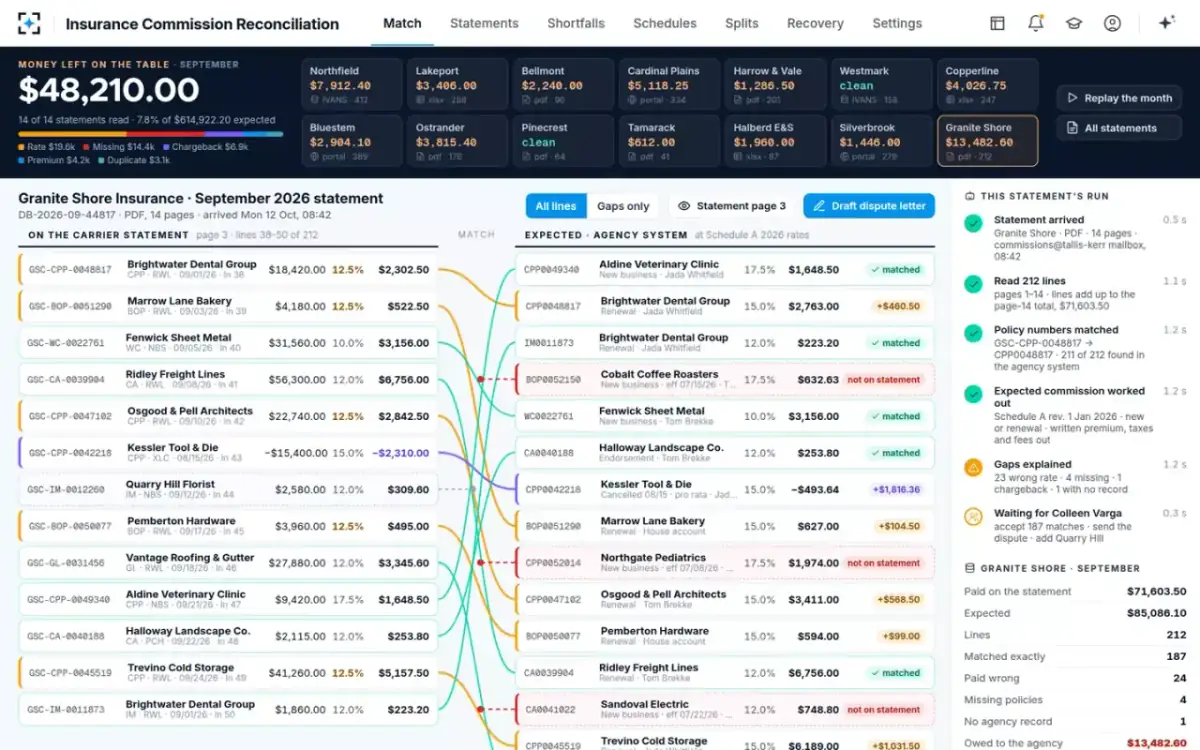
To see the same statement end to end, start from Insurance Commission Reconciliation.
Questions people ask
What is direct bill commission?
It is the commission a carrier pays an agency on a policy the carrier bills and collects itself. The agency never holds the premium; it receives a commission statement, usually monthly, listing each transaction and the commission on it, and reconciles that statement to its own records.
How long does commission reconciliation take each month?
There is no published benchmark. Our estimate for 14 statements and about 3,000 lines is nine working days by hand, of which three go on matching alone; the solution's design target for the same month is two days. Size your own by counting lines and timing a sample.
Is a commission specialist the same as a commission accountant?
Usually, yes: the titles commission specialist, commission accountant and accounting specialist describe the same seat. Larger agencies split it, with a specialist matching statements and an accountant handling disputes, accruals and producer pay.
Does the commission specialist also pay producers?
Often. Producer splits are usually computed from the same reconciled statements, which is why a late or wrong close becomes a payroll problem. In the solution's sample, a producer's share of a disputed item is held and released on the statement where the carrier pays, rather than paid and clawed back.
What happens to a statement line that cannot be matched?
It waits for a person. In the solution, a line below the agency's match confidence (0.90 in the sample) is never forced; a line paid on a policy the agency has no record of is flagged so the policy is added before the statement is posted.
How long should commission records be kept?
State rules differ. Florida requires the books on a premium payment to be kept for at least three years after payment, and its agents to keep policy records for five years after a policy expires; New York requires each principal's funds to be traceable in the books. Keep the statement, the reconciliation and the dispute file together for at least the longest period your states require.