Insurance commission reconciliation software checks the commission each carrier actually paid an agency against what the agency should have been paid, line by line: it reads the carrier's statement in whatever format it arrives, matches each line to the policy in the agency management system, works out the expected commission from the carrier's schedule and agreement, and explains every difference. The hard part is not adding up; it is reading dozens of statement layouts, joining policy numbers that never look the same twice, and knowing which schedule was in force for which transaction. Botminds' Insurance Commission Reconciliation does this with six agents, each with written limits, while the commission accountant and the controller decide what is chased and what is posted.
The clearest way to judge any such tool is to follow one line through it. The line below comes from the solution's fictional sample agency, Tallis Kerr Insurance Group, and the statement its carrier Granite Shore Insurance sent for September 2026. The times are the sample run's; they show the order of work, not a performance guarantee.
One statement line, from the carrier's PDF to a held producer share
Agent
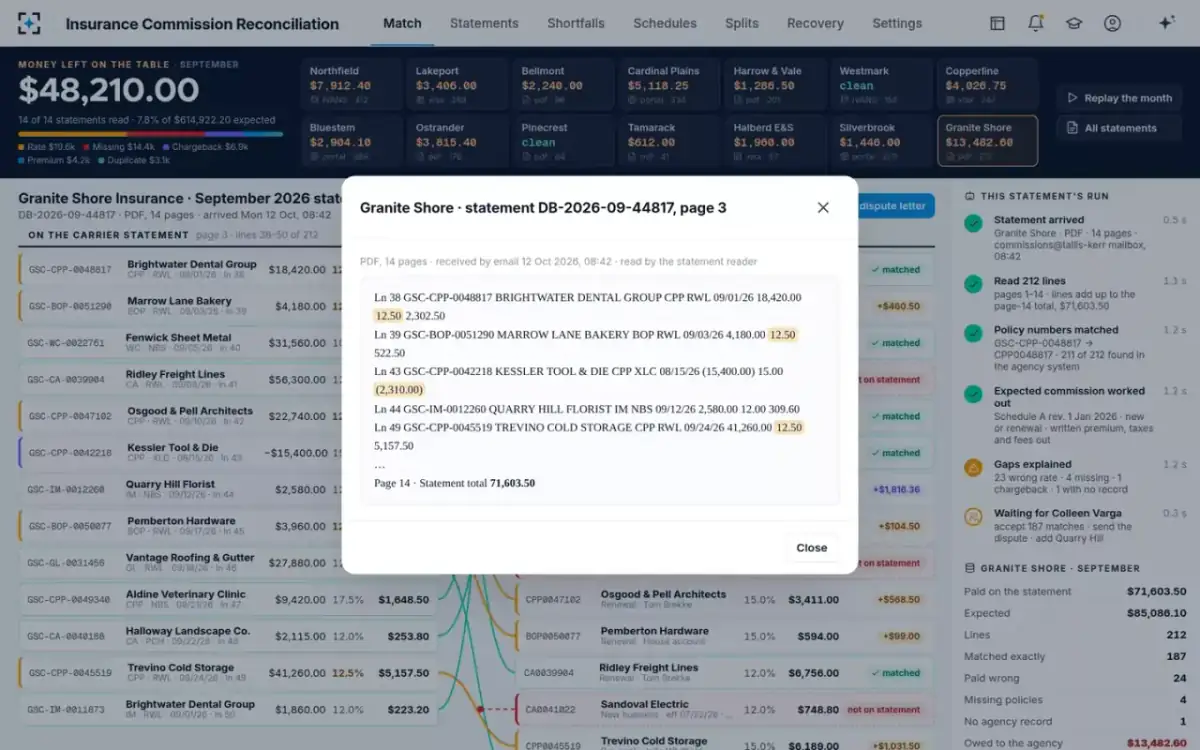
Statement reader · 1.1 sPicks up the 14-page PDF that arrived at 08:42 and reads all 212 lines. Line 38, page 3: GSC-CPP-0048817, Brightwater Dental Group, CPP renewal effective 1 Sep, premium $18,420.00, rate 12.50, commission $2,302.50. Checks the lines add up to the page-14 total, $71,603.50.
Never: guesses an unreadable amount; it flags the line
Agent
Matcher · 1.2 sTurns GSC-CPP-0048817 into the agency system's CPP0048817 and confirms insured, effective date and transaction: a renewal, producer Jada Whitfield.
Never: forces a match below 0.90 confidence, or edits a policy record
Agent
Schedule reader · 1.2 sFinds the rate in force on 1 Sep 2026: Commission Schedule A, rev. 1 Jan 2026, §2.1, commercial package renewals 15.0% of written premium; §2.4 excludes taxes and fees. Expected: $2,763.00.
Never: applies a schedule before its effective date
Agent
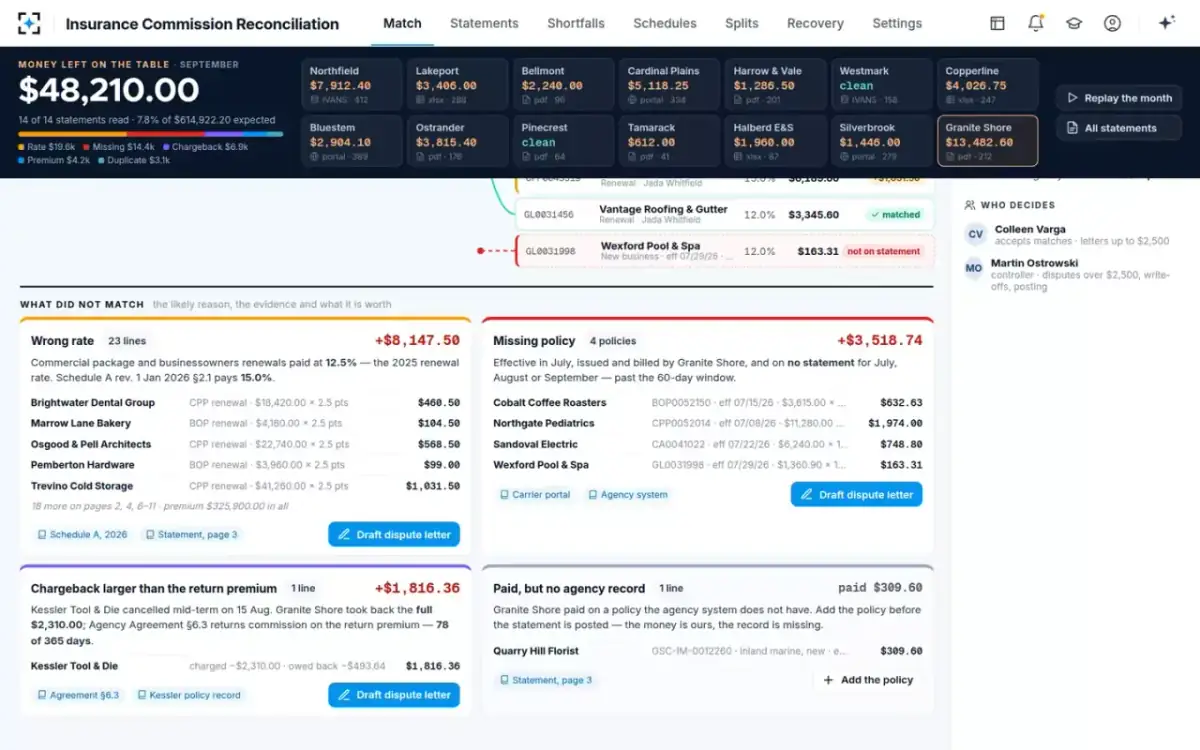
Gap explainer · 1.2 sCalls the $460.50 difference a wrong rate, 2.5 points, one of 23 renewals paid at last year's 12.5%, and attaches the statement line and the clause.
Never: calls an item inside the timing window a shortfall
Agent
Dispute letter writer · 08:51Drafts the letter to Granite Shore's agency accounting: three items, $13,482.60, §2.1 quoted word for word, line 3·38 listed with the others, six documents attached.
Never: sends a letter itself
A person decides
Commission accountant · 09:04Reads the letter against the lines, and sends it for approval because it is over $2,500.
A person decides
Agency controller · 09:20Approves and signs. The letter goes to the carrier at 09:21, reply due 11 November.
Agent
Split calculatorHolds the producer's 25% renewal share of the $460.50, $115.13, and releases it on the statement where the carrier pays.
Never: changes a split percentage, or pays on commission not yet recovered
What is insurance commission reconciliation software?
It is software that answers one question for every line on every carrier statement: was this the right commission? That needs three sources side by side: the statement, the agency system's record of the policy and transaction, and the carrier's commission schedule and agency agreement. Tools that only compare statement totals with the agency system's receivable answer a different question, whether the money arrived, and leave the rate unchecked.
Most agencies already own part of this. An agency management system can import commission downloads, post direct bill receipts and flag lines it cannot match. What it does not usually hold is the schedule: rates by line of business and transaction type, with effective dates, and the agreement clauses on chargebacks and disputes. Without the schedule there is nothing to say a renewal paid at 12.5% should have been paid at 15.0%, which is why the sample statement's 23 under-paid renewals looked paid. A spreadsheet, the agency system and agents compared on the same month shows where each approach stops.
Can software read carrier commission statements in PDF?
Yes, if it reads the page rather than expecting a file layout. A PDF statement is the hardest of the four common formats, because lines wrap, columns shift between pages and the total sits on the last page. Software that reads it has to do two things a template importer does not: keep each figure tied to the page and line it came from, and prove it read everything by adding the lines up to the carrier's printed total.
The second check matters more than it looks. A reader that drops one line produces a reconciliation that is wrong in the carrier's favour and looks clean. In the sample, the statement reader read 212 lines and confirmed they summed to $71,603.50, the total Granite Shore printed on page 14; any figure on the screen opens the page it was read from. The same reader takes spreadsheets, portal exports and commission downloads, and reads a month once even when the electronic download and the emailed copy both arrive.
The statement as the carrier printed it, line 38 included
How does software handle different carrier codes and policy numbers?
It normalises them and then refuses to trust a single key. Carriers add prefixes, drop leading zeros, append term numbers and use their own transaction codes; the agency system stores its own form. Good matching strips each to a comparable form and then requires agreement on the insured, the effective date and the transaction type as well, so a renewal is not joined to last year's term and an endorsement is not joined to the original issue.
Two settings decide how this behaves, and a buyer should be able to see both. The first is the confidence below which the software leaves a line for a person (0.90 in the sample agency's settings). The second is what happens to a line with no agency record at all: in the sample, Quarry Hill Florist's inland marine policy was paid on the statement but missing from the agency system, and the solution's answer was to add the policy before posting, not to post the cash to a suspense account and forget it.
How accurate is automated commission matching?
We found no published, independent benchmark for it, so measure it yourself on a month you have already closed. Two numbers matter. Match precision is the share of matched lines that are joined to the right policy and transaction; check it by sampling matched lines and reviewing them by hand. Coverage is the share of all statement lines checked against a schedule rate, not just matched; it should be every line. Five measures for a reconciliation you can trust sets out the formulas.
The test that tells you most is a replay. Give the software a closed month's statements, schedules and agency records, and compare what it finds with what your team found. Differences fall into three piles: gaps it found that you missed (money), gaps you found that it missed (a weakness to understand before buying), and gaps it calls that are not real (noise your accountant will have to clear every month). The third pile is the one demonstrations hide.
The same line, as each step leaves it
| Step | What it adds | Evidence kept | Who can overrule it |
|---|---|---|---|
| Read | Policy, insured, line, transaction, premium $18,420.00, rate 12.50, commission $2,302.50 | Statement page 3, line 38; lines sum to $71,603.50 | Accountant, on any unreadable line |
| Match | Agency record CPP0048817, renewal, producer | Both records, with the four keys compared | Accountant, on any match below 0.90 |
| Expect | Rate 15.0%, expected $2,763.00 | Schedule A rev. 1 Jan 2026, §2.1 and §2.4, page reference | Carrier relations, if the schedule is wrong |
| Explain | Wrong rate, 2.5 points, $460.50 | Line, clause and the 22 other renewals paid the same way | Accountant: accept, reject or carry |
| Claim | Item 1 of 3 in a $13,482.60 letter | Letter text, six attachments, approval record | Controller: sign or return |
| Pay | $115.13 of the producer's share held | Producer agreement clause on disputed amounts | Controller; the split itself is never changed by an agent |
What happens to lines the software cannot match?
They should go to a person with everything needed to decide, and never be forced. A line can fail to match for four reasons: the policy is missing from the agency system, the policy number is too far from any record, two records fit equally well, or the transaction is one the agency has not booked (often an endorsement). Each needs a different action, so a queue labelled "unmatched" is not enough; the software should say which of the four it is.
Missing policies run the other way and are easier to miss: a policy in the agency system that appears on no statement. A rule is needed to separate late from lost. The sample agency calls a policy missing only when it is more than 60 days past its effective date; younger items are carried to the next month. On the Granite Shore statement that rule found four July policies, issued and billed by the carrier, on none of the July, August or September statements: $3,518.74 of commission.
What did not match: four trays, each with its reason and its evidence
Where does a person sign? The limits that make the output usable
Software that can draft a dispute could also send one, write off a difference or post a statement, and a buyer should ask which of those it may do alone. In this solution the answer is none: agents read, match, explain and draft; the accountant accepts matches and sends letters up to $2,500; the controller approves larger disputes, every write-off and every posting. Thresholds are the agency's settings, and changes to them wait for the controller.
What the agents decide, and what stays with people
The agents do: Every line of every statement, tied to its page, checked against the printed total.
People decide: Lines the reader flags as unreadable.
The agents do: Every line at or above the agency's confidence threshold.
People decide: Every line below it, and every paid line with no agency record.
The agents do: The rate from the schedule in force on the transaction, with its page.
People decide: Whether the schedule itself is right, if carrier relations disputes it.
The agents do: A likely reason and an amount for each gap, with evidence.
People decide: Accept, reject or carry each gap; nothing inside the timing window is disputed.
The agents do: A draft quoting the clause and listing every line.
People decide: Sending (accountant up to $2,500; controller above), write-offs and posting.
The agents do: Splits on reconciled commission; disputed shares held.
People decide: Split percentages and any release outside the producer agreement.
Regulators have not written commission-specific rules for automated tools. The UK's Financial Conduct Authority calls itself technology-neutral and judges outcomes, not tools (FCA, AI Update, 2024; more in AI for commercial insurance brokers). In the US, insurers' use of AI falls under the NAIC's model bulletin in the jurisdictions that adopted it; what the NAIC AI bulletin requires is covered in its own guide. Either way a trail of who decided what is the agency's protection.
Does reconciliation software work with your agency management system?
It should read from the agency system and write back to it only after approval. Reading means pulling policy, premium, producer and direct bill transaction data for the period; writing means posting reconciled statements and adding policies the agency was missing. The solution reads the agency system and posts only after the controller approves, so the agency system stays the book of record and the reconciliation is the evidence behind each entry.
Ask any vendor three things here: which fields it reads and how often, whether it ever writes without a person approving, and what happens when a statement arrives through both the commission download and email. A tool that double-counts a month, or posts before review, creates the errors it was bought to find.
What does commission reconciliation software cost, and what should it return?
We found no independent survey of prices, so judge cost against two returns you can measure on your own month: commission recovered, and hours moved off matching. On the arithmetic in the KPI guide, the first is the larger. In the sample month, the 14 statements paid $566,712.20 against $614,922.20 expected, and the gap, $48,210.00, was 7.8% of expected commission; that is fictional sample data, and your own replay is the only number worth using. The KPI tree and payback method builds the case from there.
Ten questions for a commission reconciliation demonstration
- Will you replay one of our closed months?
Our statements, schedules and agency records; compare with what our team found, line by line.
- How do you prove a statement was read completely?
Look for a check against the carrier's printed total, and a link from each figure to its page.
- Where do expected rates come from?
From our schedules and agreements, with effective dates and page references, or from a table someone keys?
- What happens below your match threshold?
The line should go to a person, with the candidates and the keys that disagree.
- How do you separate timing from shortfall?
Ask for the rule, in days, and whether it is ours to set.
- How do you check chargebacks on cancellations?
Commission should follow the premium returned unless our agreement says otherwise.
- Can anything be sent, written off or posted without a person?
The answer should be no, with the thresholds visible.
- How are producer splits handled on disputed items?
Held and released, or paid and clawed back?
- What is recorded for each decision?
Who, what and when, for agents and people alike.
- What do you not handle?
A vendor that cannot answer this has not met your book.
Where this kind of software fits, and where it does not
It fits best where an agency is paid on many direct bill statements by many carriers, in mixed formats, with schedules that change during the year. That is where line-by-line checking finds money and where hand matching consumes the close. The sample agency's recovery screen shows wrong rates as the largest reason every month, which the sample puts down to carriers changing schedules in January and April while their systems follow late.
It fits less well where an agency has a handful of carriers on electronic downloads that already match cleanly, or where most business is agency billed and the reconciliation is of premium collected rather than commission paid. Contingent and profit-sharing commissions, calculated on a year's loss ratio rather than per line, are a different calculation, covered in contingent commission calculation software. And no tool replaces the schedule talks: if the agency never obtained the new schedule, there is nothing to check the rate against.
To see the full statement and the dispute letter, start from Insurance Commission Reconciliation.
Questions people ask
How does commission reconciliation software match statements?
It reads each line, normalises the carrier's policy number to the agency system's form and confirms the match on insured, effective date and transaction type. In the solution, a match below the agency's confidence threshold (0.90 in the sample) is left for the accountant rather than forced.
Does it check commission rates or only totals?
Rates are the point. The expected commission on each line comes from the schedule in force on that transaction, with the page the rate came from. A total that ties can still hide under-paid renewals offset by an over-paid line.
Can it read IVANS commission downloads?
The solution reads commission downloads as well as PDFs, spreadsheets and portal exports, and when a download and an emailed copy of the same month both arrive, it reads the statement once. Ask any vendor to show the duplicate case on your data.
Does reconciliation software send dispute letters automatically?
It should not, and this one does not. The dispute letter writer drafts a letter quoting the clause and listing every line; the accountant sends letters up to $2,500 and the controller approves larger ones.
How long does it take to reconcile a statement with software?
In the sample run, reading, matching, checking and explaining a 212-line PDF took seconds per step, and the dispute was approved and sent 39 minutes after the statement arrived. The time that remains is people reading the gaps and the letter, which is where it should go.
Is commission reconciliation software only for large agencies?
No; it pays where statements are many and varied, not where the agency is large. An agency with 14 carriers in four formats has the problem; one with three carriers on clean downloads may not. A replay of one month answers it for your book.