Contingent commission calculation software takes a commission agreement whose pay depends on results, such as a binder's sliding scale and profit commission or an agency's contingency schedule, reads its terms, applies them to premium and loss data at the valuation date, and produces the commission with every step shown. The arithmetic is the easy part; the hard part is reading the agreement into parameters without guessing, because two agreements with identical inputs can pay very different amounts, and one silent phrase about IBNR or rounding is enough to put an MGA and its carrier weeks apart. Botminds' Profit Commission Calculation is software of this kind for MGAs and their carriers: one agent reads the binder's commission clauses into the calculator and quotes the clause behind every term, five more total the bordereaux, apply the agreed reserves, calculate, reconcile with the carrier and draft the statement, and the head of finance decides and signs.
The examples come from two places: the solution's fictional sample (Harrowgate Specialty Underwriters and Calder Point Insurance Company, binder HSU-CPI-24, underwriting year 2024), and two real agency contingency contracts published in a 2016 academic study.
Six agents in Profit Commission Calculation, and the three decisions none of them makes
Agent
Binder terms readerReads commission, profit commission and reserve clauses and every endorsement into eleven terms, each quoting its clause.
Never: Infers a term the binder does not state
Agent
Bordereau totallerTotals premium and claims bordereaux in each delegate’s layout to the valuation date; ties them to general ledger and cash.
Never: Edits a bordereau line
Agent
Reserve and IBNR checkerApplies the IBNR the reserve schedule makes binding; shows other studies; watches large losses.
Never: Sets or changes a reserve
Agent
Commission calculatorRuns the sliding scale and profit commission with deficits and caps, exact to the cent.
Never: Rounds or nets differently from the clause
Agent
Counterparty reconcilerRebuilds the carrier’s figure and bridges the difference, one clause at a time.
Never: Accepts or disputes for the MGA
A person decides
Head of finance, then the carrierDecides each difference and signs; the carrier countersigns; only then does the statement drafter send.
What is contingent commission calculation software?
It is software that computes a commission which depends on how the business turns out, rather than on premium alone. A contingency arrangement, in the words of a 2016 study published in Risk Management and Insurance Review, "represents ex post compensation normally tied to underwriting profitability, volume, and annual growth" (Puelz, 2016). For an MGA under a binder the contingent part is usually a sliding scale on the loss ratio and a profit commission on underwriting profit; for an agency it is usually a schedule combining loss ratio with premium volume, growth and retention.
Any such software has to do four things: read the agreement's terms, assemble the inputs to the valuation date, calculate, and show its work to the other side. Tools differ most in the first and last. A calculator with fields for "rate" and "loss ratio" assumes someone has already read the contract; a tool that cannot show the clause behind each number leaves the counterparty to rebuild the figure from scratch, which is where the weeks go.
What is a contingent commission calculation example?
The 2016 study gives an unusually clear one, because it reports two real contracts offered to the same agency, one by a multi-billion-dollar insurer and one by a smaller regional insurer, and applies both to the same agency results. The author, Robert Puelz of Southern Methodist University's Cox School of Business, notes how rare such data is: agencies are "not keen to publish or share their arrangements" (2016 working-paper version).
Same agency, same year, two contingency contracts: $25,110 or $28,800
| Step | Contract 1 (large insurer) | Contract 2 (regional insurer) |
|---|---|---|
| Agency results used | $1.2 million written premium, 4% growth, loss ratio 0.20 | Same, plus 90% retention |
| Base factor | 1.55% from the premium-and-growth grid | 2.0% for premium and growth + 4.0% for retention = 6.0% |
| Loss-ratio adjustment | × 1.35 multiplier at a 0.20 loss ratio | × (0.60 maximum − 0.20 actual) = × 0.40 |
| Bonus factor | 2.0925% | 2.4% |
| Contingent commission | $1.2 million × 2.0925% = $25,110 | $1.2 million × 2.4% = $28,800 |
| Loss ratio period | Prior three years | Three years including the bonus year |
| IBNR | Excluded | Included |
| When it pays nothing | Multiplier falls to zero at a 0.50 loss ratio | At or above the 60% maximum loss ratio |
The two contracts treat IBNR in opposite ways, and the paper says so in one footnote. For contract 2, "By definition, incurred losses explicitly consider reserves for individual losses plus a factor for IBNR." Contract 1, by contrast, says in terms that it leaves IBNR out. A tool that calculated both with one definition of "loss ratio" would be wrong on one of them, however good its arithmetic.
“Contract (1) explicitly states that it does not include IBNR.”
Puelz (2016), SMU Cox working paper, footnote 14
Can software read a commission clause?
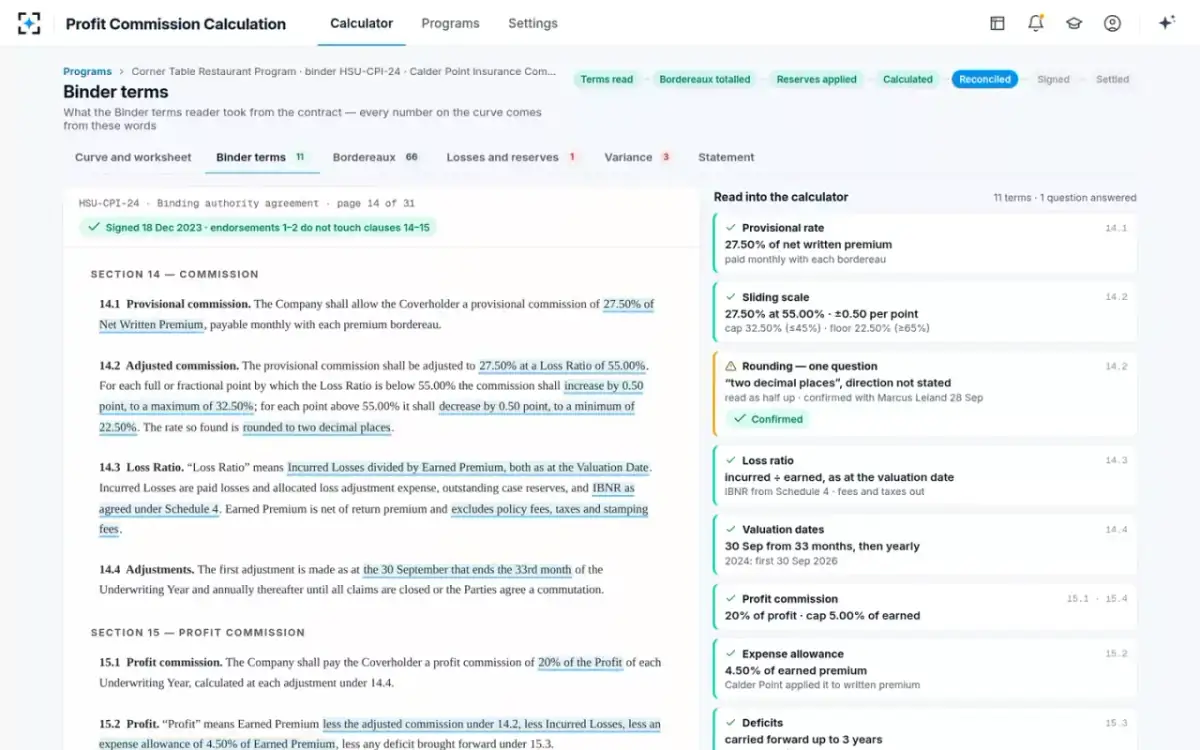
It can, if it treats reading as extraction with a citation rather than interpretation, and asks instead of guessing. In Profit Commission Calculation the binder terms reader reads the commission, profit commission and reserve clauses of the binding authority agreement and every endorsement into the calculator's terms: provisional rate, pivot, slope, cap, floor, rounding, loss-ratio definition, valuation dates, expense allowance, deficit years, profit commission cap and payment split. Every term quotes its clause, and where the contract is silent or ambiguous, the reader asks the finance team.
On the sample binder it took nine seconds to read clauses 14 and 15 and Schedule 4 into eleven terms, and it raised one question. Clause 14.2 says the adjusted rate is "rounded to two decimal places" but not in which direction, so the reader asked, and the parties confirmed half up with the carrier's program accountant on 28 September. The reader also recorded that endorsements 1 and 2 do not touch clauses 14 and 15, because an endorsement that changes the expense allowance or the deficit period is the easiest way for a calculation to go wrong while looking right.
The clause-reading agent's output: eleven terms, each with its clause, in Profit Commission Calculation
What the clause-reading agent may never decide
A reading agent earns trust by its limits as much as its accuracy. In the solution, three decisions stay with people whatever the agents find. Reserves: case reserves are the claims administrator's and IBNR is the figure agreed under the binder's reserve schedule, so no agent sets or changes one. Disputes: the counterparty reconciler explains every difference with the carrier and recommends, but never accepts or disputes on the MGA's behalf. Payment: the statement drafter prepares the calculation statement, the reply and the settlement instruction, and nothing is sent or settled before both signatures.
Prudential supervisors frame the same balance from the firm's side. The Prudential Regulation Authority's 2026 priorities letter to insurers welcomes AI-driven efficiency and then adds that new technology must not come at the cost of safety and soundness (PRA, Insurance supervision: 2026 priorities). For a commission calculation the safety is concrete: an extraction anyone can check against the clause, arithmetic anyone can re-perform, and a person's signature on every decision with money attached.
Can AI calculate profit commission?
AI should read and explain; the calculation itself should be ordinary arithmetic. Language models are good at finding the operative words in a 31-page binder and at explaining a difference in plain words; they are not where a figure exact to the cent should come from. In the solution, the commission calculator uses only the binder terms and the agreed totals, never rounds or nets differently from the clause, writes no step without a source, and is exact to the cent.
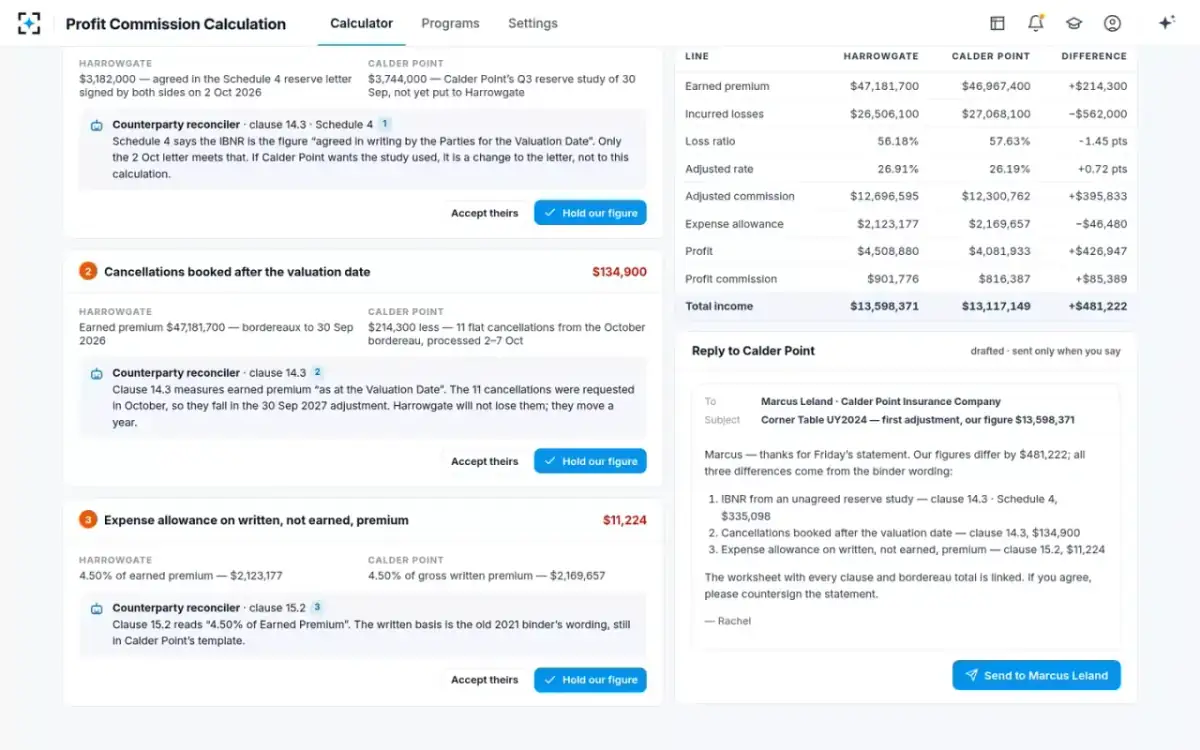
The explanation layer is where AI adds most. When the carrier's statement for the sample came in $481,222 below the MGA's figure, the counterparty reconciler rebuilt the carrier's figure from its own inputs and bridged the gap in three steps, each tied to a clause: an unagreed reserve study ($335,098), cancellations booked after the valuation date ($134,900) and an expense allowance on gross written rather than earned premium ($11,224). A person then chose, for each, whether to hold the MGA's figure or accept the carrier's.
Explaining the carrier's figure, one clause at a time, in Profit Commission Calculation
What to ask before you buy contingent commission calculation software
Most demonstrations show a correct answer on clean data. The useful questions are about the agreement you actually have, the files you actually receive and the counterparty who will check the result.
Ten questions to put to any contingent commission calculation software
- Does it read our clause, or ask us to type parameters?
If parameters are typed, ask who checks them against the contract, and how.
- Does every term show the clause it came from?
Including endorsements, and the binder version in force for the underwriting year.
- What does it do when the clause is silent?
It should ask and record the answer, not default.
- Can it hold two definitions of loss ratio at once?
With and without IBNR, paid or incurred, as each agreement says.
- Does it read bordereaux in each delegate’s own layout?
And tie them to the general ledger and cash before using them.
- Which IBNR does it use, and can it show the others?
The agreed figure in the calculation; other studies beside it, with their effect.
- How does it treat items after the valuation date?
Reported and held for the next adjustment, never moved between periods.
- Does it carry deficits and caps across years?
For as many years as the clause allows, re-measured if the clause says so.
- Can it explain the carrier’s different figure?
Difference by difference, each with its clause and amount.
- Who signs, and what is recorded with the signature?
The worksheet, binder and bordereaux versions, so an auditor can re-perform it.
Where it fits, and where it does not
Software built around a clause-reading agent pays off where the clause is complex and the counterparty checks the number; it is overkill where neither is true. A plain flat commission on premium needs no reading; a program with one underwriting year and no profit commission needs a spreadsheet, not a platform.
Where Profit Commission Calculation fits, and where something simpler is enough
A good fit: Sliding scale, profit commission, deficits and caps across several underwriting years
Something simpler is enough: A flat commission on premium, with no adjustment
A good fit: Monthly premium and claims bordereaux from delegates in their own layouts
Something simpler is enough: One clean premium total a year
A good fit: A carrier or MGA that rebuilds the figure and argues the difference
Something simpler is enough: No one checks the figure line by line
A good fit: IBNR agreed per valuation date, with other studies in circulation
Something simpler is enough: Paid losses only, no IBNR in the formula
A good fit: Several binders, each with open underwriting years
Something simpler is enough: A single program in its first year
How to test it on your own binder
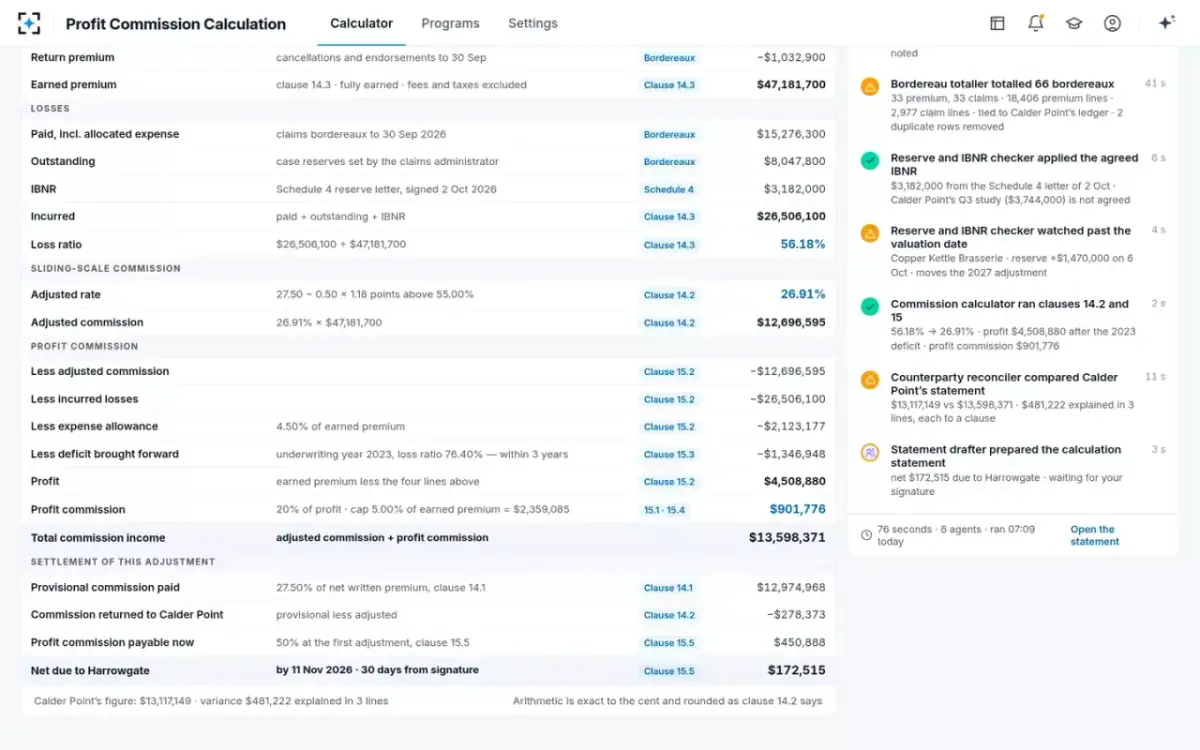
The fairest test is last year's adjustment. Take a binder whose adjustment both sides have already signed, give the software the signed binder with its endorsements, the bordereaux to that valuation date and the reserve letter, and compare its figure with the signed one. Then give it the carrier's original statement and see whether it explains the difference you spent weeks on. Starting from the worksheet you have describes how last year's spreadsheet becomes the test case.
Two further checks separate tools quickly. Put a large loss after the valuation date and see whether it stays out of the adjustment and appears as a what-if; in the sample, a $1,470,000 reserve increase on 6 October moved the projected income down $879,053 without touching the 30 September figure. And change a clause, such as the deficit period, to see whether every open year recalculates. The systems one number crosses covers how the result reaches the general ledger.
The worksheet the agents produce: every line with its clause or bordereau, in Profit Commission Calculation
Questions people ask
How is contingent commission calculated?
By applying the agreement's formula to results at a valuation date: on a binder, usually a sliding-scale rate on the loss ratio plus a share of profit; at an agency, usually a factor from a premium-and-growth grid adjusted by the loss ratio. In the 2016 study, one contract gave a $1.2 million agency $25,110 and the other $28,800 for the same results.
What is contingent commission?
It is pay that depends on how business placed with an insurer performs, measured after the fact, typically on profitability, volume or growth. For MGAs it usually takes the form of a sliding-scale commission and a profit commission under the binder; why the law makes MGAs wait covers how state law treats it.
Can a contingent commission be calculated in Excel?
Yes, and most are. The risks are in the inputs and the version control, not the formulas: a spreadsheet does not know which clause a number came from, carries a deficit only if someone copies it across, and is overwritten at the next valuation.
What is the contingent commission calculation formula?
There is no single formula; each agreement writes its own. Binders typically pay a percentage of earned premium less commission, incurred losses, an expense allowance and any deficit; agency contracts typically multiply premium by a factor set by volume, growth and loss ratio.
Does the software replace the actuary or the auditor?
No. In the solution no agent sets a reserve, and the auditor re-performs the calculation from the recorded clause, bordereaux and reserve versions. The software removes the rebuilding and the guessing, not the judgements.