A deficit carry forward in a profit commission is the clause that takes a loss-making year's negative profit off the profit of later years before the commission percentage is applied, for a set number of years or until the deficit is used up. Without it, an MGA or agent is paid a share of every good year while the carrier alone absorbs the bad ones; with it, a bad year is recovered from the next good ones, and its value to the carrier is the commission percentage times the part of the deficit that later profits actually absorb. Botminds' Profit Commission Calculation carries deficits forward exactly as the binder allows, shows the deficit on the binder's own curve, and recalculates every open underwriting year when a new bordereau lands, so both sides can see what a deficit is worth before the adjustment that uses it.
The numbers below come from the solution's fictional sample: binder HSU-CPI-24 between Harrowgate Specialty Underwriters and Calder Point Insurance Company, which pays a 20% profit commission and carries a deficit forward up to three years. The scenarios that go beyond the sample are our arithmetic on the same terms, labelled as such.
What one $1,346,948 deficit costs the MGA, under five paths for the next three years
What is deficit carry forward in a profit commission?
It is a rule about memory: how long a calculation remembers a bad year. Each underwriting year's profit is calculated on its own; where the result is negative, the clause carries it into the next year's calculation as a deduction, and if the next year cannot absorb all of it, the remainder moves on again, until the deficit is used up or the period the clause allows runs out. The profit commission percentage is then applied to what is left.
The clause is usually two lines of the binder, which is why it is easy to underestimate. In the sample, clause 15.2 defines profit as earned premium less the adjusted commission, incurred losses and a 4.50% expense allowance, "less any deficit brought forward under 15.3", and clause 15.3 carries a deficit forward up to three years. How each phrase is read is set out in the profit commission clause, annotated.
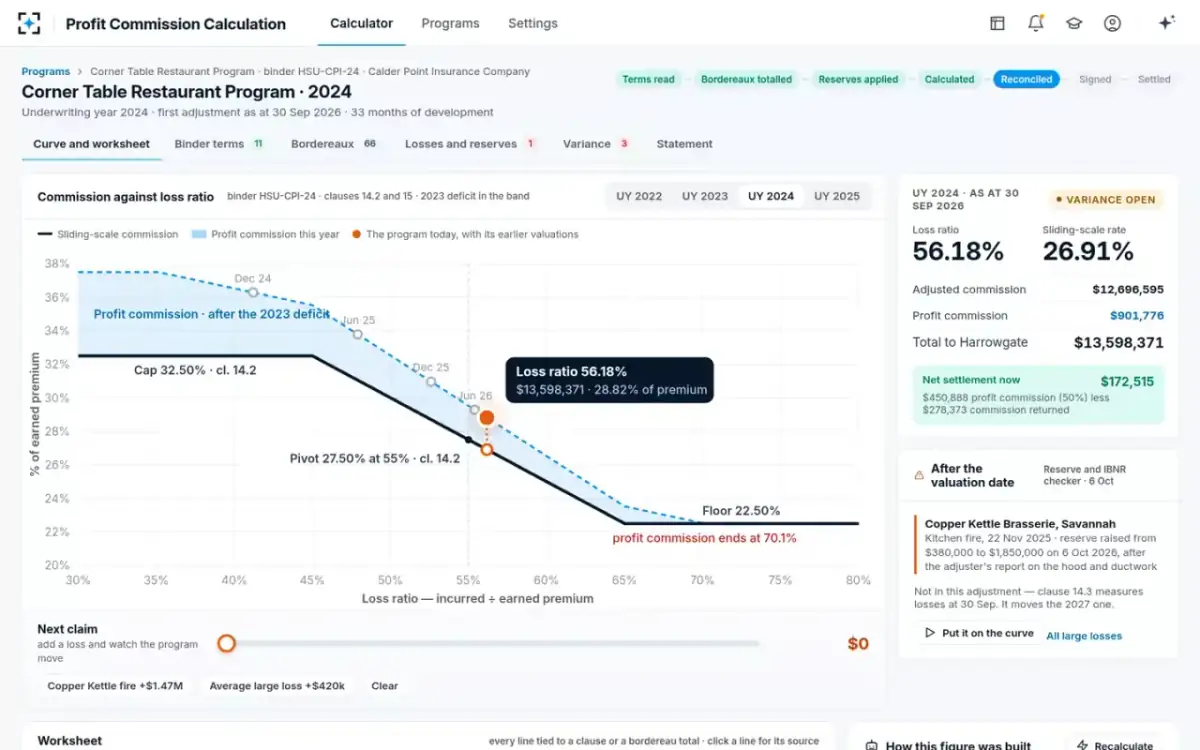
How the sample's 2023 deficit was carried into 2024
Underwriting year 2023 of the sample program ran badly. At 45 months its loss ratio was 76.40%, the sliding-scale commission had fallen to its 22.50% floor, and the year's profit was negative: a deficit of $1,346,948. No profit commission was due on 2023, and the deficit moved into 2024's calculation.
2024 was a good year. Before the deficit, its profit was $5,855,828; after it, $4,508,880, and the 20% profit commission fell from $1,171,166 to $901,776. The deficit was used up in one year, and its value to the carrier was exactly 20% of it: $269,390 that Harrowgate would otherwise have been paid on 2024.
The deficit on the curve: profit commission after the 2023 deficit, in Profit Commission Calculation
Who benefits from a deficit carry forward?
The carrier, directly: the clause moves part of a bad year's cost back onto the agent. Without it, a profit commission behaves like an option the agent holds on each year separately: it collects on every good year and walks away from every bad one. A carry-forward joins the years together, so the agent's pay follows the program's result over several years rather than its best ones.
The agent benefits less obviously. A clause that protects the carrier from paying on lucky years is one reason a carrier can offer a higher profit commission percentage, or a first adjustment earlier than it otherwise would. And it aligns the MGA's underwriters with the long result: in the sample, the program underwriter can see that pushing 2024 past a 70.1% loss ratio would cost nothing more in this year's profit commission, but would leave part of 2023's deficit unabsorbed for 2025, and that above about 73% 2024 would start a deficit of its own.
What the deficit is worth depends on the years that follow
The value of a deficit clause is not the deficit; it is 20%, or whatever the percentage is, of the part of it that later profits absorb within the window. That makes it path-dependent. The five paths in the chart above use the sample's deficit and terms. In path A the deficit is absorbed in one year. In path B three thin years absorb it over three, so the cost is the same $269,390 but the MGA receives almost no profit commission for three years: $30,610 instead of $300,000. In path C a loss in the third year stops the absorption at $700,000, and the remaining $646,948 lapses. In path D nothing is absorbed.
For the MGA, the timing in path B matters as much as the total. Three years of near-zero profit commission on a program that is, on its own results, making money is the case where finance teams most often ask whether the deficit was calculated correctly; the answer depends on whether it was measured once or keeps moving.
Fixed or re-measured: the deficit that keeps growing
A deficit measured at one valuation is still an estimate, because the deficit year keeps developing. If the clause carries forward the deficit "as at" each adjustment, a worsening deficit year takes more off later years; if it fixes the deficit when first measured, the carrier bears later deterioration. Path E shows the difference: if 2023's loss ratio rose from 76.40% to 80.00%, its deficit would grow by about $1,426,046 (the commission is already at its floor, so all of it falls on profit), and a re-measured deficit would cost the MGA $554,599 rather than $269,390.
The sample shows why the question cannot be left open. 2023 moved 32.4 points of loss ratio between its 12-month and 45-month readings. A deficit on long-tailed business can easily double before it is used, and a clause silent on re-measurement guarantees that the two sides will each pick the reading that suits them. How one IBNR figure moves the payout shows how that development arrives.
How long is a deficit carried forward, and what each year is worth
The window is negotiated, and each extra year has a value that can be measured on the program's own paths. The table runs the sample's deficit through windows of one, two and three years on the thin-year paths above.
The deficit's cost to the MGA by length of window, on the same deficit and terms
| Window | Path B: $600k, $500k, $400k | Path C: $400k, $300k, then a loss | What lapses on path C |
|---|---|---|---|
| One year | $120,000 | $80,000 | $946,948 |
| Two years | $220,000 | $140,000 | $646,948 |
| Three years (the sample) | $269,390 | $140,000 | $646,948 |
| Until extinguished | $269,390 | $140,000 so far, more if later years profit | Nothing |
Two patterns are worth reading out. On thin years, each extra year of window adds real value to the carrier, $100,000 for the second year on path B. On a path where the program turns bad again, the extra year adds nothing, because there is no profit left to absorb the deficit; the window that matters is the one that covers the next good years. A reinsurance treaty's deficit clause raises the same questions between a cedant and its reinsurer, and the reinsurance series works one over five years in profit commission calculation in reinsurance.
Does a deficit carry forward reset?
A deficit stops in one of four ways: it is used up by later profit, its window runs out, the binder ends and its open years are settled, or the parties commute. In the sample the 2023 deficit was used up by 2024 and reset to nothing. Whether a deficit survives a renewal into a new binder, or is wiped when a program moves to a new carrier, depends on wording most clauses leave thin.
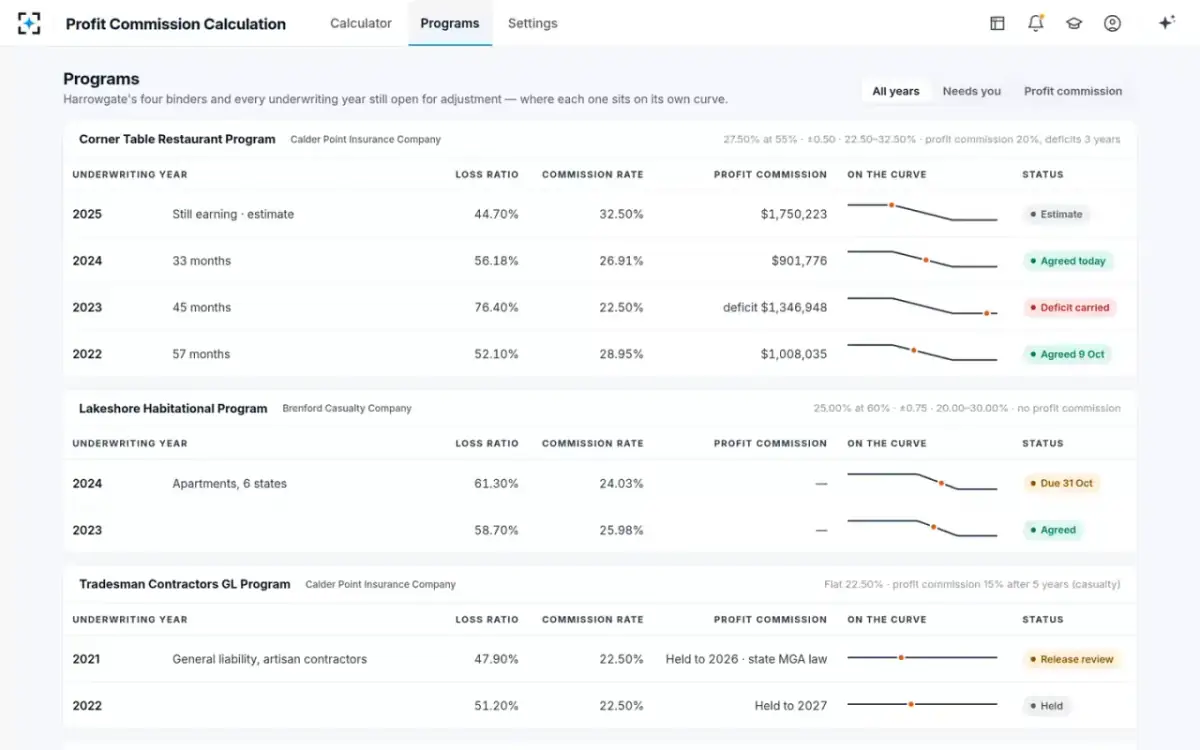
The most expensive reset is the unintended one. A spreadsheet rebuilt for each underwriting year starts at zero unless someone carries last year's deficit across by hand, and a deficit that lives in last year's file is the easiest number in the calculation to lose. In the solution the deficit is part of the calculation itself: the programs view shows every year still open, with its deficit carried or its profit commission due.
Every binder's open years, with deficits carried and profit held, in Profit Commission Calculation
Three ways to keep a bad year in the count
A carry-forward is one way to stop a profit commission forgetting a bad year; averaging over several years is another, and having no link between years is the third. A 2016 study of two real agency contingency contracts, by Robert Puelz of Southern Methodist University and published in Risk Management and Insurance Review, describes the averaging approach in one contract.
“The loss ratio of the book is calculated over the prior three year time horizon as losses incurred divided by three years of earned premiums.”
Puelz, 'Contingent Commissions and the Management of the Independent Agency', SMU Cox working paper, February 2016
The opposite design appears in the Fifth Circuit's account of the Lincoln General auto program, where the MGA was paid the difference whenever losses ran below a 69.4% target loss ratio, and the court described what happened in a bad year: "if claims paid exceeded that target loss ratio, the additional amount needed to pay claims would come out of the 10% otherwise owed to Lincoln" (Lincoln General v. U.S. Auto, 5th Cir. 2015). In that description the carrier's margin, not a deficit carried against the agent, absorbs the bad year.
Deficit carry forward, multi-year averaging, or no link: how each treats a bad year
Deficit carried forward (the sample binder): Its negative profit is deducted from the next good years’ profit
Three-year loss ratio (one contract in the 2016 study): Its losses sit inside a rolling three-year ratio
Deficit carried forward (the sample binder): Up to three years, or until used up
Three-year loss ratio (one contract in the 2016 study): Exactly three years, then it rolls out
Deficit carried forward (the sample binder): Pays nothing until the deficit is absorbed, then pays in full
Three-year loss ratio (one contract in the 2016 study): Pays on the blended ratio, so the effect is spread
Deficit carried forward (the sample binder): The deficit is forgotten, or not re-measured
Three-year loss ratio (one contract in the 2016 study): Premium and losses of three years must be held consistently
Deficit carried forward (the sample binder): The carrier’s margin absorbs the bad year, as in the court’s account of Lincoln General
Three-year loss ratio (one contract in the 2016 study): Same: each year pays or not on its own
The deficit and the statutory hold-back, side by side
Where the MGA sets loss reserves or controls claim payments, state laws modelled on NAIC Model #225 hold interim profits one year after they are earned on property business and five on casualty, and until verified (Model #225, §4L). The hold-back and the carry-forward protect the carrier in different ways: the carry-forward reduces what is owed, the hold-back delays when it is paid. On casualty business the hold-back runs longer than many deficit windows.
Three clocks on one underwriting year: the deficit window and the two hold-backs
- Year 1
- Year 2
- Year 3
- Held, years 1–5
- Held
The practical effect is that on casualty programs where the hold-back applies, profit for early years is still unpaid when later years' results arrive. Whether a later deficit can be set against profit that is earned but held depends on the clause, not the statute; a clause that says so gives the carrier a protection the deficit window alone does not. Why the law makes MGAs wait covers the hold-back itself.
Valuing the clause before you sign it
A deficit clause can be priced on the program's own history before the binder is signed, without a model more complex than a spreadsheet. The method below is ours; the inputs are the program's.
A four-step method to value a deficit carry forward on your own program
| Step | What to do | On the sample |
|---|---|---|
| 1. List year results | Each underwriting year’s profit before any deficit, at its latest valuation | 2022 positive; 2023 −$1,346,948; 2024 +$5,855,828 |
| 2. Replay the clause | Carry each deficit forward in date order for the window, absorbing it from later profits | 2023’s deficit used up by 2024 |
| 3. Price it | Percentage × deficit absorbed, year by year | 20% × $1,346,948 = $269,390 in 2024 |
| 4. Stress it | Repeat with the deficit year worsened and the next years thinner | Path E: $554,599; path C: $140,000 |
Questions people ask
What is a loss carried forward in a profit commission?
It is the same thing as a deficit carried forward: a year's negative profit deducted from later years' profit before the commission is calculated. In the sample, 2023's $1,346,948 deficit came off 2024's profit and cut the profit commission from $1,171,166 to $901,776.
How long is a deficit usually carried forward?
As long as the clause says: a fixed number of years, or until extinguished. The sample binder carries deficits up to three years; on thin years each extra year of window is worth real money to the carrier, and on a run of bad years it is worth nothing.
Is the deficit re-calculated each year?
Only if the clause says the deficit is taken as at each adjustment. If 2023's loss ratio in the sample rose to 80%, a re-measured deficit would grow by about $1,426,046 and cost the MGA $554,599 instead of $269,390.
Does a surplus also carry forward?
Not unless the clause says so; most wording deals only with deficits. A clause that carries surpluses too behaves more like a multi-year average, which some agency contingency contracts use directly through a three-year loss ratio.
What does deficit carried forward mean in accounting?
In general accounting it means an accumulated loss brought into the next period's balance. In a profit commission it is narrower: a contract term that reduces a later year's profit commission, and the carrier's statutory accrual for profit commission has to reflect it.