The profit commission formula on an MGA binder is: profit commission = agreed percentage × (earned premium − the agent's commission − incurred losses − an expense allowance − any deficit brought forward), paid only when the result is positive and only up to any cap the clause sets. Incurred losses mean paid losses plus outstanding case reserves plus incurred but not reported (IBNR), measured at a valuation date the binder names, and on many binders the commission subtracted is itself a sliding scale that moves with the loss ratio. The arithmetic is simple; the work is in the inputs and in reading each clause exactly, which is what Botminds' Profit Commission Calculation does: its agents read the binder's clauses, total the bordereaux to the valuation date, apply the agreed reserves and write a worksheet where every line names its source.
The worked example on this page is the solution's fictional sample: binder HSU-CPI-24 between Harrowgate Specialty Underwriters and Calder Point Insurance Company for the Corner Table Restaurant Program, underwriting year 2024, first adjustment as at 30 September 2026, 33 months after the year began.
The profit commission formula on the sample binder, term by term
Earned premium
Written − return premium, fully earned
Net of cancellations; policy fees, taxes and stamping fees excluded by clause 14.3.
$47,181,700
Adjusted commission
Sliding-scale rate × earned premium
27.50% at a 55% loss ratio, 0.50 point per point, 22.50%–32.50%.
−$12,696,595
Incurred losses
Paid + outstanding + agreed IBNR
Measured at the valuation date; IBNR from the signed reserve letter.
−$26,506,100
Expense allowance and deficit
4.50% × earned premium, plus the 2023 deficit
The carrier’s allowance, then any deficit carried up to three years.
−$3,470,125
What is the profit commission formula?
A profit commission is the agent's percentage of the underwriting profit the binder defines, and the formula is that definition written as arithmetic. Most clauses share four parts: a measure of premium, a measure of losses, the deductions the carrier keeps for itself, and a percentage with its limits. Where they differ is in each part's detail: whether premium is written or earned, whether losses include IBNR, whether the expense allowance is a percentage of earned or written premium, how long a deficit is carried, and whether the commission subtracted is fixed or sliding.
The sample binder writes it in clause 15.2: profit "means Earned Premium less the adjusted commission under 14.2, less Incurred Losses, less an expense allowance of 4.50% of Earned Premium, less any deficit brought forward under 15.3", and clause 15.1 pays the coverholder 20% of it. Those are the sample's fictional words, but they are the shape of a common binder clause, and each phrase sets one number; the profit commission clause, annotated takes them one at a time.
How is profit commission calculated? Step one, the loss ratio
The loss ratio comes first because everything else follows from it: the sliding scale reads it, and the profit is what the loss ratio leaves. There is no single loss ratio in insurance. Losses can be paid or incurred, with or without IBNR and claim expenses; premium can be written or earned, gross or net of fees and taxes. A binder picks its variation in words, and the words are where two calculations part.
In the sample, clause 14.3 defines the loss ratio as incurred losses divided by earned premium, both as at the valuation date, with incurred losses being paid losses and allocated loss adjustment expense, outstanding case reserves and the IBNR agreed under Schedule 4. Earned premium is net of return premium and excludes policy fees, taxes and stamping fees. For 2024 that gives paid of $15,276,300, outstanding of $8,047,800 and agreed IBNR of $3,182,000, so $26,506,100 incurred over $47,181,700 earned: a loss ratio of 56.18%.
Step two: the sliding scale sets the commission
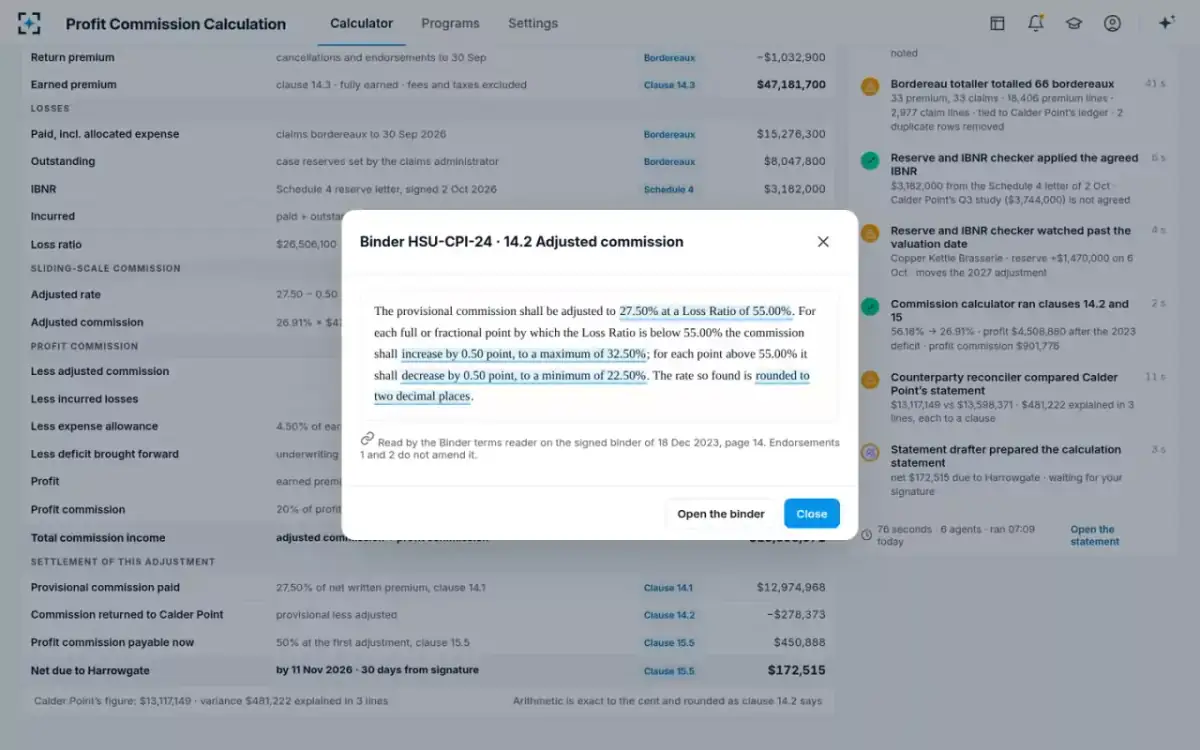
A sliding scale adjusts the provisional commission up when losses are low and down when they are high, between a cap and a floor. The sample's clause 14.2 starts at 27.50% at a 55.00% loss ratio and moves 0.50 point for each full or fractional point the loss ratio is above or below, from a maximum of 32.50% to a minimum of 22.50%, with the rate rounded to two decimal places.
At 56.18% the loss ratio is 1.18 points above the pivot, so the rate is 27.50 − 0.50 × 1.18 = 26.91%, and the adjusted commission is 26.91% × $47,181,700 = $12,696,595. The provisional commission already paid, 27.50% of the same premium, was $12,974,968, so $278,373 goes back to the carrier. Treaty sliding scales work on the same idea between insurer and reinsurer, and the reinsurance series explains them in what a sliding scale commission is.
The binder's words behind the adjusted rate, opened from the worksheet in Profit Commission Calculation
Step three: from profit to profit commission
Profit is what remains of earned premium after the commission, the losses, the carrier's expense allowance and any deficit still being carried. The table below runs the sample year through the binder in the order its clauses apply.
Profit commission example: one underwriting year through the binder, line by line
| Line | How it is reached | Clause | Amount |
|---|---|---|---|
| Earned premium | $48,214,600 written − $1,032,900 return premium; fully earned at 33 months | 14.3 | $47,181,700 |
| Incurred losses | Paid $15,276,300 + outstanding $8,047,800 + agreed IBNR $3,182,000 | 14.3 | $26,506,100 |
| Loss ratio | $26,506,100 ÷ $47,181,700 | 14.3 | 56.18% |
| Adjusted rate | 27.50 − 0.50 × 1.18, rounded to two decimals | 14.2 | 26.91% |
| Adjusted commission | 26.91% × $47,181,700 | 14.2 | $12,696,595 |
| Expense allowance | 4.50% × $47,181,700 | 15.2 | $2,123,177 |
| Deficit brought forward | Underwriting year 2023, loss ratio 76.40%, within three years | 15.3 | $1,346,948 |
| Profit | $47,181,700 − $12,696,595 − $26,506,100 − $2,123,177 − $1,346,948 | 15.2 | $4,508,880 |
| Profit commission | 20% × $4,508,880; cap 5% × earned premium = $2,359,085, not reached | 15.1–15.4 | $901,776 |
The order matters. The expense allowance is a percentage of earned premium, not written, so it falls if premium is returned. The deficit is subtracted after the expense allowance, so a bad prior year reduces this year's profit dollar for dollar. And the profit commission is tested against its cap after the percentage is applied: here 20% of profit is $901,776, well under the $2,359,085 cap, which would bite only below a loss ratio of about 35.1%.
Step four: what is paid now, and what waits
The formula gives the year's profit commission; the payment clause decides how much of it moves now. The sample binder pays 50% of the profit commission at the first adjustment and the balance at later ones, so the settlement is the profit commission payable now less the commission returned: $450,888 − $278,373 = $172,515 due to Harrowgate within 30 days of signature.
Paying half now is a hedge against development. If the year's losses rise at the next valuation, the profit commission falls, and anything already paid above the new figure is repaid. In the sample that would take about $4,340,000 more incurred loss on 2024. Where the MGA sets reserves or controls claim payments, state law adds its own hold-back on top of whatever the clause says, described in why the law makes MGAs wait.
Where each premium dollar went in the example
Seen as shares of the premium, the profit commission is a thin slice that depends on everything above it. In the sample year the MGA's profit commission is 1.91% of earned premium, beside 26.91% for its commission and 56.18% for losses.
One dollar of earned premium through the sample binder, in cents
The whole premium dollar
- Losses including IBNR · 56%
- Adjusted commission · 27%
- Expense, deficit and profit · 17%
The 17 cents left after losses and commission
- Carrier’s expense allowance · 27%
- 2023 deficit recovered · 17%
- MGA’s profit commission · 11%
- Carrier’s profit · 45%
Why one dollar of loss costs the MGA sixty cents
On a binder with both a sliding scale and a profit commission, each extra dollar of incurred loss costs the MGA twice: once in the commission rate and again in the profit. On the sample's slope the rate falls 0.50 point for every point of loss ratio, so each dollar of loss takes 50 cents off the commission; profit then falls by the other 50 cents, and the MGA's 20% share of that is 10 cents more. Sixty cents per dollar is exactly what the sample shows for a late $1,470,000 kitchen-fire reserve: income down $879,053.
What one more dollar of incurred loss costs the MGA, by where the loss ratio sits
The bands explain behaviour that otherwise looks like stubbornness. An MGA sitting on the slope has three times the stake in an IBNR argument that it has at the floor, and a year that has slid past 70.1% stops costing the MGA anything this year but starts building a deficit that will cost it later. The deficit carried forward values that second effect.
Three formulas in use, and how they share a bad year
Not every profit-based commission is a percentage of profit. Some contracts pay the agent the difference between a target loss ratio and the actual one. The Fifth Circuit described such an arrangement in a 2015 dispute over an auto program: the managing general agent took 20.6% of premium after the issuing company's share for its administrative work, claims were expected to run at 69.4%, the "target loss ratio", and the carrier expected the remaining 10% as its profit.
“As an incentive, U.S. Auto could receive an additional commission based on any amount the target loss ratio exceeded actual losses.”
Lincoln General Insurance Co. v. U.S. Auto Insurance Services, No. 13-10589 (5th Cir. 18 May 2015)
A profit commission and a target-loss-ratio commission, side by side
Profit commission (the sample binder): 20% of profit after commission, losses, expenses and deficits
Target-loss-ratio commission (as the court described it): The amount by which actual losses fall below 69.4% of premium
Profit commission (the sample binder): The carrier keeps 80% of the profit
Target-loss-ratio commission (as the court described it): The agent keeps the whole difference below target
Profit commission (the sample binder): Shared: the sliding scale cuts the commission, and a deficit is carried up to three years
Target-loss-ratio commission (as the court described it): The carrier’s 10% margin absorbs losses above target
Profit commission (the sample binder): Agreed IBNR is part of incurred losses
Target-loss-ratio commission (as the court described it): The agreements adjusted incurred losses for IBNR, per the court
Profit commission (the sample binder): Clauses 14–15 of the binder
Target-loss-ratio commission (as the court described it): The program agreements, as summarised by the Fifth Circuit
The design choice is who keeps the upside and who absorbs the downside, and it is set in the formula, not in negotiation at each adjustment. A reinsurance treaty's profit commission follows the same subtraction between a cedant and its reinsurer, with a ceding commission in place of the agent's commission; profit commission calculation in reinsurance works one through.
Rounding, netting and timing: where two correct calculations differ
Two people applying the same formula to the same bordereaux still reach different answers when the clause leaves a choice open. Rounding is the smallest: the sample clause rounds "the rate so found" to two decimal places without a direction, and says nothing about rounding the loss ratio first. Add the late kitchen-fire reserve and the loss ratio is 59.2944%. Rounded to 59.29% before the scale is applied, the rate is exactly 25.355%, which half-up rounding makes 25.36%; left unrounded, it is 25.3528%, which is 25.35% whichever way you round. One hundredth of a point is about $4,700 of commission on this premium. The solution's binder terms reader asked about the direction, and the parties confirmed half up on 28 September.
Timing and basis matter more. Cancellations requested after the valuation date belong to the next adjustment under a clause that measures premium "as at" that date; counting them now cut the carrier's figure by $134,900. An expense allowance taken on gross written premium instead of earned premium cut it by another $11,224. Neither is an arithmetic error: each is a reading of the formula's inputs, and each is settled by pointing to the clause.
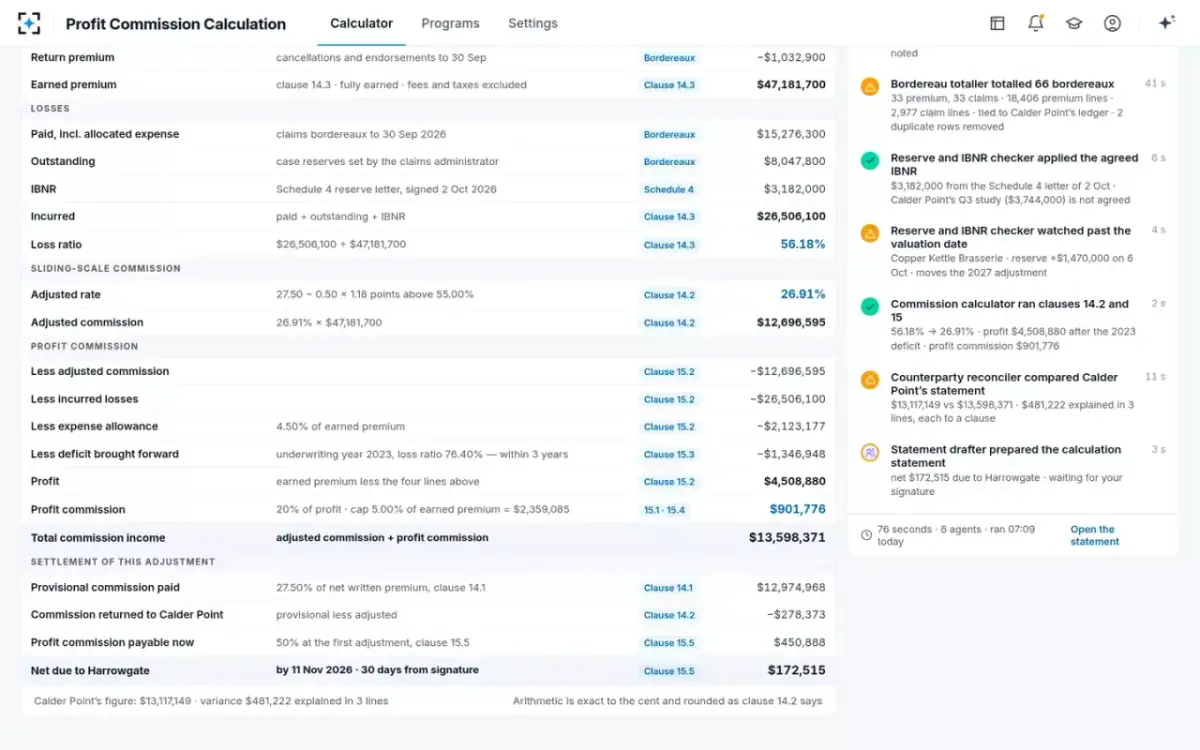
The worksheet: the profit commission formula with a source for every line
Questions people ask
What is profit commission in insurance?
It is a commission paid after the fact out of underwriting profit, to an MGA under a binding authority, to an agent under a contingency agreement, or to a cedant under a reinsurance treaty. In the sample binder it is 20% of the profit left after the adjusted commission, incurred losses, a 4.50% expense allowance and any deficit brought forward.
Does the profit commission formula include IBNR?
Only if the clause says so, and most binders that pay on developed results do. The sample counts the IBNR agreed in writing for the valuation date, $3,182,000 for 2024; using the carrier's unagreed study instead would have raised the loss ratio to 57.37% and cut the MGA's income by $335,098.
How do you calculate profit commission on a binder?
Compute the loss ratio as the clause defines it, apply any sliding scale to set the commission, subtract commission, incurred losses, the expense allowance and any deficit from earned premium, and apply the percentage and cap. Then apply the payment clause: in the sample, 50% is paid at the first adjustment and the rest later.
What is a profit commission calculation example?
In the sample year: $47,181,700 earned, $26,506,100 incurred, a 56.18% loss ratio and a 26.91% adjusted commission leave $4,508,880 of profit after the expense allowance and a $1,346,948 deficit. At 20% the profit commission is $901,776, of which $450,888 is paid now.
Is the expense allowance taken on written or earned premium?
Whichever the clause names; the sample says 4.50% of earned premium. Taking it on gross written premium instead raises the allowance from $2,123,177 to $2,169,657 on the carrier's figures and was one of the three differences between the two sides' calculations.