Profit commission reserves are the loss reserves a profit commission calculation subtracts from premium: the outstanding case reserves on reported claims and the reserve for losses incurred but not reported (IBNR), measured at the valuation date the clause names. They decide the payout more than any rate in the clause, because they are estimates, they are large, and the party that sets them can move its own pay; that is why Florida's MGA statute names IBNR in its profit hold-back, and why a federal appeals court recounted how removing IBNR from a commission formula inflated an MGA's commission. Botminds' Profit Commission Calculation applies only the IBNR the binder makes binding, shows every other study beside it with its effect, never sets a reserve, and watches large losses after the valuation date so a late reserve move is seen before the next adjustment.
The figures come from the solution's fictional sample: Harrowgate Specialty Underwriters' Corner Table Restaurant Program under binder HSU-CPI-24 with Calder Point Insurance Company, underwriting year 2024, first adjustment at 30 September 2026.
One IBNR figure, from the actuary's study to the profit commission cheque
A person decides
Claims administratorSets case reserves on reported claims: $8,047,800 outstanding on 2024 at 30 September.
A person decides
Actuaries on each sideEstimate IBNR: $3,744,000 in the carrier’s study, $3,050,000 from the MGA’s actuary.
A person decides
Both partiesSign the Schedule 4 reserve letter on 2 October: IBNR of $3,182,000 for this valuation date.
Agent
Reserve and IBNR checkerApplies the signed $3,182,000; shows the two other studies and their effect.
Never: Sets or changes a reserve
Agent
Commission calculatorLoss ratio 56.18%, rate 26.91%, profit commission $901,776; half paid now.
Agent
Reserve and IBNR checker, each morningFlags a $1,470,000 reserve increase on 6 October, after the valuation date, for the 2027 adjustment.
Never: Moves a loss between periods
What is a profit commission reserve?
The phrase is used three ways, and a finance team should know which one it means. First, the loss reserves inside the calculation: case reserves plus IBNR, which together with paid losses make up incurred losses. Second, the carrier's accrued liability for profit commission it will owe, which statutory accounting requires it to book for the earned portion of the business. Third, the part of a profit commission already calculated but deliberately held back, like the 50% the sample binder defers to later adjustments, or the interim profit state law holds where the MGA sets reserves.
The three are linked by one number. The IBNR in the calculation sets the loss ratio; the loss ratio sets the profit commission; the profit commission sets both the carrier's accrual and the amount held back. This page follows the first. The carrier's accrual is the subject of contingent commission accounting treatment, and the statutory hold-back of why the law makes MGAs wait.
Does profit commission include IBNR?
It does if the clause says incurred losses include IBNR, and on business that develops slowly most clauses should. Without it, the early years of a program look more profitable than they will turn out to be, and the agent is paid on claims nobody has reported yet. The sample binder's clause 14.3 counts paid losses and allocated expense, outstanding case reserves, and the IBNR agreed under its reserve schedule.
Florida writes IBNR into the statute. Its MGA law holds back interim profits wherever the MGA can determine their amount by establishing "the total of all loss reserves, including IBNR if any, used in calculating the interim profits" (Fla. Stat. §626.7451(9), 2026). The NAIC's model text speaks of establishing loss reserves without naming IBNR (Model #225, §4L), and the statutory accounting rule for the carrier's own accrual asks that its assumptions be consistent with the loss reserves it records, IBNR included (SSAP No. 71, as printed in NAIC working-group materials, 2020).
How does IBNR affect profit commission?
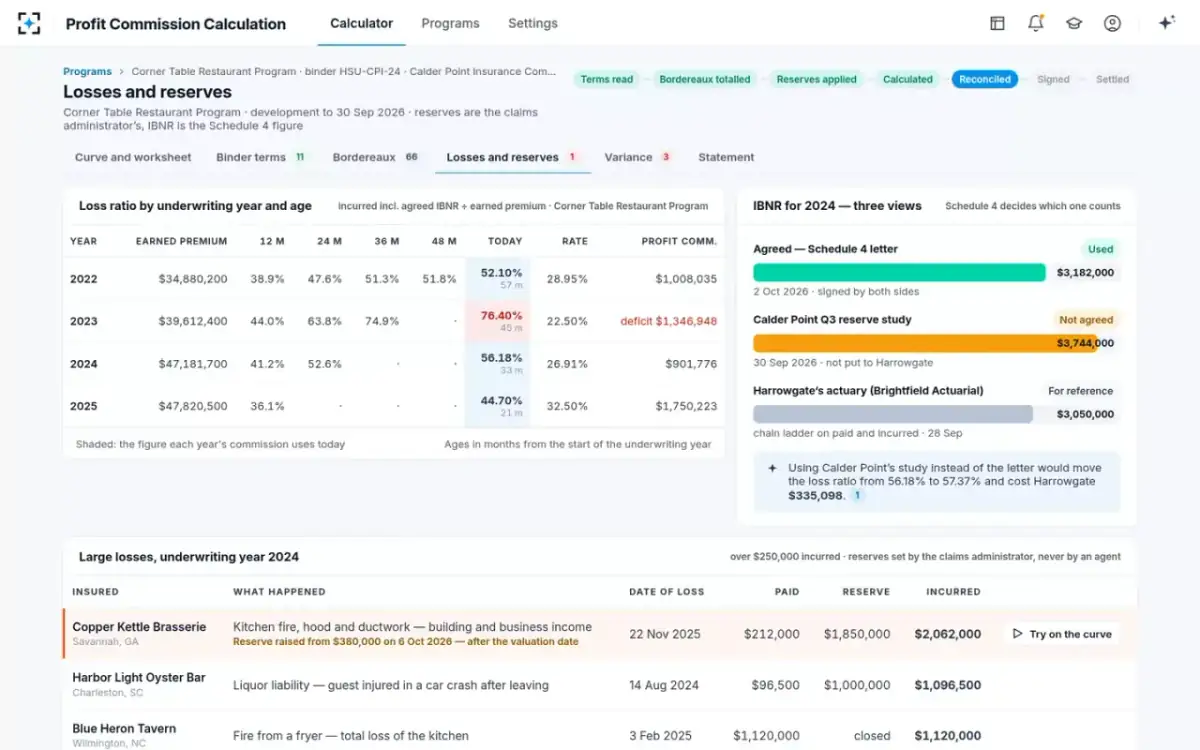
On a binder with a sliding scale, every dollar of IBNR costs the MGA up to sixty cents. In the sample, the commission rate falls half a point for every point of loss ratio between 45% and 65%, so a dollar of extra IBNR takes 50 cents off the commission, and the MGA's 20% share of the remaining 50 cents of profit takes 10 cents more. Three IBNR views existed for 2024 on the day of the adjustment.
Three IBNR views for one year: what each would do to the MGA's income
The spread between the two actuaries is $694,000, about 2.6% of incurred losses; the spread in the MGA's income is $414,342, about sixty cents on each dollar of difference. That asymmetry is why the clause, not the size of each party, should decide which IBNR counts. The sample's Schedule 4 does it in one phrase: IBNR is the figure agreed in writing by the parties for the valuation date. The carrier's study was dated 30 September and never put to the MGA; under that wording it is a proposal to change the letter, not an input to this adjustment.
Losses and reserves: the agreed IBNR used, the others shown, in Profit Commission Calculation
Who sets the reserves for a profit commission?
Case reserves are set by whoever handles the claims, IBNR by an actuary, and the clause should say which IBNR binds both sides. When the MGA itself handles claims or sets reserves, the law adds two checks, because the person paid on the profit is also estimating the losses. The NAIC model makes the insurer obtain an actuary's opinion each year on reserves an MGA establishes, and holds the MGA's share of interim profits until it has been verified.
The Fifth Circuit's 2015 opinion in Lincoln General shows what the rule guards against. The agreements in that auto program paid the MGA an extra commission when losses came in below a 69.4% target loss ratio, and adjusted incurred losses upward for IBNR so that the accounts would reflect what would ultimately be paid. The court recounted what happened when the MGA ran short of money in 2007:
“U.S. Auto removed incurred but not reported losses from the commission calculations, thereby creating the illusion of smaller incurred losses.”
Lincoln General Insurance Co. v. U.S. Auto Insurance Services, No. 13-10589 (5th Cir. 18 May 2015)
The opinion explains the effect in plain terms: the loss ratio fell further below the target, the commission rose, and when claimants later reported those losses the money to pay them was not in the trust account. It is the strongest public illustration of why an IBNR figure inside a commission formula belongs to someone other than the party paid on it, or at least to an agreement both parties sign.
Why the first valuation overstates profit: losses by age
A profit commission paid on an early valuation pays on losses that have not finished arriving, and the size of that effect is visible in a program's own triangle. In the sample, underwriting year 2023 looked like a profitable year at 12 months and turned into a deficit by 45.
Loss ratio by underwriting year and age in the sample program: the same year, read four times
| Underwriting year | 12 months | 24 months | 36 months | Latest | What the latest reading pays |
|---|---|---|---|---|---|
| 2022 | 38.9% | 47.6% | 51.3% | 52.10% at 57 months | Rate 28.95%; profit commission $1,008,035 |
| 2023 | 44.0% | 63.8% | 74.9% | 76.40% at 45 months | Rate at the 22.50% floor; deficit $1,346,948 |
| 2024 | 41.2% | 52.6% | — | 56.18% at 33 months | Rate 26.91%; profit commission $901,776 |
| 2025 | 36.1% | — | — | 44.70% at 21 months | Estimate only; first adjustment at 30 September 2027 |
2023 rose 32.4 points between its first and fourth readings. Had a profit commission been paid on the 12-month figure, the MGA would be repaying all of it now and carrying a deficit into the next three years. This is the practical case for the two protections most binders combine: a first adjustment late enough for most claims to be reported (33 months in the sample), and a payment split that keeps part of the profit commission back for later valuations.
What is a profit commission true-up?
A true-up is the later adjustment that recalculates a year's profit commission on newer losses and settles the difference with what has already been paid. In the sample, 50% of 2024's profit commission, $450,888, is paid at the first adjustment; each later annual adjustment recalculates the year and pays more, or recovers some, until all claims close or the parties commute.
The useful number is the headroom before a claw-back. On the sample's terms, 2024 can absorb about $4,340,000 more incurred loss before its profit commission, $449,918 at that point, falls below the $450,888 already paid; the loss ratio would then be 65.38%, at the scale's floor. Knowing that number turns a large-loss report into a decision about cash rather than a surprise at the next adjustment.
A reserve move after the valuation date, put on the curve before the next adjustment
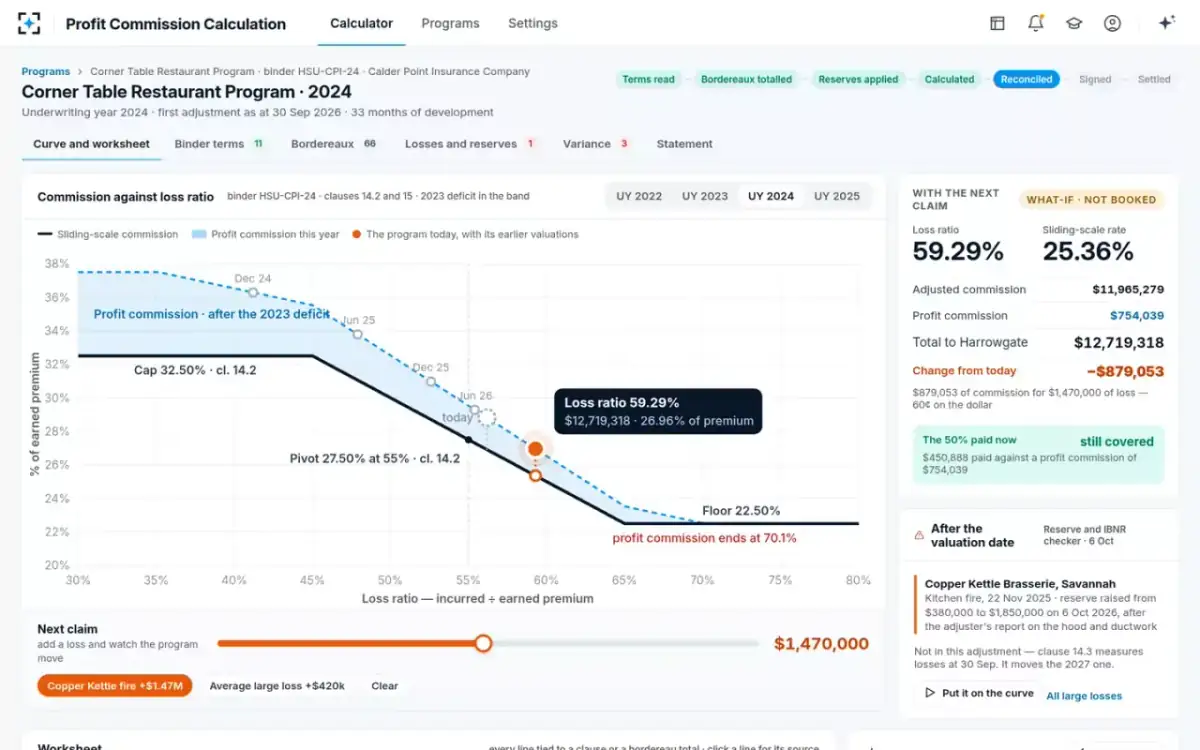
The sample's late loss shows the mechanism. On 6 October, six days after the valuation date, the reserve on a November 2025 kitchen fire at the fictional Copper Kettle Brasserie rose from $380,000 to $1,850,000. The binder measures losses at 30 September, so it stays out of this adjustment; on the curve it would move the loss ratio to 59.29%, the rate to 25.36% and the MGA's income down $879,053, and it uses 34% of the claw-back headroom. The solution watches reserve moves above a threshold, $250,000 in the sample's settings, every morning.
Three dates that must line up: valuation, reserve letter and bordereau
A profit commission's reserves are only consistent if they are measured at the same date as its premium and paid losses, and in practice those figures arrive on different days. In the sample, the valuation date was 30 September 2026. The reserve letter fixing IBNR for that date was signed on 2 October; the September claims bordereau, carrying paid and outstanding as at 30 September, arrived on 8 October; the carrier's reserve study was dated 30 September but never agreed; and the Copper Kettle reserve moved on 6 October.
Each of those belongs to a period by its "as at" date, not its arrival date. The September bordereau and the 2 October letter belong to this adjustment because they describe 30 September; the 6 October reserve move does not, because it describes a later day. A calculation that sorts inputs by when they arrived, as a shared inbox does, mixes periods; one that sorts them by the date they describe keeps the loss ratio honest. The solution's bordereau totaller reports late items and never moves them between periods.
Why is profit commission paid late?
Profit commission is paid late by design and, too often, by dispute. By design, because the profit cannot be known until losses develop: the first adjustment comes months or years after the underwriting year closes, part of the payment is held for later valuations, and where the MGA sets reserves or controls claims, state law holds interim profits one year on property business and five on casualty. By dispute, because two sides with different reserve studies reach different figures and settle them by email.
The second kind of lateness is the avoidable one. In the sample, the carrier's figure was $481,222 below the MGA's on the first pass, and $335,098 of that was the reserve study alone. A clause that names the binding IBNR, and a calculation that shows the other studies without using them, turns that difference from an argument into a decision about whether to change the reserve letter.
What the solution does with reserves, and what it never does
Profit Commission Calculation treats reserves as inputs that belong to people. Case reserves are the claims administrator's; IBNR is the figure agreed under the binder's reserve schedule; unagreed studies are shown beside it with their effect and never used; which view counts is a setting, and every change to it is versioned. The reserve and IBNR checker applies the agreed figure, compares it with every other study, and watches large losses after the valuation date.
What it never does is set or change a reserve, move a loss between periods to change an adjustment, or accept a different study on the MGA's behalf. Those limits are what make the number usable by the actuary who signs the reserve opinion and the auditor who re-performs it, and they are the same limits that the four people behind an MGA profit commission rely on when they sign.
Questions people ask
How much does IBNR change a profit commission?
On the sample binder, each dollar of IBNR between a 45% and 65% loss ratio costs the MGA sixty cents of income, and twenty cents at the cap or floor of the sliding scale. The carrier's study, $562,000 above the agreed IBNR, would have cut the MGA's income by $335,098.
Can the carrier use its own reserve study in the calculation?
Only if the clause lets it. The sample binder makes IBNR the figure agreed in writing for the valuation date, so a study one side has not accepted is a proposal to change that agreement, not an input; the solution shows it, with its effect, but does not use it.
What happens to losses reported after the valuation date?
They wait for the next adjustment if the clause measures losses as at the valuation date, as the sample's does. The Copper Kettle reserve increase of $1,470,000 on 6 October falls in the 2027 adjustment and leaves the $450,888 already paid covered.
Does the MGA need an actuary for its reserves?
Where the MGA establishes loss reserves, laws based on NAIC Model #225 require the insurer to obtain an actuary's opinion on them each year, and Florida extends the duty to total reserves including IBNR. The opinion is the insurer's duty, but it rests on the MGA's data.
When does a profit commission get clawed back?
When a later valuation produces a lower profit commission than has already been paid, the difference is repaid on the clause's terms. In the sample that would take about $4,340,000 more incurred loss on 2024, and the excess would be repaid within 30 days.