A profit commission clause is the part of a binding authority agreement, agency contract or reinsurance treaty that defines the profit an agent shares in and how its share is calculated and paid. In an MGA binder it usually runs to two or three clauses and a schedule: a commission clause with a provisional rate and a sliding scale, a profit commission clause that defines profit, sets the percentage, the expense allowance, the deficit carry-forward and the cap, and a reserve schedule that decides which IBNR counts. Every phrase sets a number, and a phrase that is silent leaves the number to whoever builds the spreadsheet, which is why two honest calculations of the same clause disagree. Botminds' Profit Commission Calculation reads the clause into the calculator term by term, quotes the clause behind every term, and asks the finance team wherever the wording is silent.
The clause annotated here is the fictional sample in the solution: clauses 14 and 15 and Schedule 4 of binder HSU-CPI-24 between Harrowgate Specialty Underwriters and Calder Point Insurance Company, signed 18 December 2023, for the Corner Table Restaurant Program.
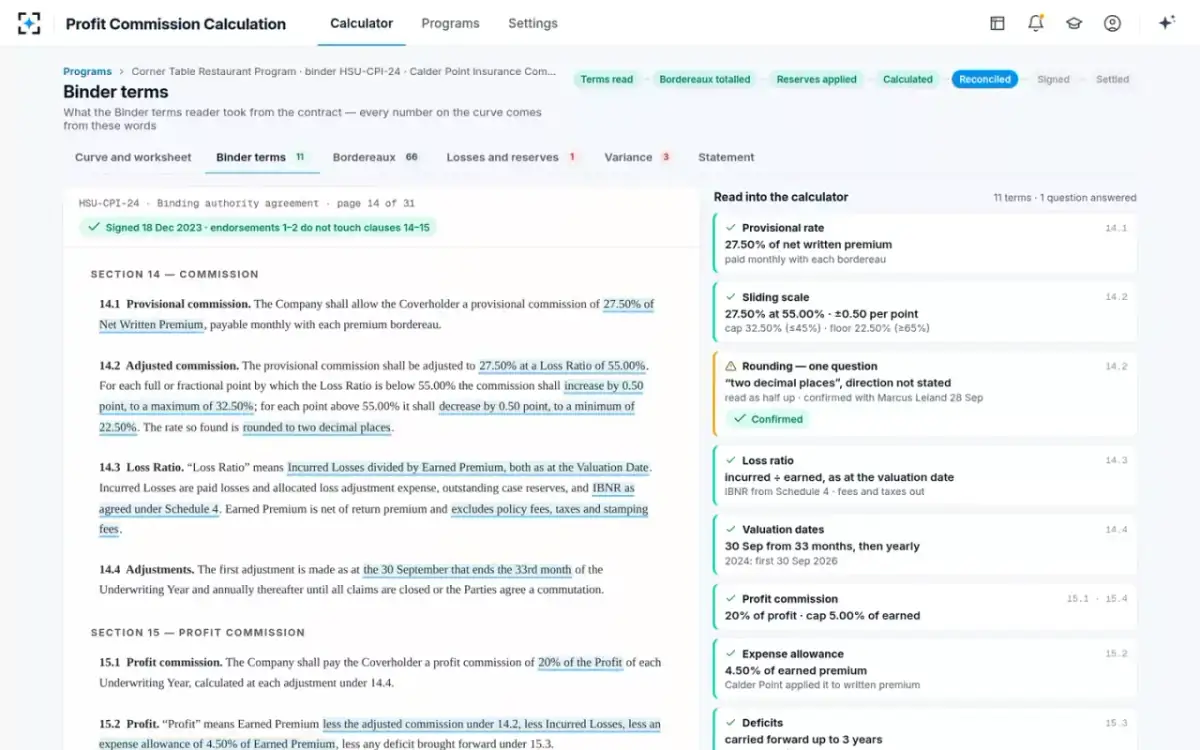
The profit commission clause, phrase by phrase: the number each one sets
What the sample clause says: “a provisional commission of 27.50% of Net Written Premium, payable monthly with each premium bordereau”
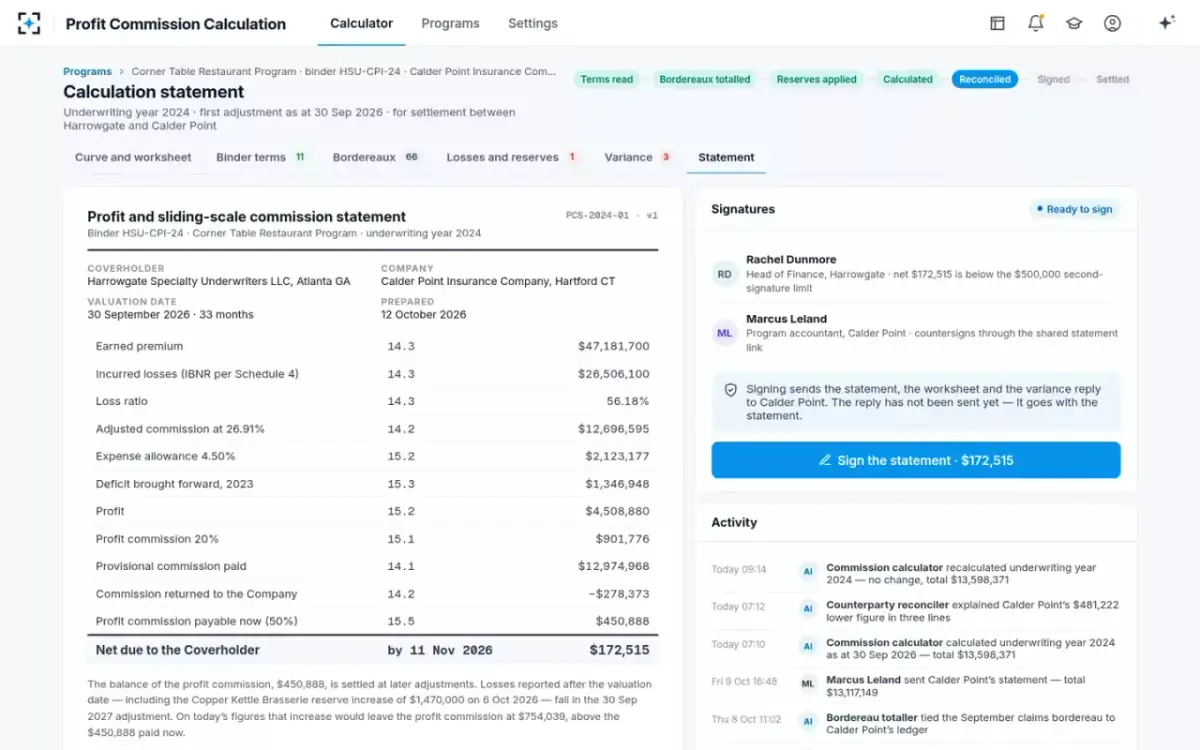
The number it sets, and what happens if it is silent: The cash the MGA keeps before any adjustment: $12,974,968 on 2024. Silent on the premium base and every later adjustment starts from a different number.
What the sample clause says: 27.50% at a 55.00% loss ratio, 0.50 point per point, to a maximum of 32.50% and a minimum of 22.50%, “rounded to two decimal places”
The number it sets, and what happens if it is silent: The adjusted rate, 26.91% on 2024. Silent on the rounding direction; the solution asked, and the parties confirmed half up.
What the sample clause says: Incurred losses over earned premium “both as at the Valuation Date”; IBNR “as agreed under Schedule 4”; fees, taxes and stamping fees excluded
The number it sets, and what happens if it is silent: The 56.18% that drives both the scale and the profit. Silent on IBNR and each side picks its own study.
What the sample clause says: First “as at the 30 September that ends the 33rd month”, then annually until claims close or a commutation
The number it sets, and what happens if it is silent: When each number is measured. Silent and late items drift between periods.
What the sample clause says: “20% of the Profit of each Underwriting Year”
The number it sets, and what happens if it is silent: $901,776 on 2024. Per year, not pooled across years.
What the sample clause says: Earned premium less the adjusted commission, incurred losses, “an expense allowance of 4.50% of Earned Premium”, and any deficit
The number it sets, and what happens if it is silent: $4,508,880 of profit. Silent on the allowance base and the carrier may take it on written premium.
What the sample clause says: Carried forward up to three years
The number it sets, and what happens if it is silent: $1,346,948 from 2023 taken off 2024. Silent on re-measurement and counting, and the deficit is argued every year.
What the sample clause says: Cap of 5.00% of earned premium; 50% paid at the first adjustment
The number it sets, and what happens if it is silent: Cap $2,359,085, not reached; $450,888 paid now, the rest at later adjustments.
What is a profit commission clause?
A profit commission clause turns "we share the profit" into a definition two accountants can calculate the same way. It names the profit (premium less which deductions), the share, the period it is measured over, when it is measured, how a loss in one period affects the next, and when the money moves. On a binder it sits beside the commission clause and often depends on it, because the commission the profit is measured after is itself adjusted.
The clause is also where the contract divides work between the parties. The NAIC's Managing General Agents Act requires a written contract before an MGA places business, and it asks for more than a list of duties.
The contract must be one that “where both parties share responsibility for a particular function, specifies the division of such responsibilities”.
NAIC Managing General Agents Act (Model #225), §4
A profit commission is the clearest shared function in a binder. The MGA holds the bordereaux and often the claims; the carrier holds the cash, the general ledger and usually the reserve study. A clause that names whose figure counts for each input, and on what date, is the clause that produces one number.
What should a profit commission clause include?
A complete clause answers every question a calculator would otherwise have to guess. The checklist below is built from the terms the solution's binder terms reader extracts and from the questions that most often divide an MGA's figure from its carrier's.
What a profit commission clause should state, so both sides reach one number
- The premium base, and its exclusions
Written or earned, gross or net of return premium; whether policy fees, taxes and stamping fees are out. The sample excludes $612,400 of fees and $1,468,950 of taxes and stamping fees.
- The loss measure
Paid, outstanding, allocated expense and IBNR, each named.
- Whose IBNR, agreed how
A figure agreed in writing for each valuation date, or a named actuary’s study.
- The valuation dates
The first adjustment, the interval after it, and when adjustments stop.
- The sliding scale, if any
Pivot, slope per point, cap and floor, and whether fractional points count.
- Rounding
Which figure is rounded (the loss ratio, the rate, or both), to how many places, and in which direction.
- The expense allowance
Its percentage and the premium it is taken on.
- The profit percentage and cap
Per underwriting year or pooled; the cap as a share of premium or a fixed sum.
- Deficits
How many years a deficit is carried, from when, whether it is re-measured, and whether a surplus also carries.
- The payment split
What share is paid at each adjustment and what is held for development.
- Claw-back
How an overpayment is repaid when a later valuation is worse, and by when.
- Late items
What happens to cancellations, claims and corrections booked after the valuation date.
- Termination and commutation
How open years are settled if the binder ends or the parties commute.
- The statutory hold-back
Where the MGA sets reserves or controls claims, payment no earlier than state law allows.
The definitions do most of the work: loss ratio, earned premium, incurred losses
Most disputes about a profit commission are disputes about definitions, not percentages. Clause 14.3 of the sample is a good example of a tight one: "Loss Ratio" means incurred losses divided by earned premium, both as at the valuation date; incurred losses are paid losses and allocated loss adjustment expense, outstanding case reserves, and IBNR as agreed under Schedule 4; earned premium is net of return premium and excludes policy fees, taxes and stamping fees.
Each part of that sentence removed an argument at the first adjustment. "As at the Valuation Date" kept eleven flat cancellations, worth $214,300 and requested in October, out of the 2024 figure; the carrier's statement had counted them, and the difference was $134,900 of the MGA's income. "As agreed under Schedule 4" kept the carrier's third-quarter reserve study, $562,000 higher than the agreed IBNR, out of the calculation; using it would have cost $335,098. The exclusions kept fees and premium taxes out of the denominator. How one IBNR figure moves the payout follows the second of those through the whole calculation.
A statutory accountant reads the same definitions from the other side. The NAIC's statutory accounting rule for contingent commissions ties the carrier's liability to the terms of each commission agreement (SSAP No. 71, as printed in NAIC working-group materials, 2020), so a vague definition becomes a vague accrual in the carrier's annual statement as well as a vague payment.
The binder's clauses beside the terms read into Profit Commission Calculation
What is a profit commission deficit clause?
A deficit clause carries a loss-making year's negative profit into later years, so the agent is not paid a profit commission on good years while the carrier alone absorbs the bad ones. The sample clause 15.3 carries a deficit forward up to three years. In the sample, underwriting year 2023 ran at a 76.40% loss ratio and produced a $1,346,948 deficit, which comes off the 2024 profit before the 20% is applied, costing Harrowgate $269,390 this year.
"Up to three years" still leaves four questions a careful clause answers. From when are the years counted: the deficit year's end, or its first adjustment? Is the deficit fixed when first measured, or re-measured at every valuation as the deficit year develops? Is a deficit used in date order when there are two? And does a surplus carry forward too, or only a deficit? The deficit carried forward, valued both ways puts numbers on each answer.
What is a profit commission on renewal clause?
A renewal provision answers how a renewed binder treats the underwriting years before it, and searches for "profit commission on renewal clause" are usually looking for one of three choices. The years may be pooled, so the profit commission is calculated on the combined results of the expiring and renewed binders; a deficit in the expiring binder may follow the program into the renewal; or profit commission on the expiring years may be conditional on renewal, or forfeited if the agent moves the business.
Common variants in profit commission wording, and the number each one moves
| Term | One wording | Another wording | What changes |
|---|---|---|---|
| Measurement period | Each underwriting year on its own | Three years pooled | Pooling lets a good year absorb a bad one without a separate deficit clause |
| Renewal | Deficit follows the program into the renewed binder | Each binder settles alone | Whether a renewal starts clean |
| IBNR | Agreed in writing for each valuation date | Carrier’s latest study | Who controls the largest judgement in the number |
| Expense allowance | % of earned premium | % of gross written premium | Larger allowance when premium is returned |
| Cap | % of earned premium | Fixed sum | How much upside the agent keeps in a very good year |
| Payment | Share paid at each adjustment | All at final adjustment | How much the agent must repay if the year worsens |
When is profit commission payable under the clause?
Under the clause, profit commission is payable at the adjustments the clause names and in the shares it names; under statute, sometimes later. The sample's clause 14.4 sets the first adjustment as at the 30 September that ends the 33rd month and annual adjustments after it until all claims are closed or the parties agree a commutation, and clause 15.5 pays 50% at the first adjustment. For 2024 that is $450,888 now, netted against $278,373 of commission returned, so $172,515 moves within 30 days of signature.
Where the MGA sets loss reserves or controls claim payments, state MGA laws modelled on NAIC Model #225 override the clause's timing: interim profits wait one year after they are earned on property business and five years on casualty, and until verified. A clause that pays earlier on such business is not a clause the carrier can follow; why the law makes MGAs wait sets out the rule state by state.
Commutation and termination: how the last adjustment is written
A profit commission clause has to say how it ends, because an underwriting year can stay open long after the binder that wrote it. The sample keeps adjusting "until all claims are closed or the Parties agree a commutation", so the last adjustment is either the one after the final claim closes, which on liability business can be many years out, or a negotiated settlement of the remaining reserves.
A commutation turns the open IBNR into a price, and the profit commission follows that price. If the clause does not say whether the commutation amount is treated as incurred losses for the final adjustment, the two sides will argue about it at exactly the moment the relationship is ending. The same applies on termination: a carrier exiting a program needs the clause to say which years stay open and who values their reserves.
The clause in the statement: each line of the payout tied to its clause number
Reading a clause into a calculation without guessing
The discipline that turns a clause into one agreed number is simple to state: every parameter quotes its clause, nothing is inferred, and silence becomes a question. In the sample, the solution's binder terms reader extracted eleven terms (provisional rate, sliding scale, rounding, loss-ratio definition, valuation dates, profit commission, expense allowance, deficits, cap, payment and IBNR), quoted the clause behind each, and raised exactly one question: clause 14.2 says "two decimal places" but not which way. It was answered by the carrier's program accountant on 28 September and recorded beside the term.
The reader also checks the amendments. The sample's endorsements 1 and 2 do not touch clauses 14 and 15, and the reader says so on the screen, because an endorsement that changes the expense allowance or the deficit period is the most common way a calculation goes wrong while looking right. When the carrier's statement used an expense allowance on gross written premium, the reason turned out to be the wording of an older 2021 binder still in the carrier's template. The agent that reads the clause describes how that reading is done and what it may never decide.
Questions people ask
What is profit commission wording?
It is the text of the clause that defines profit and the agent's share of it. Good wording names the premium base, the loss measure including IBNR, the valuation dates, the expense allowance, the deficit rule, the cap and the payment split; the sample binder does this in clauses 14 and 15 and Schedule 4.
What is a carry forward in a profit commission clause?
It is the rule that moves a deficit, and sometimes a surplus, from one period into the next calculation. The sample carries a deficit forward up to three years, so 2023's $1,346,948 deficit reduces 2024's profit before the 20% is applied.
Can an endorsement change the profit commission clause?
Yes, and that is why a calculation must read the binder with every endorsement, at the version in force for the underwriting year. In the sample, endorsements 1 and 2 leave clauses 14 and 15 untouched, and the solution records which binder version each signature relied on.
What happens to profit commission if the binder is terminated?
The clause decides: open underwriting years usually keep being adjusted until claims close or the parties commute the remaining reserves. A clause that is silent on termination leaves the valuation of open years to negotiation at the end of the relationship.
Does state law override a profit commission clause?
On timing it can. Where an MGA sets loss reserves or controls claim payments, state laws based on NAIC Model #225 hold interim profits for one year after they are earned on property business and five years on casualty, whatever the clause says.
Who drafts a profit commission clause?
The carrier and the MGA negotiate it as part of the binding authority agreement, usually with the carrier's program underwriting and legal teams drafting. Finance teams on both sides should read it before signature, because each silent phrase becomes an annual argument at the adjustment.