An MGA profit commission is the share of a program's underwriting profit that a carrier pays its managing general agent on top of the ordinary commission, calculated under the binding authority agreement once an underwriting year's losses have had time to develop. It is hard to get right because the MGA writes the business, often handles the claims and holds the data, so it can move the very profit it is paid on; that is why US state laws modelled on the NAIC's Managing General Agents Act hold the payment back until the profit has been verified, and why four people, not one, stand behind the figure. Botminds' Profit Commission Calculation is built for that chain: its agents read the binder's commission clauses, total the premium and claims bordereaux to the valuation date and apply the agreed reserves, and every person in the chain checks and signs only the part that is theirs.
The figures on this page come from the solution's fictional sample: Harrowgate Specialty Underwriters, an MGA writing the Corner Table Restaurant Program under binder HSU-CPI-24 for Calder Point Insurance Company, at the first adjustment of underwriting year 2024, valued at 30 September 2026. The rules are quoted from the model law and state statutes, linked where they appear.
Who checks an MGA profit commission before it is paid, in Profit Commission Calculation
Agent
Binder terms readerReads the commission and profit commission clauses into eleven terms, each quoting its clause.
Never: Infers a term the binder does not state
Agent
Bordereau totaller and reserve checkerTotals 66 bordereaux to the valuation date; applies the IBNR in the signed reserve letter.
Never: Sets or changes a reserve
A person decides
MGA head of financeDecides each difference with the carrier and signs the calculation statement.
A person decides
Carrier program accountantRebuilds the figure from the carrier’s inputs and countersigns.
A person decides
Actuary and auditorThe actuary attests to the reserves the profit rests on; the auditor re-performs the arithmetic.
What is an MGA profit commission?
An MGA profit commission is a second, deferred layer of pay that rewards the agent for the quality of the business, not its volume. The first layer is the commission on premium, often provisional and adjusted later along a sliding scale that falls as the loss ratio rises. The second is a percentage of whatever profit is left once the carrier has deducted that commission, the incurred losses, an expense allowance and any deficit carried from an earlier year.
In the sample binder the two layers work like this. Harrowgate is paid a provisional 27.50% of net written premium each month. At the first adjustment the commission is reset along the binder's scale to 26.91%, because the year's loss ratio came in at 56.18% against a 55% pivot, and the profit commission is 20% of the remaining profit: $901,776 on $47,181,700 of earned premium, or 1.91 cents on each premium dollar. Small as a percentage, it is the part of an MGA's income that moves most with each reserve, and the profit commission formula, line by line, shows why.
Many searches ask whether an MGA's commission is based on revenue or on profit. Under a binder like this one, both: the provisional commission follows premium, the sliding scale follows the loss ratio, and the profit commission follows underwriting profit after expenses. An agency's contingent commission works on a similar idea, but it is usually set by the insurer for its whole agency force rather than negotiated clause by clause for one program.
Who calculates profit commission, and who checks it?
The MGA usually calculates its profit commission first, because it holds the bordereaux, and the carrier then rebuilds the figure from its own general ledger and reserves; an actuary stands behind the reserves and an auditor can re-perform the whole sum. No single person can verify it alone, because the inputs belong to different people: the clause to the contract, the premium and claims to the bordereaux, the reserves to the claims administrator and the actuary, and the cash to the carrier.
The NAIC's model law writes this division into the contract itself. It requires a written agreement setting out each party's responsibilities before an MGA may place business, and it lists what the insurer must do for itself whatever the contract says (NAIC Model #225, October 2002 edition). A profit commission sits across those duties: the MGA prepares, the insurer pays, and the insurer's own reviews and actuarial opinion are what make the profit "verified".
Four people behind one MGA profit commission, before and with the agents
Today
Rebuilds the same sum in a workbook each year, pasting 66 bordereaux and choosing an IBNR, then argues the result with the carrier for weeks.
With agents
Starts from a worksheet where every line names its clause or bordereau total, decides each difference, and signs.
Still theirs: The decision on every difference, and the first signature
Today
Rebuilds the MGA’s figure from his own general ledger for each of 30 programs and finds a different answer.
With agents
Sees the MGA’s inputs beside his own, with the clause behind each difference, and countersigns through a shared link.
Still theirs: The countersignature, and the cash
Today
Delivers a reserve study that one side uses and the other does not know about.
With agents
Sees which IBNR the calculation used and what any other study would change.
Still theirs: The reserve opinion; no agent sets a reserve
Today
Re-performs someone else’s workbook at year end, without the clause versions or the bordereaux it used.
With agents
Reads each line with its clause, bordereau months and reserve letter, at the version that was signed.
Still theirs: The audit judgement
The MGA's head of finance: prepares the figure and signs first
The MGA's head of finance owns the first version of the number, and the hard part is not the arithmetic but the inputs. A profit commission needs the clause as signed and amended, premium and claims by underwriting year up to the valuation date, the IBNR the parties agreed, and any deficit still being carried. Texas writes the raw material into statute: an MGA must send each insurer an account report at least once a calendar quarter covering written, earned and unearned premium, paid and outstanding losses, losses incurred but not reported, and management fees (Tex. Ins. Code §4053.103).
What goes wrong is ordinary. In the sample, the bordereau totaller found two duplicate claim rows for one insured, $41,800 paid twice in the file but once in the carrier's cash; eleven flat cancellations worth $214,300 that arrived on the October bordereau, after the valuation date; and $612,400 of policy fees with $1,468,950 of surplus lines taxes and stamping fees sitting inside the premium bordereaux, which the binder excludes from earned premium. Each one changes the loss ratio, and the loss ratio sets both the sliding scale and the profit.
The head of finance's signature confirms the MGA's reading of the contract and its totals. In the sample, Rachel Dunmore signs the calculation statement for a net $172,515; a second signature from the chief financial officer would be needed above $500,000, a limit set in the solution's settings.
The carrier's program accountant: rebuilds it from the carrier's side
The carrier's program accountant checks the MGA's figure by building his own, from the carrier's general ledger, cash and reserve studies, and then explaining the gap. The model law gives him the data to do it: the MGA must render accounts detailing all transactions at least monthly, and the insurer must have access to the records in a form it can use (Model #225, §4B and §4D).
Two honest calculations of the same profit commission rarely agree on the first pass. In the sample, Calder Point's statement came in $481,222 below Harrowgate's, and the whole gap came from three readings of the same binder, not from arithmetic.
The $481,222 between the MGA's figure and the carrier's came from three readings of one binder
The variance with the carrier, one clause at a time, in Profit Commission Calculation
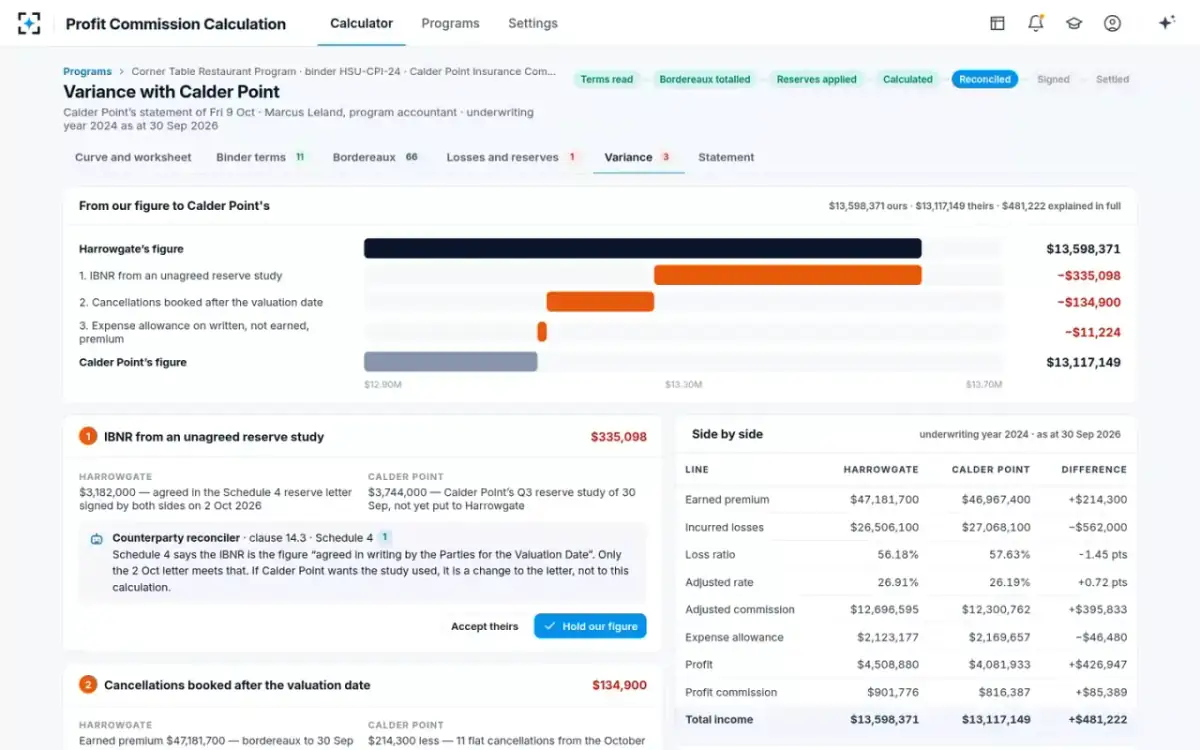
The program accountant's countersignature confirms that the carrier accepts each reading. Where the readings differ, the clause decides, not the bigger party: the sample binder defines IBNR as the figure agreed in writing for the valuation date, so a reserve study one side has not seen is a proposal to change that letter, not an input to this calculation.
The actuary: does an MGA profit commission need an actuary?
Where the MGA establishes loss reserves, yes: the model law makes the insurer obtain an actuary's opinion on them every year, and those reserves are the largest judgement inside any profit commission. The text is short.
“If an MGA establishes loss reserves, the insurer shall annually obtain the opinion of an actuary attesting to the adequacy of loss reserves established for losses incurred and outstanding on business produced by the MGA.”
NAIC Managing General Agents Act (Model #225), §5B
States sharpen it. New York's Regulation 120 requires the actuary to be a member of the American Academy of Actuaries in good standing (11 NYCRR §33.6(b)). Florida applies the duty wherever the MGA establishes total loss reserves, IBNR included (Fla. Stat. §626.7454(2), 2026), which puts the estimate of claims not yet reported, the number that moves a profit commission most, squarely inside the opinion.
In the sample, three views of IBNR for underwriting year 2024 existed on the day of the adjustment: $3,182,000 in the reserve letter both sides signed on 2 October, $3,744,000 in the carrier's third-quarter study, and $3,050,000 from Harrowgate's own actuary. Using the carrier's study would have cost Harrowgate $335,098. The actuary's role is to stand behind one of those numbers; how one IBNR figure moves the payout follows it from the study to the cheque.
The auditor: re-performs it at year end
The auditor's check is re-performance: taking the same clause, the same totals and the same reserves, and reaching the same figure without trusting anyone's workbook. On the carrier's side the profit commission is an accrued liability in its statutory statements, and on the MGA's side it is income its own audited statements must support; the model law requires the insurer to hold independent audited financial statements of each MGA for the two most recent fiscal years (Model #225, §5A).
Re-performance fails for practical reasons more often than for errors of principle. The workbook was overwritten for the next valuation; the bordereaux it used were later corrected; the clause was amended by an endorsement nobody linked. In the solution, each signature is recorded with the worksheet version, the binder version and the bordereaux it used, so the audit senior in the sample, Helen Achebe, can open any line and see the words or the months behind it.
Signed and countersigned: one figure, two signatures, in Profit Commission Calculation
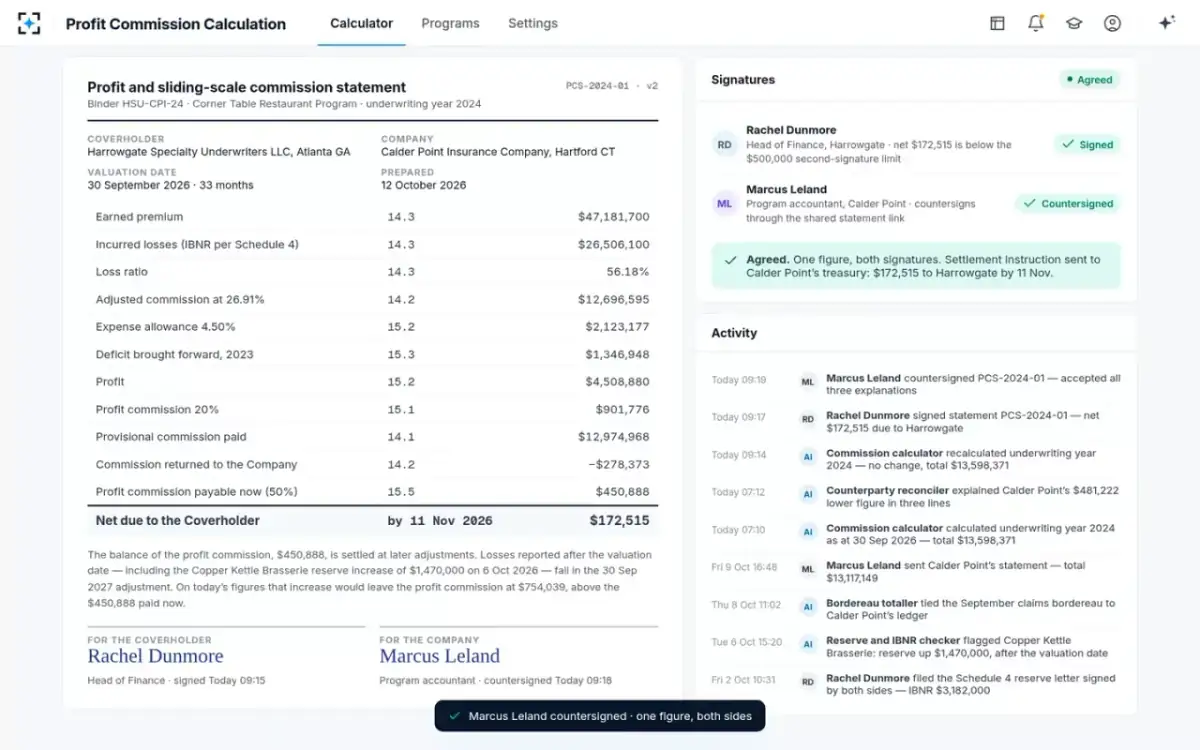
When is profit commission paid to an MGA?
A profit commission is paid when the binder says, and, where the MGA can influence the profit, no earlier than state law allows. Binders usually set a first adjustment some months after the underwriting year closes and further adjustments each year after; the sample binder values the year at the 30 September that ends its 33rd month, pays 50% of the profit commission then, and settles the rest at later adjustments.
The statutory hold-back is the stricter clock. Where the MGA can set the profit by establishing loss reserves or controlling claim payments, the model law and the states that follow it hold interim profits for one year after they are earned on property business and five years on casualty, and until they have been verified. The rule, the states that differ and what it does to an MGA's cash are set out in why the law makes MGAs wait.
The payment also has to be undone if the year deteriorates. In the sample, the $450,888 paid now stays covered unless about $4,340,000 more of incurred loss lands on 2024, at which point the year's profit commission would fall to $449,918 and the excess would be repaid within 30 days. A late kitchen-fire reserve increase of $1,470,000 uses 34% of that headroom.
What each signature confirms
A signature is only worth the evidence behind it, so each one should be tied to a specific check. The table below is one way to write that into a program's procedures; the checks are ours, built from the duties above.
Four checks before an MGA profit commission is paid, and the evidence each needs
| Person | What the signature confirms | Evidence it needs | Where it usually breaks |
|---|---|---|---|
| MGA head of finance | The clause is read as signed, and the totals are complete to the valuation date | The binder and every endorsement; bordereaux tied to the carrier’s general ledger and cash | Late items moved between periods; fees and taxes left in premium |
| Carrier program accountant | The carrier accepts each reading, or names the one it disputes | The carrier’s own rebuild, line by line beside the MGA’s | A different IBNR or expense basis nobody named |
| Actuary | The reserves the profit rests on are adequate | The reserve letter agreed for the valuation date; any later study shown, not used | A study used by one side and unseen by the other |
| Auditor | The figure can be re-performed from the same inputs | Versions of worksheet, binder and bordereaux at signature | Workbooks overwritten for the next valuation |
Where the four checks break down, and what the agents take on
In spreadsheets, the four checks collapse into one person's workbook and three people's trust. The head of finance pastes the bordereaux, the program accountant pastes the same files into his own model, and each picks an IBNR; the actuary's letter and the auditor's re-performance arrive later, against whichever version survived. The arguments that follow are about inputs, and they take weeks because nobody can see the other side's inputs.
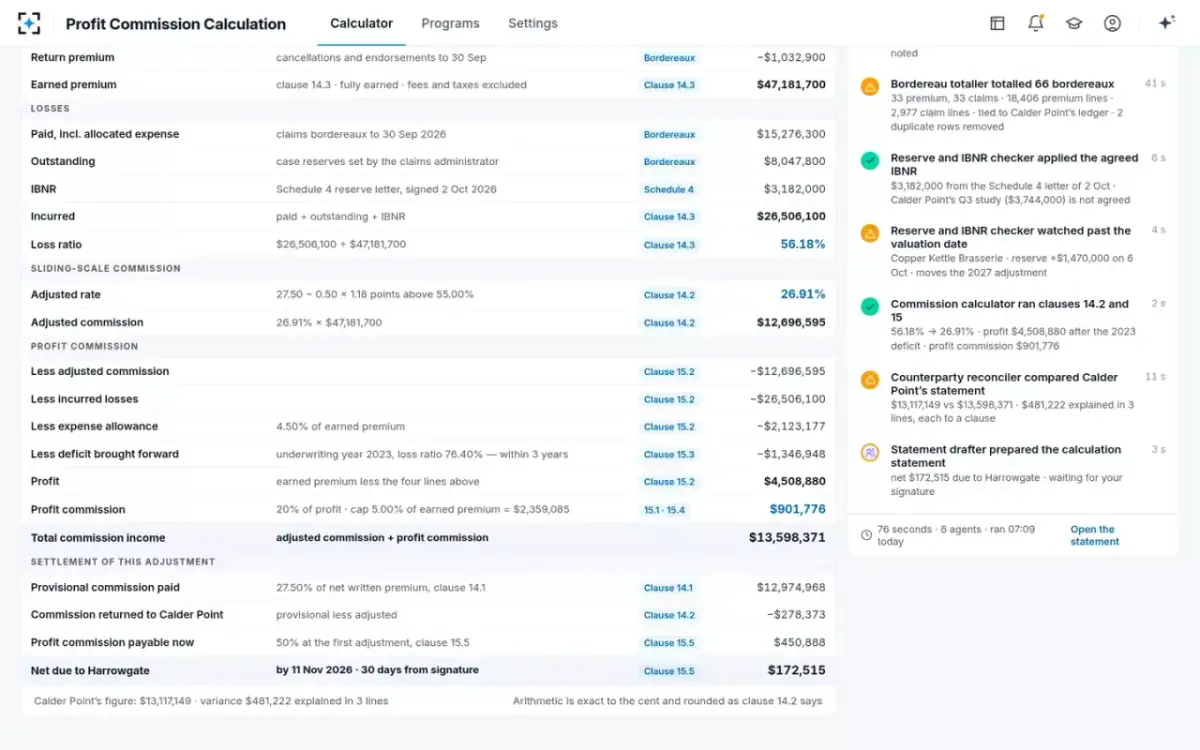
Profit Commission Calculation keeps the checks separate and gives each its evidence. Six agents do the mechanical part: one reads the binder's commission, profit commission and reserve clauses into eleven terms and asks when the contract is silent, as it did when clause 14.2 said "two decimal places" without saying which way to round; one totals the bordereaux and reports late items without moving them; one applies the agreed IBNR and watches large losses after the valuation date; one runs the arithmetic to the cent; one rebuilds the carrier's figure and explains the difference; one drafts the statement. In the sample the six took 76 seconds. None of them sets a reserve, accepts or disputes a difference, or sends anything before both signatures; the agent that reads the clause sets out what that one agent may and may not decide.
The worksheet each signer reads: every line with its clause or bordereau
Questions people ask
What is a profit share for an MGA?
A profit share, or profit commission, is the MGA's percentage of a program's underwriting profit, paid after losses have developed. In the sample it is 20% of the profit left after the adjusted commission, incurred losses, a 4.50% expense allowance and a deficit carried from the year before, capped at 5% of earned premium.
Is MGA commission based on revenue or profit?
Usually on both. The provisional commission is a percentage of premium; a sliding scale adjusts it to the loss ratio; a profit commission adds a share of profit. The binder's commission clauses decide how much of the MGA's income follows each, and they differ from program to program.
Can an MGA calculate its own profit commission?
It can prepare it, and usually does, because it holds the bordereaux. Where it also sets reserves or controls claim payments, state laws modelled on NAIC Model #225 hold the payment until the profit is verified, and the carrier must obtain an actuary's annual opinion on those reserves.
What happens if the carrier calculates a different figure?
The two sides bridge from one figure to the other, one difference at a time, and settle each by the clause. In the sample the carrier's figure was $481,222 lower, entirely explained by an unagreed reserve study, cancellations booked after the valuation date and an expense allowance on the wrong premium base.
How is an MGA profit commission different from an agent's contingent commission?
Both reward profitable business after the fact. An MGA's profit commission is negotiated in the binder for one program and often sits on top of a sliding scale; an agency's contingent commission is usually a schedule the insurer offers its agents, combining loss ratio with volume or growth. MGAs that set reserves also face the statutory hold-back that ordinary agents do not.
Who should sign the profit commission statement?
At minimum the MGA's head of finance and the carrier's program accountant, with a second MGA signature above a set amount; in the sample that limit is $500,000. The actuary's opinion and the auditor's re-performance stand behind the statement rather than on it.