Profit commission calculation in SAP, or in any ERP that runs an insurer's or MGA's general ledger, can mean configuring the general ledger to compute the commission, or posting a figure calculated elsewhere into it; in both cases the number depends on inputs the general ledger does not hold. A profit commission needs the binder's clause as signed, premium and claims by underwriting year to the valuation date from the bordereaux, the IBNR the parties agreed, and any deficit still being carried, and only the payments already made live in the general ledger. The practical question is therefore not whether SAP can multiply a percentage, but where the calculation should sit so those five sources agree. Botminds' Profit Commission Calculation sits between them: agents read the clause, total and tie the bordereaux to the carrier's general ledger and cash, apply the agreed reserves, and produce a signed statement whose figures the general ledger then posts; it replaces none of the systems around it.
The figures are the solution's fictional sample: Harrowgate Specialty Underwriters and Calder Point Insurance Company, binder HSU-CPI-24, Corner Table Restaurant Program, underwriting year 2024 at 30 September 2026. We describe no vendor's modules: whether a particular SAP configuration can hold a sliding scale is a question for its owners; what any configuration needs from outside the general ledger is the subject here.
The systems one profit commission crosses, and where Profit Commission Calculation sits
A person decides
Binder (contract system or document store)The signed clause and endorsements: rate, slide, cap, floor, expense allowance, deficits, payment.
Agent
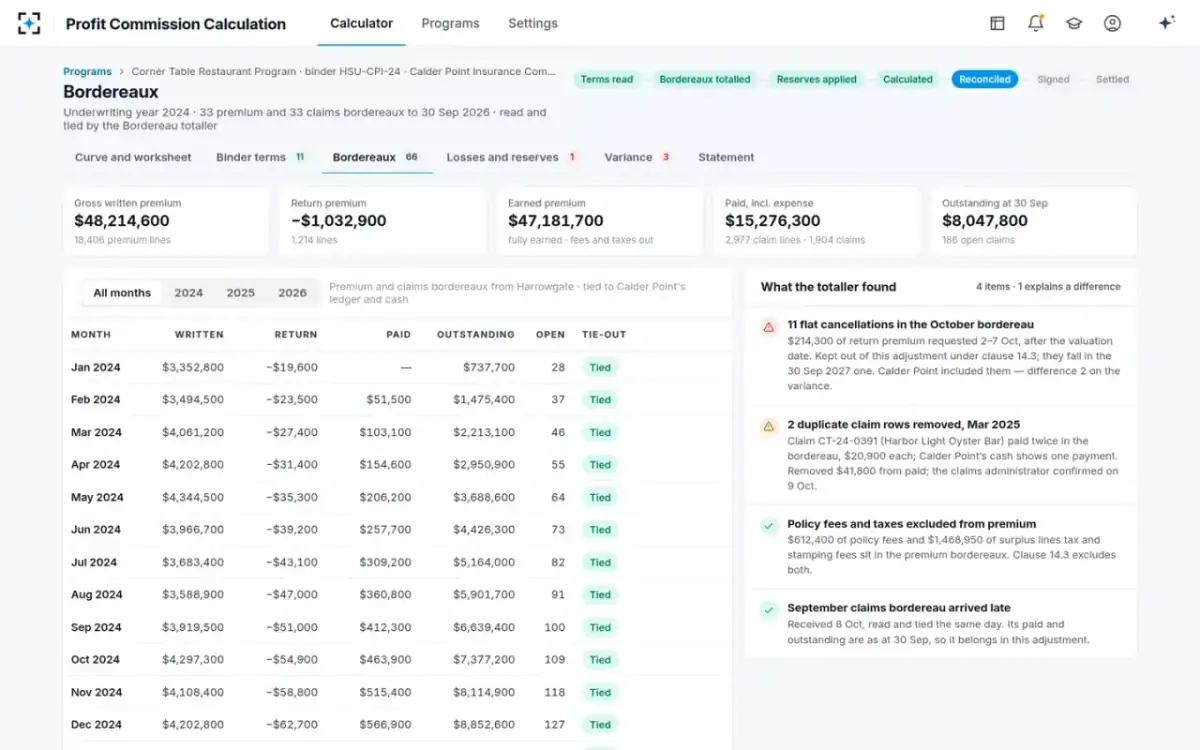
Bordereaux and claims (MGA and claims administrator)66 monthly files totalled by underwriting year to 30 September and tied to the general ledger and cash.
Never: Edits a line or moves a late item
Agent
Reserving (actuaries)The IBNR in the signed reserve letter is applied; other studies are shown.
Never: Sets a reserve
Agent
Calculation and reconciliationWorksheet with a source for every line; the carrier’s figure rebuilt and explained.
A person decides
Signatures, then the general ledgerBoth sides sign; the general ledger posts the commission returned and the profit commission paid now.
Can SAP calculate profit commission?
A general ledger can store rates, run formulas and post the result, so in principle an ERP can calculate a profit commission once its inputs are in it. The difficulty is the inputs: underwriting-year premium net of cancellations and fees to a valuation date, losses including an IBNR that changes with each reserve letter, deficits carried across years, and the reading of a clause that may define each of those differently from the next binder. Most of that is not accounting data, and loading it there each year is the same pasting a spreadsheet requires, with a longer change cycle.
So the decision is about placement. Seen as shares of the sample year's earned premium, more than half of the figure is decided by the claims system and the reserving model, and the rest by the clause applied to them; the books record the result but hold none of the inputs that set it.
Which system decides each share of one year's earned premium in the sample
Underwriting year 2024, $47,181,700 of earned premium
- Claims system: paid and case reserves · 49%
- Reserving: agreed IBNR · 7%
- Binder clauses: commission and expense · 31%
- Deficit and profit · 13%
What each system holds, and what it hands to the calculation
Each system is the record for one input, and each hand-off needs one check before the number moves on. The table maps them for the sample.
Five systems, five hand-offs: what a profit commission takes from each
Binding authority agreement
What it holdsCommission, profit commission and reserve clauses; endorsements
What it hands overEleven terms, each with its clause
The checkThe version in force for the underwriting year
MGA policy and bordereau files
What it holdsPremium, cancellations, fees and taxes, by policy and month
What it hands overEarned premium by underwriting year to the valuation date
The checkTied to the carrier’s general ledger and cash, month by month
Claims system
What it holdsPaid losses, allocated expense, case reserves
What it hands overPaid and outstanding to the valuation date
The checkDuplicates removed; late moves reported, not moved
Reserving model
What it holdsIBNR studies by each side’s actuary
What it hands overThe IBNR in the signed reserve letter
The checkSigned for this valuation date
Carrier general ledger (SAP or another ERP)
What it holdsProvisional commission paid, cash, accruals
What it hands overPayments already made; receives the statement’s postings
The checkProvisional paid equals cash
The law already assumes the MGA's data has to be usable elsewhere. The NAIC model gives the insurer access to the MGA's records in a form it can use, and monthly accounts of all transactions (Model #225, §4B and §4D); Texas requires a quarterly account report with written, earned and unearned premium, paid and outstanding losses, IBNR and management fees (Tex. Ins. Code §4053.103). Those are the profit commission's inputs, delivered in the MGA's layout; turning them into the general ledger's layout is the integration work.
Where should profit commission be calculated?
Where its inputs can be read and its result checked, and that is rarely inside the general ledger itself. There are three common placements, and each has a place.
Three places to calculate a profit commission, compared
| Inside the ERP | In a spreadsheet beside it | In a calculation layer that posts to it | |
|---|---|---|---|
| Clause reading | Typed into configuration by a consultant | Typed into cells by finance | Read from the binder, each term with its clause |
| Bordereaux | Loaded through an interface built per layout | Pasted each valuation | Read in each delegate’s layout, tied to general ledger and cash |
| IBNR | A field someone updates | A cell someone updates | The signed letter; other studies shown beside it |
| Deficits across years | Possible if modelled | Copied by hand | Carried by the clause’s rule for every open year |
| Counterparty check | Exports for the other side to rebuild | The file is emailed | A shared statement, line by line |
| Change cycle | A configuration change per new clause | Immediate, unversioned | A versioned setting, every change logged |
| Best when | Few binders, stable simple terms | One binder, one person, no dispute | Several binders, bordereaux, and a counterparty that checks |
Why the systems have to agree: the accounting rule and the control
The carrier's profit commission accrual is a statutory liability, and the rule for it ties the commission to the rest of the books. SSAP No. 71 requires contingent commission liabilities to follow each agreement's terms, to be established for the earned portion where the formula relates to loss experience, and to use assumptions consistent with the insurer's other underwriting balances, its loss reserves and IBNR among them (SSAP No. 71, as printed in NAIC working-group materials, 2020). A commission calculated on one IBNR and a reserve booked on another is the inconsistency the rule forbids.
For larger insurers the agreement is also a control obligation. The NAIC's Annual Financial Reporting Model Regulation requires a management report on internal control over financial reporting from insurers with $500 million or more of annual direct written and assumed premiums, and it defines the control broadly.
Internal control over financial reporting means “a process effected by an entity’s board of directors, management and other personnel designed to provide reasonable assurance regarding the reliability of the financial statements”.
NAIC Annual Financial Reporting Model Regulation (Model #205), §3J
In practice that puts the hand-offs in the table above inside the control environment: the bordereau tie-out, the reserve agreement and the reconciliation of the commission paid to the commission calculated. A calculation layer that records which clause, bordereau and reserve version each figure used gives the control its evidence; one that does not leaves it to whoever kept the file.
Bordereaux tied to the carrier's general ledger, month by month, before any figure moves
What is a commission sub-ledger?
A commission sub-ledger is the subsidiary ledger that records, by agreement and period, the commission an insurer has paid, owes or expects to recover, so that provisional payments, adjustments and accruals can be reconciled to the general ledger. For a binder with a sliding scale and a profit commission it needs at least four balances per underwriting year: provisional commission paid, adjusted commission at the latest valuation, profit commission calculated, and profit commission paid or held.
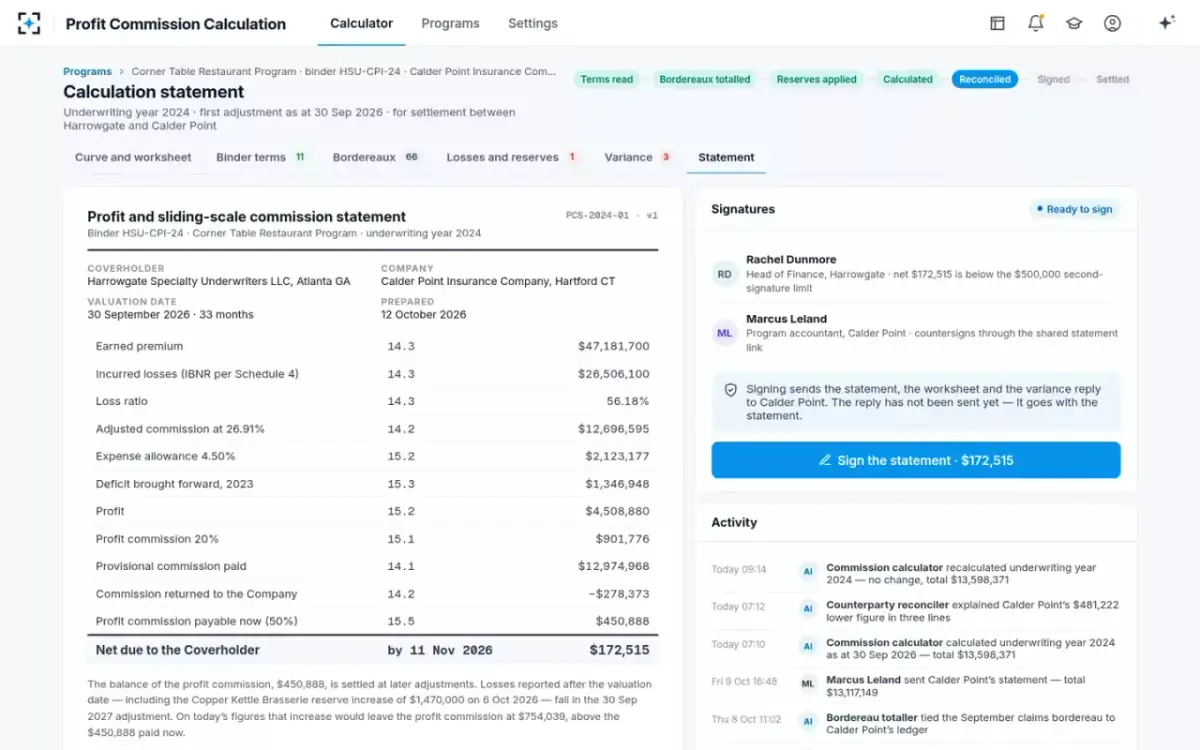
In the sample, those four for 2024 are $12,974,968 paid provisionally, $12,696,595 adjusted, $901,776 calculated and $450,888 paid now with $450,888 held for later adjustments. The statement nets them to a single movement, $172,515 to the MGA, but the sub-ledger needs all four, because each later adjustment will move the second, third and fourth again.
How the signed figure reaches the general ledger
The cleanest integration posts from the signed statement, not from the calculation, so that the books record only what both sides agreed. The table shows what one adjustment carries into a carrier's books; account names vary, and these are descriptions, not a chart of accounts.
What the sample's first adjustment carries into the carrier's general ledger
| Movement | Amount | Source line on the statement | What the general ledger needs with it |
|---|---|---|---|
| Commission returned by the MGA | $278,373 | Provisional $12,974,968 less adjusted $12,696,595 (clause 14.2) | Underwriting year, valuation date, binder version |
| Profit commission calculated for the year | $901,776 | 20% of $4,508,880 profit (clause 15.1) | Accrual basis and the IBNR used |
| Profit commission paid now | $450,888 | 50% at the first adjustment (clause 15.5) | The amount held for later adjustments |
| Net settlement to the MGA | $172,515 | Paid now less commission returned; due by 11 November 2026 | Both signatures and the statement version |
The signed statement the general ledger posts from, in Profit Commission Calculation
How do you integrate commission calculations with the general ledger?
Read from the systems of record, write to one place, and post only what was signed. In the sample the calculation reads the binder, the bordereaux, the claims feed, the reserve letters, the carrier's general ledger and cash for the tie-out, and the carrier's own statement; it writes a worksheet, a variance, a reply and a statement; and the settlement instruction goes to the carrier's treasury only after both signatures. Recalculation is automatic for every open underwriting year when a bordereau lands, so the figure the general ledger will eventually post is visible all year rather than only at the adjustment.
Two design rules prevent most integration faults. First, the valuation date holds: losses and cancellations after it are reported and wait for the next adjustment, never moved between periods to change this one. Second, versions travel with figures: each signature is recorded with the worksheet, binder and bordereaux versions it used, which is what lets an auditor tie a general ledger balance back to the words of the clause. Contingent commission accounting treatment covers what the carrier books, and the four people behind an MGA profit commission who signs before it does.
Between adjustments: keeping the books current every month
An adjustment happens once a year per underwriting year, but a carrier closes its books every month and reports every quarter, so the profit commission has to be estimated in between. The figure posted at quarter-end should be the same calculation the adjustment will use, run on the bordereaux and reserves available that day, not a percentage carried from last year.
In the sample, every open underwriting year is recalculated when a bordereau lands. On the day of the 2024 adjustment, that gave four different states in one program: 2022 agreed at 57 months with a $1,008,035 profit commission; 2023 carrying a $1,346,948 deficit; 2024 agreed at $901,776, half paid and half held; and 2025, still earning at 21 months, estimated at $1,750,223 on a 44.70% loss ratio. A quarter-end accrual built from those four lines carries their reserves and clause readings with it, which is what the accounting rule and the auditor both ask for.
Two settings keep the monthly figures from creating work. Differences with the carrier below $5,000 are agreed automatically in the sample, so small timing gaps do not reach a person; and a second signature, from the chief financial officer, is required above $500,000, so large settlements cannot post on one person's approval. Both are versioned, so the auditor can see which rule applied when a figure was posted.
Questions people ask
How is profit commission calculated in SAP?
However it is configured, the calculation needs the same inputs: the clause's terms, premium and losses by underwriting year to the valuation date, the agreed IBNR and any deficit. Most of those are not accounting entries, which is why many carriers calculate beside the ERP and post the signed result.
What system calculates commission in insurance?
Ordinary commission on premium is often calculated in the policy or billing system; profit-based commissions are usually calculated in spreadsheets or a separate calculation layer, because they need underwriting-year results, reserves and multi-year deficits. The books record the result.
Can a contingent commission be calculated in SAP?
The arithmetic can be built anywhere; the reading of each agreement and the assembly of its inputs are the hard parts. Whether a particular SAP configuration should hold them is a question of how many agreements, how often their terms change and who must check the result.
Does Profit Commission Calculation replace our ERP?
No. It reads from the general ledger to tie bordereaux to cash and payments, and it produces the signed statement the general ledger posts from. The general ledger stays the system that books and pays.
Where do the bordereaux live?
With the MGA, which must give the insurer its records in a usable form under laws based on NAIC Model #225. The solution reads them in each delegate's own layout and ties every month to the carrier's general ledger and cash before using them.