The contingent commission accounting treatment for a US insurer is set by SSAP No. 71 of the NAIC's statutory accounting principles: a contingent commission is a liability determined by the terms of each commission agreement, accrued for the earned portion of the business where the formula depends on loss experience, and estimated on assumptions consistent with the insurer's loss reserves, including incurred but not reported losses; commissions are expensed as incurred. That is one side of the entry. The other side appears when the same clause makes the agent owe money back, a return of provisional commission or a share of losses, and a receivable from an agent that the statutory manual does not specifically identify as an admitted asset can be non-admitted, as a 2025 California examination report records for $1,472,192 of contingent commission receivables. Botminds' Profit Commission Calculation gives the carrier's statutory accountant and the MGA's finance team the same signed figures for both sides: the profit commission calculated, the share paid and held, the commission returned, and the reserves each figure rests on.
The examples use the solution's fictional sample: Calder Point Insurance Company, the carrier, and Harrowgate Specialty Underwriters, its MGA, at the first adjustment of underwriting year 2024 on binder HSU-CPI-24.
Both sides of one adjustment: what moves now, and what stays on the books
Profit commission for 2024, $901,776, owed by the carrier
- Paid at this adjustment · 50%
- Held for later adjustments · 50%
The $450,888 paid now, and how it is settled
- Netted against commission the MGA returns · 62%
- Paid in cash · 38%
How are contingent commissions accounted for?
For a US insurer's statutory statements, as an accrued liability measured under the agreement. SSAP No. 71, the statement on policy acquisition costs and commissions, puts the whole rule in one paragraph.
“Contingent commission liabilities shall be determined in accordance with the terms of each individual commission agreement. Commission liabilities determined on the basis of a formula that relates to loss experience shall be established for the earned portion. Assumptions used to calculate the contingent commission liability shall be consistent with the terms of the policy contract and with the assumptions made in recording other assets and liabilities necessary to reflect underwriting results of the reporting entity such as retrospective premium adjustments and loss reserves, including incurred but not reported.”
NAIC SSAP No. 71, ¶3, as printed in the Statutory Accounting Principles Working Group's materials, 15 October 2020
Three requirements follow. The liability follows the clause, so a deficit carried forward, a cap or a payment split in the binder all shape the accrual. It is built up as premium is earned, not waited for until the adjustment date. And its loss assumptions must match the reserves the insurer books, so a profit commission accrued on one IBNR while the balance sheet carries another is exactly what the rule does not allow. The paragraph before it states the basic treatment: "Acquisition costs and commissions shall be expensed as incurred" (SSAP No. 71, ¶2).
What is the accounting treatment for profit commission on the carrier's books?
On the carrier's statutory books a profit commission owed to an MGA or agent is a commission expense and a liability, shown with other commissions payable until it is paid. The California examination report on one insurer lists the liability line the way it appears in a statutory balance sheet: "Commissions payable, contingent commissions, and other similar charges" (California Department of Insurance, examination of Topa Insurance Company as of 31 December 2023).
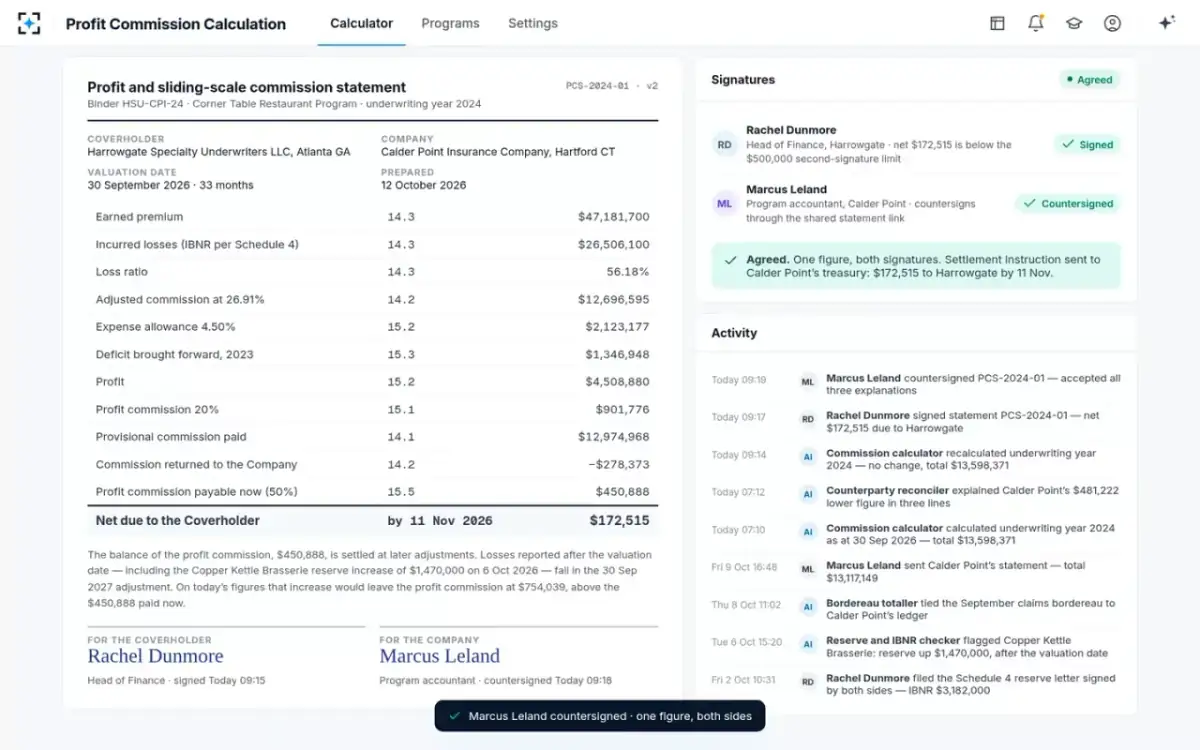
The accrual moves at every valuation. In the sample, the profit commission for 2024 is $901,776 at 33 months. Half is paid at this adjustment; the other half, $450,888, stays a liability, and at each later valuation it is re-estimated on the latest losses and the IBNR agreed for that date. If a late loss like the sample's $1,470,000 kitchen-fire reserve increase is booked, the year's profit commission falls to $754,039 and the liability with it; if about $4,340,000 more loss arrives, the liability is gone and the carrier has a claim for the excess already paid.
What is a contingent commission accounting entry?
On the carrier's side, an expense against a liability as the commission is earned, and a reduction of the liability as it is paid. The entries below follow the sample's first adjustment through the carrier's books in simplified form; account names vary from company to company.
A contingent commission journal entry, step by step, on the carrier's books
Each month of the underwriting year
DebitCommission expense
CreditCash or amounts due to the MGA
Amount$12,974,968 in all
WhyProvisional 27.50% (clause 14.1)
Adjustment, 30 Sep 2026
DebitAmount due from the MGA
CreditCommission expense
Amount$278,373
WhyAdjusted rate 26.91% (clause 14.2)
Adjustment, 30 Sep 2026
DebitCommission expense
CreditContingent commissions payable
Amount$901,776
WhyProfit commission for the year (clause 15.1), less anything accrued earlier
Settlement, by 11 Nov 2026
DebitContingent commissions payable
CreditAmount due from the MGA, and cash
Amount$450,888 = $278,373 + $172,515
WhyHalf paid now, netted (clause 15.5)
Until later adjustments
Debit—
CreditContingent commissions payable stays open
Amount$450,888
WhyThe half held, re-estimated each valuation
The settlement line is the one to notice. The commission the MGA returns, $278,373, is not paid in cash; it is deducted from the profit commission paid now on the same statement, and only the net $172,515 moves. That keeps the carrier's claim on the MGA from ever standing alone as a receivable, which matters for the reason in the next section.
Is a contingent commission receivable an admitted asset?
Not automatically, and a recent California examination shows the consequence. Statutory accounting admits only the assets its manual identifies; an amount an agent owes the insurer under a profit and loss sharing agreement is not on that list by name. The California Department of Insurance's limited-scope examination of Topa Insurance Company, filed in June 2025, records what happened to one such balance.
“Additionally, the Company reported a contingent commission receivable of $1,472,192 from agents, which is primarily from amounts accrued over the years for the profit/loss sharing provision in the general agent agreement with United Insurance Group. These assets are not specifically identified as admitted assets within the Accounting Practices and Procedures (AP&P) Manual.”
California Department of Insurance, Report of Limited Scope Examination of Topa Insurance Company as of 31 December 2023
The report applies SSAP No. 4, under which an asset not specifically identified in the manual is non-admitted, and non-admits that receivable together with $1,203,970 of broker rebate commission receivables, $2,676,162 in all. It attributes the year's adjustments to the audit performed by the company's independent auditors; with other adjustments, surplus as regards policyholders fell by $1,292,354, from $45,712,006 to $44,419,652.
Two commission receivables a California exam report records as non-admitted
The lesson for a profit commission clause is practical. A clause whose downside is a payment the agent must make later, a loss share or a claw-back of profit commission already paid, creates a receivable the carrier may not be able to count as an asset. A clause that settles returns by deduction from amounts the carrier owes on the same statement, as the sample's does, keeps most of that exposure inside the netting; any balance that remains is for the carrier's statutory accountants to assess under SSAP No. 4.
When is contingent commission recognised?
On the carrier's statutory books, as the business earns, where the formula relates to loss experience, and re-estimated at each reporting date on current loss estimates. A profit commission is not held back from the accounts until the binder's adjustment date; an underwriting year that is still earning, like the sample's 2025 at 21 months, already carries an accrual on its earned portion, based on its current loss ratio of 44.70% and the clause's terms.
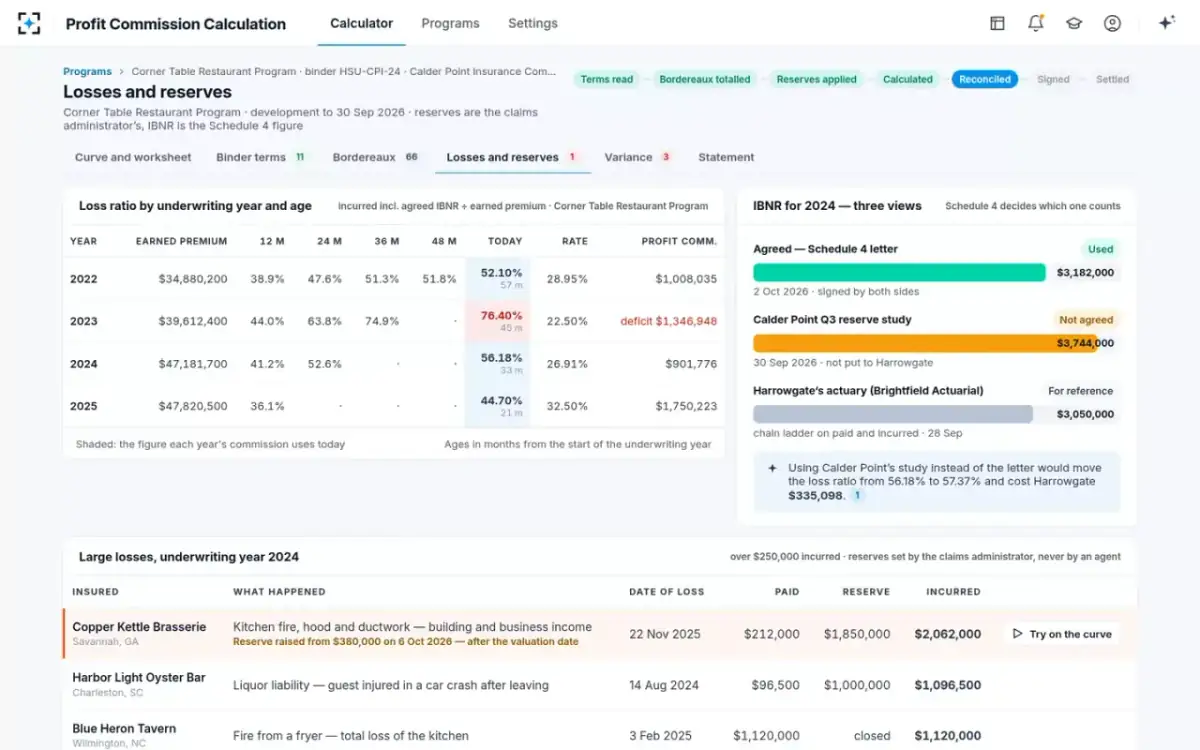
Losses by year and age, and the IBNR every accrual must match, in Profit Commission Calculation
The MGA's side runs on its own accounting framework, and two points from this series bear on it. Where the MGA sets reserves or controls claims, state MGA laws based on NAIC Model #225 forbid paying interim profits until one year (property) or five years (casualty) after they are earned and until verified (Model #225, §4L), so cash may trail any income the MGA's auditors allow it to recognise by years. And the amount can move down as well as up at each valuation. Why the law makes MGAs wait covers the hold-back.
Why the accrual and the reserves must use the same IBNR
Because the rule says the assumptions must be consistent, and because inconsistency shows up as a figure nobody can defend. In the sample, three IBNR views existed for 2024: the $3,182,000 the parties agreed, the carrier's $3,744,000 study and the MGA actuary's $3,050,000. A carrier that books reserves on its own study but accrues the profit commission on the agreed figure, or the reverse, has two underwriting results for one year.
One year, three IBNR views: the profit commission accrual each would produce
| IBNR view | Loss ratio | Profit commission for the year | Held after 50% paid now |
|---|---|---|---|
| Agreed in the signed reserve letter: $3,182,000 | 56.18% | $901,776 | $450,888 |
| Carrier’s third-quarter study: $3,744,000 | 57.37% | $845,050 | $394,162 |
| MGA’s own actuary: $3,050,000 | 55.90% | $914,965 | $464,077 |
The amounts are not large against the year's premium, but the principle is what an examiner or auditor tests: the commission accrual and the loss reserves should tell the same story. The cleanest way to make sure they do is to calculate the accrual from the same reserve letter the carrier books, and to show any other study beside it with its effect, which is how one IBNR figure moves the payout in the solution.
What examiners and auditors test in a contingent commission accrual
Three things, on the evidence of the rule and the California report: that the accrual follows the agreement, that its loss assumptions match the booked reserves, and that any balance claimed from agents is one the statutory manual admits. The Topa report shows that the third test is applied by independent auditors as well as examiners: the receivable was non-admitted in adjustments the report attributes to the audit by the company's independent auditors, and the examination report records them.
Two further checks come from the MGA rules rather than the accounting. Where the MGA sets loss reserves, the insurer must obtain an annual actuarial opinion on them, so the IBNR inside the commission accrual has an actuary behind it; and where the hold-back applies, profit commission paid earlier than the statute allows is a compliance finding, not just an accounting one. A file that shows, for each open year, the clause version, the reserve letter, the amount paid and held, and both signatures answers all five checks from one place.
Contingent commission disclosure requirements
Disclosure to buyers is a separate obligation from the accounting, and New York's is the most detailed we read. A producer must tell the purchaser that compensation may vary with the volume or profitability of business placed, and on request must describe the compensation in writing; where its amount is not known at the time, the disclosure must include the circumstances that will determine it and "a reasonable estimate of the amount or value, which may be stated as a range of amounts or values" (11 NYCRR §30.3(d)(2)).
A profit commission is the textbook case of compensation whose amount is not known at the time of sale. A producer that can show the range a clause produces, for example the sample binder's income at different loss ratios on its own curve, has the material for that estimate in the contract itself rather than in a guess. We did not verify a 50-state set of disclosure rules, and other states' texts should be read directly.
What the accountant gets from the calculation
The statutory accountant needs four things from a profit commission calculation: the figure for each open underwriting year at the reporting date, the share paid and the share still owed or recoverable, the reserve assumptions behind it, and evidence that both parties agreed. Profit Commission Calculation provides them from the same worksheet the MGA and the carrier sign: every open year recalculated when a bordereau lands, paid and held amounts per year, the IBNR used and every other study shown, and each signature recorded with the worksheet, binder and bordereaux versions it relied on. The systems one number crosses covers how those figures reach the general ledger.
The signed statement behind the entries, in Profit Commission Calculation
Questions people ask
What is SSAP 71?
It is the NAIC's Statement of Statutory Accounting Principles No. 71, Policy Acquisition Costs and Commissions. It requires acquisition costs and commissions to be expensed as incurred, and contingent commission liabilities to be determined under each agreement, established for the earned portion where they relate to loss experience, and estimated consistently with loss reserves including IBNR.
Is a profit commission an acquisition cost?
For a US insurer's statutory statements it falls under SSAP No. 71, the statement on acquisition costs and commissions, and is expensed as incurred rather than deferred. The contingent element is accrued as a liability for the earned portion of the business under the agreement's terms.
How does a deficit carried forward affect the accrual?
It reduces it, because the liability follows the agreement's terms. In the sample, the 2023 deficit of $1,346,948 cut 2024's profit commission from $1,171,166 to $901,776, and the carrier's accrual for 2024 is the lower figure.
What happens to the accrual when losses develop?
It is re-estimated at each valuation on the latest losses and agreed IBNR. In the sample, a $1,470,000 reserve increase after the valuation date would cut 2024's profit commission to $754,039 at the next adjustment, still above the $450,888 already paid.
Do contingent commission disclosure requirements apply to MGAs?
New York's Regulation 194 applies to insurance producers selling insurance contracts to purchasers; whether an MGA is the selling producer depends on its role in each placement. The rules written specifically for MGAs are the state MGA acts, which govern the contract with the insurer and the profit hold-back rather than disclosure to buyers.