A contingent profit commission in insurance is a commission paid to an agent, a managing general agent or a ceding insurer only if the business it placed turns out to be profitable, measured after losses have had time to develop. For managing general agents in the United States there is a second condition written into state law: where the MGA can influence the profit it is paid on, by establishing loss reserves or controlling claim payments, the NAIC's Managing General Agents Act and the state statutes based on it forbid paying interim profits until one year after they are earned on property business and five years on casualty business, and not until the profits have been verified. Botminds' Profit Commission Calculation applies that hold-back as a setting wherever the MGA sets reserves, shows every held year with its release date, and keeps the verification evidence, the clause, the bordereaux and the reserves, with the figure.
Where this page uses examples, they come from the solution's fictional sample: Harrowgate Specialty Underwriters, an MGA with four binders, including a restaurant program and a contractors' general liability program, with Calder Point Insurance Company.
The statutory hold-back where the MGA sets reserves: one year for property, five for casualty
- Earned
- Held 1 year
- Payable
- Earned
- Held 5 years
- Payable
What is contingent profit commission?
It is pay that depends on results after the fact. An independent agency may receive a contingent commission from an insurer for a profitable, growing book; an MGA under a binding authority agreement may receive a profit commission on a program's underwriting profit, often on top of a sliding-scale commission; a ceding insurer may receive a profit commission from its reinsurer under a treaty. In each case the payment is calculated after a valuation date and depends on losses, so it is contingent on how claims develop.
Its use varies widely, and the research is mixed on what it does. A study of US property-liability insurers in Risk Management and Insurance Review found that "wide variation existed among insurers in their use of contingent commissions" (Colquitt, McCullough and Sommer, 2011). A later study in the same journal found that "nonusers of contingent commissions are more cost and revenue efficient than are users of contingents", but that among users, "relatively higher levels of use are associated with more efficient operations and also better financial performance" (Ma, Pope and Xie, 2014).
Why is a contingent commission in insurance a sensitive payment?
Because it can pull the intermediary's interest away from the buyer's or the insurer's. For an agent, a commission tied to an insurer's profitability can influence which insurer the agent recommends, and New York requires producers to tell buyers, at or before application, "that the compensation paid to the insurance producer may vary depending on a number of factors, including (if applicable) the insurance contract and the insurer that the purchaser selects, the volume of business the producer provides to the insurer or the profitability of the insurance contracts that the producer provides to the insurer" (11 NYCRR §30.3(a)(3)).
For an MGA the risk runs the other way: toward the insurer. An MGA that handles claims and sets reserves decides much of the loss figure its profit commission is calculated on. A generous case reserve today, or an IBNR estimate left out, changes the profit it is paid on this year, and the cost appears later, when the claims are paid. The hold-back exists to make the MGA wait until that later point has mostly arrived. How one IBNR figure moves the payout shows the size of that effect on one binder.
What is the interim profits rule?
It is section 4L of the NAIC's Managing General Agents Act, one of the provisions a contract between an insurer and an MGA must contain, and it is short enough to quote in full.
“If the contract provides for a sharing of interim profits by the MGA, and the MGA has the authority to determine the amount of the interim profits by establishing loss reserves or controlling claim payments, or in any other manner, interim profits will not be paid to the MGA until one year after they are earned for property insurance business and five years after they are earned on casualty business and not until the profits have been verified pursuant to Section 5 of this Act.”
NAIC Managing General Agents Act (Model #225), §4L, October 2002 edition
Three conditions trigger it: the contract shares interim profits with the MGA; the MGA can determine their amount, whether by reserves, claim payments "or in any other manner"; and the profit is not yet past its one-year or five-year mark. Two things then have to be true before payment: the time has passed, and the profit has been verified under the model's section 5, which sets the insurer's own duties, including an annual actuarial opinion where the MGA establishes loss reserves and at least semi-annual on-site reviews of the MGA's underwriting and claims.
"Interim" is the word that does the work. An interim profit is one calculated before the underwriting year is finally settled, which is every profit commission paid at a first or later adjustment while claims remain open. The rule does not forbid sharing profit with an MGA; it forbids paying the interim figure until time and verification have made it less of an estimate.
Why are MGA profit commissions delayed?
Partly by contract and partly by law. Contracts delay profit commission because profit cannot be measured until losses develop: the sample binder makes its first adjustment at 33 months and pays half the profit commission then. The law delays it further where the MGA could shape the profit, because an early valuation is exactly when reserves are most uncertain and a party paid on profit has most room to be optimistic.
The split between property and casualty reflects how long claims take to emerge: liability claims can be reported years after the policy period and take years more to settle, while a property loss is generally known soon after the event. In the sample's restaurant program, underwriting year 2023 rose from a 44.0% loss ratio at 12 months to 76.40% at 45 months. A five-year wait on casualty profit is the law's estimate of how long it takes for that kind of movement to settle down.
The states that word it differently
The hold-back is a model provision, so each state's version must be read in its own words, and the differences are not cosmetic. They change what triggers the hold and what "verified" requires.
The interim-profit hold-back in the model and four state texts
| Text | What triggers the hold | Hold periods | What “verified” points to |
|---|---|---|---|
| NAIC Model #225 §4L (2002 edition) | MGA can determine interim profits by establishing loss reserves, controlling claim payments, or in any other manner | 1 year property, 5 years casualty, after earned | Section 5: the insurer’s duties, including an annual actuarial opinion where the MGA establishes reserves |
| Florida, Fla. Stat. §626.7451(9) (2026) | MGA can determine interim profits by establishing the total of all loss reserves, IBNR included, used in the calculation; claim payments and “any other manner” are not named | 1 year property, 5 years casualty | “Verified”, with no cross-reference; §626.7454(2) requires an actuary’s opinion where the MGA sets total reserves including IBNR |
| New York, 11 NYCRR §33.5(j) | As the model: reserves, claim payments, or in any other manner | 1 year property, 5 years casualty insurance business | §33.6, which requires an actuary who is a member of the American Academy of Actuaries |
| North Carolina, G.S. §58-34-2(d)(9) | Reserves, claim payments, “or by any other manner” | 1 year property, 5 years casualty | Subsection (f): a qualified actuary’s statement filed with the insurer’s annual statement |
| Minnesota, Stat. §60H.04(i) | As the model | 1 year property, 5 years casualty | §60H.05, which lists an independent financial examination and semi-annual on-site reviews; it contains no actuarial-opinion duty |
Florida's version is the one most likely to surprise an MGA that knows the model. It names IBNR expressly but triggers only on reserves: an MGA in Florida that controls claim payments but does not set total loss reserves is outside the words of §626.7451(9) (Fla. Stat. §626.7451(9), 2026). New York keeps the model's broad trigger and ties verification to an actuary who must belong to the American Academy of Actuaries (11 NYCRR §33.6(b); hold-back at §33.5(j)). North Carolina ties verification to the actuarial statement filed with the insurer's annual statement (G.S. §58-34-2). Minnesota's statute points verification to a section without an actuarial duty (§60H.04, §60H.05), so the contract has to say what verification will consist of.
When are profits "earned"? The question the statutes leave open
None of these texts says when a profit is "earned", and the answer moves the release date by up to a year. Premium on a policy written in December of an underwriting year is earned through the following December, so an underwriting year's premium is not fully earned until about two years after the year began. Counting five years from the end of the underwriting year, from the date its premium is fully earned, or from each accounting year's share of earned premium gives three different dates.
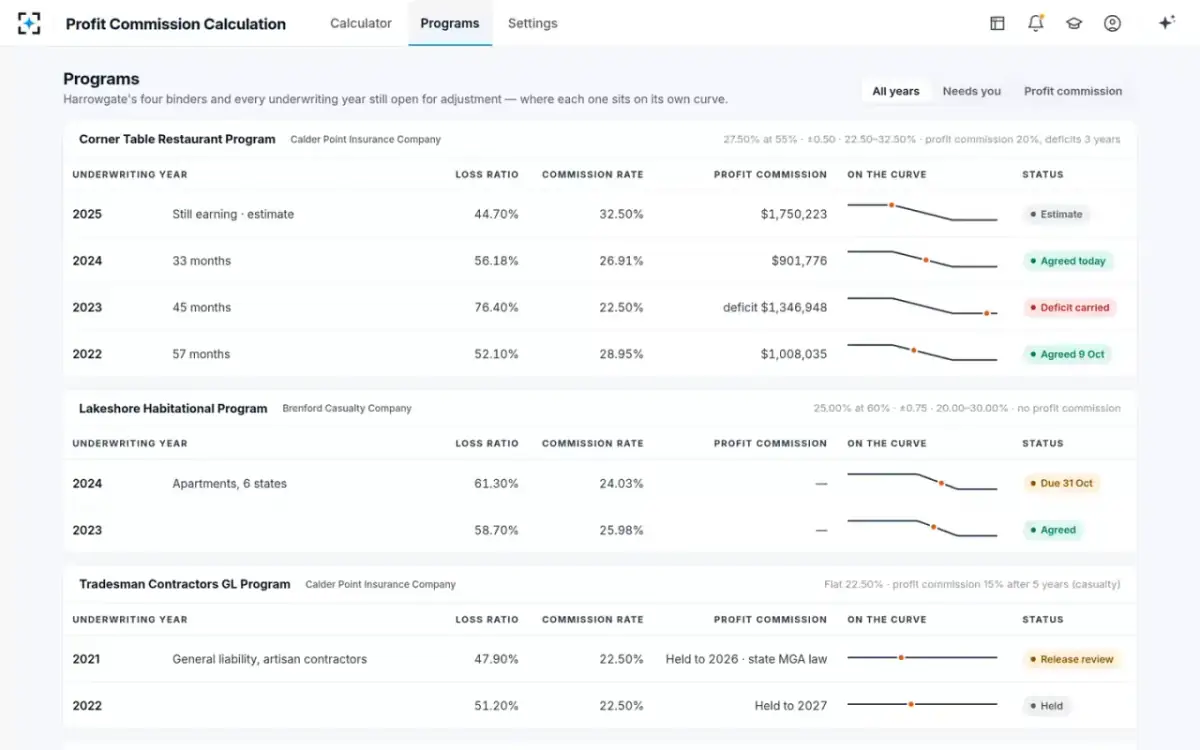
The sample shows why the reading has to be written down. Its contractors' general liability program, a casualty binder paying a 15% profit commission, shows underwriting year 2021 "held to 2026" and 2022 "held to 2027", which counts five years from the underwriting year. A carrier that counts from when the year's premium was fully earned would release each a year later. Neither statute nor model decides it; the contract and the regulator's view in the state should, and the calculation should apply whichever reading the parties sign.
Held years and their release dates on every binder, in Profit Commission Calculation
How long must an MGA wait for profit commission, and what does it cost?
On casualty business where the hold-back applies, at least five years after the profit is earned; on property, one. The cost is the time value of money: a profit commission received five years later is worth less today, and an MGA financing its operations meanwhile pays for the wait.
What $1,000,000 of profit commission is worth today, by hold-back and discount rate
At an 8% cost of funds, a five-year hold takes almost a third off the value of a casualty profit commission. That has two consequences an MGA owner should plan for. Contract design: a profit commission percentage that looks generous on property business is worth materially less on casualty business written by an MGA that sets reserves. Structure: an MGA can stay outside the trigger by not establishing loss reserves and not controlling claim payments, leaving those to the carrier or an independent administrator, which is a business decision, not a drafting trick, since the model's "in any other manner" covers indirect control too.
How the solution applies the hold-back
In Profit Commission Calculation the hold is a setting, not a manual step: "Hold interim profit where Harrowgate sets reserves", on by default in the sample, with the note that state MGA law holds property profit one year after earned and casualty profit five. Held years are shown on the programs view with their release dates, recalculated with every new bordereau, so the MGA and the carrier see the profit building up while it is held, and the verification evidence, the clause read, the bordereaux tied and the reserves agreed, is recorded with every figure.
The setting only matters where its trigger applies. The sample's restaurant program pays half its 2024 profit commission at 33 months, and there case reserves are the claims administrator's and IBNR is agreed by both sides; on the casualty program the setting holds the profit commission. Whether a given MGA's role triggers the rule in a given state is a legal question for the parties, and the table above shows why it can come out differently in Tallahassee and Albany. The four people behind an MGA profit commission explains who signs once it is released, and contingent commission accounting treatment how the carrier books it while it waits.
Questions people ask
Does the hold-back apply to every MGA profit commission?
No. Under NAIC Model #225 it applies only where the contract shares interim profits and the MGA can determine their amount, by establishing loss reserves, controlling claim payments or in any other manner. Florida's version triggers only where the MGA sets total loss reserves including IBNR.
What does "verified" mean in the interim profits rule?
The model points to its section 5, the insurer's duties, which include an annual actuarial opinion on reserves the MGA establishes. States point elsewhere: New York to an actuary who is an American Academy of Actuaries member, North Carolina to a statement filed with the annual statement, Minnesota to a section without an actuarial duty.
Is a contingent commission legal?
The texts on this page regulate contingent commissions rather than prohibit them. New York requires producers to tell buyers that compensation may vary with the volume or profitability of business placed with an insurer, and to give details on request; MGA laws based on NAIC Model #225 hold an MGA's interim profits back where it can determine them.
What is the difference between a profit commission and a contingent commission?
A profit commission is one kind of contingent commission: contingent on profit. Agency contingent commissions often also depend on volume, growth or retention; an MGA's profit commission usually depends on underwriting profit after commission, losses, expenses and deficits.
Does the hold-back stop a deficit being carried forward?
No. The hold-back delays payment of profit already calculated; a deficit clause reduces the profit calculated in later years. On casualty business the five-year hold can outlast a three-year deficit window, so whether later deficits can be set against held profit is for the contract to say.