A commission chargeback in insurance is the amount a carrier deducts from an agency's commission statement when premium on a policy is returned, often because the policy was cancelled mid-term, and sometimes because an endorsement or a premium audit reduced it. The agency was paid commission on the full premium; when part of that premium goes back to the insured, the carrier takes back the commission on that part, the unearned commission. The arithmetic is simple and still goes wrong, because the right chargeback depends on how the return premium was calculated (pro rata or short rate) and on what the agency agreement says commission follows. A carrier that takes back the full term's commission on a mid-term cancellation is over-charging, and the producer who is clawed back for it loses twice. Botminds' Insurance Commission Reconciliation checks every chargeback against the premium returned and the agreement's clause.
The worked example on this page is fictional: Corbel Signworks, a businessowners policy with Ashdown Mutual placed by Merriden & Ostley Insurance, and its producer Priya Lund. Screens come from the solution's own fictional sample agency.
One cancellation, four parties: where a chargeback comes from and where it lands
- InsuredAsks to cancelCorbel Signworks sells its premises and cancels its $24,000 annual policy effective 25 July 2026, 146 days into the term.
- CarrierComputes the return premiumPro rata, 219 of 365 days unearned: $14,400 back to the insured, unless the policy allows a short-rate charge.
- CarrierCharges back commission on its statementA negative line on the next direct bill statement. It should equal the rate paid times the premium returned, unless the agreement says otherwise.
- AgencyReconciles the chargebackChecks it against the return premium and the agency agreement; accepts it, or disputes the excess with the clause.
- ProducerSees it on the producer statementThe producer's share is deducted, or held while the agency disputes it, under the producer agreement.
What is a commission chargeback in insurance?
It is a reversal of commission already paid, triggered by a reduction in premium. On direct bill business it appears as a negative line on the carrier's commission statement; on agency bill business it appears when the agency returns premium to the insured and remits the net to the carrier. Either way the commission the agency keeps should end up equal to its rate times the premium the carrier finally kept.
Three events cause most chargebacks: a mid-term cancellation, a mid-term endorsement that reduces premium, and a premium audit (common on workers' compensation and general liability) that returns premium after the term. A flat cancellation, where the policy is cancelled from inception, returns everything and so charges back all the commission; that is a case where a full chargeback is right.
Whose money is a return premium?
Not the agency's, even for the days it holds it. Florida makes every premium, return premium and other fund an agent or agency receives under its licence a trust fund held in a fiduciary capacity (Fla. Stat. § 626.561(1); the account that holds it is explained in what a premium trust account is). New York treats every fund an agent or broker receives the same way. On agency bill business, then, the return premium the agency collects from the carrier or holds back from a remittance belongs to the insured until it is paid out. How the two billing methods move that money explains where it sits.
Regulators examine the insurer's side of the same calculation. One of the NAIC's policyholder service standards for market conduct examinations tests whether unearned premium is calculated correctly and returned to the right party on time, as the law requires (NAIC, 2024 Market Regulation Handbook Examination Standards Summary). The commission chargeback is the agency's share of that calculation, and it can only be right if the return premium it is based on is right.
How are chargebacks calculated on cancelled policies?
A chargeback is the commission rate times the premium returned. The variable is the premium returned, and it depends on who cancelled and on the policy's terms. A pro rata cancellation returns premium for exactly the unearned days. A short-rate cancellation lets the insurer keep part of the unearned premium as a charge for the early end, and returns the rest. A flat cancellation returns all of it.
State law sometimes fixes the method. For motor vehicle policies in Florida, an insurer may keep up to 10% of the unearned premium when the insured cancels but must refund all of it when the insurer cancels, computed pro rata (Fla. Stat. § 627.7283(4)); how long an insurer has to refund premium compares other states. The same section gives the insurer 30 days to refund when the insured cancels and 15 days when the insurer does. Rules differ by state and line, so the policy's cancellation condition and the state's statute both belong in the check.
One $24,000 cancellation, three ways to calculate the chargeback
| Method | Premium returned | Chargeback at 15% | Commission the agency keeps | Producer's 40% share charged back |
|---|---|---|---|---|
| Pro rata (219 of 365 days unearned) | $14,400.00 | $2,160.00 | $1,440.00 | $864.00 |
| Short rate (insurer keeps 10% of unearned) | $12,960.00 | $1,944.00 | $1,656.00 | $777.60 |
| Full chargeback (wrong on a mid-term cancellation) | $14,400.00 | $3,600.00 | $0.00 | $1,440.00 |
| Flat cancellation (from inception) | $24,000.00 | $3,600.00 | $0.00 | $1,440.00 |
The full-chargeback row is the error. The insured got $14,400 back, not $24,000, and the carrier kept $9,600 of earned premium, on which it owed the agency $1,440 of commission. Taking back all $3,600 leaves the agency nothing for 146 days of a policy it placed and serviced, and passes $576 more than her fair share of the reversal to the producer.
Is a full chargeback allowed on a pro rata cancellation?
Only if the agency agreement allows it. The question is contractual: the agreement, or the commission schedule attached to it, says what commission is paid on and what happens when premium comes back. When it is silent, the agency has to decide what rule to apply in its own checks and be ready to argue it.
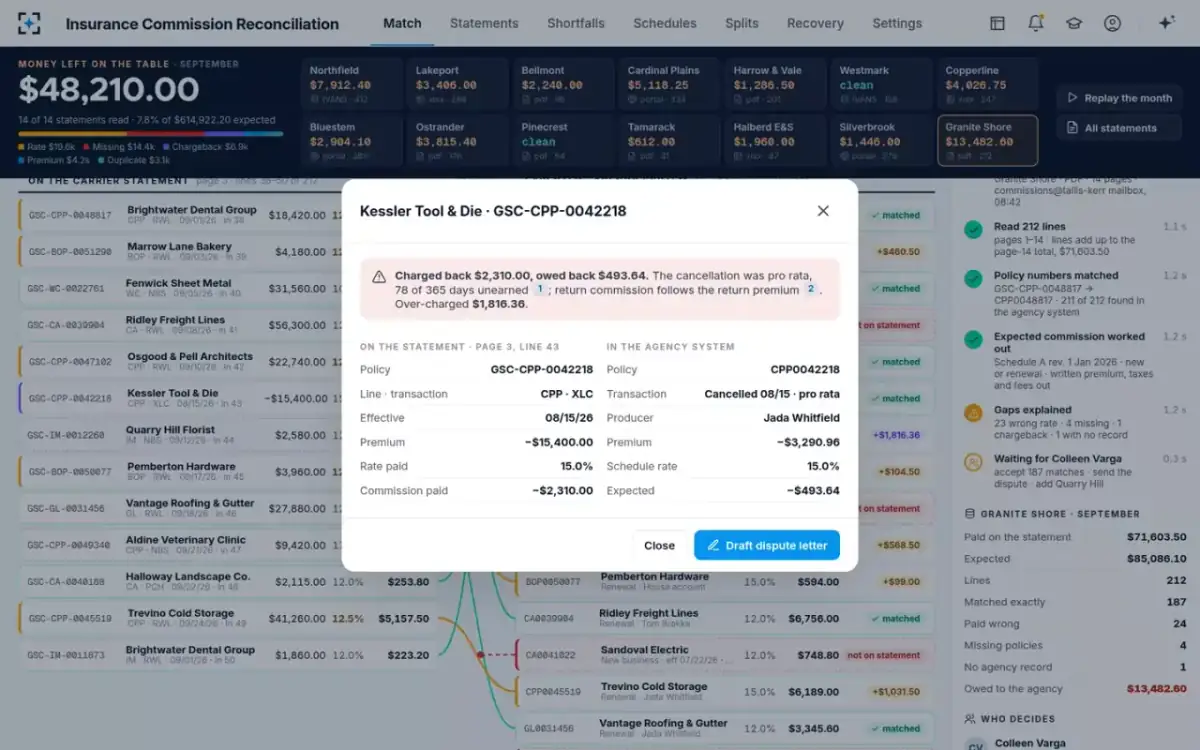
In the solution's sample, the carrier's agency agreement §6.3 returns commission only on the premium returned. A commercial package policy cancelled pro rata on 15 August with 78 of 365 days unearned had $3,290.96 of premium returned; at 15.0% the chargeback should have been $493.64, and the carrier took back $2,310.00, the full term's commission. The difference, $1,816.36, went into the dispute letter with the clause quoted. Where an agreement is silent, the sample agency's setting checks chargebacks pro rata; the alternative setting is flat.
A chargeback larger than the return premium, worked out side by side
What is unearned commission?
Unearned commission is the commission on unearned premium: the part of a policy's premium that covers days after a cancellation or that a reduction returned. It is the mirror of unearned premium, and it exists only because commission is usually paid on the full premium at issue or renewal, before the term has run. If commission were paid as premium was earned, there would be nothing to charge back.
The accounting follows. An agency that books commission at the effective date carries a risk that some of it will be reversed; reconciliation is what turns that risk into a confirmed number, line by line. A chargeback the agency never checks is an expense it accepted on the carrier's arithmetic.
One sample month's chargeback errors
$6,920
chargebacks larger than the premium returned, on 18 lines
$3,090
chargebacks taken twice, on 15 lines
$38,912
oversized chargebacks found, April to September
Chargebacks on endorsements and premium audits
Cancellations are not the only source. A mid-term endorsement that removes a vehicle or a location returns premium for the rest of the term, and commission on that return comes back at the rate the original was paid. A premium audit at the end of a workers' compensation or general liability term compares the deposit premium with the premium the actual payroll or sales support; if the final premium is lower, the difference is returned and so is its commission.
The audit case is where chargebacks can arrive latest. Take an invented workers' compensation policy with a $40,000 deposit premium at 10% commission, $4,000 paid at issue. The audit sets the final premium at $34,000, so $6,000 is returned and the chargeback should be $600. It may land on a statement months after the term ended, after the producer's share has been paid; without the audit return premium beside it, a chargeback of $600 or $4,000 looks equally plausible. Checking it needs the same three facts as a cancellation: the premium returned, the rate paid, and the agreement's clause.
Do producers pay back commission when a policy cancels?
Often, where the producer agreement says so: the producer was paid a share of the commission, and when the agency's commission is charged back, the producer's share of the chargeback is deducted from a later statement. Whether that is lawful in the way it is done is a question of the producer agreement and, for employees, state wage law. New York, for example, requires commission salespeople's terms to be in writing, including what happens on termination; how producers are paid covers those rules.
The fairness problem is timing. If the agency passes every carrier chargeback straight through, a producer pays back the carrier's error before anyone has checked it, and waits for a dispute to be won to get it back. In the example, a full chargeback would take $1,440 from Priya Lund where a pro rata one takes $864. The solution holds the producer's share of any disputed chargeback until the carrier pays, rather than clawing it back and repaying later.
How long can a carrier charge back commission?
For as long as the premium can still change, under whatever the agency agreement allows. We found no statute that limits it in general: a premium audit can return premium months after expiry, and an agreement may let a carrier recover commission on it. The practical limits run the other way: the agreement may also give the agency a window to dispute a statement (the solution's sample agreement allows 180 days from the statement date), so a chargeback that is not checked within that window may be accepted by default.
For producers, the producer agreement sets the period, and agreements differ. Whatever the period, write it down; disputes over producer clawbacks are mostly disputes over what was agreed.
Duplicate and late chargebacks: the two errors that hide
Two chargeback errors do not look like errors on the statement where they appear. A duplicate chargeback is the same cancellation charged back on two statements, often after the carrier reprocesses a transaction; each line is correct on its own and only a check across months shows the second. A late chargeback arrives long after the cancellation, sometimes after the producer's share has been paid out and the producer has left.
Both are found the same way: keep each chargeback joined to the cancellation transaction in the agency system and to every earlier statement line on the same policy. In the sample, one carrier charged back the same cancellations on its August and September statements: $1,050.00 on five lines. The monthly reconciliation measures count duplicates as their own reason so they are not lost in a total.
How do you dispute a commission chargeback?
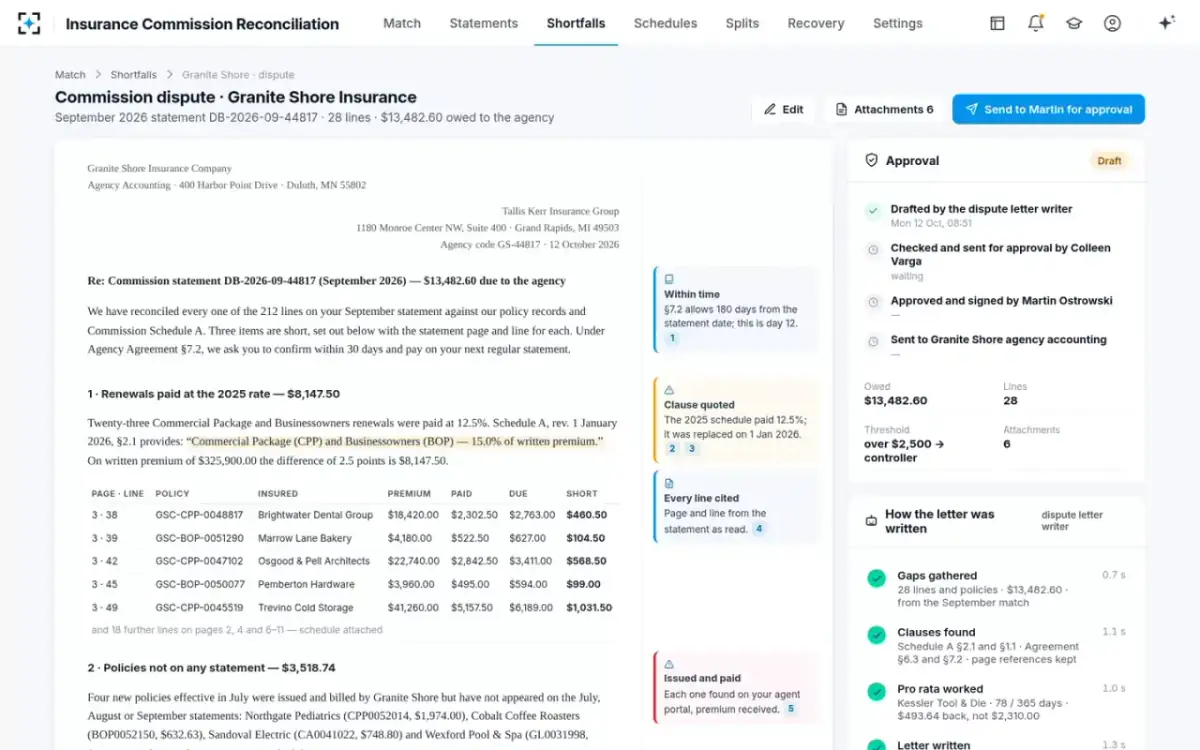
You dispute it with the carrier's own numbers: the return premium the carrier refunded, the rate it paid, and the clause that says what commission follows. A dispute that says only "this looks too high" goes to the bottom of a carrier accountant's queue; one that lists the statement page and line, the cancellation date, the days unearned and the clause gets paid.
The dispute letter: clause quoted, every line with its page
Before you accept or dispute a chargeback
- Find the cancellation in the agency system
Date, method (pro rata, short rate, flat) and who cancelled.
- Recompute the return premium
Unearned days ÷ term days × premium, less any short-rate charge the policy and state law allow.
- Apply the rate the commission was paid at
Not this year's schedule rate if the original was paid at last year's.
- Read the agreement clause
What commission follows: premium returned, or something else.
- Check earlier statements
Was the same cancellation already charged back?
- Check the dispute window
How many days the agreement allows from the statement date.
- Hold the producer's share
Until the carrier answers, under the producer agreement.
- Write the letter with page, line and clause
One line per item; attach the statement page and the agreement.
To see a chargeback found, worked out and disputed on a full statement, start from Insurance Commission Reconciliation.
Questions people ask
What is a chargeback in insurance sales?
It is commission taken back by the carrier, from the agency or through it from the producer, because premium the commission was paid on was returned or never earned. In property and casualty it usually follows a cancellation, endorsement or audit; in other lines, an agreement may also charge back advanced commission when a policy lapses early.
Is a chargeback the same as a clawback?
In practice the words overlap. Agencies tend to say chargeback for what the carrier takes back from the agency, and clawback for what the agency takes back from a producer. Both should follow the same calculation.
How is unearned commission calculated?
Multiply the premium returned by the commission rate the policy was paid at. On a pro rata cancellation of a $24,000 policy with 219 of 365 days unearned, the return premium is $14,400 and at 15% the unearned commission is $2,160.
Do chargebacks apply to renewals as well as new business?
Yes. A renewal cancelled mid-term returns premium like any other policy, and commission comes back at the renewal rate it was paid at. Check that the chargeback uses that rate, not the new business rate.
What if the carrier's chargeback is smaller than expected?
Record it as a variance with its reason, like any other. A chargeback that is too small usually means the carrier calculated return premium differently, and the difference may come back on a later statement.