A premium trust account is a separate bank account in which an insurance agent, broker or managing general agent (MGA) holds premium it has collected for an insurer, and return premium owed to policyholders, as a fiduciary and apart from its own money, until it pays the money on. The law treats those funds as belonging to someone else from the moment they arrive, so the account is less a convenience than a promise that can be audited. For a carrier that writes through MGAs, the premium trust account is where each delegate's bordereau should meet real cash. Botminds' Premium Bordereaux Reconciliation reads the bank feed of wires into that account alongside each delegate's premium bordereau and the broker's statement of account, and joins them line by line, so a carrier can see whether the money the bordereau says was collected is the money that arrived.
The rules below are quoted from the NAIC model law, state statutes and regulations, and court records. Product examples come from a fictional sample carrier, Cavendale Specialty, and its fictional delegates.
A premium trust account is not the agency's money with a different label
Premium trust account: The insurer's premium and the insured's return premium, held as a fiduciary.
The agency's operating account: The agency's own: earned commission, fees, capital.
Premium trust account: Premium and other funds received in a fiduciary capacity; in New York, also voluntary deposits to keep the account adequate.
The agency's operating account: Anything the agency owns, including commission once properly withdrawn.
Premium trust account: Payments to insurers, return premium to insureds, and the agent's commission, only while the balance still covers net premium owed (New York).
The agency's operating account: Salaries, rent, distributions.
Premium trust account: A breach of fiduciary duty; in Florida, diversion is a crime graded by amount.
The agency's operating account: A business problem.
Premium trust account: The insurer, and the regulator, "in a form usable" to each (Model #225).
The agency's operating account: The agency's own auditors.
What is a premium trust account, in the words of the law?
In US law a premium trust account is the bank account the statutes call by different names (a fiduciary account, a premium account, an escrow account) in which a licensee keeps funds it holds for an insurer or an insured. The idea is the same in each: the licensee has legal control of money it does not own, so the law makes it a fiduciary and requires the money to be kept separately and accounted for.
Florida's statute is the plainest. "All premiums, return premiums, or other funds belonging to insurers or others received by an agent, insurance agency, customer representative, or adjuster in transactions under the license are trust funds received by the licensee in a fiduciary capacity" (Fla. Stat. §626.561(1)). The licensee must account for and pay the funds "in the applicable regular course of business", and keep books that let the regulator see whether it is complying.
New York reaches the same place by regulation. Every insurance agent and broker "is responsible as a fiduciary for funds received" in that capacity, and one who does not remit immediately must deposit them in "appropriately identified accounts" from which only listed withdrawals may be made; the regulation calls any such account "a premium account" (11 NYCRR §20.3, Regulation 29).
Premium trust account requirements in the NAIC model law
For managing general agents the backbone is the NAIC's Managing General Agents Act, Model #225, which states make law in their own words. It requires the written contract between insurer and MGA to provide that "All funds collected for the account of an insurer will be held by the MGA in a fiduciary capacity in an institution that is insured by the FDIC. This account shall be used for all payments on behalf of the insurer. The MGA may retain no more than three months estimated claims payments and allocated loss adjustment expenses." (Model #225 §4C).
Four requirements sit in those three sentences. The money is held as a fiduciary. It sits in an FDIC-insured institution. The same account is used for the insurer's payments, which is how claims and return premiums get paid from it. And the MGA may hold back only a limited amount for claims, three months of estimated claims payments and allocated loss adjustment expenses, before the rest goes to the insurer. Section 4B adds the rhythm: accounts and remittance at least monthly. Section 4D adds the evidence: separate records, which the insurer may copy in a form it can use.
Do MGAs need a premium trust account? Four rulebooks compared
Yes: every US rulebook below requires an MGA to hold collected funds as a fiduciary in a bank account, though they differ on the bank, the claims money it may keep and what it must report. A carrier writing through MGAs in several states needs its binder to meet the strictest of them, and its reconciliation to test the account against each.
Do MGAs need a premium trust account? What each rulebook says
| Rulebook | Where the money is held | Claims money the MGA may keep | Remittance and reporting |
|---|---|---|---|
| NAIC Model #225 (2002 text) | In a fiduciary capacity, in an FDIC-insured institution | No more than three months of estimated claims payments and allocated loss adjustment expenses | Accounts and remittance not less than monthly |
| New York, 11 NYCRR §33.5 | In a fiduciary capacity under Regulation 29 (§20.3) | No more than three months of estimated claims and loss adjustment expense payments | Not less than monthly |
| Florida, §626.7451 | In a fiduciary capacity, in an FDIC-insured bank; used for all payments as the insurer directs | Up to 60 days of estimated claims payments and allocated loss adjustment expenses | Monthly or more frequent |
| Texas, ch. 4053 | An escrow account in a Federal Reserve member bank with FDIC-insured accounts; deposits made "on receipt" | No day limit; notice to the regulator if funds for losses exceed 60 days' expected payments by more than $100,000 | Account report at least once each calendar quarter |
Texas is the outlier in form, not in substance. Its statute does not borrow the model's three-month claims allowance. Instead it requires the MGA to "maintain an escrow account", and "On receipt, the managing general agent shall deposit in the escrow account all money collected for each insurer with which the agent has a contract" (§4053.105). Except as the contract allows, the MGA "may not use, take as an offset, or convert" money that is or should have been deposited. The Texas check on claims money is a notice duty rather than a cap, which is why a carrier should still put a figure in the binder.
A premium trust account for insurance agents, not only MGAs
The duty is not limited to MGAs. Florida's §626.561 covers every agent, agency, customer representative and adjuster, and adds a separate-account rule for insurers an agent is not appointed with: funds for each such insurer, other than a surplus lines insurer, must be kept "in a separate account so as to allow the department or office to properly audit such funds". New York's Regulation 29 applies to every agent, title insurance agent and broker, and lets an agent on an "account current system" comply by keeping "at least the net balance of premiums received but not remitted", provided each principal's share is "reasonably ascertainable" from its records.
For a carrier the practical consequence is a chain of trust accounts. The retail broker holds the policyholder's premium in its own account, then pays the MGA's account, which then remits to the carrier. Each hop is a fiduciary transfer, and each is a place where a reconciliation can fail. How the UK handles the same chain is different: there the question is whose agent the broker is when it takes the money.
Can commission be kept in a premium trust account?
Commission can pass through the account, but the agent may take it out only as the rules allow, and never in a way that leaves the account short of what is owed. New York says so in two lines: depositing a premium "shall not be construed as a commingling of the net premium and of the commission portion of the premium", and commission may be transferred to an operating account, "provided, however, that no withdrawal may be made if the balance remaining in the premium account thereafter is less than aggregate net premiums received but not remitted" (11 NYCRR §20.3(b)(4)–(5)).
Contracts often let the MGA deduct commission before the money ever reaches the account. In the programme the Fifth Circuit examined in Lincoln General v. U.S. Auto Insurance Services, the agency agreement required a "Premium Trust Account" but gave the MGA the "privilege of retaining [its] commission[]" before depositing collected money. That privilege did not make the money the MGA's while it calculated its share, as the court held.
"Such language required U.S. Auto to handle all funds as a fiduciary from the moment it accepted them until the time they left its control—a period including when it calculated commissions, made deductions, and ultimately deposited the remaining premiums."
Lincoln General Insurance Co. v. U.S. Auto Insurance Services, No. 13-10589 (5th Cir. 18 May 2015)
The district court had held that no duty was owed for premiums before they reached the trust account; the Fifth Circuit reversed, pointing to the contract's words and to Texas's statement that an MGA holds money "in a fiduciary capacity" (§4053.106). The point for a carrier is that the fiduciary duty starts at collection, not at deposit, so the reconciliation should start there too: the bordereau's gross premium, not only the net that reached the bank.
Can an MGA pay claims from the trust account?
Yes, if the contract lets the MGA handle claims, and within a limit. The model law lets the fiduciary account pay anything owed for the insurer, which includes claims, and caps the claims money the MGA may keep at three months of estimates. Florida halves that to 60 days and adds that the account is used "for all payment as directed by the insurer" (§626.7451(3)).
The cap is the line a carrier's credit controller should watch. Money held for claims is not premium the MGA can sit on, and a claims fund that keeps growing while losses do not is a delegate holding the carrier's cash. Texas turns that into a reporting trigger: the MGA must notify the department within 30 days when money held for losses is more than $100,000 above what it expects to pay in the next 60 days (§4053.108(a)(4)). What an MGA may keep, and for how long draws each state's allowance on one timeline.
Who should own the premium trust account?
The account holds the insurer's money, so the safest structure puts the insurer's name on it and the MGA's authority over it in writing. In a 2025 examination report, California's Department of Insurance found that an insurer's MGA "is the owner of all bank accounts set up for the purposes of collecting premiums and paying claims on behalf of the Company", and recommended that the insurer set up accounts "in the name of the Company, with Swyfft named as a fiduciary" to comply with the California Insurance Code (California DOI, Topa Insurance Company, examination as of 31 December 2023).
Ownership matters most on a bad day. An account in the insurer's name is easier to freeze, trace and recover than one the MGA controls outright. Binders in the UK reach a similar result by contract: the binders in XL v IPORS required all money received to be deposited "into an account separate from the Coverholder’s general or operating account", and, in a later version, held on trust under the FCA's client-money rules ([2022] EWHC 2093 (Comm), ¶¶9–10).
What happens if premium trust money is misused?
Misuse is a breach of fiduciary duty everywhere and a crime in some states. Florida grades the offence by the amount diverted or misappropriated, "either temporarily or permanently", and the grades are steep.
Florida grades diversion of premium trust funds by amount
| Amount diverted or misappropriated | Offence under §626.561(3) |
|---|---|
| $300 or less | Misdemeanor of the first degree |
| More than $300, but less than $20,000 | Felony of the third degree |
| $20,000 or more, but less than $100,000 | Felony of the second degree |
| $100,000 or more | Felony of the first degree |
The civil consequences reach further than the agent. In XL v IPORS, the carrier obtained a proprietary injunction over the coverholder's euro and sterling premium accounts in 2017. At trial in 2022 the judge found the coverholder liable for £296,589 and €7,360,909 of premium that should have been held in the premium accounts as trustee and paid over, and found its sole director liable in knowing receipt and dishonest assistance, after tracing transfers from the premium accounts through a business account into his personal account. In Lincoln General, the trial court found the MGA had moved about $50 million to affiliated companies, and the premium trust account ran out of money to pay claims by 2006.
How to prove a premium trust account balances every month
A premium trust account balances when the bank balance covers everything held for others: premium received but not yet remitted, return premium owed, and claims money within the allowance. New York writes the test into its withdrawal rule; the other states imply it. Proving it each month takes three sources that rarely agree on the first pass: the bordereau, the bank account and the broker's statement.
The monthly test a premium trust account should pass
Premium received for insurers
Gross premium collected − commission and fees the binder lets the agent deduct
From the bordereau, tied to the bank feed
Premium accountant
Return premium owed
Cancellations and refunds due to insureds, not yet paid
From the bordereau and the cancellation notices
Premium accountant
Claims money held
Claims fund, up to the binder's cap (three months in the model, 60 days in Florida)
From the claims bordereau and fund statement
Claims finance
Bank balance must cover the sum
Balance ≥ the three terms above; any surplus is the agent's own deposit
New York: no withdrawal may leave the account below net premiums received but not remitted
Head of DA finance
The difficulty is the first term. The bank account shows wires; the bordereau shows policies. A single wire may pay forty policies, and a single policy may arrive in four wires at four exchange rates. Until each wire is split into its remittance lines and joined to the bordereau, nobody can say whether the account holds what it should, only whether its total looks plausible.
Premium Bordereaux Reconciliation: the bank feed beside the bordereau and the broker's statement
Where Premium Bordereaux Reconciliation checks the trust money
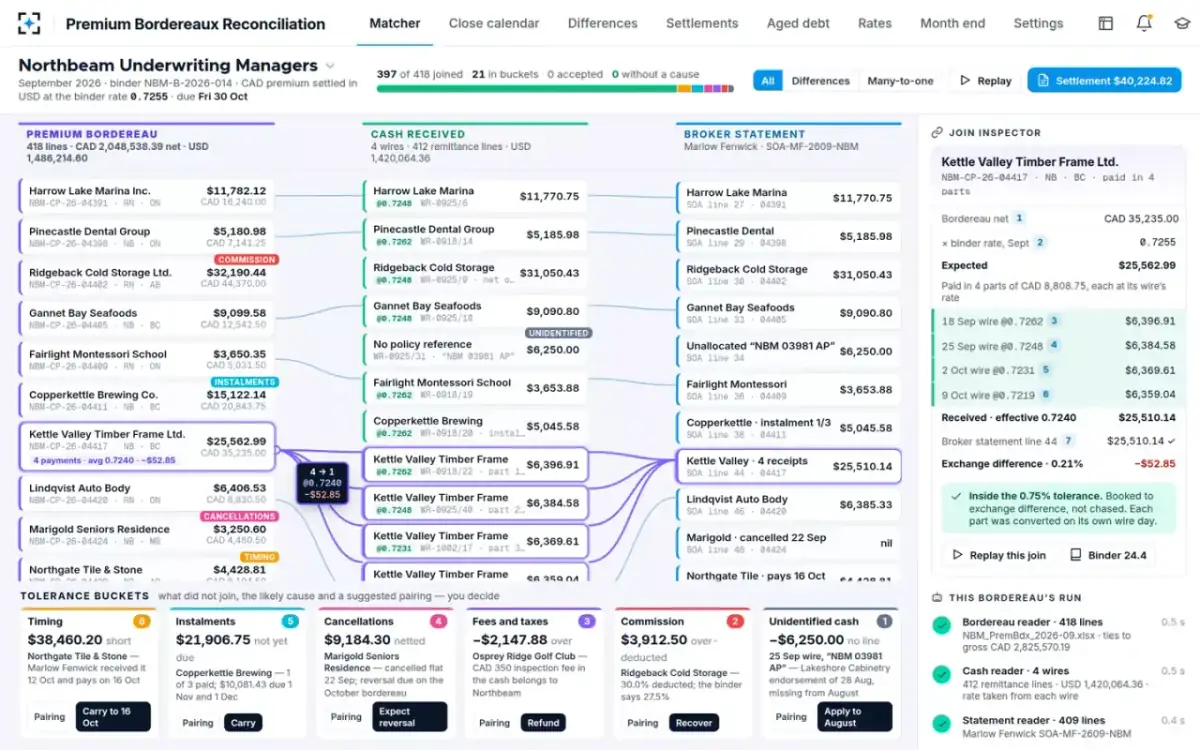
The solution checks the trust money from the carrier's side: it shows, delegate by delegate, whether premium the bordereau declares has arrived, what is still legitimately in transit, and what has no explanation. It does not operate the account, move money or post to the general ledger. Cash is never allocated without a remittance line or a pairing a person accepted, and settlements and reminders are drafted for people to send.
At the sample carrier, Northbeam's September bordereau declared $1,486,214.60 of net premium at the binder rate and the wires brought $1,420,064.36. The $66,150.24 gap broke down into instalments not yet due, cancellations to reverse, an exchange difference inside tolerance and $40,224.82 actually owed, with every amount traced to lines. That is the evidence a carrier needs before it can say a delegate's premium account is in order, and what an MGA needs from its own accounting software to answer the carrier.
The month-end pack: every delegate reconciled, every difference with a cause

Questions people ask
What is a premium fund trust account?
It is another name for a premium trust account: a fiduciary bank account for premium and other money held for insurers and insureds. Statutes use several labels (fiduciary account, premium account, escrow account) but the duties are the same in substance: keep it separate, use it only for permitted payments, and be able to account for every principal's share.
Is a premium trust account the same as an escrow account?
In Texas it effectively is: the MGA statute requires an "escrow account" in a Federal Reserve member bank with FDIC-insured accounts, and all money collected for each insurer goes into it on receipt. Other states use "fiduciary capacity" language instead. Either way the money is not the agent's.
Who keeps the interest on a premium trust account?
It depends on the rulebook and the contract. New York allows interest to be transferred to an operating account only "if the principals have consented thereto in writing". The 2016 binder in XL v IPORS expressly authorised the coverholder to keep interest accruing on its premium account.
How long must premium trust account records be kept?
Florida requires licensees to preserve books, accounts and records pertaining to a premium payment for at least three years after payment. Model #225 leaves the period to each state's record retention statute, and New York's MGA rule points to its Regulation 152. A carrier's binder can require longer.
Can an agent put its own money into the premium trust account?
New York allows "a voluntary deposit" to keep a minimum balance, guarantee the account's adequacy, or pay premiums due but uncollected. Outside such rules, commingling the agent's funds with fiduciary funds needs the written consent of the person for whom they are held.