Insurance cash allocation software companies sell tools that apply incoming money to whatever it pays: a policy, an instalment, an invoice or a line on a delegate's premium bordereau, leaving anything that cannot be matched as unallocated cash with a reason. For a carrier writing through managing general agents and coverholders the hard part is not reading the bank file. It is joining one wire to forty bordereau lines, or four wires at four exchange rates to a single line, net of commission, without forcing a match that is not there. Botminds' Premium Bordereaux Reconciliation does that with six agents, and this guide follows the one at its centre, the matcher, through a delegate's month: what it reads, how it joins, what it leaves for a person, and what it may never do. It ends with the questions to put to any vendor, including us.
The month is the September 2026 close of a fictional sample carrier, Cavendale Specialty, and its fictional delegate Northbeam Underwriting Managers in Toronto, which writes Canadian commercial property in Canadian dollars settled in US dollars at the binder rate of 0.7255.
How a wire becomes allocated premium in Premium Bordereaux Reconciliation
Agent
Cash and remittance readerReads each bank wire and remittance advice into allocatable pieces with reference, date, currency and the rate the wire got. Northbeam's four September wires became 412 remittance lines.
Never: allocate cash without a remittance line or a pairing a person accepted.
Agent
Bordereau and statement readersTurn the delegate's premium bordereau (418 lines, tied to its totals) and the broker's statement of account into standard lines.
Never: guess an amount; an unreadable one is flagged.
Agent
MatcherJoins bordereau, cash and statement line by line, one-to-one or up to six part-payments to one line, at the binder rate, and shows the rate used on every join.
Never: join outside $5.00 or 0.75% of the line; outside, it suggests and a person decides.
Agent
Difference explainerGives every unjoined piece a cause (timing, instalments, cancellation, fees and taxes, commission, unidentified) with its evidence and, where one exists, a suggested pairing.
Never: call a timing item a debt before its due date.
A person decides
Premium accountantAccepts or rejects each suggested pairing and cause; only then is the cash applied.
What is insurance cash allocation?
Insurance cash allocation is the step that turns money in the bank into money applied to the right policy, so that the receivable falls, the commission is right and the statement can say what is still owed. Under direct billing it is mostly a matter of reading a payer's reference. Under delegated authority it is a matching problem across three documents that each describe the same money differently.
The delegate's premium bordereau lists policies and their gross, commission, taxes and net premium in the policy currency. The wire is a single amount in the settlement currency, often covering many policies, sometimes only part of one. The broker's statement of account says what the intermediary received and passed on, on its own dates. Cash matching in insurance means joining all three line by line, and cash allocation means applying the money once the join is accepted. Until both are done, a carrier can say how much arrived but not what it paid for.
What insurance cash allocation software companies offer, by where they start
The tools on the market tend to start from one of four places, and where a tool starts decides what it does well under delegated authority. The table is our classification of the kinds of product a carrier will meet, not a ranking of named companies; most real products mix two kinds.
Four starting points for insurance cash allocation software
| Starts from | Good at | Where it strains under delegated authority |
|---|---|---|
| Bank reconciliation and cash application | Reading bank files, matching amounts and references, high volumes of one-to-one payments | Net-of-commission wires against gross bordereau lines; part-payments at different exchange rates |
| The insurer's policy or billing system | Direct-billed and agency-billed policies it issued, with its own policy numbers | Bordereau business written on the delegate's system, reported monthly in the delegate's layout |
| Bordereau data platforms | Turning many delegate layouts into one data set for underwriting and reporting | Cash: many start from the bordereau and stop before the bank feed and the broker's statement |
| Agent-based reconciliation | Reading each source as it comes, joining across three documents, explaining each difference with evidence | Newer; needs evidence that every join and every agent step can be checked and replayed |
A carrier choosing between them should start from its own mix. A book that is mostly direct-billed needs cash application against its own policies. A book written mostly through delegates, in several currencies, needs a tool that starts from the bordereau and ends at the bank, and shows its working at each join. Comparing reconciliation software by what each reads and writes back takes the same question to the whole close.
How is premium cash allocated to policies? One wire, four rates, one line
Premium cash is allocated by joining each remittance line to the bordereau line it pays, at the rate of exchange the binder specifies, and booking any difference to a named account rather than to the policy. The difficult cases are the ones where one line is paid in pieces.
Take Kettle Valley Timber Frame Ltd., policy NBM-CP-26-04417 on Northbeam's September bordereau: net premium CAD 35,235.00, or USD 25,562.99 at the binder rate of 0.7255. Northbeam paid it in four parts of CAD 8,808.75, on 18 September, 25 September, 2 October and 9 October, and each part was converted on its own wire day, at 0.7262, 0.7248, 0.7231 and 0.7219. The four wires brought USD 25,510.14. A matcher that only joins one wire to one line sees four unexplained receipts and one unpaid policy.
Four part-payments at four rates converge on one bordereau line
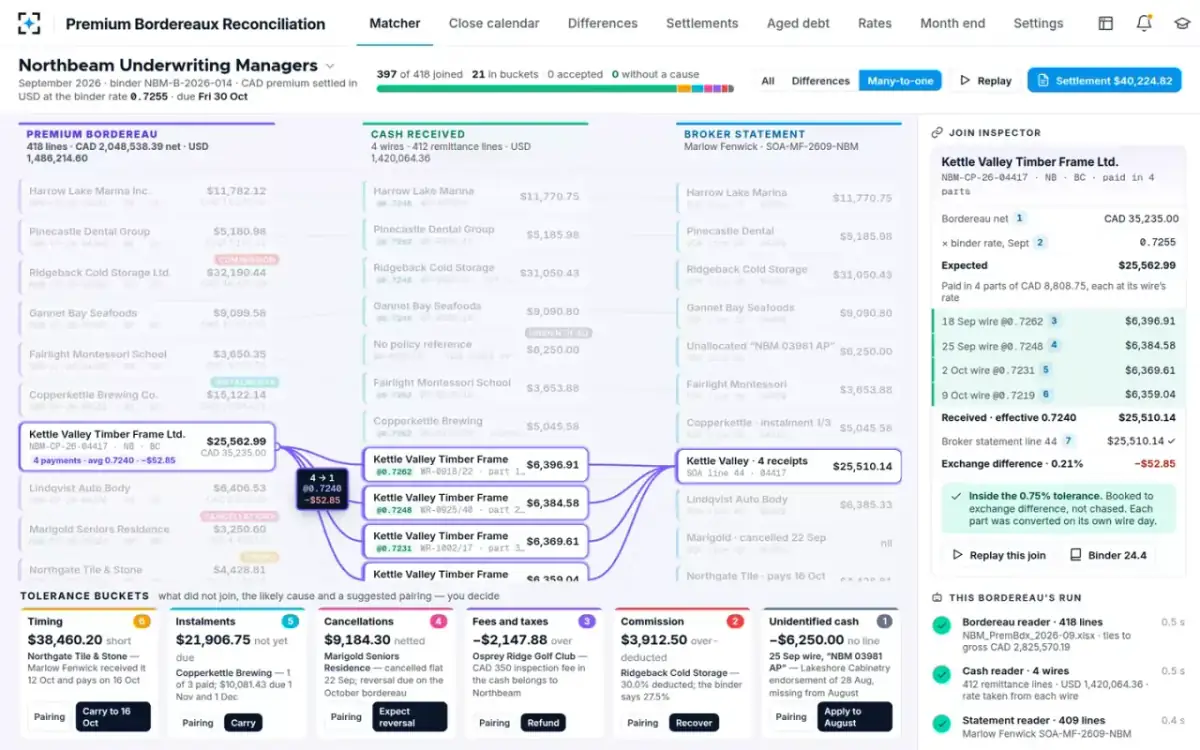
The matcher joins the four strands to the one bordereau line and the one statement line, and works out the difference: USD 52.85, or 0.21% of the line. That is inside the carrier's exchange tolerance of 0.75%, so the difference goes to the exchange difference account, not back to the delegate as a debt. The delegate's finance manager, who would otherwise receive a query for $52.85 he cannot fix, never hears about it.
Inside the matching agent: four keys, two tolerances, six pieces
The matcher joins on four keys, inside two tolerances, and allows up to six pieces of cash on one line. All three are settings the carrier controls, changed only through a draft its head of delegated-authority finance approves.
The keys are the policy reference, the insured's name, the remittance reference and the amount; a carrier can narrow them to reference and amount. The tolerances are an amount, $5.00 a line in the sample, and an exchange share, 0.75% of the line. A join counts when it falls inside either, so a currency join off by $52.85 on a $25,000 line qualifies under the exchange tolerance but a same-currency line off by $52.85 does not. Many-to-one joins can be switched off; in the sample they are on, up to six pieces.
How far each of Northbeam's 397 joins sat from the binder rate
The distribution is the argument for showing rates on every join. Most of Northbeam's wires converted within a fifth of a percent of the binder rate, and none outside the tolerance; but the six joins between 0.5% and 0.75% are the ones a reviewer should look at first, because they are where a mistaken rate, a missing fee or a wrong policy would hide. On the sample carrier's other currencies the picture was not as clean: three of Tidewater Marine's sterling lines fell outside 0.75% and became differences for a person.
What is unallocated cash in insurance, and where does it belong?
Unallocated cash is money received that cannot yet be applied to any policy or bordereau line, usually because the remittance carries no usable reference, pays something the bordereau does not show, or arrives without a remittance advice. It sits in a suspense or unapplied account until someone finds where it belongs, and the longer it sits, the harder that gets.
On 25 September a wire of $6,250.00 reached Cavendale with no policy reference, only the text "NBM 03981 AP". The difference explainer read 03981 as a policy number and AP as additional premium, and found an additional-premium endorsement on Lakeshore Cabinetry's policy, bound on 28 August and never reported on Northbeam's August bordereau. At the August binder rate the endorsement matched the wire inside the $5.00 tolerance. The explainer suggested the pairing; it did not make it.
An unidentified receipt, paired by the evidence to an endorsement the bordereau missed
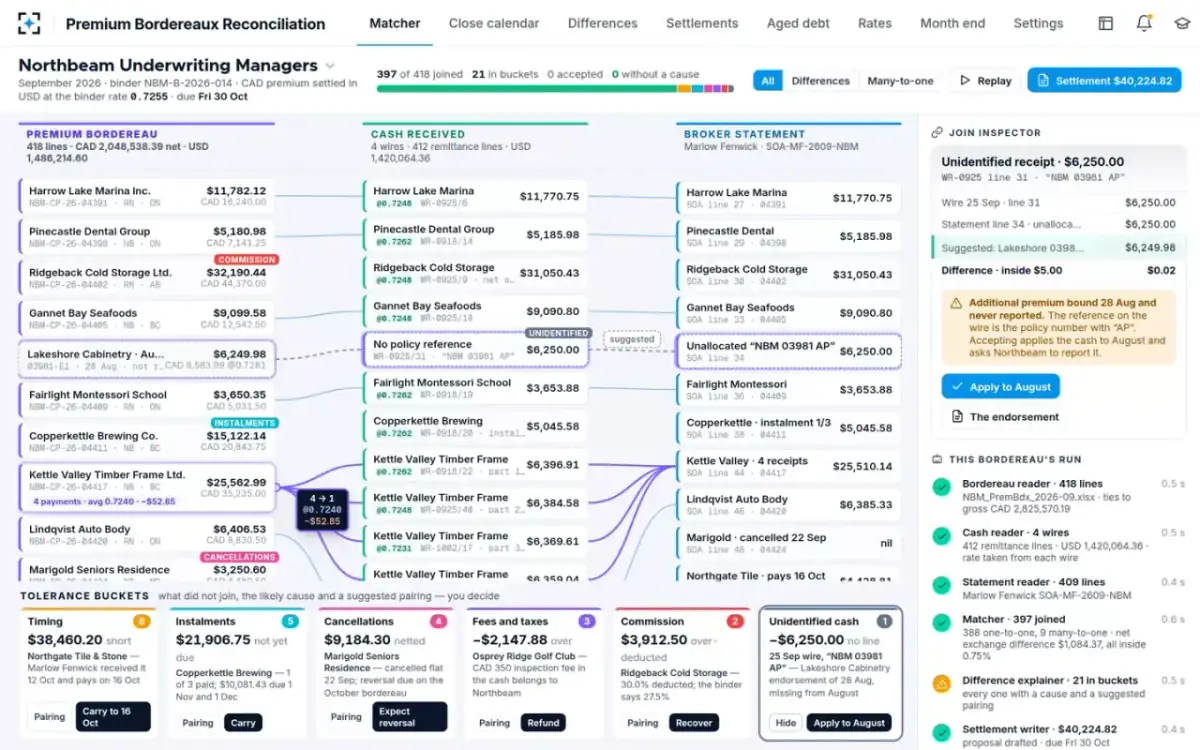
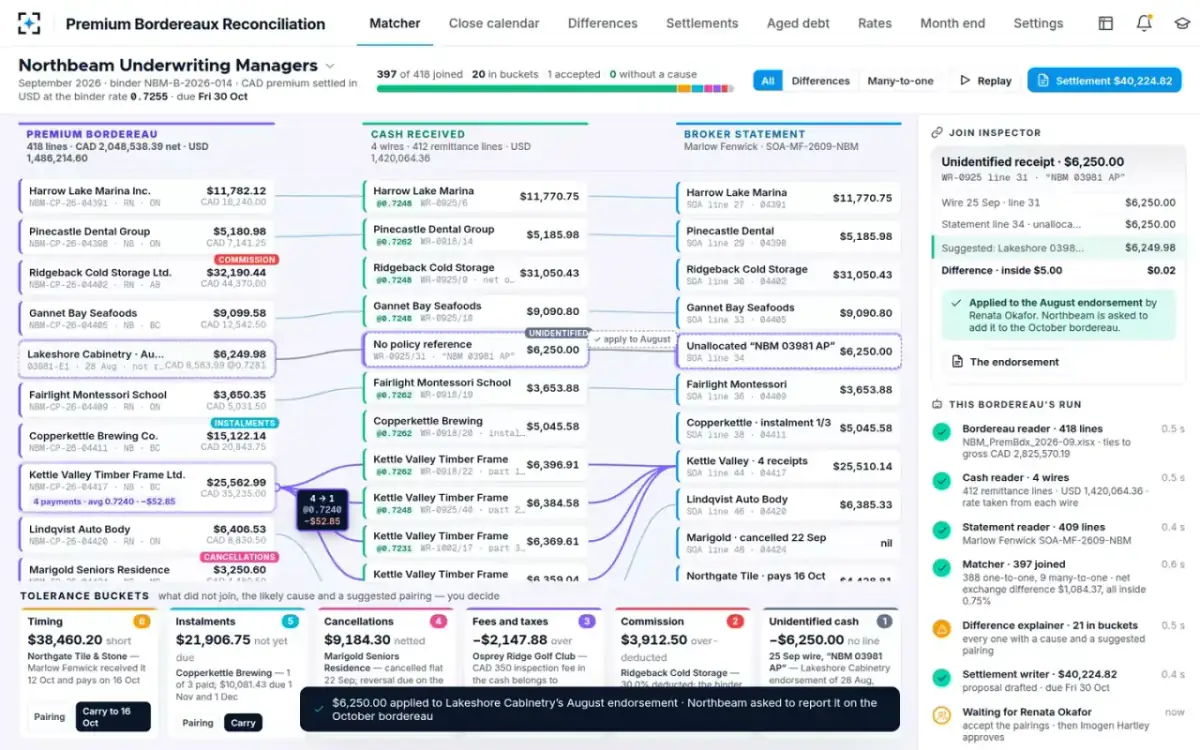
Renata Okafor, the sample carrier's premium accountant, read the evidence and accepted. The dashed suggestion became a solid join, the unidentified bucket emptied, and Northbeam was asked to report the endorsement on its October bordereau. The audit trail shows who applied the cash and when. That last step is the one most allocation tools skip: the receipt is applied, but the bordereau that should have declared it is never corrected, and the same endorsement turns up as a difference again in an audit a year later. What a premium bordereau should contain, endorsements included, is set out line by line elsewhere.
Pairing accepted: the join turns solid and the delegate is asked to correct its bordereau
What are the insurance cash allocation rules?
No rulebook prescribes an allocation method, but four sets of rules shape what allocation software must respect: whose money it is, when commission may leave it, how differences must be treated, and whether amounts may be netted. Each is a constraint a carrier should be able to see the tool honouring.
First, the money belongs to someone else until it is applied. US MGA law requires funds collected for an insurer to be held "in a fiduciary capacity" (NAIC Model #225 §4C), so an allocation is a statement about trust money, not a bookkeeping preference. Second, commission rides inside the premium. New York says depositing a whole premium does not count as mixing the net premium with the commission inside it (11 NYCRR §20.3(b)(5); quoted in what a premium trust account is), which is why a matcher has to compare net with net, at the binder's commission rate, and flag a delegate that deducted more.
Third, differences need reasons, but timing is a reason. The UK client money rules require a firm to find the cause of a reconciliation difference and correct it promptly, unless the only cause is timing between the two parties' systems (FCA CASS 5.5.63R(3); the rule is quoted in insurance client money rules). A tool that treats every timing item as an error floods the queue; one that treats every error as timing hides it. Fourth, no silent netting. California's examiners criticised an insurer that offset claims paid against premium due, and recommended reporting amounts net only where a valid right of offset exists (California DOI, Topa examination, 2025).
What the matching agent may never do
The useful description of an allocation agent is the list of things it may not do, because those are the controls an auditor will test. Premium Bordereaux Reconciliation's limits are fixed in the product and visible to the carrier.
Six things the matching agents in Premium Bordereaux Reconciliation never do
- Allocate cash on its own say-soCash is applied only against a remittance line or a pairing a person accepted.
- Join outside toleranceAnything beyond $5.00 or 0.75% of the line becomes a suggestion for a person, never a join.
- Hide the rateEvery currency join shows the binder rate and the rate the wire actually got.
- Call timing a debtA timing item is not treated as owed before its due date under the binder.
- Send anythingSettlements and reminders are drafted for a person to send.
- Post to the general ledgerJournals are drafted; write-offs above the line tolerance are a person's decision.
Responsibility does not move to the vendor with the work. The European insurance supervisor's 2025 opinion on AI governance is plain: the insurer remains ultimately responsible for the AI it uses, whether it built the system or a vendor did (EIOPA, Opinion on AI governance and risk management, EIOPA-BoS-25-360, August 2025). In US states that have adopted the NAIC's model bulletin on AI, an insurer's AI programme is expected to cover how it assesses third parties' AI systems; what the NAIC AI bulletin requires is covered in the compliance series.
Can AI match premium payments? Questions for any vendor
Yes, AI can match premium payments, including the part-payments, foreign currency and missing references that defeat amount-and-reference matching; the question for a buyer is whether each match can be checked. These are the questions we would ask any insurance cash allocation software company, and expect to be asked ourselves.
Ten questions to put to insurance cash allocation software companies
- Show me one wire split into its remittance lines
From your own sample, not a slide: reference, date, currency and rate on each piece.
- Join four part-payments at four rates to one line
And show the binder rate, the effective rate and where the difference goes.
- What happens outside tolerance?
A suggestion for a person, or a forced match? Who can change the tolerance, and is the change approved?
- How do you treat net-of-commission cash?
Does the tool compare net with net at the binder's commission rate, and flag an over-deduction with the arithmetic?
- Find a receipt with no policy reference
What evidence does the suggestion cite, and can it point to business missing from an earlier bordereau?
- Separate timing from debt
Can it hold premium in transit and instalments not yet due without calling them arrears?
- Read a delegate's layout you have not seen
Bring a bordereau, wire file and broker statement from your own delegates to the trial.
- Replay a join
Can an auditor see the three lines a join rests on and rerun it a year later?
- What does the tool post?
Drafted journals for a person, or automatic postings to the general ledger?
- Who sends what to the delegate?
Settlements and reminders should be drafted with lines attached and sent by a named person.
Where Premium Bordereaux Reconciliation fits for cash allocation, and where it does not
The solution fits a carrier, or a fronting insurer, that receives premium from MGAs and coverholders as monthly bordereaux and net wires, often in several currencies, and wants every line joined or explained before settlement. In the sample month it joined 397 of Northbeam's 418 lines, 95.0%, automatically; the remaining 21 sat in buckets with a cause each, and one suggested pairing was accepted by a person.
It is not a cash application engine for direct-billed personal lines, it does not replace a bank reconciliation of the carrier's own operating accounts, and it does not post. A carrier whose delegates already send clean, policy-level remittance with one wire per policy will get less from it than one whose delegates send what Northbeam sent. For how a balanced month can still be wrong, see the premium bordereaux reconciliation report; to see the agents on your own files, start from Premium Bordereaux Reconciliation.
Questions people ask
What is cash matching in insurance?
Cash matching joins money received to the items it pays: policies, instalments or bordereau lines, and, under delegated authority, the broker's statement too. It precedes allocation, which applies the money once the match is accepted. A good match records which lines it rests on and at what rate of exchange.
How is unallocated cash cleared?
By finding the evidence that ties it to a policy: a reference fragment, an amount at a past month's rate, a broker's statement line or an endorsement missing from a bordereau. In the sample, a $6,250.00 wire referenced only "NBM 03981 AP" was paired with an August endorsement the delegate never reported, and applied once the premium accountant accepted it.
Should exchange differences be charged back to the delegate?
Not if they arise because part-payments converted on different days and the binder fixes a single settlement rate; most carriers book them to an exchange difference account inside a tolerance. In the sample the tolerance is 0.75% of the line, and the September net exchange difference across four currency delegates was −$2,378.47.
What match rate should a carrier expect?
It depends on the delegate's references, currencies and payment habits more than on the tool. In the fictional sample month, 95.0% of one delegate's lines joined automatically and the rest were explained. The design target is that every open difference has a cause and an owner before settlement.
Can a carrier allocate cash the delegate has not declared?
It can apply the cash, but it should also have the delegate correct its bordereau, as the sample does when it asks Northbeam to report the missing endorsement in October. Otherwise the declared premium and the cash will disagree again at the next audit.