A broker premium settlement date is the day by which premium a broker, coverholder or managing general agent has collected must reach the insurer, net of the commission it may keep. It is set by contract: under delegated authority, by the binder's schedule, usually as a number of days after the end of the month the business was written or reported. For the carrier, each day past that date costs money in three ways: income on cash it does not have, surplus it loses once a balance passes ninety days due, and staff time spent finding out why. The cost begins earlier than most carriers think, because a long settlement term can carry premium past the statutory line even when the delegate pays on time. Botminds' Premium Bordereaux Reconciliation measures every delegate against its own settlement date and splits each difference into what is genuinely late and what is only timing, so the carrier prices and chases the right balance.
Product examples come from a fictional sample carrier, Cavendale Specialty, and its fictional delegates as at Monday 12 October 2026. The rules and court records are linked where they appear.
Most of the sample's $243,743.28 is young; $3,120.00 has crossed ninety days
What is a premium settlement date?
A premium settlement date is the contractual deadline for paying premium on to the insurer. For direct business it is the policy's due date. For business written through intermediaries it is the date in the agency or binding authority agreement by which the intermediary must remit what it has collected, after deducting its commission and any fees the agreement allows.
In US managing general agency business the statute sets a frame and the contract fills it. The NAIC's model act requires the MGA contract to provide for accounts and remittance of all funds due at least monthly (Model #225 §4B; quoted in premium remittance meaning), and the contract decides which funds are due when. In the London market, the binder schedule sets the date outright, as one High Court judgment records.
What are premium settlement terms? 30, 60 or 90 days
Premium settlement terms are the clauses that set the settlement date, the currency, the rate of exchange and what may be deducted. The most important is the period allowed after month end. In the binders between XL Insurance and the coverholder IPORS, the court described both the reporting and the settlement period.
"The schedules to the Binders required IPORS to send monthly premium bordereaux either to the brokers or to XL within 15 days after the end of each month," the judgment records, and "The period allowed for settlement varied across the Binders with sums due to XL to be paid within 30 days, 60 days or sometimes 90 days of the end of the month." The coverholder accounted for premium net of commission, which could not exceed 35% or 37.5% of gross premium including the placing broker's brokerage (XL v IPORS [2022] EWHC 2093 (Comm), ¶¶11–12).
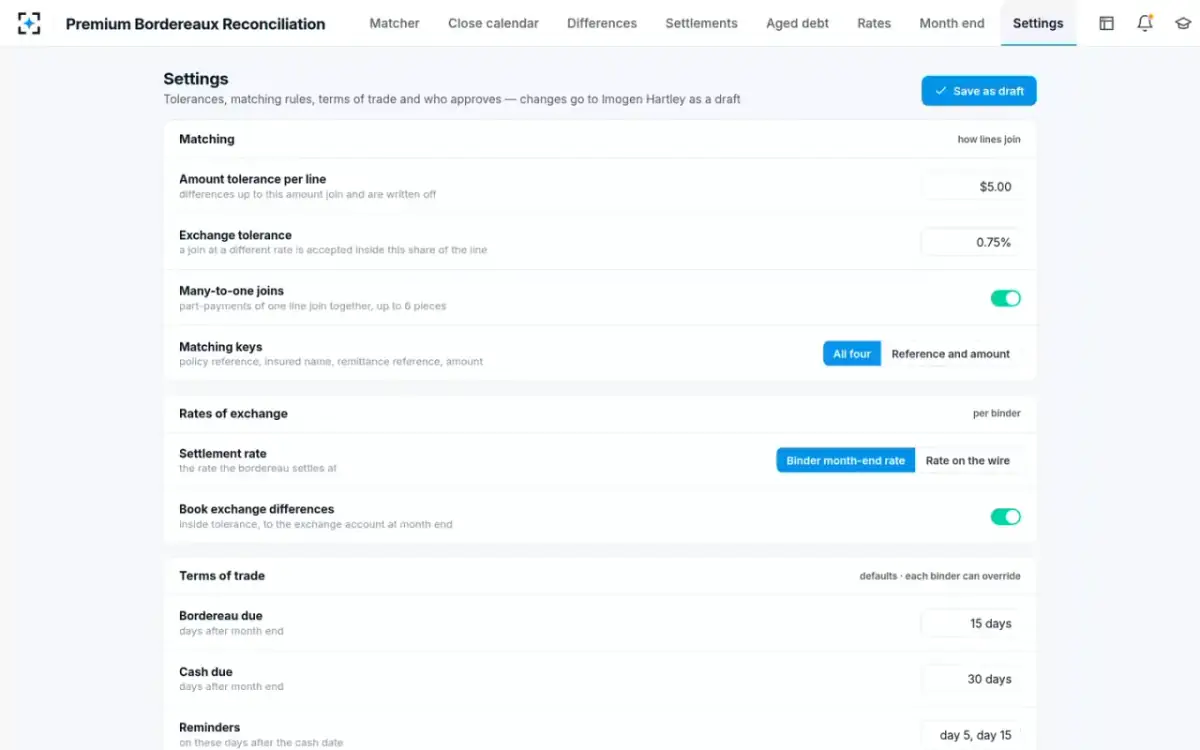
The sample carrier's defaults are the shortest of those terms: bordereau within 15 days and cash within 30 days of month end, each binder free to override them. Its settlement proposal for Northbeam Underwriting Managers quotes the clause it applies: premium payable in US dollars at the binder rate, net of 27.5% commission, 30 days after the end of the month.
Terms of trade as settings in Premium Bordereaux Reconciliation: bordereau day, cash day, reminder days
When is premium due to the insurer, and when is it late?
Premium is due to the insurer on the settlement date the binder sets for the month it belongs to, and it is late the day after, but only the part that was actually due. A settlement figure that treats every unpaid bordereau line as late overstates the debt, sours the delegate and hides the lines that matter.
Northbeam's September shows the difference. Its bordereau declared $66,150.24 more net premium than its four wires brought. Of that, $21,906.75 was instalments not yet due under the policies' own plans, $9,184.30 was cancellations to be reversed on October's bordereau, and $1,084.37 was exchange difference inside the carrier's tolerance. After a $6,250.00 receipt was applied to an August endorsement, what Northbeam owed by Friday 30 October was $40,224.82: premium in transit, commission deducted at 30% instead of 27.5%, less fees that had come in with the cash. None of it was late on 12 October. The difference explainer, by design, never calls a timing item a debt before its due date.
What happens if premium is settled late? One binder's year, as the court recorded it
Late settlement usually starts as a paperwork delay and ends, in the worst cases, in court. The judgment in XL v IPORS records how the carrier's position moved from invoices to injunctions over about a year, in the coverholder's final binder.
From unpaid invoices to a proprietary injunction: the XL v IPORS chronology
| Date | What happened |
|---|---|
| First half of 2016 | The coverholder sends monthly premium bordereaux as required; the carrier invoices the amounts shown; the invoices go unpaid. |
| 28 July 2016 | The carrier asks for an update on payment of the January, February and March invoices. |
| 9 September 2016 | A chaser is sent. |
| 13 September 2016 | The coverholder cites difficulties reconciling, acknowledges around €2.2 million plus smaller sterling amounts outstanding, and offers staged payments to March 2017. |
| September 2016 | The first promised payment is missed; the carrier demands the full amount by the end of October. |
| 2 November 2016 | Citing unspecified credits, the coverholder says only €263,143.15 is due, and pays that. |
| 30 November 2016 | The binder ends on the coverholder's own notice of cancellation. |
| 1 February 2017 | Letter before claim. |
| 13 March 2017 | Proceedings issued for €4,365,504.28 and £40,309.74 due under the bordereaux. |
| 16 June 2017 | Proprietary injunction over the euro and sterling premium accounts; freezing injunction to £4,500,000. |
Two details matter for any carrier. First, the bordereaux kept arriving on time while the cash stopped: a credit control process that watched only bordereau deadlines would have seen nothing wrong. Second, the delegate answered a specific demand with an unspecific credit. A carrier that can show, line by line, which bordereau lines, wires and statement lines disagree leaves no room for an unparticularised credit; the judge noted that in five years none was ever evidenced (¶40). The credit control process in insurance sets out who should be watching which clock.
The ninety-day line: when settlement terms outrun the statement
For a US carrier the most expensive clock is not in the binder at all. NAIC's statutory accounting principle for uncollected premium, SSAP No. 6, makes premium balances more than ninety days past due nonadmitted, unless related unearned premium offsets them (as quoted in NAIC INT 99-27; the rule is worked through in non-admitted premium receivable). A nonadmitted balance no longer counts toward the surplus that supports the carrier's writings. California's 2025 examination report on Topa Insurance Company shows the mechanics: adjustments arising from the audit by the company's independent auditors, which the report records, non-admitted commission receivables and other assets and, partly offset by a reinsurance adjustment, cut its surplus as regards policyholders by a net $1,292,354.
The ninety days run from the policy's due date, not the delegate's settlement date. California's examiners made the point in 2025: the NAIC rule counts the days overdue from the due date in the policy, never from any contract between the insurer and its agent (California DOI, Topa Insurance Company examination; their wording is quoted in the credit control process in insurance). A long settlement term therefore buys the delegate time the carrier's statement does not give the carrier.
One policy due 1 September, three settlement terms: when the cash arrives against the ninety-day line
- Before the settlement date59 days
- Margin to day 9031 days
- Before the settlement date89 days
- Margin to day 901 day
- Before day 9090 days
- Over 90 days, on terms29 days
The middle lane is the uncomfortable one. A 60-day term leaves a single day of margin for business due at the start of the month, so one late wire puts it over the line. On a 90-day term, premium due on the first of the month sits more than ninety days past due for four weeks even when the delegate is perfectly on time, and in this example a wire three days late would carry it over the 31 December quarter end, nonadmitted on that statement. A carrier that grants 90-day terms should know how much premium that puts on the wrong side of the line at each quarter end.
The NAIC has relaxed the rule only in specific disasters, for affected policyholders, and only for a time. After Hurricane Ida, for example, its working group tentatively agreed that insurers "may wait 150 days (90 days per existing guidance, plus a 60-day extension)" before nonadmitting premiums receivable from directly affected policyholders, ending on 23 January 2022 (NAIC INT 21-02T). A delegate's slow month is not a disaster. How the line works on the statement itself, across agents' balances and instalments, is covered by Premium & Claims Reconciliation.
How do you calculate the cost of late premium? A method in three parts
The cost of late premium is the sum of three things the carrier can measure: lost income on the cash, surplus lost while a balance is over ninety days due, and the time spent chasing and explaining it. No published benchmark gives a figure for delegated authority; the method below uses the carrier's own numbers.
What each late day costs: three terms, the carrier's own inputs
Lost income on the cash
Late balance × your short-term yield × days late ÷ 365
The yield the treasury earns on cash it holds; small per day, large across a book
Treasury
Surplus while over ninety days
Balance over 90 days past the policy's due date, for each statement date it spans
Nonadmitted at the quarter end, to the extent no unearned premium relates to it, however likely it is to be paid
Statutory reporting
Chasing and explaining
Hours on the delegate × your loaded hourly cost
Reminders, calls and re-reconciliation; highest when the debt has no stated cause
Credit control
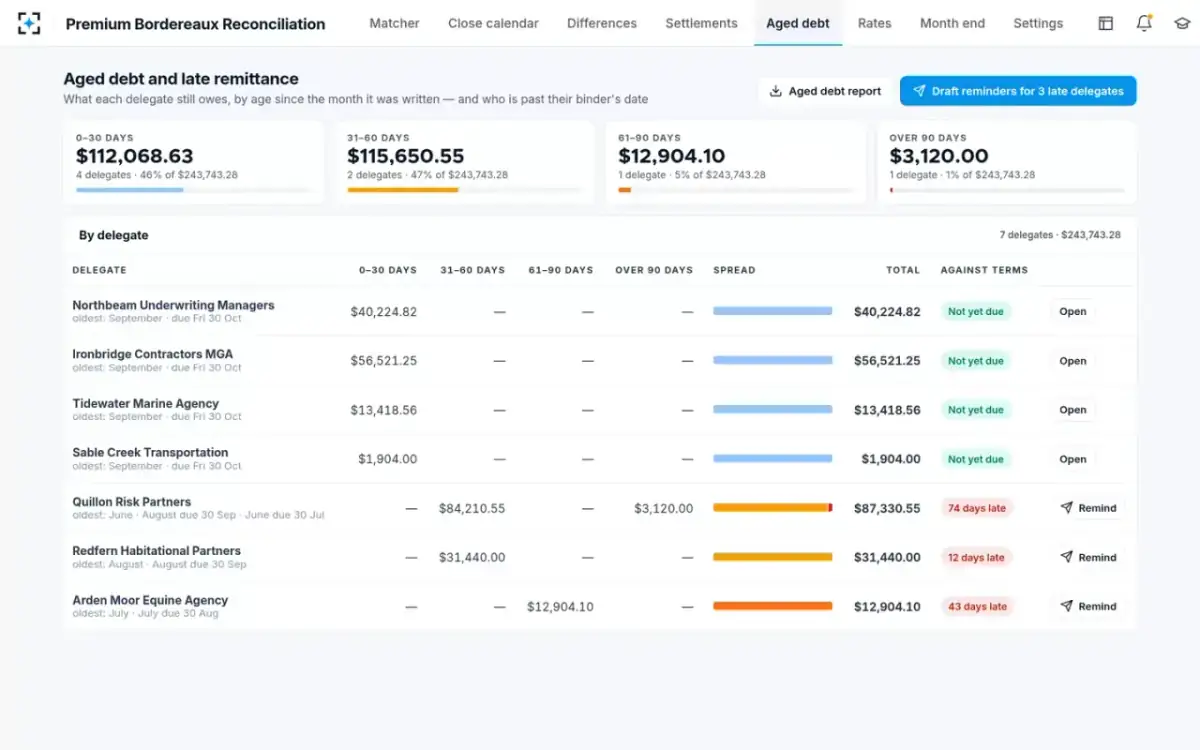
Applied to the sample, the first term is modest. At an illustrative 4% yield, Quillon Risk Partners' $87,330.55 costs about $9.57 a day in lost income, Redfern Habitational's $31,440.00 about $3.45 and Arden Moor Equine's $12,904.10 about $1.41. Nobody escalates a delegate for $10 a day.
The second term is where the money is. If each policy's premium fell due in the month it was written, Quillon's $3,120.00 of June premium was more than ninety days past due at the 30 September quarter end, and Arden Moor's earliest July premium had just crossed it. Every dollar over the line, to the extent no unearned premium relates to it, is nonadmitted on that statement, and a carrier with dozens of delegates can carry a material sum there without any single delegate looking alarming. The third term is the one Premium Bordereaux Reconciliation is built to shrink: when every difference already has a cause and a line, a credit controller's time goes on the delegates that are actually late.
Aged debt in Premium Bordereaux Reconciliation, each delegate against its own settlement date
Texas writes a settlement threshold into statute
Texas turns late settlement into a regulatory event. Its MGA chapter requires the managing general agent to notify the Texas Department of Insurance within 30 days when balances due to an insurer for more than 90 days exceed $1 million or 10 percent of the insurer's policyholder surplus, or when balances due for more than 60 days from agents reporting to the MGA exceed $500,000 (Tex. Ins. Code §4053.108(a)(1)–(2)). An MGA that routinely operates above those limits may meet the duty with a single annual report, once the department verifies it.
For a carrier the statute is a ready-made escalation line. If a Texas MGA's balances are near the threshold, the regulator may hear about it from the MGA before the carrier's credit committee does. A carrier's aged-debt list should therefore show, for each Texas delegate, the balance over ninety days against both figures.
Shortening the settlement cycle without breaking the terms
A carrier can shorten its effective settlement cycle without renegotiating a single binder: most of the delay in a delegated-authority close is the time between cash arriving and the carrier knowing what it paid for. The checklist below works on that time.
Seven ways to settle sooner on the terms you already have
- Reconcile each delegate as its documents arrive
Read and join the bordereau the day it lands, not when the last delegate has sent; Northbeam was 95.0% joined while Pelham Cross's bordereau was still due.
- Separate what is due from what is timing
Instalments not yet due and cancellations to reverse come out of the settlement figure, so the delegate is asked only for what it owes.
- Send the settlement with its lines
A statement of balance that cites the binder clause and attaches the lines gets paid; a total gets a counter-statement.
- Agree a tolerance for exchange differences
Book small currency differences to an exchange account instead of chasing them; the sample uses 0.75% of the line.
- Remind on fixed days after the cash date
The sample drafts reminders on day 5 and day 15; a person sends them.
- Price the ninety-day line into new terms
Before granting 60- or 90-day settlement, model how much premium it puts over ninety days at each quarter end.
- Escalate patterns, not single misses
Bordereaux on time and cash slipping, month after month, is the pattern in XL v IPORS; escalate it before the second quarter.
The solution's part in this is specific. It reads each delegate's documents as they arrive, separates timing from debt, drafts the settlement proposal with its lines and the reminders on the carrier's chosen days, and routes settlements over the approval limit to the head of delegated-authority finance. It never sends, never posts and never moves money. What a delegate may keep before it remits explains the delegate's side of the same date.
Questions people ask
How long does a broker have to settle premium?
As long as its agreement with the insurer allows. Binders recorded by the English Commercial Court allowed 30, 60 or sometimes 90 days after month end; US MGA contracts must provide for remittance of funds due at least monthly. A broker's own terms with policyholders do not extend what it owes the insurer.
What is a broker premium settlement agreement?
The part of a terms of business agreement or binder that fixes when and how the intermediary pays premium to the insurer: the period after month end, currency, rate of exchange, permitted deductions and the statement that accompanies payment. It may also say whether the intermediary holds premium as the insurer's agent, which decides who bears the loss if the intermediary fails.
Does a longer settlement term change when premium is nonadmitted?
No. Under NAIC statutory accounting the ninety days run from the policy's due date, not from the agent's contract; California's examiners cited that rule in 2025. A 90-day settlement term can leave premium more than ninety days past due even when the delegate pays on time.
Should a carrier charge interest on late premium?
Only if the binder provides for it, and many do not. Where it does, the interest compensates the lost-income term of the cost, but not the surplus lost to nonadmission or the time spent chasing.
When should a carrier escalate a late delegate?
When the delegate is past its own settlement date and cannot tie its reply to lines, when the same gap recurs for a second month, or when a statutory line is near: the ninety-day line on the carrier's statement, or, for Texas MGAs, the §4053.108 notice thresholds.