A premium bordereaux reconciliation report shows, for one delegate and one period, how the premium the delegate declared on its bordereau compares with the cash the carrier received and with the broker's statement of account, line by line, with every difference given a cause and an amount. Its job is to let the carrier settle with confidence: what is owed, what is still in transit, what was deducted wrongly, and what nobody can yet explain. The trap is that a report can tie the bordereau to the cash perfectly and still be wrong, because it tests the delegate's declaration against the delegate's payments and not against what the delegate actually collected. Botminds' Premium Bordereaux Reconciliation builds the report from the joins its agents make between all three sources, and this guide shows what such a report proves, what it cannot, and the extra tests that close the gap.
The worked example is the September 2026 report for a fictional delegate, Northbeam Underwriting Managers, as reconciled by a fictional carrier, Cavendale Specialty. The court records cited are real and linked.
What a balanced premium bordereaux reconciliation report proves, and what it does not
A balanced report proves: Every line the delegate declared was paid, or has a cause such as timing, instalment or cancellation.
It does not prove: That the delegate declared every policy it bound and every premium it collected.
A balanced report proves: The cash matches the bordereau's own net figures, at the binder rate.
It does not prove: That the bordereau applied the binder's commission rate, limits and territory. A wrong rate on both sides balances.
A balanced report proves: The money the carrier received is accounted for.
It does not prove: That premium still held by the delegate is in a premium account, in the right name, and not spent.
A balanced report proves: This month's declaration ties to this month's cash.
It does not prove: That last month's missing endorsement, or a cancellation never reversed, has been put right.
What is a premium bordereaux reconciliation?
A premium bordereaux reconciliation compares three accounts of the same money for one delegate and one month: the premium bordereau, which lists what the delegate bound and what it says is due; the cash, as wires and remittance advices into the carrier's account; and the broker's statement of account, which says what the intermediary received and passed on. It joins them at the policy line, not at the total, and explains every line that will not join.
The reconciliation exists because the law gives the carrier a right to the delegate's figures but not a guarantee that they are right. US MGA law requires the delegate to account to the insurer for every transaction at least monthly and gives the insurer access to its records in a form it can use (NAIC Model #225 §4B, §4D). In the UK the binder does the same work by contract. Either way the bordereau is the delegate's statement of its own performance, and the reconciliation is the carrier's test of it.
How do you reconcile premium bordereaux? Three sources, line by line
You reconcile premium bordereaux by reading each source into lines, joining the lines across sources on the policy reference, the insured, the remittance reference and the amount, converting at the binder's rate, and putting everything that does not join into a cause with its evidence. Doing it on totals first is the common mistake: a total can agree while two errors cancel.
For Northbeam's September, the bordereau had 418 lines tying to gross premium of CAD 2,825,570.19 and net premium of CAD 2,048,538.39, or $1,486,214.60 at the binder rate of 0.7255. Four wires brought $1,420,064.36, which the cash reader split into 412 remittance lines. The broker's statement from Marlow Fenwick listed what it had received and passed on. The matcher joined 397 bordereau lines, 388 one-to-one and nine paid in parts, each inside $5.00 or 0.75% of the line. The other 21 went into buckets.
Why Northbeam's premium bordereau and cash differed by $66,150.24, as Premium Bordereaux Reconciliation explained it
Why do premium bordereaux not match cash?
Premium bordereaux and cash disagree for six ordinary reasons and one or two bad ones. The ordinary ones are timing, instalments, cancellations, fees and taxes riding with the premium, commission taken at the wrong rate, and exchange rates; the bad ones are premium that was never declared and premium that was declared but not paid over. A good report names which is which, because the response differs: timing is followed up, a wrong commission is recovered, missing premium is investigated.
The Northbeam report shows the ordinary kind. Six lines of premium were still in transit at the cut-off; five instalment lines were not yet due; four cancellations, such as one cancelled flat on 22 September, would reverse on the October bordereau; three lines carried fees that belonged to Northbeam, such as a CAD 350 inspection fee. Two lines were short because Northbeam had taken commission at 30.0% instead of the binder's 27.5%. And one wire of $6,250.00 had no policy reference at all, until the evidence tied it to an August endorsement.
A commission difference, worked out to the cent with the binder's rate beside it
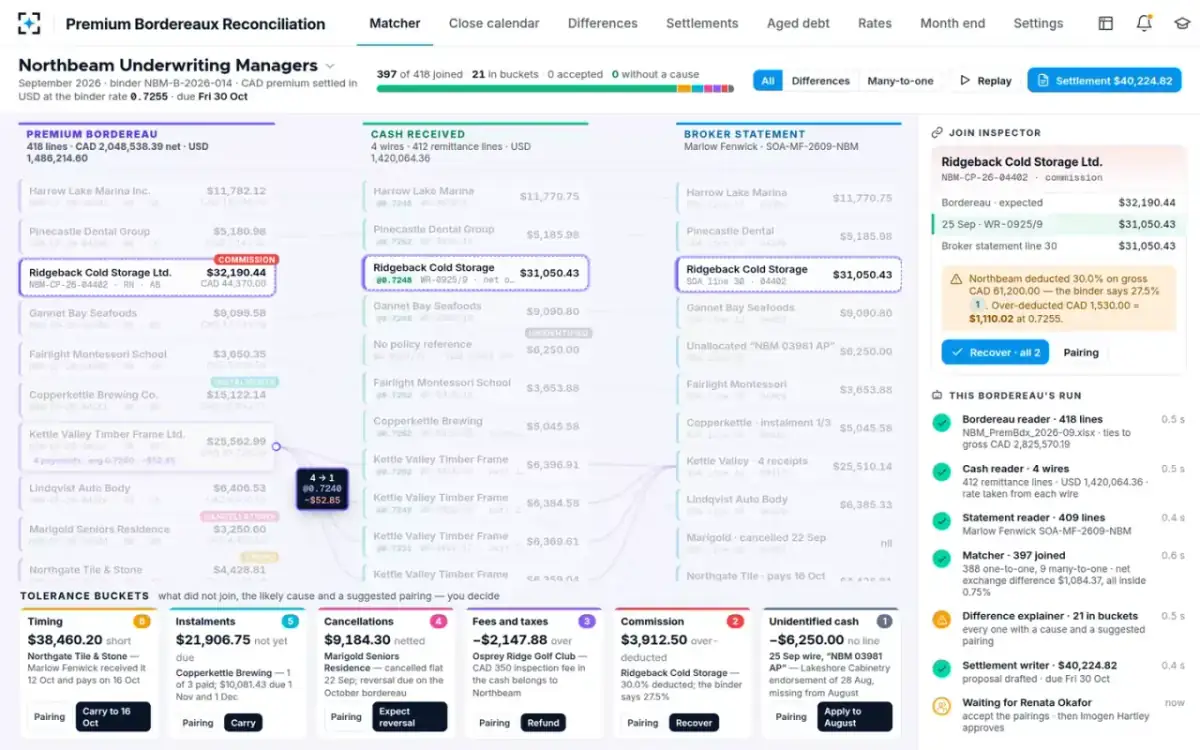
Notice what the commission line needs. The bordereau showed Ridgeback Cold Storage's net at $32,190.44 and the cash and statement agreed with each other at $31,050.43. A reconciliation that trusted the delegate's own net would have found a short payment and no reason. Only by recomputing commission from gross premium at the binder's rate does the cause appear, and only the binder can say which rate is right.
Balanced is not accurate: what the court found in XL v IPORS
The clearest public record of a reconciliation that could not have caught the problem is the 2022 Commercial Court judgment in XL Insurance Company SE v IPORS Underwriting Ltd. The coverholder sent monthly premium bordereaux within 15 days of month end, was entitled to deduct commission of up to 35% or 37.5% including brokerage, and was required to declare all premium to the binders and hold it in separate premium accounts.
The judge found two different gaps. The first was the familiar one: premium the bordereaux showed as payable that was never paid over. The second was premium that never appeared on the bordereaux at all, found only when a forensic accountant analysed the coverholder's bank statements alongside information from third parties, including brokers who confirmed that average brokerage was 17.5%.
"The exercise described in the two sub-paragraphs above identified the shortfall in the amounts paid to XL as against the amounts shown as payable in the bordereaux. As I indicated earlier, however, premium had been under-declared."
XL Insurance Company SE v IPORS Underwriting Ltd [2022] EWHC 2093 (Comm), ¶58(iii)
Two gaps in one delegate's premium, as the court found them
| UK business | Republic of Ireland business | |
|---|---|---|
| Shown as payable in the bordereaux but not paid to the insurer | £117,120 | €5,194,283 |
| Under-declared premium due to the insurer, after the coverholder's commission | £179,469 | €2,166,626 |
| Total the coverholder was found liable for | £296,589 | €7,360,909 |
A premium bordereaux reconciliation report built from the bordereaux would have shown the first row and nothing of the second. Every line in it would have been accurate as to the bordereau. The under-declared premium, more than €2 million after commission on the Irish book alone, was invisible to any test that started from the delegate's own list of policies.
The judgment also shows a test that can catch it. The judge observed that the transfers out of the premium accounts into the coverholder's business account could not have been legitimate commission, because "for the transfers to have been legitimate, the gross premium written by IPORS would have had to have been substantially higher" (¶63). Commission is a fixed share of premium. A delegate whose spending needs more commission than its declared premium can generate is telling the carrier something its bordereau does not.
Three tests a balanced report has not passed
Three tests close most of the gap between balanced and accurate: completeness against independent evidence, conformity with the binder, and custody of the money still held. None is exotic, and each uses documents the carrier can ask for under the binder.
Completeness. Test the bordereau against something the delegate did not write: the premium account's bank statements, the brokers' statements of account, or a sample of policies issued in the carrier's name. In XL v IPORS it was bank statements and third parties that showed the gap. A carrier can also run the commission test the judge used: if the delegate's commission on declared premium could not cover its costs, ask why.
Conformity. Test each line against the binder, not just against the cash. In Markel v Surety Guarantee Consultants, the bordereaux were the means by which the carrier's manager was meant to check business against the binding authority's limits; the court found they stated exposures as within the limits where bonds had exceeded them, left some bonds off entirely, and, for another insurer, reported Canadian bonds months late and with the territory stated as the UK ([2008] EWHC 1135 (Comm), ¶¶29, 85–86). On the cash side the same test catches a commission rate above the binder's, as in Northbeam's two lines.
Custody. Test where undelivered premium sits. A report that balances what arrived says nothing about premium the delegate still holds. Ask for premium account statements, check the account is in the name the binder requires, and compare the balance with premium declared but not yet remitted. California's examiners in 2025 found an MGA that owned every bank account it used to collect premium and pay claims for the insurer (California DOI, Topa Insurance Company examination; quoted in what a premium trust account is); a reconciliation from the insurer's side would not have shown it.
What a premium bordereaux reconciliation report should show
A useful report shows the money at three levels: the delegate summary, the line-level joins and the differences, each tied to the binder clause that decides it. At the sample carrier the report is part of a month-end pack the head of delegated-authority finance signs.
Every open difference across delegates, with its cause, evidence and owner
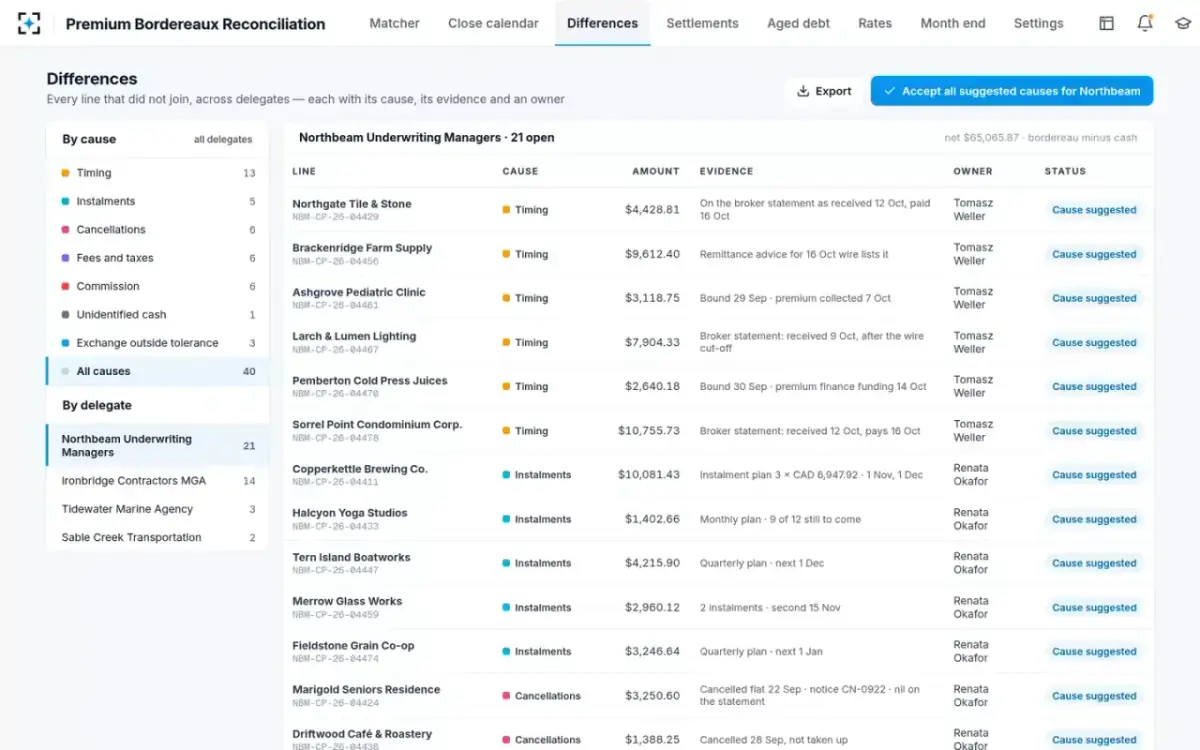
The minimum contents are: the delegate, binder and period; gross and net premium declared, and the rate of exchange applied; cash received, by wire and remittance line; the broker's statement position; joined lines, with one-to-one and part-payment joins distinguished; each unjoined line with its cause, amount, evidence and owner; exchange differences booked; the settlement figure and the clause it rests on; and items carried from earlier months. The last item is the one most reports drop, and the one that turns a recurring small difference into a pattern someone notices.
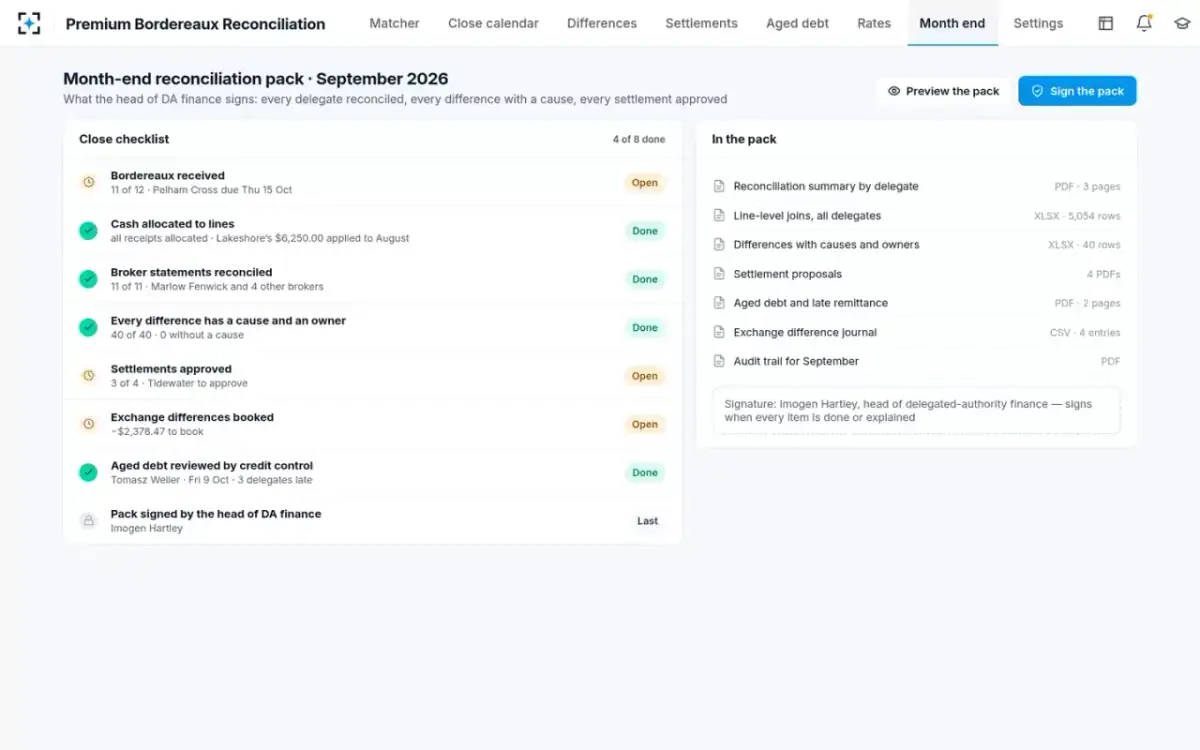
The Premium Bordereaux Reconciliation month-end pack the head of delegated-authority finance signs
What is under-declared premium, and how is it found?
Under-declared premium is premium a delegate collected for the carrier but did not report on its bordereau, so it is neither in the carrier's books nor in the settlement. It is found by comparing the bordereau with evidence the delegate did not produce: bank statements of the premium account, brokers' statements, policy documents and, in a dispute, the delegate's own accounts.
Not all under-declaration is deliberate. The sample's $6,250.00 wire paid an additional-premium endorsement that Northbeam bound on 28 August and simply left off its August bordereau; the reference on the wire led to it. That is the honest version, and it is common: endorsements, mid-term adjustments and late-bound risks fall between two months. Premium Bordereaux Reconciliation suggests the pairing from the evidence, a person accepts it, and the delegate is asked to declare the endorsement on its next bordereau. How the matching agent finds where unallocated cash belongs follows that receipt step by step.
Who signs the premium bordereaux reconciliation report?
The report should be prepared by the premium accountant, reviewed by someone who did not prepare it, and signed by the person accountable for delegated-authority finance. No statute prescribes the signatory; the carrier's own controls do, and examiners and auditors will ask who reviewed what.
At the sample carrier, Renata Okafor accepts each pairing and checks the settlement lines, settlements over $25,000 go to Imogen Hartley, the head of DA finance, and she signs the month-end pack once every difference has a cause and an owner. The agents draft; they never send, never post to the general ledger and never sign. What the lines of a premium bordereau should contain is the companion to this guide. For reinsurance accounts, where the same word covers a different reconciliation, see premium reconciliation in reinsurance.
Questions people ask
What is premium reconciliation?
Premium reconciliation compares premium recorded in one place with premium recorded or received in another and explains the differences. Under delegated authority it means joining the delegate's premium bordereau, the cash and the broker's statement line by line; in reinsurance it means reconciling ceded or assumed premium between the parties' accounts.
How often should premium bordereaux be reconciled?
At least as often as the delegate accounts, which under the NAIC model law is not less than monthly. Reconciling each month's bordereau before the next arrives keeps timing items from compounding and lets the carrier settle on the binder's own date.
Can a premium bordereaux reconciliation detect fraud?
It detects some symptoms, such as declared premium not paid over or commission above the binder rate, but not premium that was never declared. In XL v IPORS that gap was found from bank statements and third-party evidence, not the bordereaux. Pair the reconciliation with completeness and custody tests.
What tolerance should a premium reconciliation use?
A tolerance small enough that a real error cannot hide in it and large enough that rounding and exchange movements do not flood the queue. The sample uses $5.00 a line or 0.75% of the line for currency joins; anything outside becomes a suggestion for a person, never an automatic join.
What happens to cancellations on a premium bordereau?
A cancellation reverses premium previously declared, so the cash for it should be nil or a refund, and the reversal should appear on a later bordereau. In the sample, four cancellations worth $9,184.30 were set aside from September's settlement to reverse on October's bordereau.