MGA accounting software has one job that ordinary small-business accounting does not: it must keep the managing general agent's own money (commission, fees, capital) apart from premium, return premium and claims funds it holds as a fiduciary for each carrier, and prove that split to the carrier and the regulator every month. Most MGA accounting problems that reach examiners or courts are failures of that one job, not of bookkeeping in general. This guide turns the statutes and court records into the questions an MGA's finance team, or a carrier reviewing its MGAs, should put to any accounting software before buying it. It also shows where Botminds' Premium Bordereaux Reconciliation fits: beside the MGA's general ledger, joining its premium bordereau to the cash and the brokers' statements line by line, so that what the MGA reports to its carrier reconciles before it is sent.
Product examples come from a fictional sample carrier, Cavendale Specialty, and its fictional delegate Northbeam Underwriting Managers. Statutes and court findings are linked where they appear.
Twelve questions to ask MGA accounting software about money that isn't yours
1. Does every carrier have its own fiduciary balance?
Good answerPremium held, by carrier, at any date, separate from operating cash.
WhyFunds collected for an insurer are held as a fiduciary (Model #225 §4C).
2. Is fiduciary money tracked from collection, not only from deposit?
Good answerGross premium is recorded when received, before commission is taken.
WhyThe Fifth Circuit held the duty ran from the moment funds were accepted.
3. When may commission leave the trust account?
Good answerOnly when earned under the binder, and never below premium owed.
WhyNew York bars a withdrawal that leaves less than net premiums received but not remitted.
4. Can it net claims against premium?
Good answerOnly where the binder grants a right of offset, shown as separate lines.
WhyCalifornia's examiners criticised offsetting claims paid against premium due.
5. Does it cap the claims fund?
Good answerWarns when claims money exceeds the binder's limit (three months in the model, 60 days in Florida).
WhyTexas requires notice when it exceeds 60 days' needs by over $100,000.
6. Whose name is on the bank account?
Good answerThe account, owner and signatories match what each binder requires.
WhyAn MGA owning all premium accounts was an exam finding in 2025.
7. Can it produce each carrier's monthly account?
Good answerAll transactions for the month, by carrier, with the remittance due.
WhyAccounts and remittance are required at least monthly (Model #225 §4B).
8. Can it produce the Texas quarterly account report?
Good answerWritten, earned and unearned premium, paid and outstanding losses, IBNR and management fees.
WhyTex. Ins. Code §4053.103.
9. Does it age what is owed to each carrier?
Good answerAgainst the binder's settlement date and against the policy's due date.
WhyCarriers nonadmit premium over ninety days due; Texas sets notice thresholds.
10. Does every bordereau line tie to cash or a cause?
Good answerLine-level joins to wires and brokers' statements, with timing, instalments and cancellations named.
WhyA carrier's settlement is only as good as the lines behind it.
11. Can a carrier or examiner read the books "in a form usable"?
Good answerExports by carrier, period and policy, with the audit trail.
WhyModel #225 §4D; Texas examiners may audit fiduciary money.
12. Who can move money, and is it logged?
Good answerNamed approvers and limits for transfers out of fiduciary accounts.
WhyIn XL v IPORS, premium-account transfers to an operating account ran for years.
What is MGA accounting?
MGA accounting is the bookkeeping and reporting of a managing general agent, which collects premium, pays claims and earns commission on behalf of one or more insurers. It differs from ordinary agency accounting because much of the money moving through the MGA's books belongs to its carriers, and the law requires it to be held, reported and remitted on the carriers' terms.
The NAIC's model act, which most states have enacted in their own words, sets the frame: the MGA contract must require accounts "detailing all transactions" and remittance of funds due at least monthly, fiduciary custody of funds collected for the insurer in an FDIC-insured institution, and separate records the insurer may copy (Model #225 §4B–D). An MGA's accounting software is the system that has to make those promises true.
How should an MGA account for premium? Three balances that are never the MGA's
An MGA should account for premium as three fiduciary balances, held by carrier, until each is paid away: premium due to the carrier, return premium due to policyholders, and claims money held for the carrier's claims. Its own income is only the commission and fees the binder lets it keep, and only once earned.
Florida states the principle for every licensee: premiums, return premiums and other funds belonging to insurers or others, received under the licence, are trust funds held in a fiduciary capacity (Fla. Stat. §626.561(1)). New York forbids an agent or broker to commingle funds received in that capacity "with his, her, or its own funds or with funds held by him, her, or it in any other capacity" without the written consent of the person for whom they are held (11 NYCRR §20.3(c)).
The timing of commission is where software usually goes wrong. Many agency agreements let the MGA take commission before depositing premium. The Fifth Circuit held, in Lincoln General v. U.S. Auto Insurance Services, that such a privilege did not suspend the fiduciary duty while the MGA calculated and deducted its share: the duty covered the funds from the moment they were accepted (No. 13-10589, 5th Cir. 2015). Software that records only the net amount deposited cannot show that the gross was handled as a fiduciary.
Where a premium dollar went under two delegated programmes, as courts described them
UK binder, commission cap 35% (XL v IPORS)
- Placing broker's brokerage · 17.5%
- Coverholder's own commission · 17.5%
- Remitted to the insurer · 65%
UK binder, commission cap 37.5% (XL v IPORS)
- Placing broker's brokerage · 17.5%
- Coverholder's own commission · 20%
- Remitted to the insurer · 62.5%
US auto programme, after the fronting fee (Lincoln General)
- MGA compensation · 20.6%
- Expected losses (target loss ratio) · 69.4%
- Reinsurer's margin · 10%
The chart shows why an MGA's books are mostly someone else's money. On the UK binders, roughly two-thirds of every gross pound collected belonged to the insurer from the start; in the US programme, the MGA's own compensation was about a fifth of what remained after the fronting fee. In XL v IPORS the judge noted that only in the first year of the binders would the coverholder's legitimate commission have covered its office expenses, and that the bulk of the transfers out of the premium accounts could not have been legitimate commission.
Does an MGA need separate bank accounts?
Yes. The model act requires an MGA to hold collected funds as a fiduciary in an insured bank and to keep separate records, which in practice means an account apart from its own; binders often go further and require one account per carrier, or at least separate identification of each carrier's money. Texas requires an escrow account into which the MGA deposits, on receipt, all money collected for each insurer (§4053.105); Florida requires an agent to keep funds for each insurer it is not appointed with in a separate account the regulator can audit.
The binder can require more. The 2012 binder in XL v IPORS required all money received to be deposited into an account separate from the coverholder's operating account and "identified in the Coverholder’s book of account, separately from other funds similarly held by the Coverholder for other insurers" ([2022] EWHC 2093 (Comm), ¶9). One pooled account is lawful in many places, but then the software must be able to say, at any moment, how much of it belongs to each carrier.
Ownership is the other half. California's examiners reported in 2025 that an insurer's MGA owned every bank account used to collect its premium and pay its claims, and recommended accounts in the insurer's name with the MGA named as fiduciary (California DOI, Topa Insurance Company). Accounting software cannot fix an account structure, but it can make the structure visible: each account, its legal owner, its signatories and the binders it serves. What a premium trust account is sets out the account rules state by state.
What reports does an MGA send its carrier?
An MGA sends its carrier monthly accounts with the remittance, usually as a premium bordereau and often a claims bordereau, plus whatever the binder and state law add. The statutory minimum is the model act's monthly account; Texas adds a quarterly account report with set contents and notices to the regulator when balances or claims funds cross set lines.
Reports a US MGA owes its carrier and regulator, and what each must show
| Report | How often | What it must show | Source |
|---|---|---|---|
| Account of all transactions, with remittance | Not less than monthly | All transactions; funds due remitted | Model #225 §4B; Fla. Stat. §626.7451(2) ("monthly or more frequent") |
| Account report to each insurer | At least once each calendar quarter | Written, earned and unearned premiums; losses and loss expenses paid and outstanding; IBNR; management fees | Tex. Ins. Code §4053.103 |
| Notice to the Texas Department of Insurance | Within 30 days of the trigger | Balances due to an insurer over 90 days above $1 million or 10% of its surplus; agents' balances over 60 days above $500,000; claims money more than $100,000 above 60 days' needs; claims authority withdrawn; contract ended | Tex. Ins. Code §4053.108 |
| Audited financial statements | Annually, on file with the insurer | Independent audit for the two most recent fiscal years showing positive net worth | Model #225 §5A |
The Texas notice line is worth building into the software rather than a spreadsheet. An MGA whose balances due to a carrier for more than ninety days pass $1 million has thirty days to tell the regulator, and the carrier will want to know first. The same aged view tells the carrier what its own statement will show; what each late day costs the carrier works through the ninety-day line.
How should MGA accounting software handle currency and part-payments?
It should record each receipt at the rate the bank actually applied, settle with the carrier at the rate the binder specifies, and carry the difference to a named exchange account, line by line. An MGA that writes in one currency and settles in another otherwise accumulates an unexplained residue that grows with every month.
Northbeam, the sample delegate, writes Canadian commercial property in Canadian dollars and settles with its carrier in US dollars at a binder rate fixed for the month, 0.7255 for September. One policy was paid to the carrier in four parts, wired on four days at four rates, from 0.7262 down to 0.7219; the four wires came to $52.85 less than the bordereau line at the binder rate. The carrier's tolerance absorbed it because the reconciliation could show where it came from. Software that posts only the total of each wire cannot show that, and every such line becomes a query.
UK coverholders holding client money have a rule for the same problem: money segregated in a different currency must be topped up at least every 25 business days to the original currency amount at the previous day's closing spot rate (FCA CASS 5.5.8R). The US MGA statutes quoted on this page set no such rule, so the binder's rate clause decides.
What examiners and courts find when MGA accounting fails
The public record shows the same handful of failures, each one an accounting control that was missing or ignored. None needed sophisticated fraud to start; most began as a convenient shortcut in how money was recorded or moved.
In the California examination published in 2025, the MGA owned the premium and claims accounts; the insurer aged uncollected premium from the policy expiration date rather than the due date; it offset claims paid against premium due; and it netted refunds owed to policyholders against uncollected premium instead of carrying them as a liability. In Lincoln General, the trial court found that the MGA moved about $50 million to affiliated companies in its first four years, and the premium trust account ran out of money to pay claims by 2006. In XL v IPORS, the judge found the coverholder liable for £296,589 and €7,360,909 of premium that should have been held in the premium accounts and paid over, after transfers from those accounts to its business account and on to its director.
A month-end close for an MGA's fiduciary money, in eight checks
- Bordereau ties to its own totals
Every line read, gross, commission, taxes and fees, and net, with no unreadable amount left as zero.
- Every bordereau line joins cash or has a cause
Including part-payments and foreign currency at the binder rate.
- Brokers' statements agree
What each broker says it received and passed on matches what arrived.
- Commission at the binder rate
Recomputed from gross; an over-deduction is premium owed back.
- Return premium carried as owed
Refunds due to policyholders shown as liabilities, not netted away.
- Claims fund within the cap
Against the binder and state limit; Texas notice if above 60 days' needs by over $100,000.
- Bank balance covers what is held for others
Premium not yet remitted, return premium owed and claims money, by carrier.
- Ageing against the carrier's two clocks
The binder's settlement date and the policy's due date, with the ninety-day line marked.
The questions about MGA accounting software that matter most
Of the twelve questions in the matrix, three decide most purchases. Can the software show each carrier's fiduciary balance at any date, from gross collection rather than net deposit? Can it tie every bordereau line to cash or a cause? And can it produce what a carrier or an examiner asks for in a usable form without a week of spreadsheets? A system that answers all three is doing MGA accounting; one that answers none is doing small-business bookkeeping with an insurance chart of accounts.
What accounting software for MGAs rarely does well is the second question. General ledgers are built around postings, not around joining a policy-level bordereau to wires that pay forty policies, or four wires that pay one, in another currency. That is the gap a reconciliation layer fills, and why an MGA's finance team may want one beside its general ledger rather than inside it.
Where Premium Bordereaux Reconciliation fits for an MGA
Premium Bordereaux Reconciliation is not an MGA's general ledger and does not replace its accounting software. It is built around the carrier's month: its agents read each delegate's premium bordereau, the wires and remittance advices, and the broker's statement of account, join them line by line and give every difference a cause. An MGA meets it from the other side, as the statement of balance it receives, and can run the same reconciliation on its own bordereau, cash and brokers' statements before sending.
The statement of balance an MGA receives from Premium Bordereaux Reconciliation, every amount traced to its lines
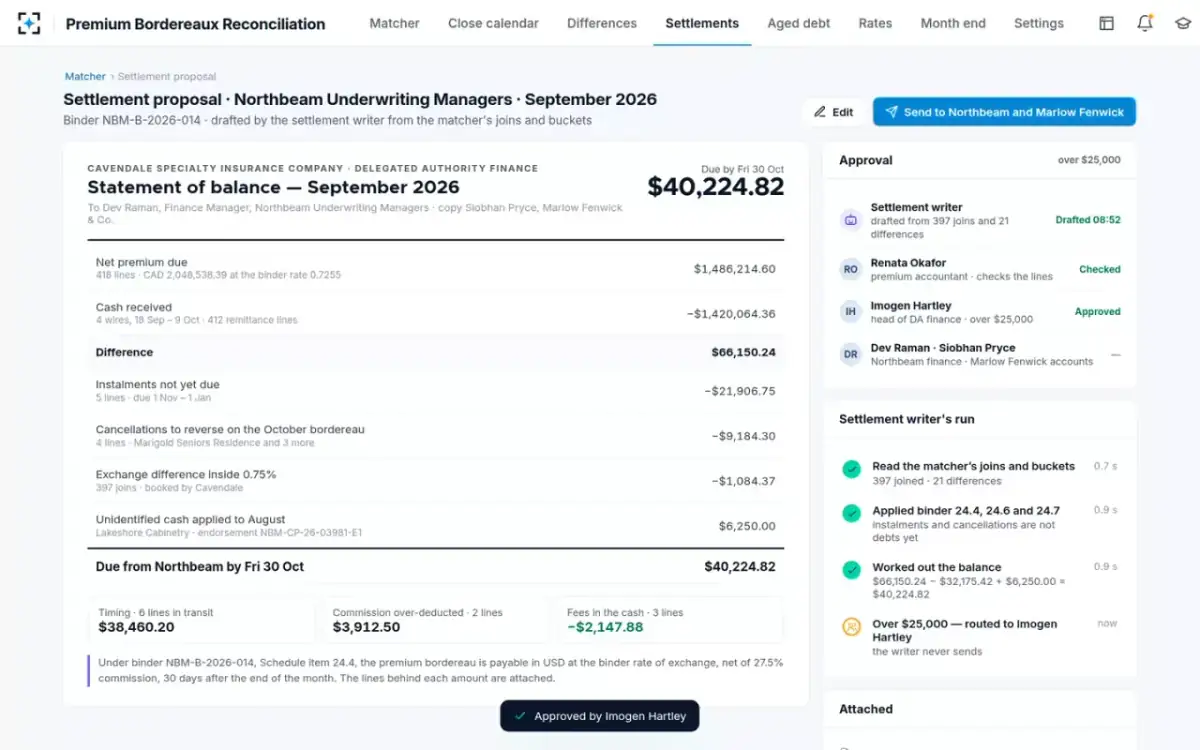
For Northbeam's finance manager, the difference is concrete. He paid one policy in four wires; on the statement of balance, all four are joined to it and the 0.21% exchange difference has been absorbed inside the carrier's tolerance. Two commission lines show the binder's 27.5% against the 30% he deducted. And the $6,250.00 he sent for an endorsement left off August's bordereau is applied, with a request to declare it in October.
A reminder an MGA can answer line by line
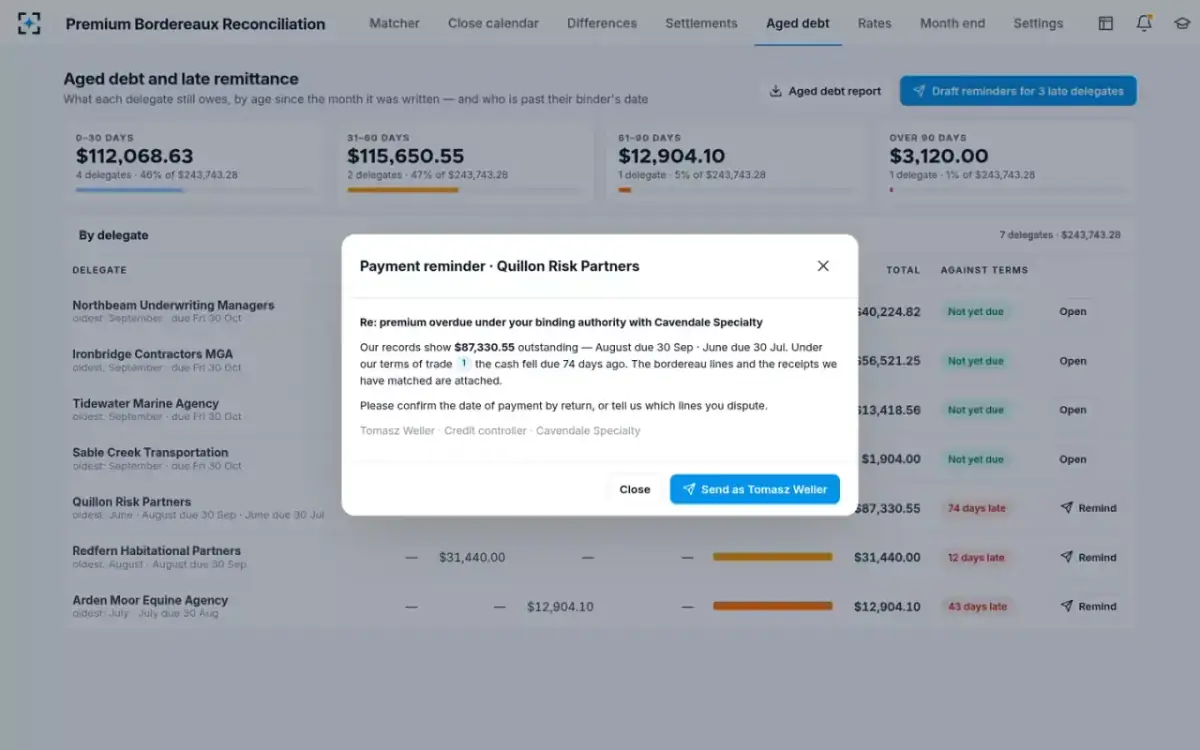
The solution never moves money, never posts and never sends; settlements over the carrier's limit are approved by its head of delegated-authority finance. For an MGA comparing tools, the premium reconciliation software comparison sets out what each kind reads and writes back, and the insurance client money rules cover UK coverholders. To see it on a month of your own bordereaux, start from Premium Bordereaux Reconciliation.
Questions people ask
What accounting software do MGAs use?
MGAs use general-ledger packages, insurance agency management systems and policy administration systems with accounting modules, often with spreadsheets for bordereaux and reconciliations. The choice matters less than whether the system can hold fiduciary balances by carrier and tie every bordereau line to cash; many MGAs add a reconciliation layer for the second.
What is MGA fiduciary accounting?
Accounting for money the MGA holds for others (premium for carriers, return premium for policyholders, claims funds) separately from its own, so that each balance can be shown, by carrier, at any date. The model act and state laws make the MGA a fiduciary for those funds, and Texas lets its examiners audit them.
Can an MGA use one bank account for several carriers?
Often, if state law and the binders allow it, but its books must identify each carrier's share at all times. Some binders require separate accounts or separate identification per insurer, and Florida requires a separate account for each insurer an agent is not appointed with.
How should an MGA record commission?
As income only when earned under the binder and only out of premium actually received, recomputed from gross at the binder's rate. New York prohibits a withdrawal from the premium account that would leave less than the net premiums received but not remitted.
What happens if an MGA's books do not reconcile?
The carrier cannot settle with confidence, its own statement may carry nonadmitted balances, and regulators may examine the MGA as if it were the insurer under the model act. In the cases on the public record, unreconciled premium accounts preceded findings of diverted funds.