A premium reconciliation software comparison is most useful when it compares tools by what each reads and what each writes back, rather than by feature lists. The general ledger, the bank feed of the premium account and the store of delegates' bordereaux already exist, and regulators examine the fiduciary money that runs through them, so the question for a carrier or MGA is which tool can read all three, join them line by line and explain every difference, while leaving the general ledger as the books. This guide compares five kinds of premium reconciliation software on that basis and sets out a go-live that changes nothing in the general ledger until people decide to post. Botminds' Premium Bordereaux Reconciliation is one of the five kinds: an agent-based layer that reads each delegate's premium bordereau, the wires and remittance advices, and the broker's statement of account, and writes back drafted settlements, reminders and journals for people to approve, send and post.
Product examples come from a fictional sample carrier, Cavendale Specialty, and its twelve fictional delegates. The comparison is our classification of kinds of software, not a ranking of named products.
Premium reconciliation software comparison: five kinds, by what each reads and writes back
| Kind of software | Reads | Writes back | Fits best when |
|---|---|---|---|
| Spreadsheets and the general ledger's bank reconciliation | Bank statement lines; bordereau totals typed or pasted in | Manual journals | A few delegates in one currency, paying one wire per month |
| Insurance accounting or billing system | Its own policies, invoices and agency statements | Postings, directly | Business the carrier issued and bills itself |
| Bordereau data platform | Each delegate's file, mapped to one layout | Clean data for underwriting and reporting | The main problem is data quality, not cash |
| Cash application engine | Bank files and remittance advices | Cash applications, often posted automatically | High volumes of one-to-one payments with good references |
| Agent-based reconciliation layer | Bordereaux, wires, remittance advices, broker statements and binder terms | Drafted settlements, reminders, journals and a month-end pack, for people to approve and post | Many delegates, several currencies, part-payments and missing references |
What is premium reconciliation software?
Premium reconciliation software compares premium as recorded in one place with premium recorded or received in another, finds the differences and helps people explain and clear them. Under delegated authority the three places are the delegate's premium bordereau, the cash received into the premium account, and the broker's statement of account; the software's value lies in joining them at the policy line rather than at the total.
The word covers several different jobs, which is why comparisons go wrong. Reinsurers reconcile ceded and assumed premium between treaty accounts; insurance reconciliation software for reinsurance accounts is a different comparison. Group benefits carriers match each employer's payment to the list bill and the enrolment file, which is the work of Group Premium Reconciliation. This guide is about premium written under binding authorities and reported on bordereaux.
Does reconciliation software replace the general ledger?
No, and a carrier should be wary of one that tries. The general ledger is where the carrier's books are kept and where auditors and examiners look; reconciliation software should read from it, draft entries for it, and leave the posting to people with the authority to post.
The law already assumes the delegate's books and the carrier's access to them. The NAIC's model act requires the MGA contract to give the commissioner access to all the MGA's books, bank accounts and records, in a form the commissioner can use (Model #225 §4D). Texas requires the MGA to keep separate records of the business it handles for each insurer and make them available for inspection by each insurer and by the department's examiners (Tex. Ins. Code §4053.104). Those records are the books; a reconciliation tool that rewrites them creates a second version an examiner will ask about.
What the tool should add is evidence: for every settlement figure, the bordereau lines, remittance lines and statement lines it rests on, and for every difference, its cause. The UK client money rules show the standard expected where a rulebook prescribes one: a firm reconciles its own records to the bank's at fixed intervals, and must find and correct the reason for any discrepancy that is not purely a timing difference (FCA CASS 5.5.63R).
What Premium Bordereaux Reconciliation reads, and what goes back to people
Agent
Reads the bordereau inboxEach delegate's premium bordereau, in its own layout (spreadsheet, CSV or PDF), into standard fields tied to the file's totals.
Never: guess an amount.
Agent
Reads the bank feed and remittance advicesWires into the premium account, with the rate each got, split into allocatable remittance lines.
Never: allocate cash without a remittance line or an accepted pairing.
Agent
Reads broker statements and binder termsWhat each broker received and passed on, and each binder's commission, currency, rate and settlement days.
Never: edit a statement.
Agent
Drafts what goes backSettlement proposals, reminders, an exchange difference journal and the month-end pack, each with its lines attached.
Never: send, or post to the general ledger.
A person decides
People approve, send and postThe premium accountant accepts pairings; the head of DA finance approves settlements over the limit and signs the pack; finance posts the journals.
Can reconciliation software read bordereaux in each delegate's layout?
Some can and many cannot; it is the first thing to test. Delegates send bordereaux in their own layouts and formats, and a tool that needs every delegate to adopt the carrier's template moves the reconciliation problem into an onboarding project that never finishes.
The question has two parts. Can the tool read a layout it has not seen, map it to standard fields (policy reference, insured, transaction, gross premium, commission, taxes and fees, net premium, currency) and prove the mapping by tying the lines to the file's own totals? And does it refuse to guess: does an unreadable amount become a flagged line, or a zero? In the sample, Northbeam's bordereau of 418 lines tied to gross premium of CAD 2,825,570.19 before any matching began. A tool that cannot show that tie-out is matching against numbers nobody has checked.
Four hard lines from one month, and what each kind of software needs to handle them
The fastest way to compare premium reconciliation software is to take the four or five lines from last month that took longest by hand and ask how each kind of tool would treat them. Northbeam's September had four such lines, and each one separates the kinds in the table above.
One policy, four wires, four rates. Kettle Valley Timber Frame's CAD 35,235.00 arrived as four wires of CAD 8,808.75, converted at 0.7262, 0.7248, 0.7231 and 0.7219. A tool that joins one payment to one line leaves four receipts and an unpaid policy. A tool that supports part-payments but converts at a single rate shows a $52.85 difference with no explanation. Only a tool that joins many-to-one and shows both the binder rate and each wire's rate can book the 0.21% to exchange difference and stop there.
A commission deducted at the wrong rate. Ridgeback Cold Storage's wire and the broker's statement agreed with each other and were $1,140.01 short of the bordereau. Most of it, $1,110.02, was commission taken at 30.0% instead of the binder's 27.5% on gross CAD 61,200.00; the remaining $29.99 was the wire's rate of 0.7248 against the binder's 0.7255. The commission cause appears only if the tool reads the binder's rate and recomputes from gross. Cash application engines rarely read binders.
A wire with no policy reference. The $6,250.00 receipt referenced "NBM 03981 AP" paid an endorsement missing from the previous month's bordereau. A tool that matches only within the current month's bordereau cannot find it; one that searches earlier months and reads reference fragments can suggest it, and should leave the decision to a person.
Premium that is not late. Five instalment lines worth $21,906.75 were not due until November to January. A tool that treats every unpaid line as arrears adds them to the delegate's debt and starts an argument; the comparison should check that timing and instalments stay out of the settlement figure.
What data does reconciliation software need?
Premium reconciliation software needs the same documents a premium accountant uses, and no more: the binders' terms, the bordereaux, the bank feed, the remittance advices and the broker statements, plus last month's open items. If a vendor asks for a data warehouse project first, ask why.
The inputs a premium reconciliation trial needs, and why each matters
- Binders and their schedules
Commission rates, currency, rate of exchange, bordereau and settlement days, and any instalment or fee terms: the rules every join is tested against.
- A closed month of bordereaux from every delegate
In the layouts delegates actually send, including the awkward ones.
- The bank feed of the premium account
Every wire with its value date, currency and the rate it was converted at.
- Remittance advices
What each wire says it pays; without them, one wire for forty policies is a guess.
- Broker statements of account
The intermediary's own view of what it received and passed on, including nil lines and items in transit.
- Open items from the month before
Timing items, instalments and unidentified cash carried forward, so the trial does not start from a false zero.
- The month's known answer
What your team actually settled and why, so the trial can be scored line by line.
What to write back, and what never to
Reconciliation software should write back drafts with evidence, and nothing a person has not approved. The safest division is simple: the software proposes joins, causes, settlements, reminders and journals; people accept, approve, send and post. A tool that auto-posts or auto-sends makes every error a correction in the books or a letter to a delegate.
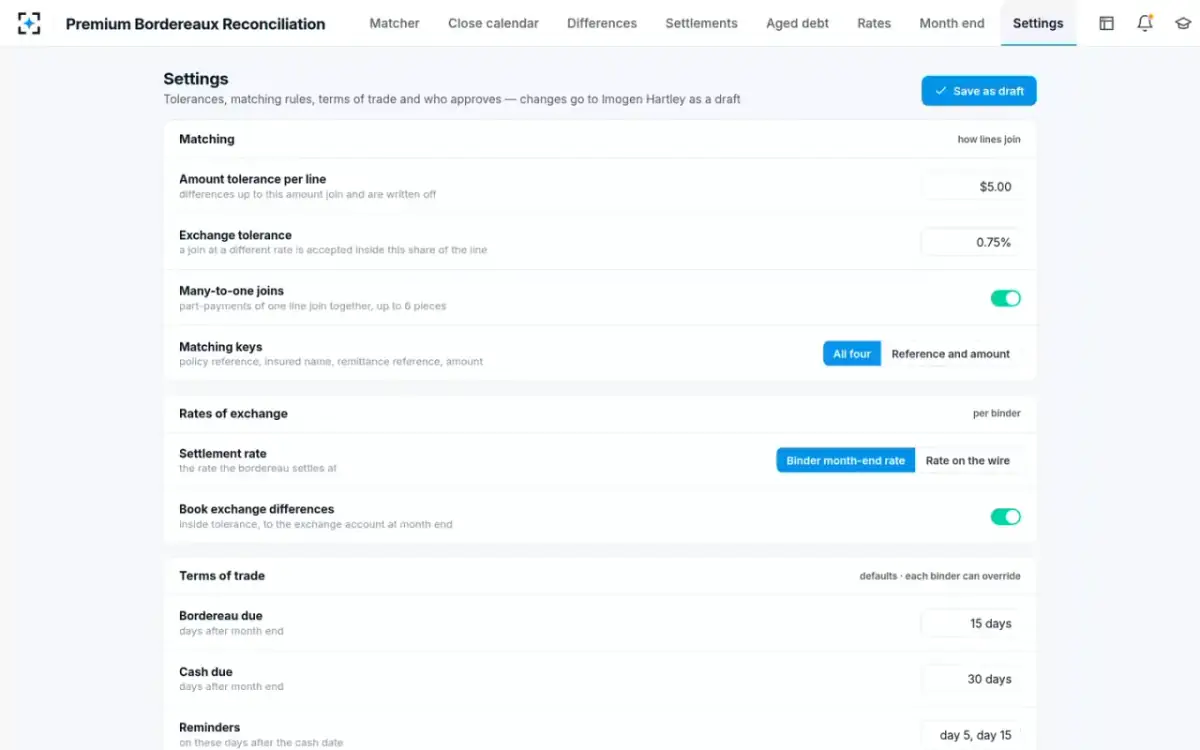
In Premium Bordereaux Reconciliation the limits are settings the carrier sees and can tighten, but the prohibitions are fixed. The matcher joins only inside $5.00 or 0.75% of a line; settlements over $25,000 go to the head of delegated-authority finance; the switch that would let agents send is off and offers no other choice; agents never post to the general ledger, and any write-off above the line tolerance is a person's decision. Every change to a setting goes to the head of DA finance as a draft.
Tolerances, matching keys, rates and terms of trade, each a setting with an approver
How long does reconciliation software take to implement?
A reconciliation layer that reads documents the carrier already receives can be proved on a closed month in weeks, not quarters, because nothing in the general ledger, the bank or the delegates' processes has to change first. The plan below is the sequence we suggest; the durations are our estimate for a carrier with about a dozen delegates and depend on how many layouts and currencies it has.
A go-live beside the general ledger: replay a closed month, run a live one in parallel, then switch
- Gather binders and a closed month2 weeks
- Replay the closed month and score it2 weeks
- Run the live month in parallel3 weeks
- Switch: people post from the drafts1 week
The replay is the step to insist on, whatever the software. Take a month your team has already closed, give the tool the same documents, and compare its joins, causes and settlement figures with what your people did. Disagreements are the useful part: some will be the tool's errors, and some will be your team's.
Scoring a premium reconciliation software comparison on your own month
Score each candidate on the same closed month, line by line, against the answer your team already has. Demonstrations on a vendor's data prove that the vendor's data reconciles.
Eight scores for a premium reconciliation software comparison
- Bordereaux read without a template
Share of delegates' files read and tied to their own totals, with unreadable amounts flagged, not zeroed.
- Lines joined correctly
Joins that match your team's, including part-payments; count wrong joins separately from missing ones.
- Differences with the right cause
Timing, instalments, cancellation, fees and taxes, commission, unidentified: does each agree with your team's?
- Currency handled at the binder rate
Both rates shown on every join; exchange differences within tolerance booked, not chased.
- Unidentified cash placed
Suggestions that a person would accept, with the evidence that supports them.
- Settlement figure reproduced
The amount owed by each delegate, and the clause it rests on.
- Nothing sent or posted without a person
Inspect the approval route and the audit trail for every action in the trial.
- A join can be replayed
Pick ten joins at random; the tool should show the lines and rates behind each.
Where Premium Bordereaux Reconciliation fits among reconciliation tools, and where it does not
It fits a carrier or fronting insurer receiving premium from MGAs and coverholders as monthly bordereaux and net wires, often in several currencies, and an MGA that wants its statements to the carrier to reconcile before they are sent. It reads what delegates already send and writes back drafts with evidence; the general ledger stays the books.
What comes out at month end: the pack, the journal and the audit trail
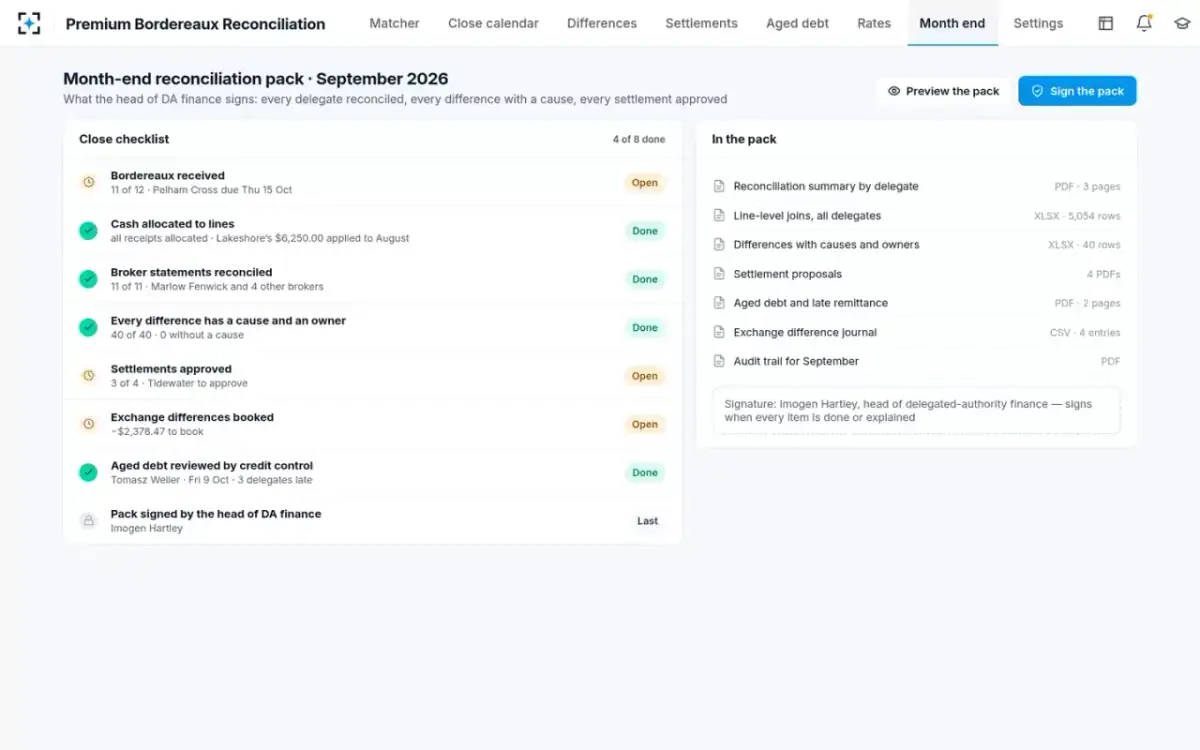
It does not fit everything. It is not an accounting system, a billing system or a bank reconciliation for the carrier's operating accounts. It is not a bordereau data platform for underwriting analytics, though it reads the same files. It does not run a UK firm's client money calculation, and it never moves money. A book that is mostly direct-billed, or delegates that already remit one clean wire per policy, will gain less than a book like the sample's, where one delegate paid one policy in four wires at four rates. The matching agent in detail and what MGA accounting software should do with trust money cover the two neighbouring decisions. To run the comparison on your own files, start from Premium Bordereaux Reconciliation.
Questions people ask
What is the best premium reconciliation software?
The one that reconciles your own closed month best, scored line by line against what your team settled. For delegated authority that usually means a tool that reads bordereaux in each delegate's layout, joins part-payments at the binder rate, and explains every difference with evidence, without posting or sending on its own.
How do you compare reconciliation software?
Give every candidate the same closed month of documents and compare joins, causes and settlement figures with your team's answer. Score bordereau reading, correct joins, causes, currency handling, unidentified cash, the settlement figure, approvals and the ability to replay a join.
Can reconciliation software post to the general ledger automatically?
Many tools can; whether they should is a control decision. Automatic posting turns every wrong match into a correcting entry. Premium Bordereaux Reconciliation drafts journals, such as the month's exchange difference journal, for finance to post.
Do delegates have to change their bordereaux for new software?
They should not have to. A tool that reads each delegate's existing layout, and ties it to the file's totals, can start without a template project; a carrier can still ask delegates to correct missing items, such as an unreported endorsement, on their next bordereau.
Is premium reconciliation software the same as bordereaux software?
No. Bordereaux software turns delegates' files into clean data for underwriting and reporting; premium reconciliation software joins the premium in those files to cash and to brokers' statements and explains the differences. Botminds offers both as separate solutions; the bordereaux management system buyer's questions cover the first.