Insurance client money rules are the UK Financial Conduct Authority's rules, in chapter 5 of its Client Assets Sourcebook (CASS 5), for money an insurance intermediary receives or holds in connection with insurance distribution: premiums on their way to insurers, and claims money and premium refunds on their way to customers. Their central question is whose money a premium is while the broker or coverholder holds it. Under a written risk transfer agreement it is treated as the insurer's from the moment the agent receives it; otherwise it is client money, held on trust for the customer and reconciled on a fixed cycle. US law asks the same question through state statutes instead. Either way, a carrier needs to see each delegate's premium line by line, which is what Botminds' Premium Bordereaux Reconciliation does: it joins each premium bordereau to the cash received and the broker's statement of account and gives every difference a cause.
The rules are quoted from the FCA Handbook as published in October 2026; the product examples come from a fictional sample carrier, Cavendale Specialty, and its fictional delegates.
Which insurance client money rules apply to the premium you hold?
- 1Is the money held in the United States?
Yes State law applies, not CASS: an MGA holds collected funds as a fiduciary in an insured bank (Model #225 §4C and each state's act).
No, UK go to 2.
- 2Are you the insurer, or a managing agent acting as such?
Yes CASS 5.1 to 5.6 do not apply to that money (CASS 5.1.1R(2)(c)–(d)).
No go to 3.
- 3Is it commission or fees properly due to you?
Yes It is your money once properly due and payable (CASS 5.1.5R(1)(a)); under a client money trust a mixed remittance still goes through the client account first.
No go to 4.
- 4Does a written agreement make you the insurer's agent to receive it?
Yes Risk transfer: the premium is the insurer's from receipt (CASS 5.2). Go to 5.
No Client money: hold it on the statutory trust (CASS 5.3) or, if you meet the conditions, a non-statutory trust (CASS 5.4).
- 5Has the insurer agreed in writing that you treat it as client money, its interests subordinated?
Yes Client money, with the insurer as a subordinated client (CASS 5.1.5AR).
No Insurer's money held as its agent: not client money, and not kept in a client bank account.
What are the insurance client money rules, and who must follow them?
The insurance client money rules apply, in the FCA's words, "to a firm that receives or holds money in the course of or in connection with its insurance distribution activity" (CASS 5.1.1R). That covers brokers, coverholders and other intermediaries. They do not apply to an insurer in respect of its permitted activities, or to a managing agent acting as such, and an approved bank holding the money in an account with itself is outside them if it tells the client in writing.
The FCA states their purpose directly: they give effect to the Insurance Distribution Directive's requirement that all necessary measures be taken to protect clients against an intermediary's inability to pass premiums to an insurer, or claims and refunds to the insured. It names two ways of doing that, and the whole chapter follows from the choice.
"The first is to provide by law or contract for a transfer of risk from the insurance intermediary to the insurance undertaking (CASS 5.2). The second is that client money is strictly segregated by being transferred to client accounts that cannot be used to reimburse other creditors in the event of the firm's insolvency"
FCA Handbook, CASS 5.1.7G(2)
What is a risk transfer agreement in insurance?
In the client money sense, a risk transfer agreement is a written agency agreement under which the intermediary receives and holds money as agent of the insurer, so that the risk of the intermediary failing with the money in hand falls on the insurer, not the customer. The FCA's guidance puts the result plainly: premium the agent receives is treated as received by the insurer, while "claims money and premium refunds will only be treated as received by the client when they are actually paid over" (CASS 5.2.1G).
The phrase has another, more common meaning in insurance: a contract clause, such as an indemnity or additional insured requirement, that shifts liability from one business to another. That is a different subject. Here the agreement shifts the credit risk on money in transit.
CASS 5.2.3R sets the conditions. A firm must not receive money as the insurer's agent unless it has a written agreement to that effect, is satisfied the policies are likely to be compatible with it, and the agreement expressly provides for the agency over premiums (or claims money and refunds, if the firm handles those). It must keep a copy of the agreement for at least six years after it ends, and tell affected clients in writing that it holds their money as the insurer's agent. Binding authorities, the FCA notes, must provide that the intermediary acts as the insurer's agent for the money its authority covers. For a delegated underwriter, risk transfer is therefore the default, and the binder is the document that proves it.
Is premium client money? The statutory and non-statutory trust
Premium is client money when there is no risk transfer agreement covering it, or when the insurer has agreed in writing that the intermediary may treat it as client money with the insurer's interests subordinated to other clients'. Client money must then be held on trust, either the statutory trust the rules impose or a non-statutory trust the firm declares.
The statutory trust, in the FCA's words, creates a relationship "under which client money is in the legal ownership of the firm but remains in the beneficial ownership of the client" (CASS 5.3.1G). On the firm's failure the money is held for clients, then for insurers, after the costs of distributing it, and only then for the firm itself. The statutory trust does not allow the firm to use client money to give clients credit, for example by paying a premium before the client has.
The non-statutory trust allows that credit, at a price. A firm may use it only if it has systems and controls to manage the credit risk, keeps a current written confirmation from its auditor that those controls are adequate, designates a manager responsible for day-to-day compliance and, if it handles retail customers' money, holds capital resources of at least £50,000 (CASS 5.4.4R). Even then it "does not permit a firm to withdraw commission from the client money trust before it has received the premium" (CASS 5.4.1G).
Risk transfer or client money trust: what changes for the premium you hold
Risk transfer (CASS 5.2): The insurer's, from the moment you receive the premium.
Client money trust (CASS 5.3 or 5.4): The client's, held on trust; you are the legal owner, the client the beneficial one.
Risk transfer (CASS 5.2): The insurer bears the loss of premium you received; the customer is treated as having paid.
Client money trust (CASS 5.3 or 5.4): Client money is ring-fenced for clients, then insurers, before your creditors.
Risk transfer (CASS 5.2): Not a client bank account, unless the insurer agrees to client money treatment (CASS 5.1.5AR).
Client money trust (CASS 5.3 or 5.4): A client bank account, segregated as soon as practicable; the FCA expects the next business day.
Risk transfer (CASS 5.2): A matter for the agency agreement.
Client money trust (CASS 5.3 or 5.4): Not under the statutory trust; allowed under a non-statutory trust that meets the conditions.
Risk transfer (CASS 5.2): What the binder requires: bordereaux, accounts and settlement with the insurer.
Client money trust (CASS 5.3 or 5.4): The client money calculation at least every 25 business days and the bank reconciliation within 10 business days of it.
The client money calculation: 25 business days, then 10
A firm holding client money must check, as often as necessary and at least every 25 business days, that the money it holds (its client money resource) is at least what it owes clients (its client money requirement), and then within ten business days reconcile each client bank account to the bank's own statement (CASS 5.5.63R). A shortfall is paid in from the firm's own money; an excess is withdrawn.
The rule is unusually precise about differences. When the bank reconciliation turns one up, the firm "must identify the reason for the discrepancy and correct it as soon as possible, unless the discrepancy arises solely as a result of timing differences between the accounting systems of the party providing the statement or confirmation and those of the firm". While a difference stays unresolved and one set of records says more money is needed, the firm must assume that record is right and top up the account. If it cannot perform the calculation at all, it must tell the FCA immediately (CASS 5.5.76R).
The clocks in the insurance client money rules
| What must happen | By when | Rule |
|---|---|---|
| Pay client money into a client bank account | As soon as practicable; the FCA expects the next business day in most cases | CASS 5.5.5R, 5.5.6G |
| Pay money due to a client into a client account or to the client | No later than one business day after it is due and payable | CASS 5.5.4R |
| Take non-client money out of a mixed remittance | As soon as reasonably practicable, and within 25 business days of clearing | CASS 5.5.16R(2) |
| Top up money held in a different currency | At intervals of not more than 25 business days, at the previous day's closing spot rate | CASS 5.5.8R |
| Client money calculation: resource against requirement | As often as necessary, at least every 25 business days | CASS 5.5.63R(1) |
| Reconcile each client bank account to the bank's statement | Within 10 business days of the calculation | CASS 5.5.63R(2) |
| Tell the FCA the calculation was not done, or a shortfall cannot be made good | Immediately | CASS 5.5.76R, 5.5.77R |
| Keep the risk transfer agreement | At least six years after it ends | CASS 5.2.3R(2) |
Commission, mixed remittances and foreign currency under CASS 5.5
Three everyday situations decide whether a firm's books stay clean: commission, mixed payments and currency. The rules for each are short, and each one is a reconciling item a carrier will see on a delegate's statement.
Commission may be drawn from the client bank account once the premium has been received from the client (or a premium finance provider on the client's behalf) and if that is consistent with the firm's terms of business, even before the premium is paid to the insurer (CASS 5.5.16R(1)). A mixed remittance, part client money and part the firm's, goes into the client account in full and the firm's part comes out within 25 business days of clearing. Client money may be held in a different currency from the one received, but then the amount held must be topped up at least every 25 business days to the original currency amount at the previous day's closing spot rate.
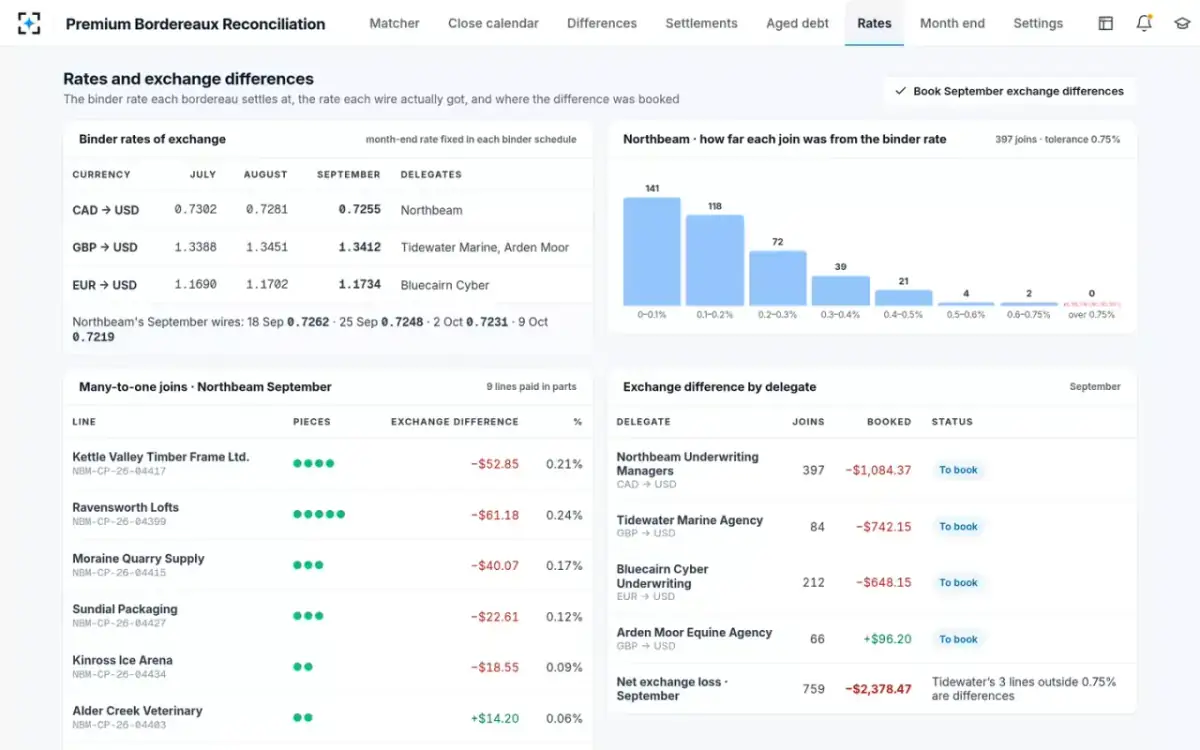
The currency rule is the one delegated-authority finance teams feel most. A coverholder that receives Canadian dollars and settles in US dollars carries an exchange difference on every line, and on a policy paid in parts it carries several. In the sample, Northbeam paid one policy in four wires at four rates; the bordereau line, at the binder rate of 0.7255, came to USD 25,562.99 and the four wires to USD 25,510.14, a 0.21% difference that sat inside the carrier's tolerance and was booked as exchange difference rather than chased.
Premium Bordereaux Reconciliation's rates view: binder rates, wire rates and the exchange difference
How a binder can switch the regime: the clause in XL v IPORS
A binder can move premium from one regime to the other, and carriers do. The 2016 binder in XL Insurance v IPORS provided that all premium received was "deemed to be received by the Coverholder on behalf of and at the risk of the Underwriters", which is risk transfer, and then that it "shall on receipt be deposited immediately into a bank account held by the Coverholder on the statutory trust or the non-statutory trust in accordance with CASS 5.3 or CASS 5.4", with the insurers treated as clients and their interests subordinated to the coverholder's other clients ([2022] EWHC 2093 (Comm), ¶10). That is the CASS 5.1.5AR arrangement, written into a binder.
The clause did not stop the money leaving. Bank statements obtained by court order showed the premium accounts close to empty while the bordereaux reported more than €4 million of premium received in the first half of 2016, and the judge found the coverholder liable for £296,589 and €7,360,909 that should have been held in the premium accounts and paid over. The regime decides who bears a loss and how the money is protected on paper; only a reconciliation shows whether the money is there. The US equivalent, the premium trust account, makes the same point in statute.
Do client money rules apply to MGAs in the US?
No: CASS is UK law. A US managing general agent answers to the state where it is licensed, and the state acts based on the NAIC's Model #225 reach the same protective result through fiduciary duty rather than a client-money trust. The MGA contract must provide that funds collected for an insurer are held "in a fiduciary capacity" in an FDIC-insured institution, with only a limited claims allowance retained (Model #225 §4C).
Texas comes closest to a client-money rule in form: the MGA must keep an escrow account, deposit "On receipt" all money collected for each insurer, and may not use, offset or convert it except as the contract provides, and the department's examiners "may audit money held in a fiduciary capacity" (Tex. Ins. Code §§4053.105–.106). What the US lacks is CASS's fixed calculation cycle. A carrier that wants a 25-business-day discipline has to write it into the binder and check it itself. How often a US MGA must remit sets out the monthly rule and the claims float.
Checking a delegate's client money position from the carrier's side
A carrier cannot run a coverholder's client money calculation, but it can test the inputs it receives every month. The checks below use only what the delegate already sends: the bordereau, the cash and the broker's statement.
Six checks a carrier can run on a UK delegate's premium each month
- Read the binder's money clause first
Risk transfer, client money with the insurer subordinated, or a mix: the answer decides which account the premium should be in and who bears a loss.
- Tie every declared line to cash or a cause
A balanced total proves little; each bordereau line should join a remittance line or carry a reason such as timing, instalment or cancellation.
- Separate commission from premium on every join
Commission taken at a rate above the binder's is premium the carrier has not received, whatever the regime.
- Show both exchange rates
The binder rate and the rate each wire got, so an exchange difference is a measured amount inside a stated tolerance.
- Treat timing as timing, with a date
The rules themselves excuse timing differences in a reconciliation; give each one the date it should clear and follow it up when it does not.
- Escalate the same unexplained gap twice
A difference carried from one month to the next is the pattern that preceded the losses in XL v IPORS.
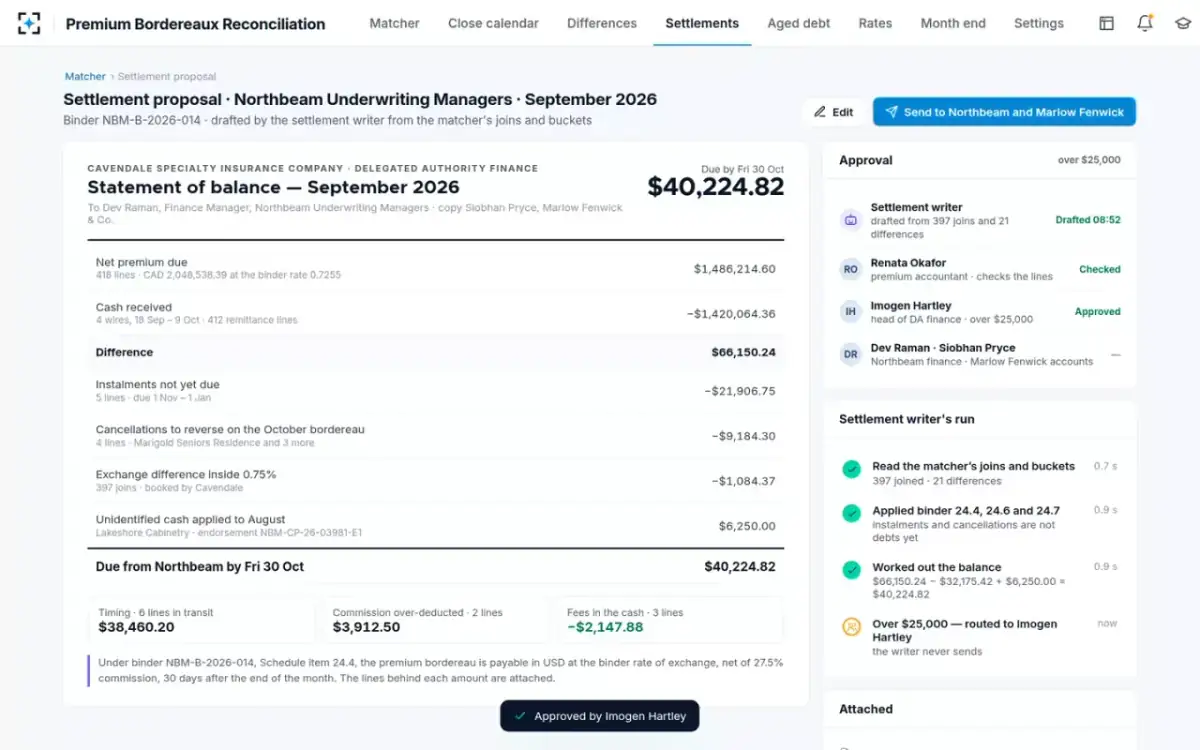
Premium Bordereaux Reconciliation is built for exactly these checks and no further. It reads each delegate's bordereau, wires and statement, joins them at the binder rate inside the carrier's tolerances, and drafts the settlement for people to approve and send. It does not perform a coverholder's client money calculation or report to the FCA, and it never moves money.
A Premium Bordereaux Reconciliation settlement proposal that shows why the delegate owes what it owes
For the matching itself, how the matching agent allocates cash follows one month in detail. To see the whole close, start from Premium Bordereaux Reconciliation.
Questions people ask
Is premium client money?
Not if the intermediary holds it as the insurer's agent under a written risk transfer agreement; then it is treated as the insurer's from receipt. It is client money if there is no such agreement, or if the insurer has agreed in writing that it be treated as client money with the insurer's interests subordinated. Return premium follows the same agreement: under risk transfer it is treated as received by the client only when actually paid over.
What is a coverholder?
HM Revenue & Customs' Lloyd's Manual describes a coverholder as a company, sometimes a Lloyd's broker, to which a managing agent delegates its authority to enter into insurance contracts for a syndicate; the document setting out that authority is the binding authority. A coverholder acts as agent of the managing agent, not of the policyholder (HMRC, LLM1100).
Can a broker take commission from client money?
Yes, once the premium has been received from the client and if the firm's terms of business allow it, even before the premium is paid on to the insurer (CASS 5.5.16R). Under a non-statutory trust it may not take commission before the premium is received, and under any regime commission is money due to the firm only once properly due and payable.
What is the difference between the statutory and non-statutory trust?
The statutory trust is imposed by the rules and forbids using client money to give clients credit. The non-statutory trust is declared by the firm, allows credit to clients and insurers, and requires adequate systems and controls, an auditor's written confirmation of them, a designated manager and, for retail customers, at least £50,000 of capital resources.
How often must the insurance client money calculation be done?
As often as necessary to keep records accurate, and at least every 25 business days, followed within ten business days by a reconciliation of each client bank account to the bank's statement. A firm that cannot perform the calculation must notify the FCA immediately.