The credit control process in insurance is the routine that turns premium written into premium received: fix when each party must pay, measure every balance against that date, chase what is late, and decide what to settle, dispute or write off. Under delegated authority it is harder than in most businesses, because the money passes through three hands before the insurer sees it (policyholder to broker, broker to the managing general agent, MGA to the carrier) and each hand runs on its own clock. Botminds' Premium Bordereaux Reconciliation is built for the carrier's end of that chain. Its agents read each delegate's premium bordereau, the wires and the broker's statement of account, join them line by line and give every difference a cause, so the credit controller spends the month chasing money that is actually late rather than working out which money that is.
The worked examples below come from a fictional sample carrier, Cavendale Specialty, and twelve fictional delegates as their September 2026 close runs through the solution. The rules come from statute, regulators and court records, linked where they appear.
Who waits on whom when premium moves under a binder
| Who is waiting | Waits on | For what | Whose clock |
|---|---|---|---|
| The broker | The policyholder | Premium, or a premium finance company's funding | The policy and the broker's terms of business |
| The MGA | The broker | Net premium and the broker's statement of account | The MGA's agreement with the broker |
| The carrier's credit controller | The MGA | The premium bordereau, then the cash | The binder's schedule: in the binders one court examined, 15 days for the bordereau and 30, 60 or 90 days for the cash |
| The carrier's finance team | The credit controller and premium accountant | Every difference explained before settlement and the month-end close | The carrier's own close calendar |
| The carrier's statutory accounts | All of the above | Cash before a balance turns ninety days overdue | The policy's due date, not the binder's |
What is credit control in insurance?
Credit control in insurance is the job of making sure premium the insurer has earned the right to is actually collected, on time and in full, and that every unpaid balance has a known reason. It sits between underwriting, which creates the receivable, and finance, which has to report it. A credit controller owns the aged-debt list, the reminders and the escalation route, and is usually the first person to notice that a delegate's figures and its cash have drifted apart.
For a carrier writing direct, credit control looks like any receivables function: invoices, due dates, dunning letters. For a carrier writing through MGAs and coverholders it looks different. The carrier rarely invoices the policyholder. It receives a monthly account from each delegate, the premium bordereau, and a cash remittance net of the delegate's commission. The NAIC's Managing General Agents Act (Model #225) requires the MGA contract to provide for monthly accounts "detailing all transactions" and monthly remittance of all funds due. Texas goes further on reporting: an MGA "shall submit an account report to each insurer" at least once each calendar quarter, and may "receive and be responsible for agency balances" on the insurer's behalf (Tex. Ins. Code §§4053.101, 4053.103).
So the carrier's credit controller is chasing an intermediary, not a customer, and chasing a net figure that is only as good as the bordereau behind it. That is why credit control under delegated authority starts with reconciliation, not with reminders.
The credit control process in insurance, step by step
The process has six steps, and the order matters: a reminder sent before the reconciliation is finished chases the wrong number. At the sample carrier the agents do the reading and matching overnight, and three people make every decision that touches a delegate or the books.
One month of credit control in Premium Bordereaux Reconciliation: agents match, people decide
Agent
Read what each delegate sentThe bordereau, cash and statement readers turn each delegate's premium bordereau, wires and remittance advices, and the broker's statement of account into standard lines, and tie the bordereau lines to its totals.
Never: guess an amount; an unreadable figure is flagged.
Agent
Join the three sourcesThe matcher joins bordereau, cash and statement line by line, one-to-one or up to six part-payments to one line, at the binder rate, inside $5.00 or 0.75% of the line.
Never: join outside tolerance; anything outside becomes a suggestion for a person.
Agent
Give every difference a causeThe difference explainer puts each unjoined line in a bucket (timing, instalments, cancellation, fees and taxes, commission, unidentified cash) with its evidence.
Never: call a timing item a debt before its due date.
A person decides
Premium accountant accepts or rejectsAccepts each suggested pairing and cause, so no cash is allocated on an agent's say-so.
A person decides
Credit controller chases what is lateOwns the timing items, reviews the aged-debt list against each binder's own date, and sends the reminders the settlement writer drafted.
A person decides
Head of DA finance approvesApproves settlements over $25,000 and signs the month-end pack once every item is done or explained.
The first three steps are mechanical and slow by hand: Northbeam Underwriting Managers alone sent 418 bordereau lines, four wires split into 412 remittance lines, and a broker statement from Marlow Fenwick. The last three are judgement. A credit controller who is also doing the first three is, in practice, a reconciler who chases in the time left over.
Who waits on whom: four parties, four clocks
Every party in the chain is waiting on the one before it, and each has a contract that sets a different clock. The broker's terms with the policyholder, the MGA's agreement with the broker, the binder's schedule with the carrier and the carrier's own close calendar rarely line up. A delay at the front of the chain arrives at the carrier weeks later, already netted, converted and part-paid.
The binder is the clock the carrier controls. In the binders a High Court judge examined in XL Insurance v IPORS, the coverholder had to send monthly premium bordereaux within 15 days of month end, and the time allowed for settlement varied by binder between 30, 60 and sometimes 90 days. The sample carrier's default is the same shape, 15 days for the bordereau and 30 for the cash, with each binder free to override it.
Four delegates on one Monday: on terms, 12, 43 and 74 days late
- Month written30 days
- Bordereau window15 days
- Cash window15 days
- Month written31 days
- To cash date30 days
- Late12 days
- Month written31 days
- To cash date30 days
- Late43 days
- Month written30 days
- To cash date30 days
- Late74 days
The chart is drawn to scale, and the scale is the point. By the time a June item is 74 days past its binder date, the policies behind it were bound three to four months earlier. Each extra layer in the chain adds its own window before the carrier's credit controller can even see the debt.
What does a credit controller do in insurance?
A credit controller in a delegated-authority finance team owns three things: the aged-debt list, the conversation with each delegate's finance manager, and the escalation route when a delegate stops paying. Job descriptions add the tools (the general ledger, the bank feed, spreadsheets of bordereaux) but the work is the same everywhere: know what is owed, by whom, since when, and why.
The division of labour around that job is worth drawing, because it shows where the time goes and who is left holding the decision when the matching runs late.
Four people carry a delegate's money; one of them is outside the carrier
Today
"By the time we know it's late, it's sixty days late." Ages debt by calendar month across a dozen delegates and chases from a spreadsheet.
With agents
Sees each delegate against its own binder's date, owns the timing items, and sends reminders already drafted with the amounts and the terms of trade.
Still theirs: Every reminder and every escalation.
Today
"The money is there. I just can't prove which policy it belongs to." Reconciles bordereaux, cash and statements by hand, delegate by delegate.
With agents
Starts from 397 joined lines and 21 explained ones, and accepts or rejects each suggested pairing.
Still theirs: The decision to apply any piece of cash.
Today
"I won't sign a settlement nobody can explain line by line."
With agents
Approves settlements over $25,000 with every amount traced to its lines, then signs the month-end pack.
Still theirs: Approvals, write-offs and the signature.
Today
"We paid it — in four pieces." Part-payments at four exchange rates come back as open items.
With agents
Receives a statement of balance where every part-payment is joined and every difference has its cause and its lines.
Still theirs: The delegate's own books and payments.
The fourth row is the one credit control most often forgets. The delegate's finance manager is on the other end of every reminder. A reminder that lists the lines and the binder clause gets an answer; a reminder that says "please pay your balance" gets a counter-statement, and the month is spent reconciling the two.
Which deadlines the law sets, and which the binder sets
The law sets the floor and the binder sets the dates. US statutes based on Model #225 require at least monthly accounts and remittance, and some states add reporting on top; the binder then fixes the day of the month, the settlement period, the currency, the rate of exchange and the commission. Credit control has to work from both, because a delegate can be on time under its binder and still leave the carrier with a statutory problem.
Texas illustrates the extra layer. Its MGA chapter requires a quarterly account report stating written, earned and unearned premiums, losses paid and outstanding, losses incurred but not reported, and management fees (§4053.103), and it makes the MGA notify the Texas Department of Insurance within 30 days when balances due to an insurer for more than 90 days exceed $1 million or 10 percent of the insurer's policyholder surplus (§4053.108). That is a credit control threshold written into statute, and a carrier with Texas MGAs needs its aged-debt list to show it.
The carrier's statutory accounts add the hardest clock of all. Under the NAIC's statutory accounting principles, uncollected premium more than ninety days due is nonadmitted, to the extent no unearned premium relates to it (SSAP No. 6, as quoted in NAIC INT 99-27). A nonadmitted balance no longer counts toward surplus, however likely it is to be paid. What each late day costs the carrier works that through in money.
The close calendar: each delegate against its own binder's dates
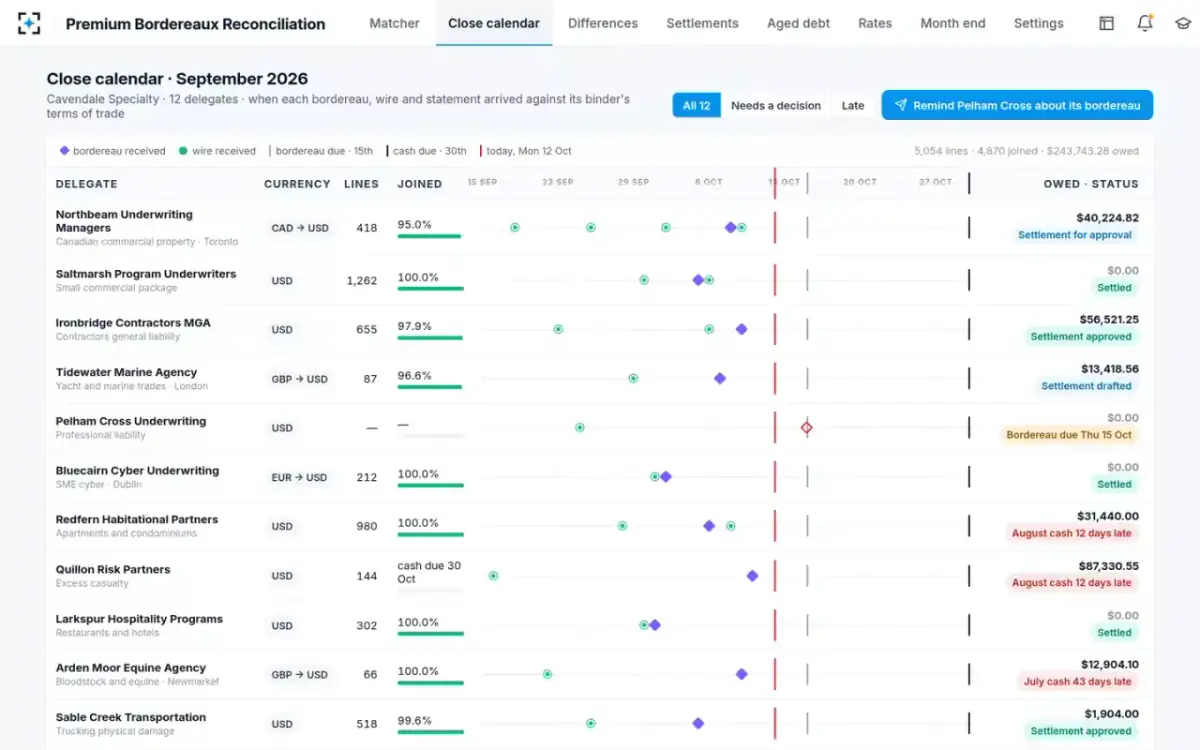
How do you age premium debt? By the binder's date, then by the policy's
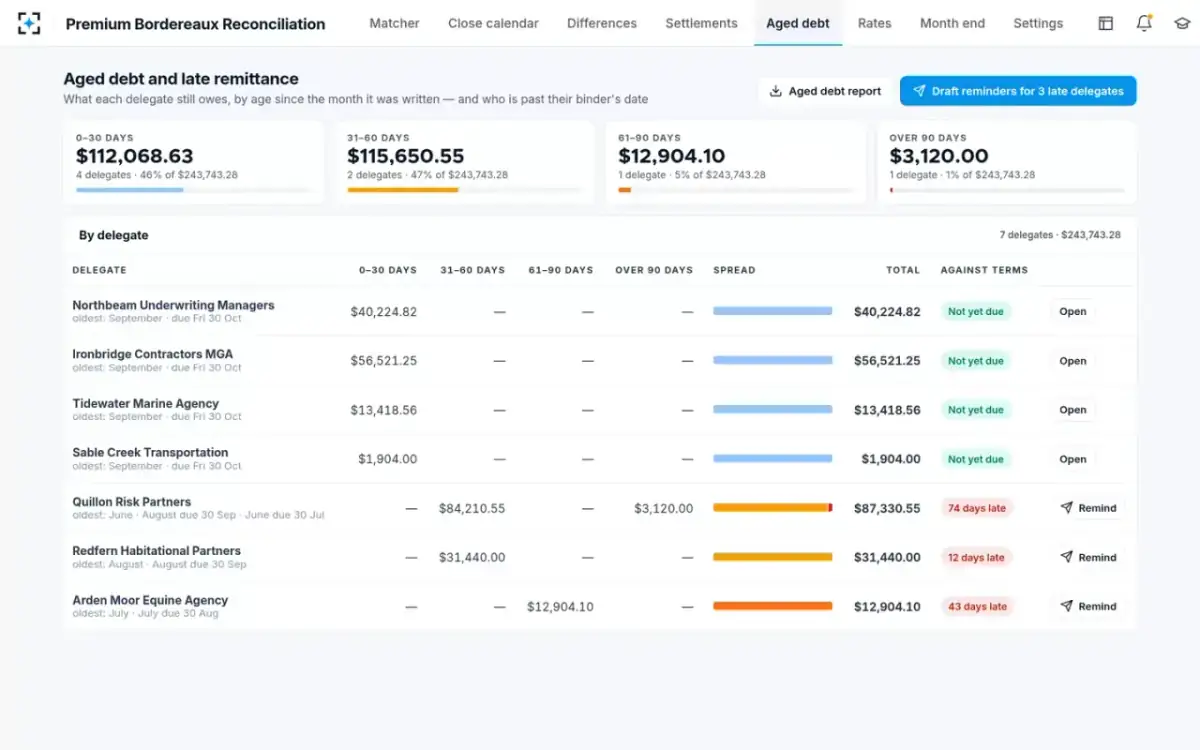
Age premium debt twice: once against the binder's settlement date, which tells the credit controller whom to chase, and once against the policy's own due date, which tells the finance team what the statement will say. Ageing only by calendar month since the business was written is the common shortcut, and it gets both wrong.
Ageing against the binder date keeps credit control fair. A delegate on a 60-day term is not late on day 31, and treating it as late spoils the relationship and buries the delegates who really are. That is why the solution's difference explainer never calls a timing item a debt before its due date: Northbeam's six lines still in transit at the cut-off, $38,460.20 of premium collected or on its way but not yet in the September wires, sat with the credit controller as timing, not as arrears.
Ageing against the policy is what statutory reporting requires, and the two can diverge. California's examiners found one insurer ageing its uncollected premium from the policy expiration date, contrary to the NAIC rule "which requires the days overdue to be calculated based on the due date of the underlying contract and not on any agent/reporting entity contractual relationship" (California Department of Insurance, Topa Insurance Company examination, filed 4 June 2025). The agency contract, in other words, does not move the statutory clock.
Aged debt by delegate, with each one's status against its terms
What happens when a delegate pays late: one court-recorded year
A late delegate rarely announces itself; it sends the bordereau on time and the cash late, then later still. The judgment in XL v IPORS records the pattern. During the first half of 2016 the coverholder sent its monthly bordereaux as required; the carrier invoiced the amounts shown, and the invoices went unpaid. In July 2016 the carrier asked for an update on January to March; a chaser followed in September.
"referring to difficulties he said IPORS had experienced reconciling transactions but acknowledging that premiums totalling around €2.2 million plus smaller amounts in £Sterling were outstanding."
XL Insurance Company SE v IPORS Underwriting Ltd [2022] EWHC 2093 (Comm), ¶15, describing the coverholder's reply of 13 September 2016
"Difficulties reconciling" is the reply every credit controller has received, and in most cases it is true. In this one, bank statements later obtained by court order showed near-empty premium accounts against bordereaux reporting more than €4 million received, and the judge found that premium had also been under-declared. The lesson for credit control is narrow and practical: an explanation that cannot be tied to lines is not an explanation. A carrier that can show the delegate exactly which bordereau lines, wires and statement lines disagree turns "difficulties reconciling" into a list of items with dates. The full sequence of that year, and what it cost, is in the guide to broker premium settlement dates.
Writing a credit control policy for delegated authority
A credit control policy for delegated authority should say, in writing, which clock applies to each balance, who may decide what, and what triggers an escalation. Most carriers have a receivables policy written for direct business; it needs eight additions before it works for binders.
Eight clauses a delegated-authority credit control policy needs
- Chase against each binder's own dates
Bordereau day, cash day, currency and rate come from the binder schedule, not a house default; a delegate is late only after its own date.
- Separate timing from debt
Premium in transit, instalments not yet due and cancellations to be reversed are tracked, not chased.
- Age a second time for the statement
Measure every balance from the policy's due date as well, so the ninety-day position is known before the quarter closes.
- Name the statutory thresholds
For Texas MGAs, balances over 90 days above $1 million or 10% of surplus trigger a notice to the regulator within 30 days (§4053.108).
- Never net claims against premium without a right to
California's examiners criticised an insurer that offset claims paid against premium due; an offset needs a valid right of offset.
- Put the lines in every reminder
Amounts, binder clause and the matched receipts go with the first reminder, so the delegate disputes lines, not totals.
- Write down who approves what
Settlement amounts, write-offs and disputes each have an approver and a limit; in the sample, settlements over $25,000 go to the head of DA finance.
- Escalate on pattern, not only on age
A delegate whose bordereaux are on time and whose cash keeps slipping is a reason to look at the premium account, not just to send a second reminder.
The fifth clause is the one most often broken under pressure. A delegate that also pays claims is tempted to send premium net of claims it has paid. The California examiners found an insurer that "offsets the total balance due per policy by the claims paid", and recommended that it stop unless offset was specifically permitted (Topa examination). A credit control policy that says so in advance saves an argument later. The money itself, and why the delegate cannot treat it as its own while it waits, is the subject of what a premium trust account is.
Where Premium Bordereaux Reconciliation fits in credit control
The solution takes the reading and matching off the credit controller's desk and gives every unpaid balance a cause and an owner; it does not chase, send or post on its own. Its six agents read each delegate's documents, join bordereau, cash and statement, explain what does not join, and draft the settlement proposal, the aged-debt list and the reminders. People accept every pairing, approve every settlement over the limit and send every message.
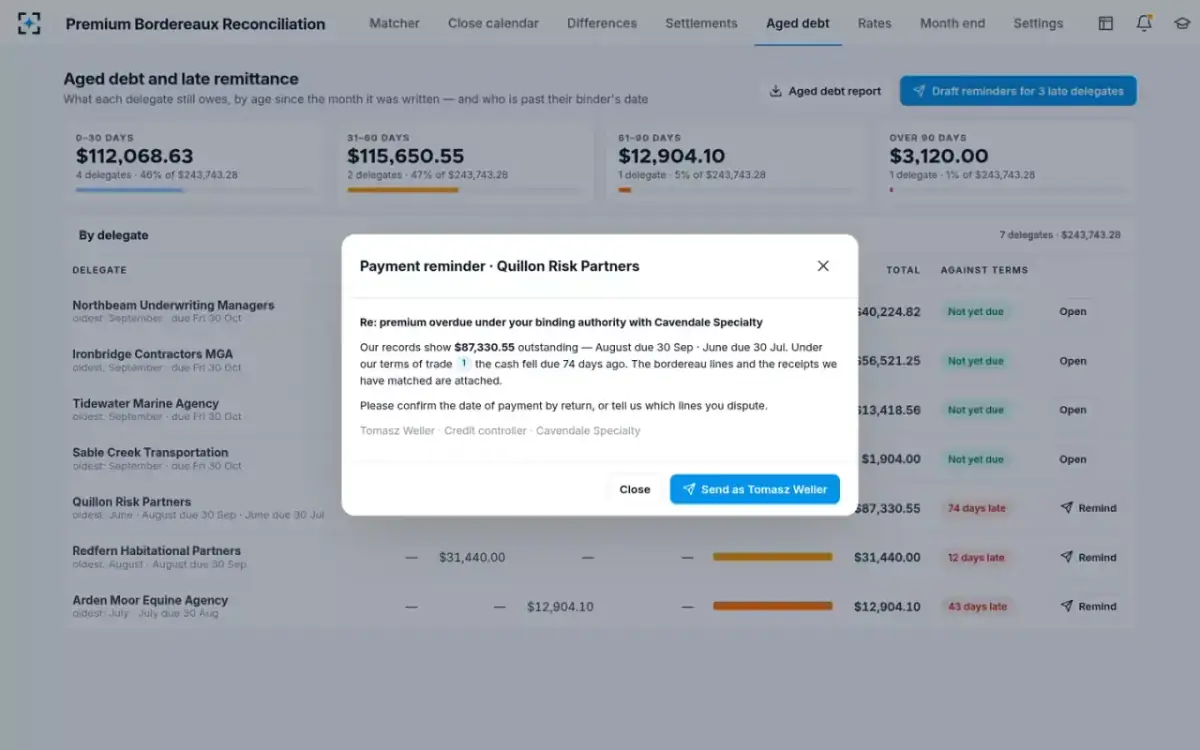
A reminder drafted with the amounts and the terms, sent by the credit controller
Where it does not fit is as important. It is not a collections platform for direct-billed policyholders, it does not hold or move money, and it does not replace the general ledger: journals are drafted for a person to post. Its job is to make sure that when a credit controller picks up the phone to a delegate, the number on the screen is the right one, and the delegate can see why. What a delegate may keep before it remits explains the other side of that call. To see the whole close, start from Premium Bordereaux Reconciliation.
Questions people ask
Who chases unpaid premium under a binding authority?
The carrier's credit controller chases the delegate, and the delegate chases its brokers and policyholders. The model law treats the MGA as collecting funds for the insurer's account, and Texas lets an MGA "receive and be responsible for agency balances". The carrier still carries the receivable on its own statement, so it cannot leave the chase entirely to the MGA.
What is a credit control policy?
A written policy that sets payment terms, how balances are aged, when reminders go, who may agree a payment plan, dispute or write-off, and when a balance is escalated. For delegated authority it must also say which binder date applies to each delegate and how the ninety-day statutory position is monitored. Without it, every escalation becomes a negotiation.
Is credit control the same as premium accounting?
They overlap but differ. Premium accounting records and reconciles what was written, received and remitted; credit control acts on what is still unpaid. In a delegated-authority team the premium accountant usually accepts the matches and explains the differences, and the credit controller owns the timing items and the late delegates.
Can a carrier offset claims against premium owed by a delegate?
Only where a valid right of offset exists. California's examiners criticised an insurer for netting claims paid against uncollected premium and pointed to SSAP No. 64, which allows amounts to be reported net only when a valid right of offset exists. The binder should say expressly whether the delegate may net claims, and the credit control policy should follow it.
How long before late premium hurts the carrier's balance sheet?
Under NAIC statutory accounting, uncollected premium more than ninety days past due is nonadmitted and no longer counts toward surplus. The clock runs from the policy's due date, not from the delegate's settlement terms, so a 90-day binder term can push a balance past the line even when the delegate pays on time.
What should a payment reminder to a delegate include?
The amount, the months it relates to, the binder clause and date it was due under, and the bordereau lines and receipts already matched. In the sample, the reminder to Quillon Risk Partners lists $87,330.55 across August and June and asks the delegate to confirm a payment date or say which lines it disputes.