Premium remittance means sending collected premium on to the party entitled to it. In everyday use it can mean a policyholder paying a premium; in delegated authority it means an agent, broker or managing general agent (MGA) passing premium on to the insurer, usually net of the commission it is allowed to keep, together with a remittance advice that says which policies the money pays for. The law sets how often an MGA must remit and how much of the insurer's money it may hold in the meantime, and those limits differ by state. Every remittance then has to be matched back to the premium bordereau it settles, which is what Botminds' Premium Bordereaux Reconciliation does: its agents read each wire and remittance advice, join them line by line to the bordereau and the broker's statement of account, and give every difference a cause.
The statutes and court records below are quoted from their own texts. Product examples come from a fictional sample carrier, Cavendale Specialty, and its fictional delegates.
The legal float: how long a delegate may hold the insurer's money, regime by regime
- Claims money the MGA may retainabout 90 days
- Claims money the MGA may retain60 days
- 60 days of expected payments60 days
- Notify the regulator above thatnotice
- Month written30 days
- Settlement period, longest binderup to 90 days
What does premium remittance mean?
Premium remittance is the transfer of premium from whoever collected it to whoever is owed it, with enough detail for the receiver to apply it. For an insurer writing through intermediaries, the remittance is the moment premium stops being the intermediary's responsibility to hold and becomes the insurer's cash. Until then it is, in the words of the statutes, held in a fiduciary capacity.
A remittance has two parts. The payment is the wire, cheque or transfer, in a currency and on a value date. The advice is the statement that goes with it: the policies, endorsements, cancellations and instalments the payment covers, and the deductions taken. A payment without an advice is cash the insurer cannot apply; an advice without the payment is a promise.
What is net premium remittance?
Net premium remittance is premium remitted after the intermediary has deducted what the contract lets it keep: its commission, sometimes a broker's brokerage taken at source, and fees or charges the insurer has agreed to reimburse. The insurer receives the net, and the bordereau shows how gross became net line by line.
The binders in XL v IPORS show the arithmetic. The coverholder "was required to account to XL for premiums net of commission", which, depending on the binder, could not exceed 35% or 37.5% of gross premium including the placing broker's brokerage; with brokerage averaging 17.5%, the coverholder kept between 17.5% and 20% before remitting the balance ([2022] EWHC 2093 (Comm), ¶12). The sample carrier's binder with Northbeam Underwriting Managers is simpler: premium payable in US dollars at the binder rate, net of 27.5% commission.
Net remittance is efficient, and it is where most remittance errors start. When the commission is taken before the money moves, nobody at the insurer sees the gross unless the bordereau shows it. Two of Northbeam's September lines were short because commission had been taken at 30.0% instead of 27.5%; on Ridgeback Cold Storage's gross of CAD 61,200.00 that was CAD 1,530.00, or $1,110.02 at the binder rate. The remittance looked complete; it was not.
How often must an MGA remit premium?
At least monthly in the states that follow the NAIC model act. The model requires the MGA contract to provide that "The MGA will render accounts to the insurer detailing all transactions and remit all funds due under the contract to the insurer on not less than a monthly basis." (Model #225 §4B). New York's Regulation 120 repeats the sentence (11 NYCRR §33.5(b)); Florida requires remittance "on a monthly or more frequent basis" (§626.7451(2)).
Texas takes a different route. Its MGA must deposit all money collected for each insurer into an escrow account on receipt, and submit an account report to each insurer at least once each calendar quarter (Tex. Ins. Code §§4053.103, 4053.105); the contract sets the remittance terms. The binder can always require more than the statute: weekly remittance, or remittance within a set number of days of each policy's inception.
"Funds due under the contract" is the phrase to read twice. The monthly rule requires the MGA to pay what the contract says is due each month, and a contract with a 60- or 90-day settlement term moves the date funds are due. The broker premium settlement date shows what a long term costs the carrier on its statement.
Can an MGA keep premium to pay claims?
Yes, within a limit, if the contract gives it claims authority. The model act lets the fiduciary account pay anything owed for the insurer, which covers claims, and caps what the MGA may hold back at three months of expected claims payments and allocated claim expenses. New York's rule sets the same three-month ceiling (11 NYCRR §33.5). Florida halves it: "The managing general agent may retain up to 60 days of estimated claims payments and allocated loss adjustment expenses." (§626.7451(3)).
Texas sets a notice duty instead of a cap. The MGA must tell the department within 30 days when money it holds for an insurer's losses is more than $100,000 above what it needs for losses and loss adjustment expenses expected in the next 60 days (§4053.108(a)(4)). Texas also forbids the MGA to use, offset or convert money that is or should have been in the escrow account, except as the contract provides (§4053.105(c); see what a premium trust account is).
The float is the money the law lets the delegate hold, and it is real money. A carrier whose MGA keeps the full three months is financing the claims account at the carrier's own expense of yield. A carrier that does not reconcile the claims fund against the binder's cap cannot tell whether its MGA is holding the float the law allows or more.
Whose money is a remittance in transit?
The insurer's, held by the intermediary as a fiduciary, until it leaves the intermediary's control. Commission the contract lets the intermediary keep does not change that while the premium is being handled, as the Fifth Circuit found in a dispute over an auto insurance programme litigated in Texas.
"The Agent [U.S. Auto] shall accept and maintain at all times all premiums collected and other funds relating to the business written under this Agreement as a fiduciary for [S&C]. The privilege of retaining commissions shall not be construed as changing the fiduciary capacity."
General Agency Agreement quoted by the Fifth Circuit in Lincoln General Insurance Co. v. U.S. Auto Insurance Services, No. 13-10589 (18 May 2015)
The court held that this language imposed a fiduciary duty that covered "collecting, handling, spending, deducting from, and depositing the premiums", reversing the trial court's view that no duty was owed before the premiums reached the trust account. In the UK the answer depends on the agreement: under a risk transfer agreement the premium is treated as the insurer's from the moment the agent receives it, and without one it is client money held on trust. The insurance client money rules set out that decision; the premium trust account covers the US account rules.
What is a premium remittance form, and what should a remittance advice carry?
A premium remittance form is the document, paper or electronic, that accompanies a remittance and lists what it pays; in delegated authority it is usually the remittance advice or the bordereau's accounting summary. Its job is to let the insurer apply every dollar to a policy without asking. The fields below are the minimum that makes that possible.
A remittance advice the insurer can apply without a phone call
- Delegate, binder and insurer
- Bordereau period the remittance settles
- Value date and wire reference
- Policy or endorsement reference
- Insured's name
- Transaction: new, renewal, endorsement, cancellation, instalment
- Gross premium, commission, taxes and fees
- Net premium remitted
- Currency, and the rate of exchange used
- Items held back, with the reason
- Part-payments, with the part number
- Items from earlier periods, with their month
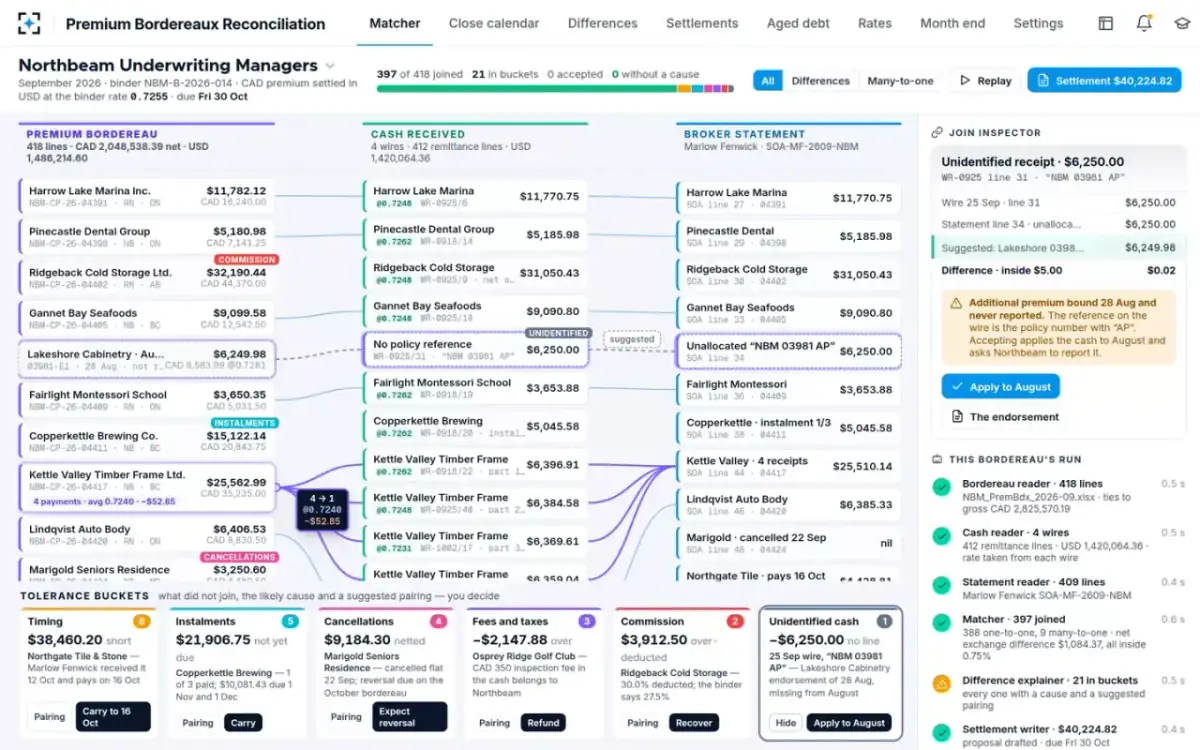
The last box is the one most advices leave out, and the one that decides whether cash can be applied. On 25 September a $6,250.00 wire reached the sample carrier with no policy reference, only "NBM 03981 AP". It paid an additional-premium endorsement bound on 28 August that Northbeam had left off its August bordereau. An advice line saying "endorsement, policy 03981, August" would have made it routine; without one it took a suggested pairing and a person's decision.
Premium Bordereaux Reconciliation pairs an unidentified remittance to the endorsement it paid
When a remittance is late, short or unidentified
A remittance goes wrong in one of three ways, and each calls for a different response. The sample carrier's September had one of each.
Three ways a remittance goes wrong, and what each needs
| Problem | Sample case | What it needs |
|---|---|---|
| Late | Quillon Risk Partners: $87,330.55 across August and June, 74 days past the binder's cash date for the oldest item | A reminder with the lines and the binder clause, sent by the credit controller, and escalation if the pattern repeats |
| Short | Northbeam: commission deducted at 30.0% instead of 27.5% on two lines, $3,912.50 in all | Recovery of the over-deduction on the settlement, with the arithmetic from gross |
| Unidentified | A $6,250.00 wire referenced only "NBM 03981 AP" | A pairing from the evidence, accepted by a person, and a request to declare the item on the next bordereau |
When each delegate's bordereau and wires arrived against its binder's dates
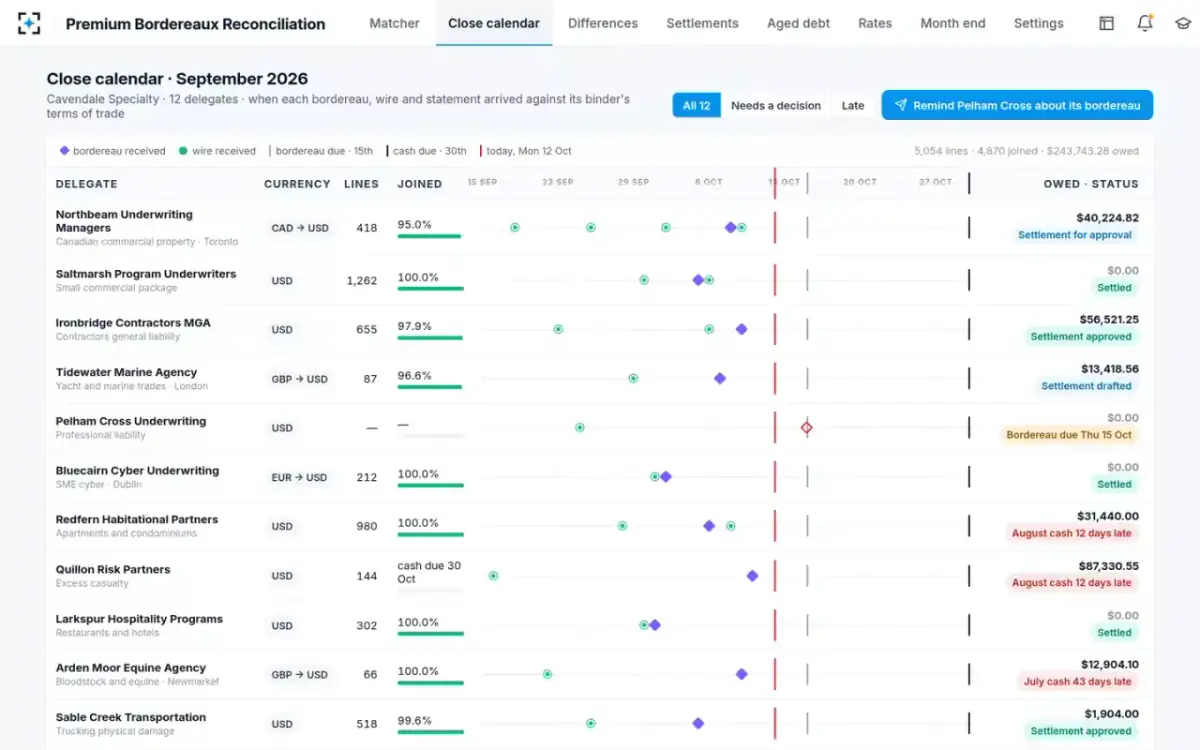
How a carrier checks its delegates' float each month
A carrier checks the float by comparing what each delegate holds with what the law and the binder let it hold, using figures the delegate already reports. Three numbers are enough, and none needs a site visit.
The first is premium held: net premium declared on the bordereau for the month, less what has been remitted, less instalments not yet due and cancellations still to be reversed. What remains is owed, and once the binder's settlement date has passed it is premium the delegate is holding that it should have paid. The second is the claims fund: the balance the delegate reports for claims, against the binder's cap expressed in days of expected claims, and, in Texas, against 60 days' expected payments plus $100,000. The third is the trend: a claims fund that grows month after month while paid claims on the claims bordereau stay flat, or premium held that keeps rolling forward, is the pattern to escalate.
The first number is the hard one, because it needs the bordereau, the cash and the broker's statement joined line by line before the remainder means anything. For Northbeam's September, the gross difference between declared net premium and cash was $66,150.24; after instalments not yet due, cancellations to reverse and an exchange difference inside tolerance were set aside, and a stray receipt was applied to August, the premium Northbeam still had to remit was $40,224.82, due 30 October. Without the line-level work, a carrier would have been chasing $66,150.24 and arguing about the other $25,925.42.
Where Premium Bordereaux Reconciliation fits in remittance
The solution reads remittances as they arrive and tells the carrier what each one paid, what it did not, and why. Its cash and remittance reader splits each wire into allocatable pieces with reference, date, currency and the rate the wire got; the matcher joins them to the bordereau and the broker's statement at the binder rate; the difference explainer gives every unjoined piece a cause. Cash is never applied without a remittance line or a pairing a person accepted, and the settlement writer drafts, for a person to send, the statement of what the delegate still owes.
It does not hold or move money, does not decide a delegate's float, and does not post to the general ledger. What it gives the carrier is a monthly, line-level answer to the question this page began with: of the money this delegate collected for us, how much has it remitted, how much may it still hold, and what is it holding that it should not. To see it on a month of your own remittances, start from Premium Bordereaux Reconciliation.
Questions people ask
Is premium remittance the same as premium payment?
Not quite. A premium payment is what the policyholder pays; a premium remittance is what the intermediary passes on to the insurer, usually net of commission and on the intermediary's own schedule. One remittance can cover many premium payments, and one premium can arrive in several remittances.
Can an MGA remit premium net of claims it has paid?
Only if the contract allows it. Texas forbids an MGA to use, take as an offset or convert escrow money except as the contract provides, and California's examiners criticised an insurer that netted claims paid against premium due. Where offset is allowed, the remittance advice should show both sides.
What happens if an MGA holds more claims money than allowed?
It breaches the contract provision the model act requires, and in Texas it may trigger a notice to the department within 30 days. The carrier should ask for the excess to be remitted; a claims fund that grows while paid losses do not is a sign to look at the account itself.
How long must premium remittance records be kept?
Florida requires licensees to keep books, accounts and records pertaining to a premium payment for at least three years after payment (§626.561(2)). Binders often require longer, and the UK client money rules require a risk transfer agreement to be kept for six years after it ends.
What is an electronic premium remittance?
A remittance sent by bank transfer with a machine-readable advice, rather than a cheque and a paper form. It speeds up matching only if the advice carries policy-level lines; a single reference for a monthly wire still leaves the insurer to split it, as the sample's cash reader did for Northbeam's four wires and 412 remittance lines.