A bordereaux management system is software that receives the risk, premium and claims bordereaux a carrier's MGAs and coverholders send, maps each delegate's layout to one standard layout, checks every row against the binding authority, returns the rows that fail and keeps a history of every file, change and decision. Buying one is hard because demonstrations use clean files, while the failures that matter come from changed layouts, binder versions and data a delegate chose not to send. Botminds' Bordereaux Management is one such system; the twelve questions below are the ones we would ask of any, ours included, each drawn from a failure a court or regulator has already described.
The questions are meant to be answered on your own files, not in a slide. A system that answers all twelve well on last quarter's bordereaux will do the job; one that cannot answer the first three should not be on the shortlist.
Twelve questions to ask any bordereaux management system
- Does it check every row, or a sample?
In Markel v SGC the carrier's audit chose 14 files at random and missed bonds issued above the limits. Ask for the share of rows each check ran on last month.
- Does it apply the binder in force on each row's inception date?
Binders are renewed and endorsed; a limit or territory can change mid-year. Ask which version a given row was tested against.
- What happens when a delegate renames a column?
Rename one in a test file. The answer should be a proposal with evidence, never a silent load.
- Does a check that cannot run say so?
A limit check with no sum insured column is waiting, not passed. Ask to see how that is shown.
- Does every rejection cite its clause?
A delegate can fix "§4.1 territory: Florida is outside TX, LA, OK, AR, MS". It cannot fix "row failed".
- Who decides a possible breach, and where is that recorded?
Territory and limit failures are not data errors. They need a named decision-maker and a dated decision.
- Does it ever guess a value?
Ambiguous dates and missing optional fields should be left for a person or left blank, never filled in.
- Can you see each delegate's file history?
Headers month by month, every mapping change, how it was recognised and who confirmed it.
- Does it find duplicates across months?
A certificate already on August's bordereau should not load again in September.
- What does it do about premium declared but not received?
A file check cannot see it. Ask how the system hands declared premium to the cash reconciliation, and who owns that.
- Can its output feed MI without rework?
One layout for every delegate, so a loss ratio or premium trend means the same across the book.
- Will it run on last quarter's files before you sign?
A replay of three closed months, with known exceptions and planted errors, is the only fair test.
What is a bordereaux management system?
A bordereaux management system turns many delegates' bordereaux into one checked, standard dataset and a set of decisions about the rows that fail. Its inputs are the delegates' files, the binding authority agreements with their endorsements and agreed field lists, the carrier's standard layout and every earlier accepted bordereau. Its outputs are a standard bordereau ready for finance and oversight, the rejected rows returned to each delegate with reasons, breach referrals to the head of delegated authority, a remembered mapping for each delegate and a timeliness and quality score.
What it is not matters as much. It is not a policy administration system for the delegate, not the carrier's general ledger and not an audit. It sits between the delegate's systems and the carrier's, and its value is that the carrier sees, every month and on every row, what was bound and declared in its name. The Prudential Regulation Authority named the underlying need in its 2026 priorities: good data is the base of sound prudential risk management and of an up-to-date view of exposure (PRA, Insurance supervision: 2026 priorities; the sentence is quoted in MGA data platforms).
Every row or a sample: the first question to settle
The first question is coverage, because everything else depends on it. A system that checks a sample, or that checks every row only when the file arrives in the expected layout, will miss exactly the rows that matter: the breaches are a small share of the rows, and a sample is unlikely to contain them. The sampling arithmetic is set out in the guide to testing bordereaux software on your own files; the short version is that a 14-row random sample of a 1,284-row file finds at least one of five bad rows only about one time in twenty.
Ask for a number, not an adjective. A system should be able to say, for last month, how many rows each check ran on and how many it could not run on and why. In the sample month shown below, every check ran on every row of every delegate's file, and the two checks that could not run on one file until a column was confirmed were reported as waiting.
The binder checks in Bordereaux Management, each with its clause, its failure action and its owner
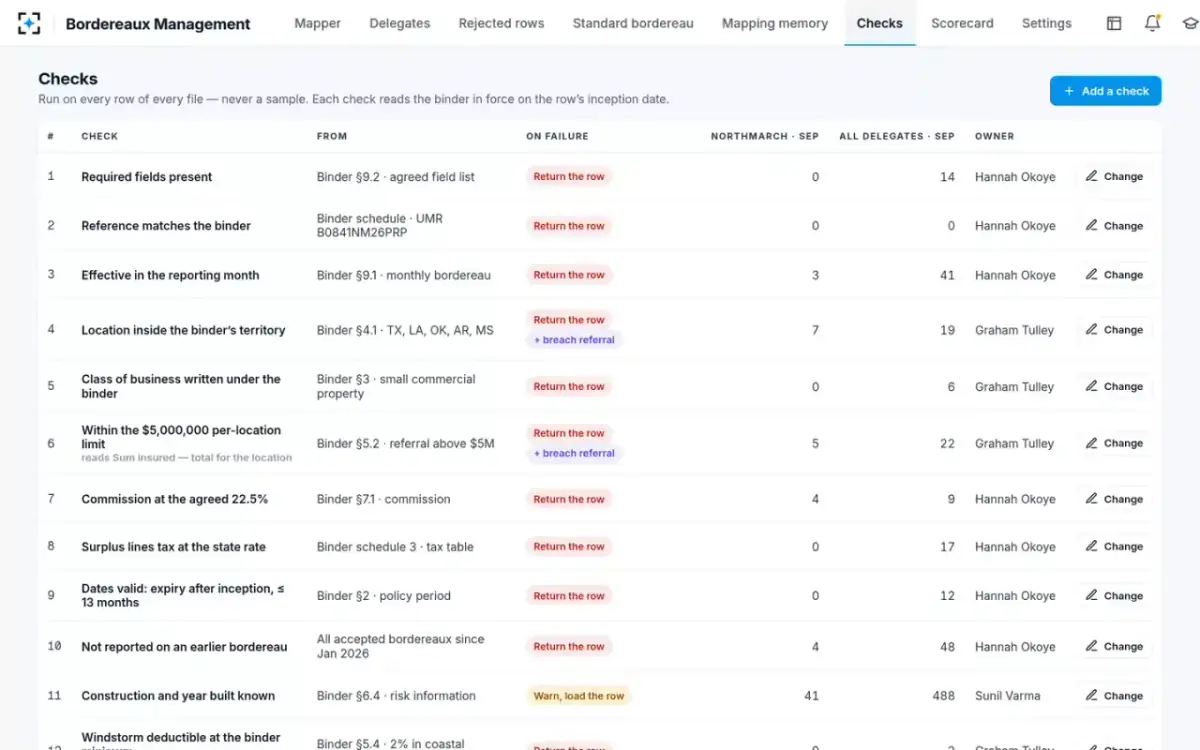
Does the system know which binder applied on the day?
A row must be tested against the binder in force on its inception date, not the binder in force when the file is checked. Binders renew annually and are endorsed in between: limits change, territories expand, classes are excluded. In Markel v SGC the binding authority was formally amended two months after it started, with the territorial limits expanded and certain bond types expressly excluded ([2008] EWHC 1135 (Comm), paragraph 27). In XL v IPORS the court worked through five successive binders between the same two parties, whose wordings "changed slightly over time".
The test for a system is simple. Take a row bound in the last month of an expired binder and reported late, on a file checked after renewal, where the two binders differ on one term. The system should test it against the old binder and say so. A system that holds one binder per delegate, overwritten at renewal, cannot pass.
What a bordereaux system can and cannot see in a file
A bordereaux system can see everything the file states and nothing it leaves out. It can test whether each row's values are inside the binder, whether the file ties, whether rows repeat and whether a column changed. It cannot know that a bond reported at £1m was issued for four times that, or that premium was collected and never declared, unless evidence from outside the file is brought to it.
What any bordereaux management system can test from the file, and what needs evidence from outside it
Visible in the file: A location or class the binder does not allow, on every row.
Needs outside evidence: A location misstated as inside the territory. In Markel, Canadian bonds were reported with the territory stated as the UK.
Visible in the file: A sum insured or exposure above the limit, once the right column is mapped.
Needs outside evidence: An exposure stated within the limit for a bond issued above it, as the Markel bordereaux did.
Visible in the file: Missing fields, totals that do not tie, rows repeated from earlier months.
Needs outside evidence: Risks bound and never reported. Some Markel bonds "were not reported at all".
Visible in the file: Commission above the agreed rate; deductions not in the schedule.
Needs outside evidence: Premium collected but not declared. IPORS' bordereaux showed over €4 million received while its premium accounts held "nil or very modest balances".
Visible in the file: Days early or late for every file, month by month.
Needs outside evidence: Why a delegate is late, and whether it matters to its finances.
The honest answer to the right-hand column is a process, not a feature. Declared premium has to be reconciled with cash received, which is the job of Premium Bordereaux Reconciliation (what its reconciliation report shows). A sample of rows has to be traced to policy or bond documents, ideally the rows a system flags as risky, which is the job of MGA & Coverholder Audit (how a risk-based audit picks the files) and of the on-site review the model act requires at least twice a year (Model #225 §5C). A vendor who claims its bordereaux system catches fraud from the file alone is claiming the left column can do the right column's work.
How should a bordereaux system handle a delegate's changed format?
It should notice the change, propose what it means with evidence, and wait for a person before relying on it. Delegates change formats more often than binders anticipate: a new system, a new staff member, a new field the carrier asked for. In the solution's sample year, 14 delegates made 31 column changes between them: renames, new columns, dropped columns and a switch of date format.
Ask the vendor to show three cases on your files: a renamed column, a new column and a dropped optional column. The right behaviour is a proposal for the first with its evidence, a nearest-field suggestion for the second that waits for a person, and a blank for the third rather than a guessed value, with the delegate told. Bordereaux ingestion describes the four kinds of change in detail.
Rejections, returns and breach decisions: who does what
A system should make the rejection, the return and the breach decision three separate things owned by three people. The check rejects the row and records why. The analyst sends the return to the delegate. The head of delegated authority decides what to do about a row that was outside the delegate's authority. Collapsing them, so that a breach is just another rejected row, is how breaches end up corrected on next month's file without anyone deciding whether they were acceptable.
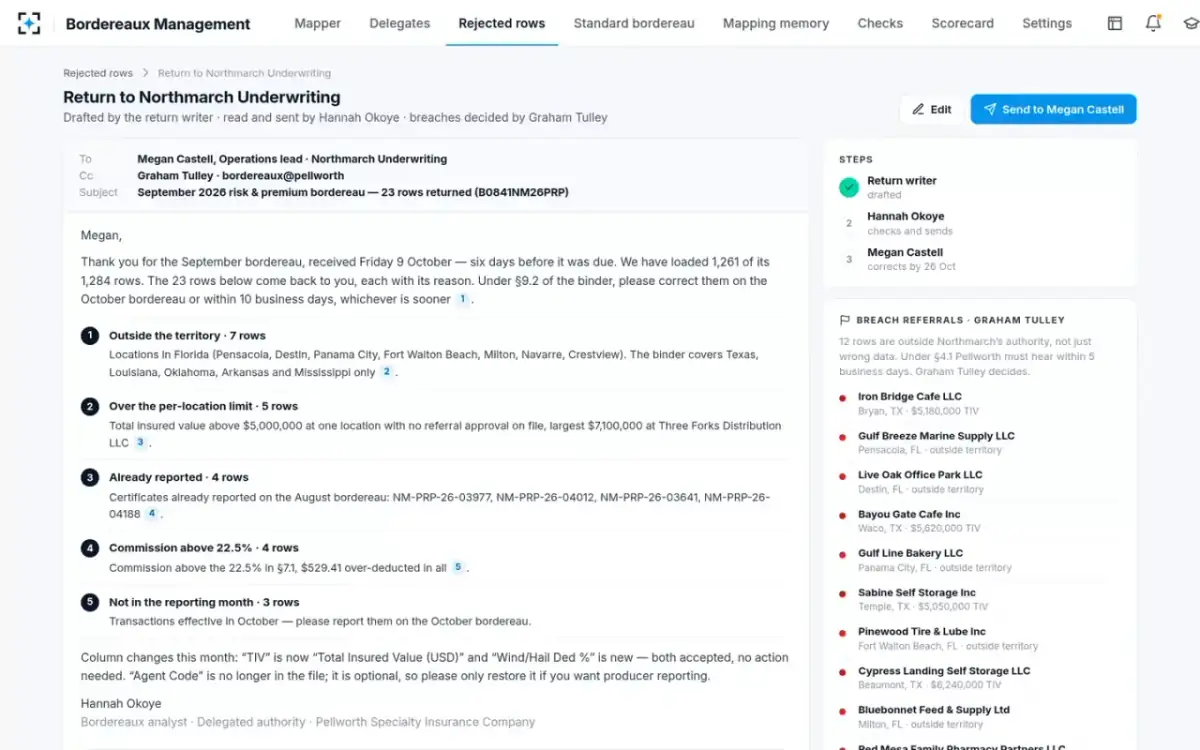
Why one delegate's 23 rows came back: just over half were possible breaches
Northmarch, September
- Outside territory · 7 · 30.4%
- Over the limit · 5 · 21.7%
- Already reported · 4 · 17.4%
- Commission · 4 · 17.4%
- Wrong month · 3 · 13%
The drafted return in Bordereaux Management: grouped by reason, each clause cited, sent by a person
What does a bordereaux management system cost, and what should you compare?
Prices vary with the number of delegates, files and rows, and with how much of the implementation the vendor does; no public benchmark exists, so compare systems on a common sheet rather than on list price. The cost that matters is the total for a year: licence, implementation, the carrier's own time to set up binders and layouts, and the analyst hours still needed per month, weighed against the escapes each system would have let through on your own files.
A scoring sheet for comparing bordereaux management systems on your own files
| Measure | How to get it | Why it matters |
|---|---|---|
| Rows checked, by check | The system's own count for each replayed month | Coverage; anything under every row needs a reason |
| Known exceptions found | Compare with the exceptions your team found in the same months | The baseline: it should find what you found |
| Planted errors found | Seed renamed columns, out-of-territory rows, over-limit rows and duplicates in copies of real files | What it finds that you would have missed |
| False rejections | Rows rejected that your team accepted correctly | Each one costs a delegate query and goodwill |
| Changes noticed | Of the column changes in the replayed files, how many were raised | An unnoticed change silences a check |
| Analyst hours per month | Your one-month timing log, before and during the pilot | The cost line the business case rests on |
| Year-one total cost | Licence, implementation, internal set-up time | Set against the two lines above |
Implementation time follows from what the carrier brings. A system can only check against binders it has, map to a layout it has been given and compare with months it has seen. Carriers that arrive with their binders, endorsements, agreed field lists, standard layout and a year of accepted bordereaux go live fastest, whichever system they choose.
Where Bordereaux Management fits, and where it does not
Bordereaux Management fits a carrier, fronting insurer or MGA that receives bordereaux from several delegates, in their own layouts, and wants every row checked against the binder with each rejection explained and every decision left to a named person. Its agents read any spreadsheet or CSV, map each delegate's file from a remembered mapping, check every row against the binder in force on its inception date, draft the returns and score each delegate's timeliness and quality. The analyst confirms changes and sends returns; the head of delegated authority decides breaches and approves changes to checks.
A system that only collects bordereaux tells the carrier what was written. Oversight starts when someone compares it with what was allowed.
It does not reconcile declared premium to cash, audit claims files, perform on-site reviews or replace the delegate's policy system, and it does not decide breaches. Those jobs belong to premium reconciliation, delegated claims audit, the carrier's audit programme and the head of delegated authority. What it gives each of them is a month of every delegate's data, checked on every row, with a reason for every rejection. To run it on a month of your own delegates' files, start from Bordereaux Management.
Questions people ask
What is bordereaux management?
Bordereaux management is the whole discipline of handling delegates' bordereaux: setting the standard layout, receiving and mapping files, checking them against binders, returning failures, referring breaches and keeping each delegate's history. Bordereaux processing is the monthly cycle inside it.
Can a bordereaux system handle every delegate format?
It should handle any spreadsheet or CSV layout, because the mapping is per delegate and learned from the first file. What no system should do is accept a changed format silently. Ask how it treats a renamed column, a new column and a switched date format, and test each on your own files.
How long does a bordereaux system take to implement?
It depends mostly on the carrier's own inputs: binders and endorsements in usable form, the agreed field list per delegate, the standard layout and earlier accepted bordereaux. Ask the vendor for a plan that starts with a replay of closed months, so the first live month is not also the first test.
Should we build a bordereaux system in-house?
Carriers with a few delegates whose layouts never change often manage with templates and spreadsheets. The case for a dedicated system grows with the number of delegates, the rate at which their layouts drift and the need to check every row rather than a sample. Run the twelve questions against your in-house process too.
Does a bordereaux management system replace delegated authority audits?
No. Checking every row every month makes audits better aimed, but the file cannot show what a delegate left out or misstated plausibly. The NAIC model act still requires the insurer to review the MGA's underwriting and claims operations on site at least semi-annually; Florida requires it at least annually.