Bordereaux data management is the discipline of receiving each delegate's bordereaux, mapping and standardising them into one layout, validating every row, returning the rows that fail and keeping the result so the carrier can use it for oversight, finance and MI. It is hard because the data arrives from outside the company, in layouts the carrier does not control, and because the errors that matter most do not look like errors. Botminds' Bordereaux Management maps each file, checks every row against the binder and explains every rejection; this guide sets out the nine ways a delegate's file goes wrong, and which of them any file check, ours included, can and cannot catch.
The ranking matters more than the list. Seven of the nine errors are visible in the file itself, to a format rule or a binder rule. The last two are not: a misstated value that sits comfortably inside the limits, and a risk or a premium that was never reported. Those are the two that English courts have spent the most time on.
What one month's checks rejected: duplicates and wrong-month rows lead, limits and territory follow
What is bordereaux data management?
Bordereaux data management is everything between a delegate's file arriving and a carrier relying on it: reading the file, placing its columns on the carrier's layout, converting dates, codes and amounts, validating each row against the binder, returning failures, and keeping a history of what each delegate sent and what was done with it. The output is one standard bordereau per delegate per month, in the same layout for every delegate.
The legal reason is that the carrier is entitled to the data in usable form and answerable for what it shows. Model #225, the NAIC Managing General Agents Act, gives the insurer the right to copy all accounts and records of its business in a form it can use (§4D; the section is quoted in MGA data platforms). The practical reason is that bad data spreads. A column mapped wrong in March is wrong in every loss ratio, premium trend and delegate report built on March. Regulators see the effect: reviewing insurers that outsource claims handling, the Financial Conduct Authority found that "generally, the MI used by firms to oversee these arrangements was inadequate", and that six of the 23 firms in its sample lacked a documented oversight framework (FCA, home and travel claims handling arrangements, 2025). That review looked at outsourced claims, not bordereaux, but the failure it describes, oversight resting on third-party data nobody has tested, is the same one.
Nine bordereaux errors, ranked by what can catch them
Every bordereau error falls into one of three classes by the check that can catch it. Format errors break a rule about the file's shape or values. Binder errors produce a perfectly formed row that the binder does not allow. Evidence errors produce a row, or the absence of one, that is consistent with both the format and the binder and is still untrue.
Nine ways a delegate's file goes wrong, and the check that can catch each
| Error | What it looks like | Caught by |
|---|---|---|
| 1. Broken structure | Header on row 3 not row 1, an extra summary sheet, row totals that do not tie to the cover sheet | A format check |
| 2. Renamed or moved column | Last month's "TIV" now arrives as "Total Insured Value (USD)"; the check that read TIV goes quiet | A value-profile check, not a name match |
| 3. Ambiguous values | A date of 04/05/2026, a currency code missing, a construction code from the delegate's own list | A format check, with a person settling the ambiguity |
| 4. Missing required fields | A blank inception date or sum insured | A format check |
| 5. Duplicates | A certificate already reported on an earlier bordereau, or twice in one file | A check against every earlier accepted bordereau |
| 6. Wrong reporting period | An October-effective risk on September's file | A binder check on the reporting month |
| 7. Outside the binder's terms | A location outside the territory, a sum insured over the limit, commission above the agreed rate, a class not allowed | A binder check, on every row |
| 8. Misstated within the limits | A £4,242,000 bond reported as a £1m exposure | Only evidence outside the file: policy documents, bond wordings, patterns |
| 9. Omitted risks, under-declared premium | A bond never reported; premium collected but not declared | Only evidence outside the file: issuance records, bank statements, third parties |
Format errors a bordereaux validation rule can catch
Format errors are the most common and the cheapest to catch: a rule about structure, type or completeness finds them on every row in seconds. They include a header that is not on the first row, totals that do not tie, blank required fields, values of the wrong type and codes that are not on the agreed list. In the sample month, 14 rows across the delegates' files failed the required-field check and 12 had dates that were invalid or a term longer than the binder allows.
Two format errors need more than a rule. An ambiguous date, such as 04/05/2026, is a valid date either way; guessing moves a risk between reporting months. The safe treatment is to settle the format from the file as a whole, which is often possible: when one sample delegate switched to day-first dates, 1,140 of its rows had a day above 12, so no other reading was possible. Where the file does not settle it, a person should. And a value outside the delegate's usual code list may be a typo or a new code; either way it needs a decision, not a default.
The silent column: why a renamed field is the most dangerous format error
A renamed or moved column is the most dangerous format error because nothing fails. The file loads, the row count ties, the totals tie, and the check that read the old column simply has nothing to read. A limit check that reads "TIV" passes every row when the delegate starts calling it "Total Insured Value (USD)", because there is no TIV to exceed the limit.
A renamed column in Bordereaux Management, spotted from its values, not its name
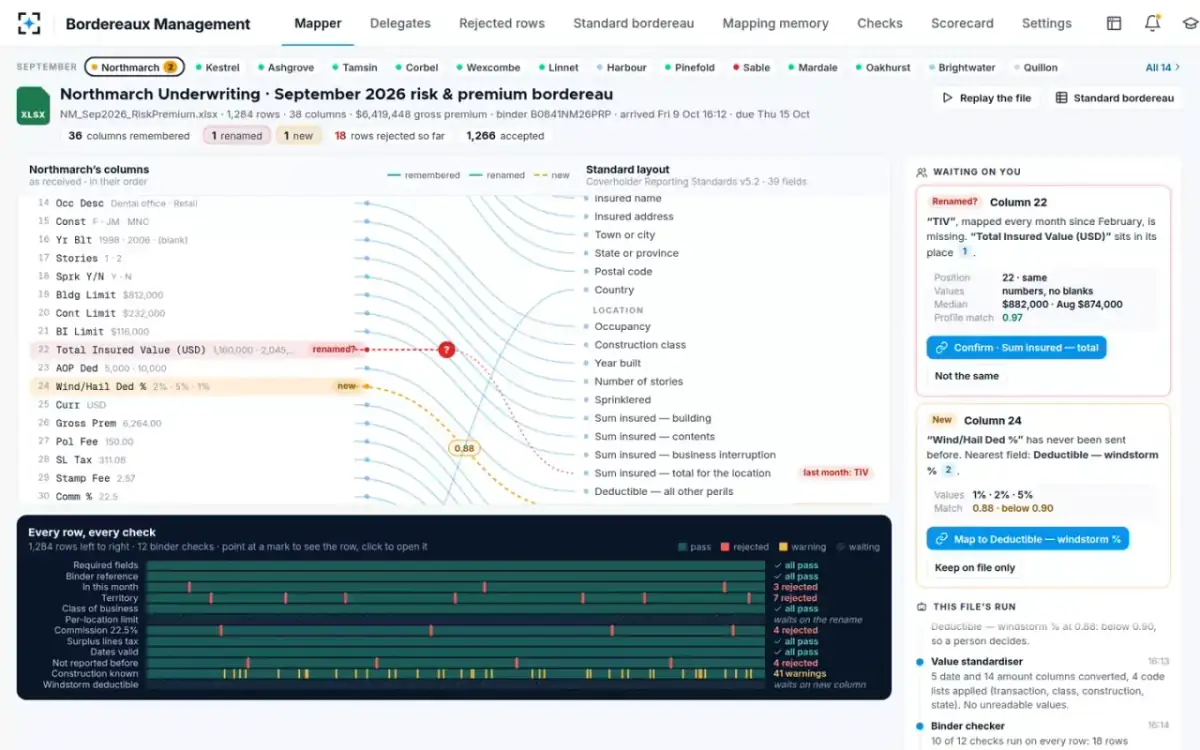
The defence is to identify columns by what they contain as well as what they are called, and to make a check that cannot run say so. In the sample month, confirming the rename let the limit check run on all 1,284 rows of the delegate's file, and it found five locations above the $5,000,000 per-location limit with no referral on file. Left unmapped, they would have loaded with no warning. Bordereaux ingestion covers the four kinds of column change and how each is spotted.
Binder errors: a clean row outside the authority
A binder error is a row that is perfectly formed and still not allowed: a Florida location on a binder limited to five Gulf states, a sum insured over the per-location limit, commission taken at 25% where the binder allows 22.5%. Format checks pass these rows. Only a check that reads the binder, in the version in force on the row's inception date, catches them.
Two kinds of binder error deserve different handling. Some are reporting faults: a duplicate certificate or an October risk on September's file goes back to the delegate to correct. Others are possible breaches of authority: a risk bound outside the territory or above a limit is not wrong data but business the delegate had no authority to write. In the sample carrier's month, 12 of the 23 rows returned to one delegate were of the second kind, and went to the head of delegated authority as well as back to the delegate.
Misstated, omitted, under-declared: errors no file check can see
The most expensive bordereau errors are invisible to any check that reads only the bordereau. In Markel International v Surety Guarantee Consultants, the Commercial Court found that an underwriting agent had issued surety bonds above the financial limits of its binding authority and reported them on its monthly bordereaux as exposures within the limits. The court's finding was precise about what the files did.
The principal misstatement was that where a bond had been issued in the name of Markel for an amount in excess of the financial limits the amount of Markel’s exposure was stated to be within the limits. Some bonds were not reported at all
Markel International v Surety Guarantee Consultants [2008] EWHC 1135 (Comm), paragraph 85
The same judgment shows the forms the misstatement took. For the second insurer, a bond for £4,242,000 was shown as an exposure of £1m; bonds written in December 2005 did not appear until April 2006, with the territory stated as the UK rather than Canada; and two bonds for £4.078m and £1m were not mentioned, though their bond numbers appeared against exposures of £1,160 and £1,400. Every one of those rows would pass a format check, and most would pass a binder check. A one-word territory error is the cruellest: a binder check reads "UK" and finds it inside the territory.
Under-declared premium is the money version. In XL Insurance Company SE v IPORS, the bordereaux were the coverholder's own declarations, and the insurer's first claim was for the sums they showed. Forensic work on the bank statements later showed that IPORS had declared far less premium than it had actually received ([2022] EWHC 2093 (Comm), paragraph 34; the case is told in what a bordereau file is worth in court); the expert's schedule put the cumulative variance at £254,579 for UK business and €3,033,276 for Republic of Ireland business. A premium bordereau that leaves out premium is internally consistent, and catching it needs cash, bank or third-party evidence; that work belongs with Premium Bordereaux Reconciliation, as the premium bordereaux reconciliation report shows, not with a file check.
How do you check bordereaux data quality?
You check bordereaux data quality in layers: the file's structure and totals first, then every row against format rules, then every row against the binder, then the file against what happened last month, and finally the declared figures against evidence from outside the file. Each layer catches what the one before cannot, and only the first four can run on every file every month without outside data.
Bordereaux data quality checks, layer by layer
- Tie the file before reading it
Row count and gross premium against the cover sheet or the delegate's stated totals. A file that does not tie is not mapped.
- Identify columns by their values
Position, type, range, blanks and median against the delegate's last accepted file. A rename should be proposed with its evidence, never silently applied or silently missed.
- Make every check report what it could not test
A check waiting on a missing column is not a pass. Show it as waiting.
- Run the binder on every row
Territory, class, limits, policy period, commission, tax and reporting month, against the binder version in force on each row's inception date.
- Compare with every earlier bordereau
Duplicates, certificates that disappear, sums insured that change between months without an endorsement.
- Look for shapes, not just rows
Many exposures exactly at a limit, or just over it, deserve a question. In Markel, bonds for £2m, £2.4m and £10m were each shown as a £1m exposure, and two others at £1,083,416 and £1,006,170.
- Test declared premium against cash
Premium declared, premium received and premium remitted should reconcile; under-declaration only shows up here.
- Test a sample against source documents
Policy or bond wordings for a sample of rows, chosen from the risky shapes above rather than at random.
The order matters for cost. The first five layers can run automatically on every row every month; the last three need people, documents and time, so they work best aimed at the rows and delegates the first five flag. Testing bordereaux software on last quarter's files shows how to plant errors of each class and see which ones a system catches.
Who is responsible for bordereaux data quality?
The delegate is responsible for producing a correct bordereau; the carrier is responsible for what it does with it. Binders put the preparation on the delegate: the IPORS wording required every premium, claim and expense on business bound to be allocated and declared to the agreement. The law keeps the consequences with the carrier: under the model act an MGA's acts count as the insurer's own, and the insurer must review the MGA's underwriting and claims operations on site at least twice a year (Model #225 §§5C, 6).
Inside the carrier the responsibility usually splits three ways. The bordereaux analyst owns the checks and the returns. The head of delegated authority owns the binder and every breach decision, and should approve any change to a check. The data and MI lead owns the standard layout every delegate is mapped to, because a mapping error there is everybody's error.
What happens if a bordereau is wrong?
A wrong row should go back to the delegate with its reason, its binder clause and a deadline, and should not be loaded. A row that is outside the delegate's authority should also go to the person who owns the binder, because it may be a breach that has to be reported, cured or ratified. What should not happen is either extreme: loading a bad row because the file passed overall, or rejecting a whole file because one row failed.
Rejected rows in Bordereaux Management, each with its reason and binder clause
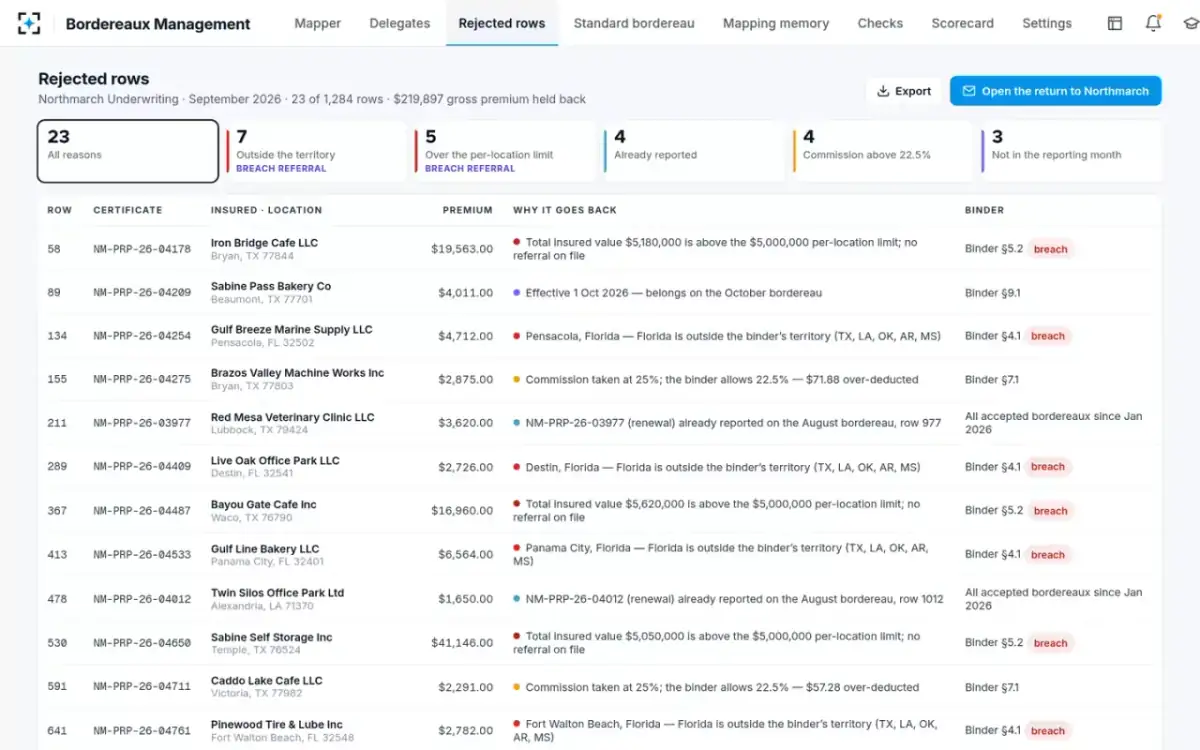
The return is also the cheapest data-quality tool a carrier has. A delegate told "file rejected" fixes nothing; one told which rows failed, why, and under which clause usually fixes the cause, and next month's file is cleaner. To see the checks, returns and breach referrals on the sample carrier, start from Bordereaux Management.
Questions people ask
What is bordereaux validation?
Bordereaux validation is the testing of each bordereau row against format rules and against the binder: required fields, valid dates and codes, territory, class, limits, policy period, commission, tax, reporting month and duplicates. Validation catches format and binder errors on every row; it cannot catch a value that is misstated but plausible, which needs evidence from outside the file.
Why are bordereaux late?
Usually because the delegate assembles the file by hand from its own systems after month end, and because nothing happens when it is late. In the sample carrier, one delegate was late on 10 of its last 11 bordereaux by about a week on average, while others filed early every month. Reminders on fixed days and a monthly timeliness score turn a habit into a number the head of delegated authority can act on.
Is there a standard format for bordereaux data?
Market standards exist, but the format that binds a delegate is the one its binder agreed. The binder in XL v IPORS required bordereaux in formats agreed in advance by the underwriters. Most carriers map each delegate's agreed format to one internal standard layout rather than forcing every delegate to change its systems.
What is the difference between a rejected row and a warning?
A rejected row breaks a binder or format rule and is not loaded until it is corrected. A warning marks a row that can be loaded but is incomplete for some purpose, such as a missing construction class or year built, which matters to catastrophe modelling but not to the binder. In the sample delegate's file, 23 rows were rejected and 41 accepted with warnings.
Can a sample of rows stand in for checking every row?
For estimating an error rate, a sample can; for finding the rows that breach the binder, it cannot, because the breaches are the rows. In Markel, the carrier's audit chose 14 files at random and found no significant reporting issues, while bonds above the limits went undiscovered.