Bordereaux automation is the use of software to do the mechanical parts of bordereaux work, opening each delegate's file, mapping its columns to the carrier's layout, standardising values, checking every row against the binder and drafting the returns, so that people spend their time on the decisions: confirming a changed column, settling an ambiguous value, deciding a breach and sending what goes to the delegate. It matters because the volume of rows grows faster than the hours to check them, and because a carrier remains answerable for every row whether a person or a machine looked at it. Botminds' Bordereaux Management is built on that division: six agents read, map, check and return each file, and the analyst and the head of delegated authority make every decision.
The question is not whether bordereaux can be automated but where the line sits. The answer below is task by task, twelve tasks in all, with the reason each lands on one side or the other.
Twelve bordereaux tasks, re-divided between agents and people
1 Track arrivals, chase late files, score each delegate
Agent
Arrival times against due dates, nothing else. Reminders on fixed days; a due date never moves.
2 Open the file, find the header row, count rows, tie totals
Agent
Mechanical. An unreadable row is flagged, never dropped; a file that does not tie is not mapped.
3 Place columns from the delegate's remembered mapping
Agent
Last month's decision, applied again when name and values still match.
4 Spot renamed, moved, new and dropped columns
Agent
By values as well as names. The output is a proposal with its evidence.
5 Confirm a rename, map a new column
Person
A wrong confirm silences a check for every month after. One click, but a person's click.
6 Convert dates, amounts, codes and flags
Agent
Where the file settles the format. A value that cannot be read is left blank and flagged.
7 Settle an ambiguous date or code
Person
Guessing moves risks between months and binders.
8 Run every binder check on every row
Agent
Rules, against the binder version in force on each row's inception date. Never a sample.
9 Draft the return, rows grouped by reason with clauses
Agent
Drafting is writing; it uses the delegate's original values and corrects nothing.
10 Read and send the return
Person
It goes to another company, under the carrier's name.
11 Decide a possible breach of authority
Person
Ratify, cure, refer or report: a decision for the person who owns the binder.
12 Change a check, a threshold or a deadline
Person
Changes are drafts until the head of delegated authority approves them.
What is bordereaux automation?
Bordereaux automation is any software that takes over a bordereaux task a person used to do by hand. At its simplest it is a spreadsheet macro or an import template that expects a fixed layout. At its most capable it reads a file it has not seen before, recognises columns from their values, remembers each delegate's mapping, runs every binder check on every row and drafts the return, while asking a person whenever it is not sure.
The difference between those two ends is not speed but how they fail. A template either accepts a file or rejects it, and when a delegate renames a column it may do neither: it loads the file and quietly stops checking what the old column held. A system that recognises columns by their values notices the change and asks. Nine ways a delegate's file goes wrong explains why that silent failure is the most dangerous one.
Twelve bordereaux tasks, re-divided between agents and people
Eight of the twelve tasks in the grid move to agents, and four stay with people. The eight share a property: their output can be checked, and a wrong output is caught by the next step. The four share the opposite property: a wrong decision changes what the carrier relies on from then on, or what another company receives in the carrier's name.
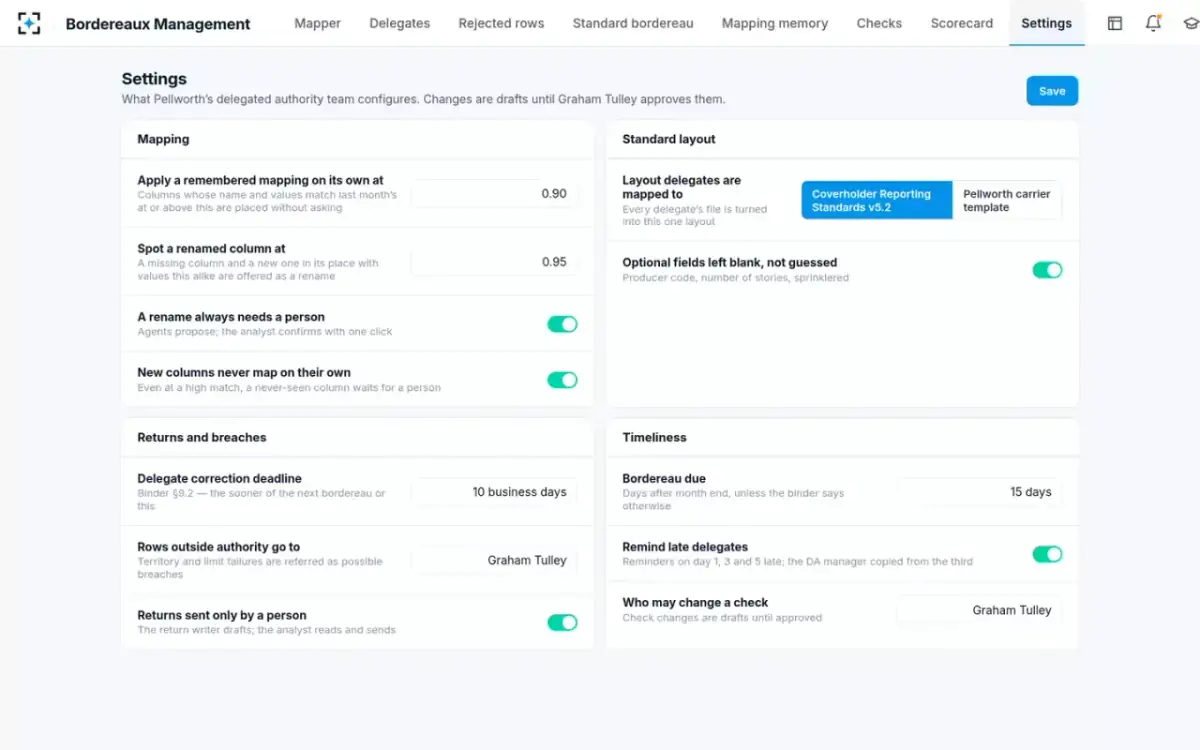
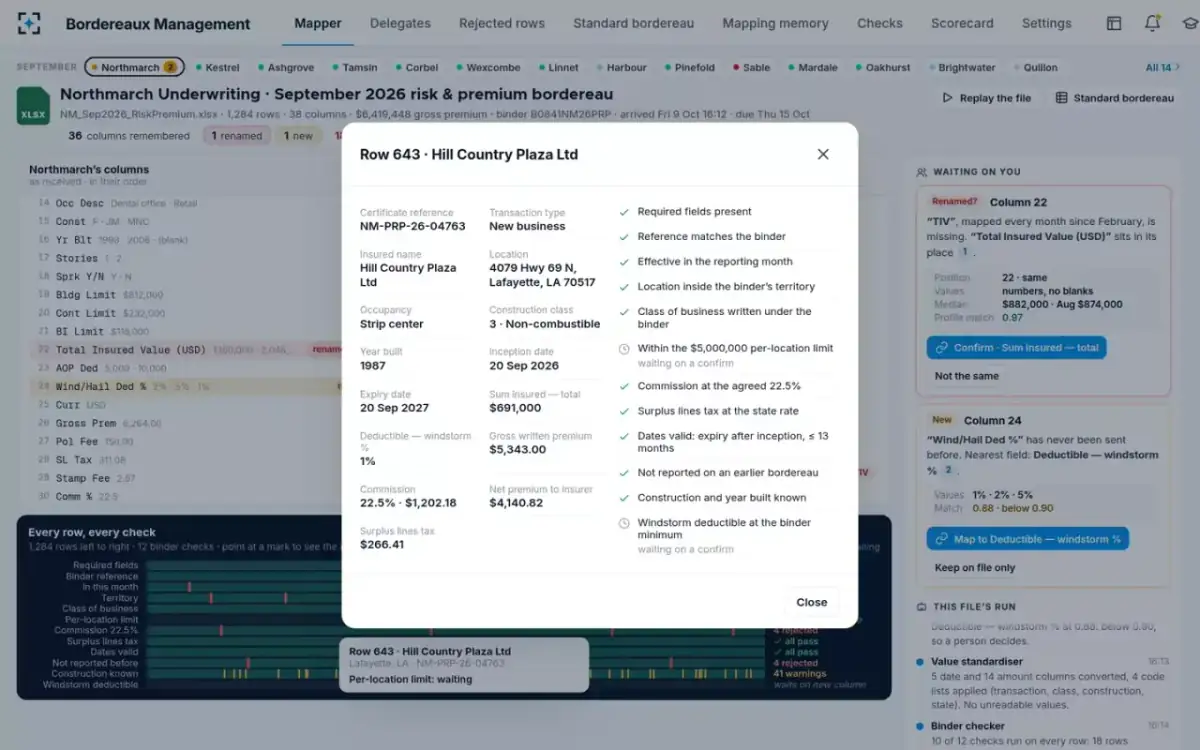
The split is clearest at the mapping step. Placing a column that matches last month's name and values is a repeat of a decision already made, and an agent can do it; the solution's default is to place it on its own at a match of 0.90 or better. Proposing that "Total Insured Value (USD)" is last month's "TIV" is a judgement with evidence, and an agent can make the proposal. Confirming it is different: once confirmed, every future month's limit check reads that column, so a wrong confirm silences a check indefinitely. That click stays with the analyst even at a match of 0.97.
Can bordereaux be automated end to end? Not the decisions the law assigns
Bordereaux can be automated from file to draft, but not end to end, because the law puts some decisions on the insurer and the binder puts others on named people. Under the NAIC Managing General Agents Act, what an MGA does in the insurer's name counts as the insurer's own act (Model #225 §6; the section is quoted in the NAIC Managing General Agents Act in plain words), so the carrier is answerable for every risk its delegates bound, and it must be able to show that someone with authority decided what to do about the ones outside the binder.
European supervisors say the same about the software itself. EIOPA's opinion on AI governance leaves the insurer answerable for every AI system it uses, whether it built the system itself or bought it from a provider (EIOPA-BoS-25-360, August 2025). Buying automation does not move the responsibility to the vendor; it moves the work. That is why the four person steps in the grid are not a courtesy but the design.
What each person keeps once the agents take the mechanical work
Today
Re-maps each delegate's columns by hand, then checks what time allows.
With agents
Reviews a short list: changed columns with their evidence, ambiguous values and rejected rows.
Still theirs: Confirming renames and new columns; settling ambiguous values; sending every return.
Today
Sees breaches at the on-site review, months after the file arrived.
With agents
Receives territory and limit failures as referrals the week the file lands.
Still theirs: Every breach decision, and approval of any change to a check or threshold.
Today
Settles on the delegate's totals, checked or not.
With agents
Receives accepted rows with gross premium, commission and net due, and the returned rows held back.
Still theirs: Settlement, and the tie of declared premium to cash received.
Today
Learns a file failed, rarely why.
With agents
Receives its rows grouped by reason, with clauses, original values and a deadline.
Still theirs: Its own data: no agent corrects a delegate's figures for it.
How does AI read a bordereau it has never seen?
It reads it the way an experienced analyst does, but on every column at once. First it finds where the data starts: the header is often not on row one, and the sample delegate's header sat on row 3. Then it profiles each column, its position, type, range, share of blanks and median, and compares the profile with the fields of the carrier's layout and with the delegate's own previous files. A column of six-figure numbers with no blanks and a median near last month's sum insured is probably the sum insured, whatever it is called.
The comparison produces a score, and the score decides what happens. In Bordereaux Management, a column matching the remembered mapping at 0.90 or more is placed on its own; a missing column and a new one alike at 0.95 or more are offered as a rename; below 0.90, or for any column never sent before, a person decides. In the sample month, "TIV" disappeared and "Total Insured Value (USD)" appeared in the same position with a median of $882,000 against August's $874,000: a profile match of 0.97, proposed as a rename and confirmed with one click. A new column, "Wind/Hail Ded %", scored 0.88 against its nearest field and waited for the analyst.
Bordereaux Management's thresholds: what the agents may do on their own, and what always waits
Where bordereaux automation must stop and ask a person
Automation should stop wherever a wrong answer would be silent or would leave the building. Four stopping points cover most of it. A rename or new column waits for a confirm, because a wrong mapping silences a check. An ambiguous value waits, because a guessed date moves a risk between reporting months. A possible breach waits for the head of delegated authority, because only the owner of the binder can decide what to do about business written outside it. And a return waits for the analyst, because it goes to another company in the carrier's name.
The opposite rule matters as much: an agent should never fill a gap with a plausible value. In the sample carrier's settings, optional fields with no source, such as producer code or number of stories, are left blank rather than inferred, and an unreadable value means the row is returned. A bordereau with honest blanks is more useful than one with confident guesses, because a blank can be chased and a guess cannot be found.
Template imports or learned mappings: two kinds of bordereaux automation compared
Most bordereaux automation in use today is one of two kinds: a fixed template per delegate, or a mapping that is learned from the data and remembered. Both run binder checks as rules; they differ in how they get the data into a shape the rules can read.
Two ways to automate the mapping step, and how each fails
Fixed import template per delegate: One template per delegate layout, built by hand.
Learned mapping, remembered and confirmed: The first file is mapped with a person; each decision is remembered for the next.
Fixed import template per delegate: Fails loudly if the column is required; otherwise loads without it and the check that read it stops.
Learned mapping, remembered and confirmed: Notices the missing column and the new one, compares their values and proposes the rename with its evidence.
Fixed import template per delegate: Ignored unless someone edits the template.
Learned mapping, remembered and confirmed: Offered with its nearest field and score; mapped by a person or kept on file only.
Fixed import template per delegate: Misreads or rejects, depending on the parser.
Learned mapping, remembered and confirmed: Settles the format from the whole file where it can; asks where it cannot.
Fixed import template per delegate: A failed import, or nothing.
Learned mapping, remembered and confirmed: A short list of changes with evidence, and checks marked as waiting until confirmed.
Fixed import template per delegate: A few delegates whose layouts never change.
Learned mapping, remembered and confirmed: Many delegates, or any whose layouts drift.
Neither kind removes the need for rules where rules are right. The binder checks themselves, territory, limit, commission, period, should be deterministic: the same row against the same clause gives the same answer, and the answer cites the clause. AI earns its place in reading and mapping, where layouts vary; it has no place deciding whether 25% commission breaches a 22.5% binder.
Is AI allowed in bordereaux processing? What regulators have said
Yes, and no regulator has published a rule specific to AI in bordereaux work; the general expectations for AI in insurance apply. In Europe, a 2026 EIOPA survey found that most reported generative AI use cases were back-end productivity tools such as data extraction. In the UK, the FCA plans to study how insurers use AI inside underwriting, claims and service, and what holds adoption back (FCA, Regulatory Priorities: Insurance, 2026), and the PRA warned that these technologies make old problems worse: poor data, dependence on outside providers and cyber exposure (PRA, Insurance supervision: 2026 priorities). The FCA's plan is quoted in insurance data analytics software for programs.
Where European insurers are using generative AI, from EIOPA's 2026 survey
347
insurance undertakings in 25 countries answered
64%
of reported use cases are back-end productivity tools, such as data extraction
49%
of undertakings have a dedicated AI policy, up from a quarter in 2023
In the US, the NAIC's model bulletin on AI asks insurers' AI programmes to cover "Due diligence and the methods employed by the Insurer to assess the third party and its data or AI Systems acquired from the third party" (NAIC Model Bulletin on the Use of AI Systems by Insurers, 2023). For a bordereaux system that means being able to show what the software decided, what a person decided, and on what evidence. A system that records every agent step and every confirm with a time and a name answers the question; one that returns only a clean file does not.
Does bordereaux automation replace bordereaux analysts?
It replaces the repetitive part of the job, not the job. The analyst's hours move from re-mapping and sampling to deciding and explaining: confirming changed columns, reading rejected rows, writing to delegates and preparing breach referrals. Those are the parts that need knowledge of the binder and of the delegate, and they grow in value as the volume of rows checked goes from a sample to every row.
What changes is the ratio. When each file arrives already mapped from memory and checked on every row, one analyst can cover more delegates without sampling. Whether that means fewer analysts, more delegates or deeper oversight is a management choice, and the honest way to make it is with your own numbers: a one-month timing log before automation, and the same log during a pilot.
One row, every check: what the agents tested and what is still waiting on a person
What to have ready before you automate bordereaux
Automation is only as good as the binder data and decisions it starts from. The checklist below is what a carrier should gather before any bordereaux automation project, whichever system it chooses; twelve questions before you buy covers what to ask the system itself.
Before you automate bordereaux: what to have ready
- Every binder in force, with endorsements
The checks read territory, class, limits, period, commission and reporting terms from them, by the version in force on each row's date.
- Each delegate's agreed field list
What the binder says the bordereau must contain; the first mapping starts from it.
- Your standard layout
One target for every delegate, owned by the data and MI lead.
- A year of accepted bordereaux
For duplicates, for each delegate's usual values, and as the baseline for a pilot.
- Your thresholds, written down
At what match a mapping applies on its own, what always needs a person, and who approves a change.
- Who decides breaches, and how fast
A named person and a time limit, so referrals do not wait in a queue.
- How returns are sent and tracked
Who sends, what deadline the binder gives, and how corrections are matched back.
To see the twelve tasks running on the sample carrier, with the agents' proposals and the analyst's confirms, start from Bordereaux Management.
Questions people ask
How accurate is automated column mapping?
Accuracy depends on how much a delegate's layout drifts and on the thresholds set; there is no published benchmark. In the solution's sample year, 31 column changes across 14 delegates were recognised and 27 were settled with one confirm. The more useful measure in a pilot is how many changes the system notices at all, since an unnoticed rename is the expensive failure.
Can bordereaux automation handle claims bordereaux?
Yes, the same steps apply to claims files: read, map, standardise and check. The checks differ, testing reserves, payments and the claims a carrier must see in full under its MGA contract, such as those open more than six months or beyond the MGA's settlement authority.
Can it read bordereaux sent as PDFs?
Bordereaux Management reads spreadsheets and CSV files, which is how most delegates send bordereaux. A PDF bordereau is a report about the data rather than the data itself; the better fix is to ask the delegate for the agreed spreadsheet format the binder usually requires.
Who checks automated bordereaux?
The analyst checks what the agents could not settle, and the head of delegated authority decides every possible breach. Every agent step and every human confirm should be recorded with a time and a name, so that an auditor can see who decided what. Sampling the agents' accepted rows against source documents remains good practice.
Does automation change the delegate's obligations?
No. The delegate still owes the bordereau in the binder's agreed format, by its due date, and still owes the corrections. Automation changes how fast the carrier finds problems and how clearly it explains them, which usually improves the next file.