Bordereaux processing is the monthly cycle a carrier, MGA or broker runs on the bordereaux its delegates send: receive each file, map its columns to the carrier's layout, check every row against the binding authority, return the rows that fail, and pass the clean data to finance for settlement and to oversight for MI. It is the operational side of a legal duty, the MGA's obligation to account and remit at least monthly, and it is labour-heavy because each delegate's file arrives in its own layout and changes without notice. Botminds' Bordereaux Management is built to take the mechanical part of that cycle, the reading, mapping and checking, off the analyst's desk.
Where the hours go is the question every head of delegated authority asks, and no regulator, court or research body has published an answer. Figures in circulation come from vendors and are not used here. What can be shown is how the month is structured, where the waiting sits, and how to measure your own; the examples come from the solution's fictional sample carrier, Pellworth Specialty Insurance Company, and its 14 delegates.
A late file eats the checking window: the days after month end, split
30-day settlement, file on its due date
- Waiting for the file · 15 days · 50%
- Left to map, check, return and settle · 15 days · 50%
30-day settlement, file 7 days late
- Waiting for the file · 15 days · 50%
- Late · 7 days · 23%
- Left · 8 days · 27%
60-day settlement, file 7 days late
- Waiting for the file · 15 days · 25%
- Late · 7 days · 12%
- Left · 38 days · 63%
What is bordereaux processing? Five steps from file to settlement
Bordereaux processing has five steps, and each one hands to the next: receive, map, check, return, settle. A file that is not received cannot be mapped; a file that is not mapped cannot be checked; and the money follows only the rows the checks accept.
The five steps of bordereaux processing, and where each one goes wrong
| Step | What happens | What goes wrong | Who decides |
|---|---|---|---|
| 1. Receive | Log the file against the delegate and month; find the header row; count rows; tie totals to the cover sheet | A late file; a nil month confused with a missing file; totals that do not tie | Analyst chases; DA manager escalates repeat lateness |
| 2. Map | Place each column on the carrier's layout; convert dates, amounts and codes | A renamed or moved column; day-first dates read as month-first | Analyst confirms renames and new columns |
| 3. Check | Test every row against the binder in force on its inception date | Sampling instead of testing every row; checks that cannot run but report a pass | Rules run; analyst reviews rejections |
| 4. Return | Send failed rows back with reason, clause and deadline; refer possible breaches | "File rejected" with no reasons; breaches treated as data errors | Analyst sends; DA manager decides breaches |
| 5. Settle | Hand accepted rows and net premium to finance; settlement within the binder's days | Settling on unchecked figures; holding everything for one bad row | Finance, against the accepted rows |
The steps look sequential, but in a month with a dozen delegates they overlap. Files arrive over a fortnight, so on any given day some are being chased, some mapped and some settled. The analyst's real work is managing that queue, and the queue is where most of the hours disappear.
The bordereaux calendar: a 15-day file and a 30, 60 or 90-day settlement
Most binders give the delegate a fixed number of days after month end to send the bordereau and a longer period to settle the money. In one binding authority set out by the English Commercial Court, the schedules required monthly premium bordereaux within 15 days of month end, and the binders allowed 30, 60 or sometimes 90 days after month end to settle the money (XL Insurance Company SE v IPORS [2022] EWHC 2093 (Comm), paragraph 11; the clauses are quoted in broker premium settlement date).
A month's business reaches the carrier as cash one to four months after it is written
- Business written30 d
- File due15 d
- Settle15 d
- Business written30 d
- File due15 d
- Settle45 d
- Business written30 d
- File due15 d
- Settle75 d
Two things follow for processing. First, the checking window is short: if the file arrives on day 15 and settlement is due on day 30, the carrier has a fortnight to map, check and return before it settles, and a late file eats that fortnight. Second, the premium is outside the carrier for weeks or months in any case, held by the delegate as a fiduciary. The model act lets an MGA retain no more than three months of estimated claims payments and allocated loss adjustment expenses (§4C); Florida cuts that to "up to 60 days" (Fla. Stat. §626.7451(3)). Processing that finishes late does not just cost hours; it delays the point at which the carrier knows what it is owed.
Where the analyst's month goes, delegate by delegate
Inside the calendar, the analyst's month goes to the exceptions, not the files. A delegate whose file arrives on time, in last month's layout, with every row inside the binder takes minutes in any system worth having. The hours go to the delegate who renamed a column, the one who switched date formats, the one whose file is late again, and the rows that need a return.
The sample month shows the pattern. Of Pellworth's 14 delegates, 12 had sent their September files by Monday 12 October, three days before most were due, 21,080 rows in all. Nine were checked and loaded with nothing waiting on the analyst. The rest held the month's work: Northmarch Underwriting's renamed and new columns and its 23 returned rows; Tamsin Ridge Underwriters' switch to day-first dates; and Sable Creek Transport, two days late and chased at 08:00 that morning.
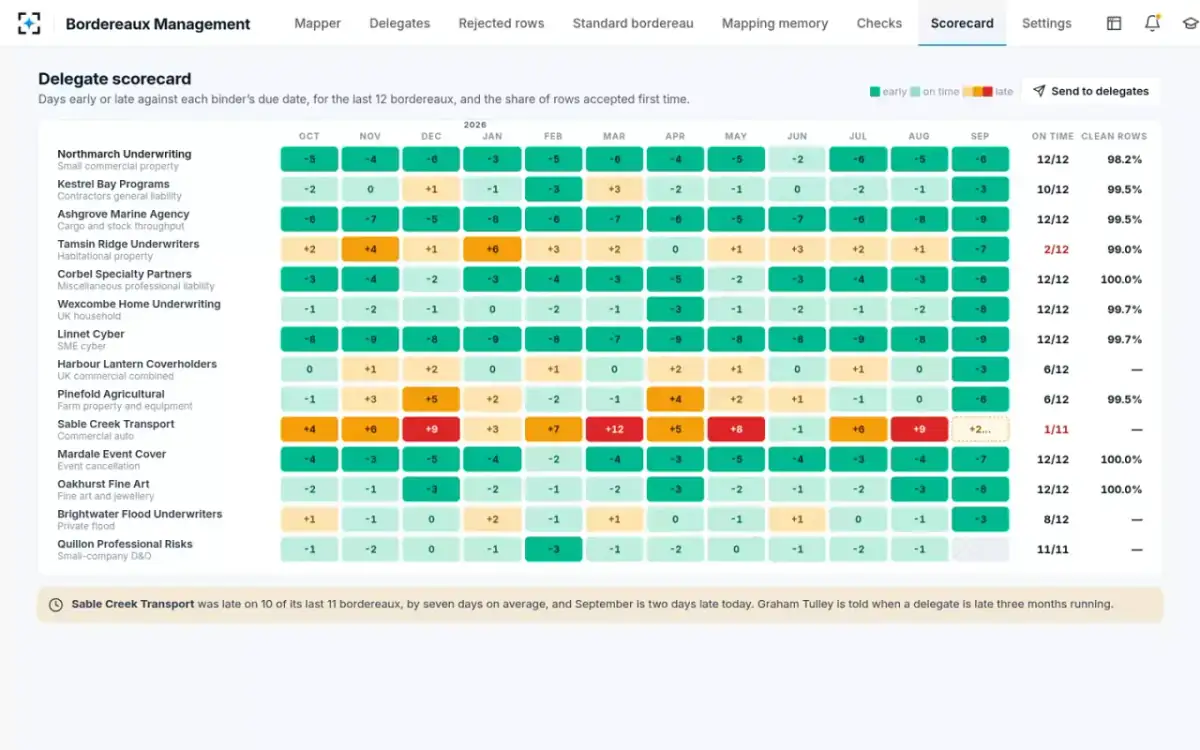
The delegate scorecard in Bordereaux Management: twelve months of early, on-time and late files
How long does bordereaux processing take? Time your own month
No regulator or market study we found gives the time bordereaux processing takes, and any single figure would mislead: the answer depends on the number of delegates, rows per file, how often layouts change and how much of the checking is done by hand. The useful number is your own, and it can be measured in one month with a simple log.
Seven measures that tell you where your bordereaux month goes
- Files and rows
Count files received per delegate per month, and rows per file. Rows drive checking time; files drive mapping time.
- Arrival against due date
Days early or late for every file. Lateness is the input everything else waits on.
- Column changes
How many files arrived with a renamed, moved, new or dropped column. Each one is a re-mapping job, and a check at risk of going silent.
- Touch time by step
For one month, log the minutes spent receiving, mapping, checking, returning and settling each file. Separate touch time from waiting time.
- Rows checked against rows received
If the checks run on a sample, record its size. The unchecked rows are where the escapes come from.
- Rows returned and why
By reason: territory, limit, commission, duplicate, period, missing field. The mix shows which delegates and which clauses cost most.
- Days from file to clean data
From arrival to the accepted file reaching finance and oversight. This is the delay the business feels.
Most teams that run the log find two surprises. Mapping, which nobody budgets for because it feels like preparation, takes a large share of the touch time. And the elapsed time is dominated by waiting, for late files, for corrections and for answers about renamed columns. Testing bordereaux software on last quarter's files uses the same log as the baseline a pilot is judged against.
Why is bordereaux processing still so manual?
Bordereaux processing stays manual because the input is not standard and keeps changing. Each delegate sends its own columns, codes and date formats, and a delegate's file changes whenever its own systems or people change. A template-based import works until the first renamed column; then it either fails loudly, and someone re-maps by hand, or it fails quietly, and a check stops working. Either way, the analyst ends up opening the file.
The second reason is that the checks depend on documents, not just data. Which binder version applied on a row's inception date, which clause sets the commission, whether a referral approval exists for a location over the limit: each needs the binder and its endorsements to hand. The third is judgement. A column whose values look like last month's sum insured is probably a rename; a date that could be read either way is not something a rule should settle. Those three, changing inputs, documents and judgement, are why processing has stayed with people, and why the right automation keeps the judgement with them. Which bordereaux tasks move to agents sets out that division task by task.
Waiting, not working: late bordereaux as the hidden cost
A late bordereau costs more than the analyst's chasing time, because everything downstream waits for it: the checks, the returns, the breach referrals and the settlement. One persistently late delegate can hold a month's oversight open for a week. The pattern is visible only if lateness is recorded every month, file by file.
One late delegate's year: ten of eleven bordereaux late, by up to twelve days
A record like that changes the conversation with the delegate. Without it, each late month is an anecdote; with it, the head of delegated authority can raise the binder's reporting clause, ask for a remediation plan or weigh the delegate at renewal. In the sample carrier, the head of delegated authority is told automatically when a delegate is late three months running, and reminders go out on the first, third and fifth day late.
What does bordereaux processing cost? A method, not a benchmark
The cost of bordereaux processing is the sum of four terms, and only the first appears in a budget. Staff time is visible. Rework, waiting and escapes are not, and in a bad month they can each exceed it.
The cost of a bordereaux month, term by term
Touch time
Hours by step × loaded hourly cost
Receiving, mapping, checking, returning and settling, from your one-month log.
Operations
Rework
Rows returned × handling per resubmission
Each returned row is handled twice: once when rejected, once when the correction arrives.
Analyst and delegate
Waiting
Net premium due × days late × cost of money
Premium settles on the binder's days; a late file delays the check that releases it.
Finance
Escapes
Rows outside authority found late × cost of each
A breach found at the on-site review rather than the week the file landed: cure, ratification or claim.
Head of delegated authority
The escapes term is the reason a cheap process can be expensive. A team that samples to save touch time lowers the first term and raises the fourth, because the rows it does not check are where breaches sit unseen until the on-site review. The model act requires that review at least twice a year (§5C); a breach found there has had up to six months to become a claim.
Can bordereaux processing be outsourced?
The processing can be outsourced; the responsibility cannot. Carriers do hand bordereaux work to third-party administrators, service companies and the MGAs themselves, and regulators accept outsourcing as such. What they do not accept is outsourced accountability. The Financial Conduct Authority put the principle plainly in its 2025 review of claims handling arrangements: a firm may hand out parts of its claims handling, never its regulatory responsibility for them (FCA, home and travel claims handling arrangements). The same review found five insurers, all of which had substantially outsourced their claims handling, with limited control or material weaknesses in their oversight.
For bordereaux the practical test is whether the carrier still sees the evidence. An outsourced processor should return the checked bordereau, every rejected row with its reason, every mapping change and every breach referral, in a form the carrier can review. If the carrier receives only a clean file and a sign-off, it has outsourced the work and the visibility with it.
Bordereaux processing vs bordereaux management: what changes with agents
Bordereaux processing is the monthly cycle; bordereaux management is the whole discipline around it, including the standard layout, the mapping history, the delegate scorecard and the breach process. With agents, processing becomes the part the machine runs and management becomes the part people own. In Bordereaux Management, the sample delegate's file arrived at 16:12 on a Friday; by 16:14 it had been read, its values standardised and 10 of its 12 checks run on every row, with two waiting on the analyst's confirm of a renamed and a new column.
Every column placed: the month's mapping saved and the file ready for oversight
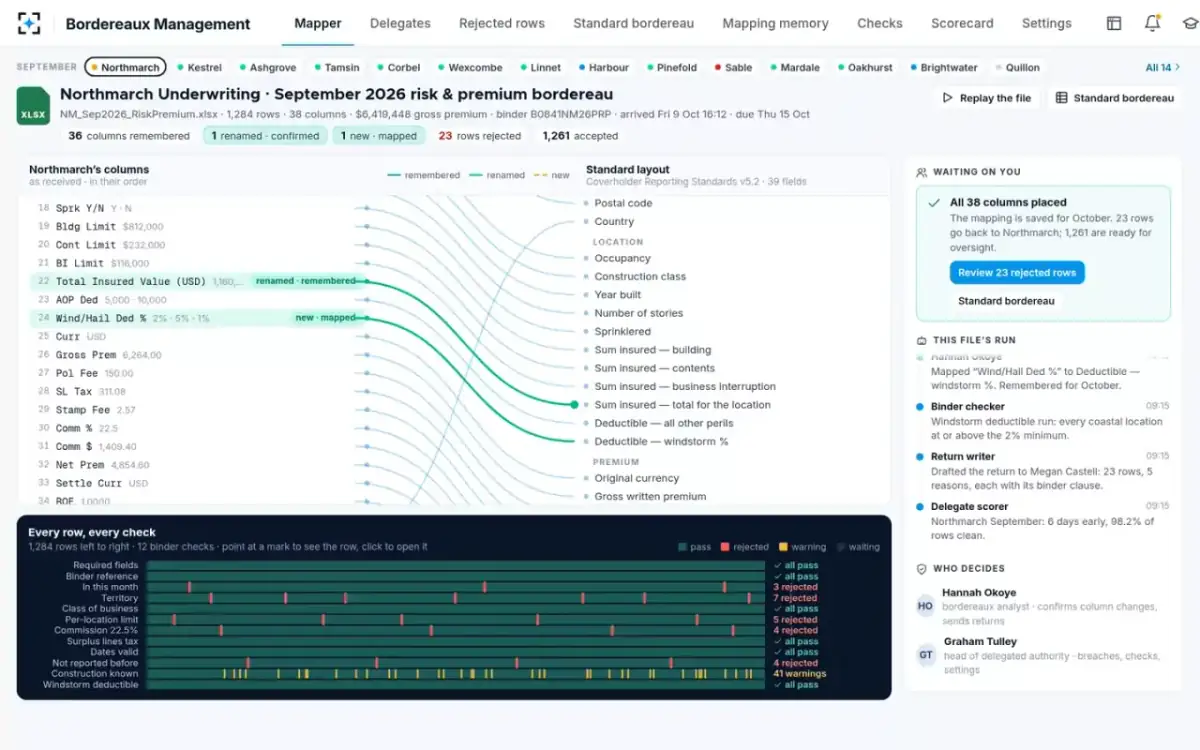
The hours that remain are the ones that should: confirming changes, reading returns, deciding breaches and talking to delegates. To see the month on the sample carrier, start from Bordereaux Management.
Questions people ask
Who does bordereaux processing?
Usually bordereaux analysts or technicians in the carrier's delegated authority or operations team, sometimes at the MGA or the broker, and sometimes at an outsourced service provider. Whoever does it, the carrier remains answerable: under the NAIC model act an MGA's acts count as the insurer's own.
Is bordereaux processing different for claims bordereaux?
The steps are the same; the checks differ. A claims bordereau is tested for reserves, payments and the claims the carrier must see in full: under Model #225 §4I, those involving a coverage dispute, those that may exceed the MGA's settlement authority and those open more than six months.
Can processing start before every delegate's file is in?
Yes, and it should. Each file can be received, mapped, checked and returned on arrival, so early delegates are settled and corrected while late ones are chased. Waiting for every file before starting turns one late delegate into a late month for all of them.
How quickly should a delegate correct returned rows?
Whatever the binder says. The sample binder in Bordereaux Management asks for corrections on the next bordereau or within 10 business days, whichever is sooner. A deadline written into the return, with the clause behind it, is the one most likely to be met.
What tools are used for bordereaux processing?
Spreadsheets and macros at small volumes, carrier-built import templates, and specialist bordereaux systems. The question to ask of any of them is how it behaves when a delegate renames a column: whether it fails loudly, fails quietly or recognises the column from its values and asks a person.