MGA reporting requirements are the duties state law places on a managing general agent (MGA) to account to the insurer it writes for, and on the insurer to oversee the MGA and tell its regulator about it. In most states they come from versions of the NAIC Managing General Agents Act (Model #225): the MGA must render accounts detailing all transactions and remit funds at least monthly, keep separate records the insurer can copy in usable form, and report claims in a timely manner, while the insurer must review the MGA on site, keep its financial statements on file and notify the regulator of each appointment. The states differ on the clocks and the content, which is what makes the work hard for a carrier with delegates in several of them. Botminds' Bordereaux Management receives each delegate's monthly bordereau, the working form of those accounts, and checks it against the binder.
This guide sets out the model and five state versions, read from each state's own statute or regulation. It is a map for compliance and delegated authority teams, not legal advice; the citations let you read each rule in full.
MGA reporting requirements by state: six rule sets side by side
| Rule set | MGA accounts to the insurer | Records | Insurer reviews the MGA | Insurer tells the regulator |
|---|---|---|---|---|
| NAIC Model #225 (2002) | Accounts of all transactions and remittance at least monthly (§4B) | Separate records; insurer may copy them in usable form; retained per the state's statute (§4D) | On site at least semi-annually; audited statements for two years; actuary's opinion if the MGA sets reserves (§5A–C) | Within 30 days of entering into or ending a contract (§5E) |
| New York, 11 NYCRR Part 33 (Regulation 120) | At least monthly (§33.5(b)) | Usable form; retained under Part 243, Regulation 152 (§33.5(d)) | On site at least semi-annually (§33.6(c)) | Not in §§33.5–33.6; see the rest of Part 33 |
| Florida, §§626.7451–.7454 | "Monthly or more frequent" (§626.7451(2)) | Usable form; retained under §626.561, which keeps premium payment records at least 3 years | On site at least annually, and within 6 months for a newly engaged MGA (§626.7454(3)) | Within 30 days, to the department and the office (§626.7454(5)) |
| Texas, Ins. Code ch. 4053 | Account report at least quarterly, content set by statute (§4053.103) | Separate records open to the insurer and the department's examiners (§4053.104) | Contract must address reports, records and auditing (§4053.102) | The MGA itself must notify the department within 30 days of five events (§4053.108) |
| North Carolina, G.S. 58-34-2 | At least monthly (subsection (d)(2)) | Usable form; retained under 11 NCAC 11C.0105 (d)(4) | On site at least semiannually, with a written report available to the Commissioner; audited MGA report on file by 1 June (g), (e) | Within 15 days, with a copy of the contract; the Commissioner may disapprove within 30 days (i), (j) |
| Minnesota, §60H.05 | Set by the contract provisions elsewhere in chapter 60H; not covered here | Insurer keeps the results of each on-site review on its records (subd. 2) | On site at least semiannually (subd. 2) | Within 30 days of appointment or termination (subd. 4) |
What are MGA reporting requirements?
MGA reporting requirements are three sets of duties that run in different directions. The MGA reports to the insurer: monthly accounts and remittance, claims as they arise, and in Texas a quarterly account report. The insurer reports to its regulator: each MGA appointment and termination, and in some states a written report of its on-site reviews on request. And in Texas the MGA reports to the regulator directly when certain financial thresholds are crossed. A carrier's delegated authority team sits in the middle of all three.
The requirements apply to MGAs in the statutory sense, which is narrower than the title. The model act defines an MGA by what it does, managing business for an insurer and underwriting premium equal to at least 5% of the insurer's policyholder surplus in a quarter or a year, together with adjusting or paying claims over $10,000 or negotiating reinsurance, and its drafting note warns that a firm calling itself a managing general agent may not be one in law (Model #225 §2D; the note is quoted in the NAIC Managing General Agents Act in plain words). Texas uses its own definition, built around supervising an insurer's local agency operations or accepting and processing policies produced by other agents (Tex. Ins. Code §4053.001).
What is the NAIC MGA model act? The baseline every state started from
The NAIC Managing General Agents Act is the model law state regulators adopted in 1989 to govern insurers' delegation of underwriting and claims to outside agents; it was amended several times and last revised in 2002 to clarify the MGA definition, change the bond requirements and update the insurer's duties. It requires a written contract before an MGA places any business, lists the contract's minimum terms, sets the insurer's duties, and makes the MGA examinable as if it were the insurer.
The contract terms in §4 are where reporting starts. The MGA must account and remit at least monthly (§4B), hold funds "in a fiduciary capacity" (§4C), keep records the insurer and the commissioner can use (§4D), and, if it settles claims, report them in a timely manner and send the claim file when a claim involves a coverage dispute, may exceed its settlement authority or has been open more than six months (§4I). Where electronic claims files exist, the contract must address their timely transmission (§4J). New York gives the reason all of this exists more bluntly than the model does: its regulation says delegated authority had been abused, to the harm of insurers and policyholders alike (11 NYCRR §33.0; quoted in the NAIC Managing General Agents Act in plain words).
Every reporting duty in this guide answers one worry: that the firm holding the pen will not tell the firm carrying the risk what it wrote.
How often must an MGA report to the insurer?
At least monthly for accounts and remittance under the model act and in New York, Florida and North Carolina; at least quarterly for the statutory account report in Texas; and as soon as a trigger is met for certain claims. The binder can require more frequent reporting, and most set a number of days after month end for the bordereau, commonly 15.
The monthly clock is the one bordereaux run on, and the others hang from it. The chart below sets the main clocks in these six rule sets side by side, in days, so a compliance calendar can be built from them.
The clocks in MGA law, in days: from a 15-day notice to an annual review
Does Texas require MGA reports? The quarterly account report
Yes. Texas requires every MGA, "At least once each calendar quarter", to submit an account report to each insurer it has a contract with, and the statute lists what the report must state, as applicable: written, earned and unearned premiums; losses and loss expenses paid and outstanding; losses incurred but not reported; and management fees (Tex. Ins. Code §4053.103). It is the closest thing in US statute to a prescribed bordereau summary.
Texas frames the MGA's role around reporting from the start. Among the general powers an MGA may exercise is to "receive and pass on daily reports and monthly accounts" (§4053.101), and the written contract must address "reports, records, and auditing" (§4053.102). The MGA must keep separate records for each insurer and make them available both to the insurer and to the department's examiners (§4053.104), and "A managing general agent holds money on behalf of an insured or insurer in a fiduciary capacity and shall properly account for that money" (§4053.106).
When an MGA must report to the regulator, not only the insurer
Texas is the state in this set that makes the MGA itself report to the regulator. Within 30 days of any of five events, on the department's forms, the MGA must notify the Texas Department of Insurance. Four of the five are about money, and each can be seen coming in a well-kept bordereau and premium account.
The five events that make a Texas MGA notify the department within 30 days
| Event | Threshold in the statute | What it usually signals |
|---|---|---|
| Balances due to an insurer are old | More than 90 days overdue and above $1 million, or 10% of the insurer's policyholder surplus | Premium held too long by the delegate |
| Sub-agents owe the MGA | Balances more than 60 days overdue from agents or MGAs reporting to it, above $500,000 | Collection problems below the MGA |
| Claims authority is withdrawn | An insurer withdraws the MGA's authority to settle claims | A loss of confidence in claims handling |
| Loss funds are too large | Money held for losses more than $100,000 above what is needed for the next 60 days | Funds accumulating outside the insurer |
| The contract ends | The contract required by §4053.102 is cancelled or terminated | A change in the delegation itself |
For a carrier, these triggers are worth tracking on its own side even outside Texas. Old balances and growing loss funds both show up first as a gap between what the bordereaux declare and what the premium account holds, which is the territory of Premium Bordereaux Reconciliation; the premium bordereaux reconciliation report shows how such a gap is found.
What records must an MGA keep, and for how long?
Every rule set in this guide requires separate records of the business the MGA writes for each insurer, open to the insurer and the regulator; how long they must be kept is set by cross-reference to each state's retention rules. New York points to Part 243 (Regulation 152), North Carolina to 11 NCAC 11C.0105, and Florida to §626.561, which requires every licensee to preserve books, accounts and records "pertaining to a premium payment for at least 3 years after payment" (Fla. Stat. §626.561(2)).
Records an MGA arrangement should be able to produce on request
- The written contract, with every endorsement
No MGA may place business without one (Model #225 §4); North Carolina requires a copy with the appointment notice.
- Each month's accounts and bordereaux, as sent
The monthly accounts of all transactions the contract requires, in the form the insurer received them.
- Separate records of the business, by insurer
In a form the insurer can use and copy (§4D); open to the department's examiners in Texas (§4053.104).
- The fiduciary account and its statements
Funds held in a fiduciary capacity in an insured bank; North Carolina and Texas specify a Federal Reserve member bank.
- Claim files
Joint property of the insurer and the MGA, and the insurer's alone if the insurer is liquidated (§4I(3)).
- The insurer's on-site review reports
North Carolina requires a written report available to the Commissioner; Minnesota requires the results kept on the insurer's records.
- The MGA's audited financial statements
Two years on file under the model; by 1 June each year in North Carolina.
The insurer's side: reviews, notices and the quarterly look for hidden MGAs
The insurer's duties are where most enforcement lands. Under the model the insurer must keep the MGA's audited financial statements for the two most recent years, obtain an actuary's opinion if the MGA sets loss reserves, review the MGA's underwriting and claims operations on site at least semi-annually, notify the commissioner within 30 days of entering into or ending a contract, and check its own books every quarter for any producer that has grown into an MGA (§5F; the duty is quoted in the MGA due diligence checklist). Florida, Minnesota and North Carolina keep the quarterly look, North Carolina with a 15-day compliance window instead of 30.
The review clock is where the states differ most visibly. New York, North Carolina and Minnesota require on-site reviews at least semiannually (11 NYCRR §33.6(c)); Florida requires one at least annually, but a newly engaged MGA must be reviewed within six months (Fla. Stat. §626.7454(3)). North Carolina adds that each review must produce a written report the insurer keeps and shows the Commissioner on request (N.C. Gen. Stat. §58-34-2(g), read from an Internet Archive copy of the General Assembly's page captured in May 2026; quoted in delegated authority auditor). What a bordereau file is worth in court shows why the review cannot rest on the bordereaux alone.
What regulators find when MGA oversight fails
Examination reports show what the requirements look like when they are missed. In a limited-scope examination of Topa Insurance Company as of 31 December 2023, filed on 4 June 2025, the California Department of Insurance described an MGA that ran almost every function of the program except reinsurance, and listed five areas of non-compliance with California's MGA provisions (CDI, Report of Limited Scope Examination of Topa Insurance Company).
Three of the five go to the heart of reporting and money: the MGA, not the insurer, owned every bank account used to collect premium and pay claims; the insurer had not carried out the semi-annual on-site reviews of the MGA's underwriting and claims; and it had not told the Commissioner in writing that it had appointed the MGA. The others were a missing fidelity bond and a contract that allowed joint employment. The examiners recommended semi-annual reviews with documented results. The report's findings are quoted, one by one, in MGA compliance audit.
One delegate, several states: keeping MGA reporting straight with Bordereaux Management
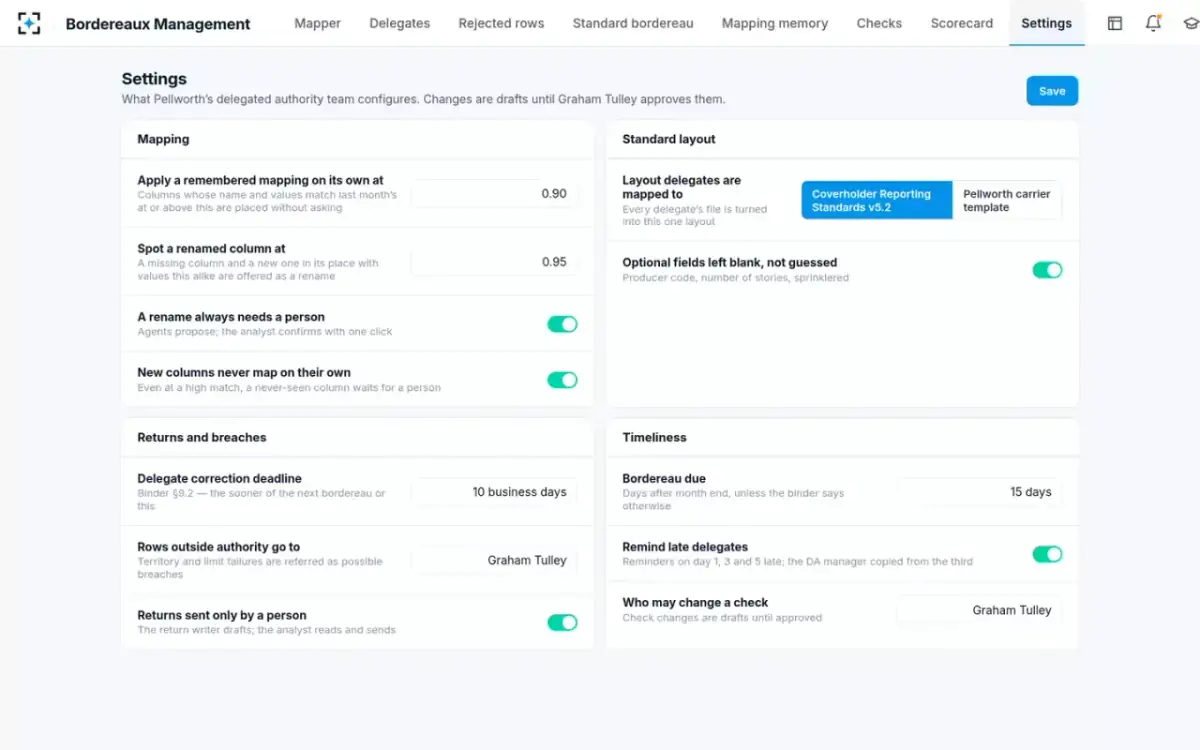
A carrier with delegates writing in several states faces the strictest rule for each, not an average. Bordereaux Management does not file regulatory notices; it keeps the monthly evidence that the rules above depend on. Each delegate's bordereau is due on the binder's schedule, 15 days after month end by default in the sample carrier unless the binder says otherwise; each file is checked on every row against the binder in force on the row's inception date; and late files, rejected rows and possible breaches are recorded month by month with who decided what.
Bordereaux Management's settings: due dates, correction deadlines and who receives breaches
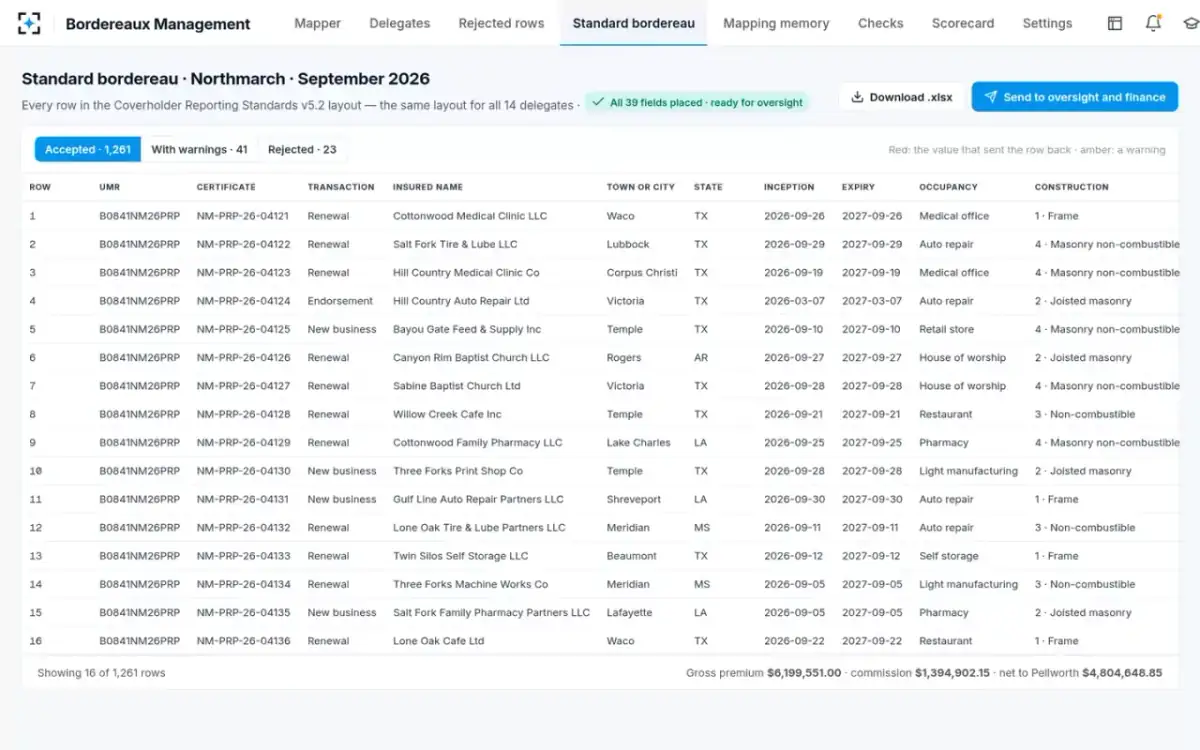
Clean monthly bordereaux are also the raw material for the reports some states prescribe. The Texas quarterly account report asks for premiums, losses paid and outstanding, incurred but not reported losses and fees; a delegate whose monthly risk, premium and claims bordereaux are complete and checked has most of the data to build it. The accepted rows sit in one standard layout for every delegate, with gross premium, commission and net due totalled.
One standard bordereau per delegate per month, the evidence behind every account
To see the monthly cycle behind these requirements on the sample carrier, start from Bordereaux Management; what bordereaux reporting is explains the files themselves.
Questions people ask
Can a regulator examine an MGA directly?
Yes. Under the model act an MGA may be examined as if it were the insurer, and its acts count as the insurer's own (§6); Florida and North Carolina enact the same rule. Texas lets the commissioner examine an MGA's financial condition and compliance and charges the MGA the examination expenses (§4053.107).
What must an MGA contract contain?
Under Model #225 §4, at least: termination for cause, monthly accounts and remittance, fiduciary handling of funds, separate usable records, no assignment, underwriting guidelines covering premium volume, rates, risk types, limits, exclusions, territory, cancellation and policy period, a surety bond, and claims terms if the MGA settles claims. The bond is at least $100,000 or 10% of the MGA's prior-year premium for the insurer, capped at $500,000.
How quickly must an insurer notify the regulator of a new MGA?
Within 30 days under the model act, in Florida and in Minnesota; within 15 days in North Carolina, where the notice must include a copy of the contract and the Commissioner may disapprove the contract within 30 days of filing. Texas requires each MGA appointment to be reported on the department's form.
What happens if an MGA does not comply?
Under the model act the commissioner may impose a penalty for each violation, suspend or revoke the producer's license and sue for damages on the insurer's behalf; if the insurer is in rehabilitation or liquidation, its receiver may sue the MGA (§7). In Florida, diverting $100,000 or more of trust funds is a first-degree felony (§626.561(3)).
Do US MGA reporting requirements apply to London market coverholders?
A coverholder writing US risks may also be a licensed producer subject to a state's rules, but its reporting to the insurer is set mainly by its binding authority. UK firms answer to the FCA and PRA, and the PRA's 2026 priorities expect strong oversight of delegated authority arrangements, including how firms would exit unprofitable ones.